Within Generative AI
Why AI Now Feels Like a Co Writer
Generative AI changes the user experience by returning editable drafts instead of labels, scores, rankings, or hidden decisions.
On this page
- From labels and scores to editable artifacts
- Why open ended outputs change user expectations
- Where draft like fluency can hide uncertainty
Page outline Jump by section
Introduction
Generative AI feels different from earlier AI systems because it usually returns something people can work on rather than something they are merely told. Traditional AI often classifies, ranks, flags, or predicts: an email is labelled spam, a transaction is scored as risky, or a recommendation system ranks items. Generative AI instead produces a draft—an email, paragraph, image, slide outline, software function, or marketing concept—that can be edited, shared, or published. This shift turns AI from a largely invisible decision-making tool into an active participant in creative and knowledge work. The result is a very different user experience, even though both generations of systems are built on statistical learning. The popularity of systems such as ChatGPT made this distinction highly visible, helping bring generative AI into mainstream use at unprecedented speed.[Reuters]reuters.comchatgpt sets record fastest growing user base analyst noteChatGPT sets record for fastest-growing user base2 Feb 2023 — ChatGPT, the popular chatbot from OpenAI, is estimated to have reach…

Why AI Now Feels Like a Co-Writer
The most important change is not that AI suddenly became intelligent in a human sense. It is that the output changed from a judgement to an artefact.
When a fraud detector produces a risk score, users rarely see the internal reasoning. The system influences a decision but does not hand the user something to revise. Generative systems do the opposite. They return material that looks unfinished enough to modify yet complete enough to be useful immediately. A person can ask for a draft report, rewrite half of it, request revisions, and combine the result with their own work.
This creates a collaborative feeling that earlier AI systems rarely produced. The interaction becomes iterative. Users are no longer asking, “What does the system think?” They are asking, “What can we make together?”
That distinction helps explain why public attention shifted so quickly toward generative AI after conversational systems became widely available. The output is directly visible, personally relevant, and immediately usable.[Reuters+2Axios]reuters.comchatgpt sets record fastest growing user base analyst noteChatGPT sets record for fastest-growing user base2 Feb 2023 — ChatGPT, the popular chatbot from OpenAI, is estimated to have reach…
From Labels and Scores to Editable Artifacts
A useful comparison is to examine what happens after an AI system responds.
With a prediction-oriented system:
- The output is usually a label, score, ranking, or recommendation.
- The user often accepts or rejects the result.
- The interaction ends quickly.
With a draft-oriented system:
- The output is a piece of content.
- The user can revise, expand, shorten, or remix it.
- The interaction often continues through multiple rounds.
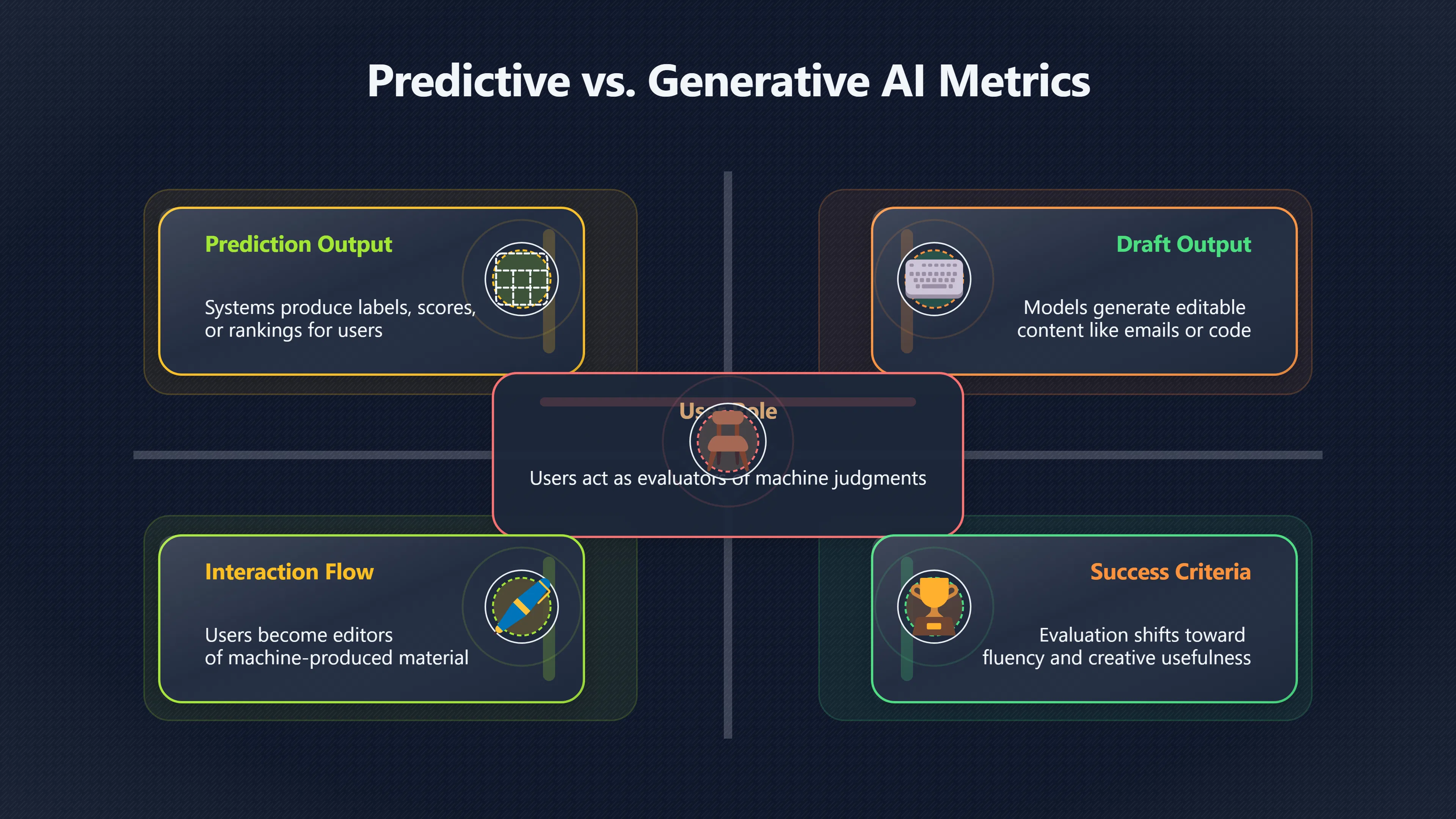
This difference changes the role of the user. In predictive systems, people are primarily evaluators of machine judgements. In generative systems, they become editors of machine-produced material.
The practical consequences are significant. A search ranking determines which pages appear first. A language model can instead produce a complete summary of those pages. A predictive coding assistant might suggest the next word. A generative coding assistant can produce an entire function or application template. The output moves closer to the final product that the user actually wants.[arXiv]arxiv.orgarXiv Generative AIarXiv Generative AI

Why Open-Ended Outputs Change User Expectations
Drafts alter expectations because they feel less constrained than predictions.
Most people understand that a recommendation score is only one input into a decision. A generated article or answer, however, resembles something a human might have written. The format encourages readers to evaluate it as communication rather than as a statistical estimate.
This can create an impression of general competence. A system that can write a poem, summarise a report, generate code, and answer questions appears adaptable across many domains. In practice, these capabilities emerge because a single generative model can be prompted to perform many tasks without requiring a separate interface for each one.[arXiv]arxiv.orgarXiv Generative AIarXiv Generative AI
The draft format also changes how success is judged. Users often do not ask whether every sentence is correct. Instead, they ask whether the output gives them a useful starting point. That makes generative AI valuable even when the first result requires editing.
Historically, many AI systems were evaluated mainly by accuracy metrics. Generative systems are often judged by usefulness, fluency, creativity, speed, and ease of revision in addition to accuracy. Those are different standards because the product itself is different.
Where Draft-Like Fluency Can Hide Uncertainty
The same qualities that make drafts useful can also make them misleading.
A prediction system usually exposes its uncertainty through probabilities, confidence scores, or rankings. Generative systems often express uncertainty poorly because their output appears as coherent language, images, or code. The result can look complete even when parts of it are incorrect.
Researchers and standards bodies have identified this as a distinctive challenge for generative AI. NIST’s Generative AI Profile highlights risks related to fabricated or erroneous content, sometimes described as “hallucinations” or “confabulations,” where systems produce plausible but false information.[NIST Publications+2NIST]nvlpubs.nist.govAI.600 1NIST PublicationsArtificial Intelligence Risk Management Frameworkby N AI · 2024 · Cited by 90 — This document is a cross-sectoral profil…
The problem is amplified by presentation. A wrong classification may be obviously wrong once checked. A polished paragraph with invented details can be harder to detect because it follows the conventions of trustworthy writing. Studies and practical evaluations have repeatedly shown that large language models can generate fluent explanations while introducing factual errors, fabricated references, or unsupported claims.[MIT Sloan Teaching Tech+2arXiv]mitsloanedtech.mit.eduMIT Sloan Teaching TechWhen AI Gets It Wrong: Addressing AI Hallucinations and…Generative AI tools can produce fabricated information…
Recent real-world incidents illustrate the risk. Investigations into AI-assisted reports have found examples of convincing-looking citations and references that did not actually exist, demonstrating how draft quality and factual quality can diverge.[TechRadar]techradar.comThe report contained 45 citations, with only five found to be accurate; the rest were either fabricated, distorted, or misleading. GPTZer…
The Deeper Mechanism: Prediction Turned Into Production
At a technical level, the contrast between prediction systems and draft systems is smaller than it appears.
Many generative language models operate by predicting likely sequences of words or tokens. What feels revolutionary is not the underlying statistical process alone but the way those predictions are assembled into long-form outputs. Thousands of tiny predictions accumulate into a document, conversation, image description, or software program.[Villanova University]villanova.eduVillanova UniversityHere's The Reason Your Gen AI Tool Sounds Right, But…25 Feb 2026 — Hallucinations are a failure of systems designe…
This creates a psychological shift. Users do not experience the individual predictions. They experience the finished artefact. The underlying mechanism remains predictive, but the product feels productive.
That is why generative AI often seems more capable than earlier forms of AI. Instead of exposing the prediction directly, it packages countless predictions into something people can read, edit, and use.
Why the Difference Matters
Understanding the distinction between drafts and predictions helps explain both the excitement and the caution surrounding generative AI.
Predictive AI mainly influences decisions. Generative AI influences creation. One tells people something about the world; the other gives them material that may become part of the world. A spam score stays inside an email system. A generated article, image, or piece of code can be copied, modified, and published.
That ability to produce editable artefacts is why modern AI often feels less like a calculator and more like a collaborator. It also explains why questions of verification, authorship, responsibility, and trust have become central. The more AI resembles a co-writer, the more important it becomes to remember that fluent drafts are not the same thing as verified knowledge.[NIST Publications+2NIST]nvlpubs.nist.govAI.600 1NIST PublicationsArtificial Intelligence Risk Management Frameworkby N AI · 2024 · Cited by 90 — This document is a cross-sectoral profil…
Amazon book picks
Further Reading
Books and field guides related to Why AI Now Feels Like a Co-Writer. Use these as the next step if you want deeper reading beyond the article.
Artificial Intelligence
Helps readers understand what AI-generated fluency does and does not mean.
The Coming Wave
Provides context for why AI-generated outputs are changing expectations.
eBay marketplace picks
Marketplace Samples
Example marketplace items related to this page. Use the search link to explore similar finds on eBay.




Endnotes
1.
Source: reuters.com
Title: chatgpt sets record fastest growing user base analyst note 2023 02 01
Link:https://www.reuters.com/technology/chatgpt-sets-record-fastest-growing-user-base-analyst-note-2023-02-01/
Source snippet
ChatGPT sets record for fastest-growing user base2 Feb 2023 — ChatGPT, the popular chatbot from OpenAI, is estimated to have reach...
2.
Source: axios.com
Link:https://www.axios.com/2023/02/06/chatgpt-tech-giants-generative-ai
Source snippet
Although most tech giants have been working on AI for years, ChatGPT’s explosive popularity since late 2022—reaching over 100 million mon...
3.
Source: arxiv.org
Title: arXiv Generative AI
Link:https://arxiv.org/abs/2309.07930
4.
Source: arxiv.org
Title: arXiv Chat GPT: A Meta-Analysis after 2.5 Months
Link:https://arxiv.org/abs/2302.13795
5.
Source: nvlpubs.nist.gov
Title: AI.600 1
Link:https://nvlpubs.nist.gov/nistpubs/ai/NIST.AI.600-1.pdf
Source snippet
NIST PublicationsArtificial Intelligence Risk Management Frameworkby N AI · 2024 · Cited by 90 — This document is a cross-sectoral profil...
6.
Source: nist.gov
Link:https://www.nist.gov/publications/artificial-intelligence-risk-management-framework-generative-artificial-intelligence
Source snippet
Artificial Intelligence Risk Management Frameworkby C Autio · 2024 · Cited by 90 — This document is a cross-sectoral profile of and compa...
7.
Source: nist.gov
Link:https://www.nist.gov/itl/ai-risk-management-framework
Source snippet
AI Risk Management Framework | NISTThe profile can help organizations identify unique risks posed by generative AI and proposes actions f...
8.
Source: mitsloanedtech.mit.edu
Link:https://mitsloanedtech.mit.edu/ai/basics/addressing-ai-hallucinations-and-bias/
Source snippet
MIT Sloan Teaching TechWhen AI Gets It Wrong: Addressing AI Hallucinations and...Generative AI tools can produce fabricated information...
9.
Source: arxiv.org
Link:https://arxiv.org/abs/2303.08896
10.
Source: techradar.com
Link:https://www.techradar.com/pro/a-major-kpmg-report-on-ai-was-found-to-be-chock-full-of-ai-hallucinations
Source snippet
The report contained 45 citations, with only five found to be accurate; the rest were either fabricated, distorted, or misleading. GPTZer...
11.
Source: villanova.edu
Link:https://www.villanova.edu/university/professional-studies/about/news-events/2026/0225.html
Source snippet
Villanova UniversityHere's The Reason Your Gen AI Tool Sounds Right, But...25 Feb 2026 — Hallucinations are a failure of systems designe...
12.
Source: nist.gov
Link:https://www.nist.gov/
Source snippet
National Institute of Standards and TechnologyNIST promotes U.S. innovation and industrial competitiveness by advancing measurement scien...
13.
Source: nist.gov
Link:https://www.nist.gov/news-events/news/2026/06/department-commerce-announces-finalization-chips-incentives-powerex-enhance
Source snippet
for U.S. Semiconductor Manufacturing...
14.
Source: nist.gov
Title: draft nist guidelines rethink cybersecurity ai era
Link:https://www.nist.gov/news-events/news/2025/12/draft-nist-guidelines-rethink-cybersecurity-ai-era
Source snippet
Draft NIST Guidelines Rethink Cybersecurity for the AI Era16 Dec 2025 — The guidelines focus on ways organizations can secure their AI sy...
Additional References
15.
Source: reddit.com
Link:https://www.reddit.com/r/technology/comments/10ro9gi/chatgpt_may_be_the_fastestgrowing_consumer_app_in/
Source snippet
ChatGPT may be the fastest-growing consumer app in...ChatGPT may be the fastest-growing consumer app in internet history, reaching 100 m...
16.
Source: adeptiv.ai
Link:https://adeptiv.ai/nist-generative-ai/
Source snippet
NIST Generative AI Profile ExplainedGenerative AI poses new sources of risk that are not covered by traditional AI governance. Some of th...
17.
Source: agatsoftware.com
Link:https://agatsoftware.com/blog/latest-nist-guidance-identifies-generative-ai-risks-and-corresponding-mitigation-strategies/
Source snippet
AGAT Software NIST AI Compliance23 Jun 2025 — The GenAI Profile builds on this foundation, specifically addressing challenges unique to G...
18.
Source: globalpolicywatch.com
Link:https://www.globalpolicywatch.com/2026/01/nist-publishes-preliminary-draft-of-cybersecurity-framework-profile-for-artificial-intelligence-for-public-comment/
Source snippet
NIST Publishes Preliminary Draft of Cybersecurity...6 Jan 2026 — According to the draft, the Cyber AI Profile is intended to “provide gu...
19.
Source: digitalgovernmenthub.org
Link:https://digitalgovernmenthub.org/examples/nist-artificial-intelligence-risk-management-framework-generative-artificial-intelligence-profile/
Source snippet
NIST Artificial Intelligence Risk Management FrameworkThis profile provides a cross-sectoral profile of the AI Risk Management Framework...
20.
Source: zw.linkedin.com
Link:https://zw.linkedin.com/posts/josenilocm_reuters-chatgpt-the-popular-chatbot-from-activity-7050953242192617472-VRUu
Source snippet
linkedin.comJosé Nilo Cruz Martins' PostReuters: "ChatGPT, the popular chatbot from OpenAI, is estimated to have reached 100 million mont...
21.
Source: misinforeview.hks.harvard.edu
Title: new sources of inaccuracy a conceptual framework for studying ai hallucinations
Link:https://misinforeview.hks.harvard.edu/article/new-sources-of-inaccuracy-a-conceptual-framework-for-studying-ai-hallucinations/
Source snippet
A conceptual framework for...by A Shao · 2025 · Cited by 15 — Introduction. AI hallucinations are inaccurate outputs generated by AI too...
22.
Source: docs.modulos.ai
Link:https://docs.modulos.ai/frameworks/nist-ai-rmf/generative-ai-profile
Source snippet
Dangerous contentViolent... The four core functions, trustworthy AI characteristics, and profiles in one place.Read more...
23.
Source: forbes.com
Title: chatgpt hits 100 million microsoft unleashes ai bots and catgpt goes viral
Link:https://www.forbes.com/sites/martineparis/2023/02/03/chatgpt-hits-100-million-microsoft-unleashes-ai-bots-and-catgpt-goes-viral/
Source snippet
ChatGPT Hits 100 Million Users, Google Invests In AI Bot...3 Feb 2023 — ChatGPT has hit an estimated 100 million monthly active users ma...
24.
Source: youtube.com
Link:https://www.youtube.com/watch?v=X4KHe8tah0c
Source snippet
ChatGPT Reaches 100 Million Weekly UsersIn this episode, we discuss the milestone achievement of OpenAI's ChatGPT, which has recently sur...
Topic Tree