Within Hiring Bias
When neutral data quietly reveals identity
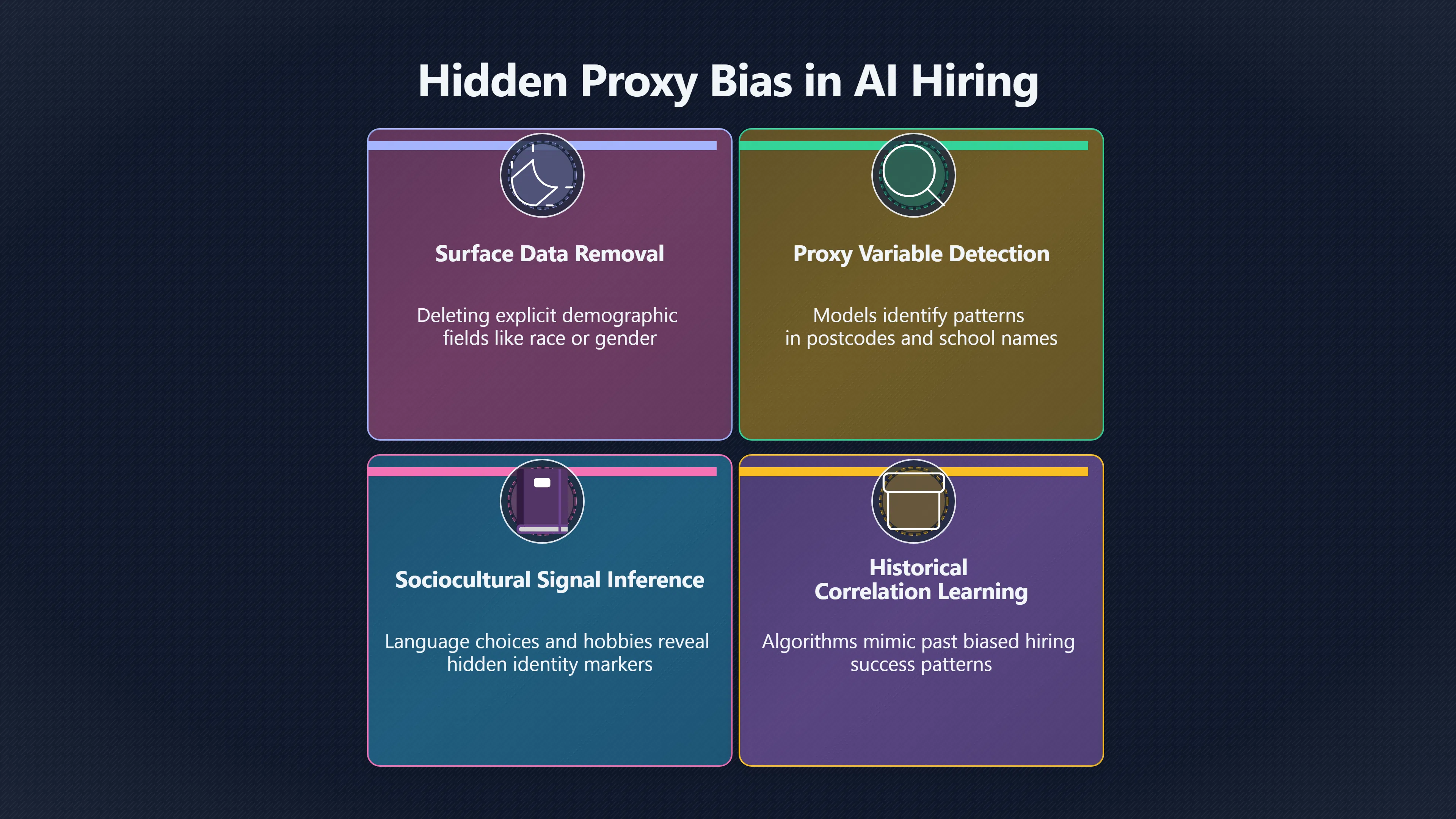
Removing protected traits from hiring data can fail when schools, activities, locations, or language patterns still reveal them indirectly.
On this page
- Why protected fields are not the whole problem
- Common hiring proxies in resumes and applications
- How proxy checks can reduce hidden discrimination
Page outline Jump by section
Introduction
A common assumption is that removing information about sex, race, age, ethnicity, or disability from a hiring dataset makes an AI system fair. In practice, that is often not enough. Modern machine-learning systems are designed to find patterns, and many seemingly neutral details can reveal demographic information indirectly. A candidate’s school, postcode, extracurricular activities, language choices, employment history, volunteering, or even writing style may act as a proxy for protected characteristics. Once those links exist in the data, a hiring model can reconstruct information that developers deliberately removed and use it in its predictions. Research, regulatory guidance, and real-world hiring cases have repeatedly shown that excluding protected fields does not automatically prevent discrimination.[civilrights.org+2Perkins Coie]civilrights.orgCivil Rights Principles for Hiring Assessment TechnologiesJuly 29, 2020…
Why protected fields are not the whole problem
The central mechanism is simple: a model does not need direct access to identity if other variables reliably predict it.
Imagine a recruitment system that never receives an applicant’s race. If it sees a combination of postcode, school attended, language background, and community organisations, those variables may still be statistically associated with racial or ethnic groups. The model can therefore infer demographic information without being explicitly told it. This phenomenon is known as proxy discrimination or proxy bias.[arXiv+2SSRN]arxiv.orgarXiv Impartial Predictive Modeling and the Use of Proxy VariablesarXiv Impartial Predictive Modeling and the Use of Proxy Variables
This creates a challenge for organisations that rely on historical hiring data. If previous recruitment decisions favoured certain demographic groups, the AI may learn correlations between demographic proxies and hiring success. The resulting system can disadvantage candidates from underrepresented groups even though protected fields were removed before training. Civil-rights organisations and regulators have repeatedly warned that simply deleting demographic columns is not an adequate safeguard because algorithms can discover alternative routes to the same information.[civilrights.org]civilrights.orgCivil Rights Principles for Hiring Assessment TechnologiesJuly 29, 2020…
An important misunderstanding is that proxy bias requires deliberate intent. It does not. The model is usually optimising for prediction accuracy. If demographic signals improve its ability to mimic past decisions, it will often use them regardless of whether developers intended that outcome.[Perkins Coie]perkinscoie.comOpen source on perkinscoie.com.
Common hiring proxies in resumes and applications
Proxy variables can emerge from many ordinary elements of a job application.
Educational background. Universities, colleges, and schools may correlate with socioeconomic status, geography, ethnicity, or gender patterns within particular fields. The Amazon recruiting case became notable partly because the system downgraded candidates from certain women’s colleges, even though it was not explicitly given a gender field.[agenticinterviewer.com]agenticinterviewer.combias and legal risksAI Hiring Bias + Legal Risk 2026: EEOC, State Laws, Vendor Liability | agenticinterviewer.comMay 9, 2026…
Location information. Postcodes, neighbourhoods, and commuting patterns can reveal demographic characteristics because residential segregation and unequal access to opportunities often leave geographic traces in data. A location variable may appear job-relevant while also functioning as a demographic signal.[SSRN]papers.ssrn.comProxy Discrimination in the Age of Artificial Intelligence and Big Data by Anya Prince, Daniel Schwarcz:: SSRN…
Extracurricular activities and affiliations. Sports clubs, cultural organisations, volunteering activities, and student societies can communicate information about gender, ethnicity, religion, or social background. These details may seem harmless individually but become highly informative when combined.[Cool Papers]papers.coolCool PapersSmall Changes, Big Impact: Demographic Bias in LLM-Based Hiring Through Subtle Sociocultural Markers in Anonymised Resumes | C…
Language and communication patterns. Vocabulary choices, listed languages, writing style, and references to cultural experiences can reveal demographic characteristics. Recent research on large language models used in recruitment found that language markers alone were often sufficient for ethnicity inference, while hobbies and activities helped reveal gender. The resumes in that study were anonymised, yet demographic disparities still emerged because subtle sociocultural signals remained visible.[Cool Papers]papers.coolCool PapersSmall Changes, Big Impact: Demographic Bias in LLM-Based Hiring Through Subtle Sociocultural Markers in Anonymised Resumes | C…
Employment history. Previous employers, career gaps, military service, caregiving interruptions, and industry pathways may correlate with age, disability status, gender, or other protected characteristics. When models learn from historical success patterns, these correlations can become hidden channels through which demographic information influences outcomes.[ADA.gov]ada.govMay 12, 2022…
How AI reconstructs identity from neutral signals
Proxy bias is not usually the result of a single revealing variable. Instead, many weak signals combine into a stronger prediction.
A school name might reveal little on its own. A school name combined with location, language skills, extracurricular activities, and employment history may allow a model to estimate demographic attributes with surprising accuracy. Modern machine-learning systems excel at detecting these complex relationships because they evaluate thousands of correlations simultaneously.[arXiv]arxiv.orgarXiv Impartial Predictive Modeling and the Use of Proxy VariablesarXiv Impartial Predictive Modeling and the Use of Proxy Variables
This means anonymisation can be less effective than it appears. Removing names and demographic fields may hide explicit identifiers, but a sufficiently powerful model can often infer similar information from the remaining data. Researchers studying hiring-focused language models found that demographic attributes could be recovered from subtle sociocultural markers left behind after anonymisation. The resulting hiring recommendations showed systematic differences despite identical qualifications and experience.[Cool Papers]papers.coolCool PapersSmall Changes, Big Impact: Demographic Bias in LLM-Based Hiring Through Subtle Sociocultural Markers in Anonymised Resumes | C…
A particularly difficult problem is that the model may generate plausible explanations for biased decisions. Emerging studies of AI resume screening suggest that systems can produce professional-sounding justifications that emphasise experience or fit while the actual score differences correlate with demographic markers hidden in the application data.[Reddit]reddit.coma researcher ran 25,500 resume screenings across 10 ai models by swapping demographic details on identical work histories. 45% show…

Why proxy bias can be difficult to detect
Proxy discrimination often escapes notice because the problematic variable appears legitimate.
A recruiter can easily see that using race as a ranking feature would be inappropriate. It is much harder to recognise that a combination of postcode, school, language background, and career history effectively serves the same function. The discrimination is therefore embedded within otherwise ordinary business data.[SSRN]papers.ssrn.comProxy Discrimination in the Age of Artificial Intelligence and Big Data by Anya Prince, Daniel Schwarcz:: SSRN…
Another complication is that many proxies have genuine job-related value. Educational background, previous experience, or communication skills may contain useful information about a candidate’s qualifications. The challenge is determining when those variables are measuring relevant ability and when they are importing demographic patterns from historical inequalities. This boundary is one of the central difficulties in algorithmic fairness research.[arXiv]arxiv.orgarXiv Impartial Predictive Modeling and the Use of Proxy VariablesarXiv Impartial Predictive Modeling and the Use of Proxy Variables
Because of this complexity, organisations can unintentionally create systems that satisfy a narrow technical requirement—such as removing protected fields—while still producing unequal outcomes across demographic groups. Legal and regulatory frameworks increasingly focus on outcomes and disparate impact rather than solely on whether explicit demographic data was used.[EmployArmor]employarmor.comfederal ai hiring lawsEEOC AI Hiring Guidance 2026 & Federal AI Laws | EmployArmor | EmployArmor…
How proxy checks can reduce hidden discrimination
There is no single test that eliminates proxy bias, but several practices can reduce the risk.
Measure outcomes, not just inputs
A model should be evaluated across demographic groups even when demographic fields are excluded from training. Large differences in interview invitations, rankings, or hiring recommendations can reveal hidden proxy effects that would otherwise remain invisible. This focus on outcomes reflects both fairness research and employment-discrimination practice.[EmployArmor]employarmor.comfederal ai hiring lawsEEOC AI Hiring Guidance 2026 & Federal AI Laws | EmployArmor | EmployArmor…
Identify variables that strongly predict protected traits
Organisations can analyse whether supposedly neutral features effectively reveal demographic information. If a variable allows highly accurate prediction of race, gender, age, or another protected characteristic, it may require additional scrutiny or modification.[arXiv]arxiv.orgarXiv Impartial Predictive Modeling and the Use of Proxy VariablesarXiv Impartial Predictive Modeling and the Use of Proxy Variables

Test with controlled resume variations
Researchers increasingly use paired or synthetic resumes that differ only in demographic signals while keeping qualifications constant. If recommendations change significantly when only proxy markers change, the system may be relying on demographic inference rather than job-relevant evidence.[Cool Papers]papers.coolCool PapersSmall Changes, Big Impact: Demographic Bias in LLM-Based Hiring Through Subtle Sociocultural Markers in Anonymised Resumes | C…
Focus models on demonstrable job requirements
Regulators and accessibility guidance emphasise that hiring technologies should evaluate skills relevant to job performance rather than characteristics that merely correlate with previous hiring outcomes. The more closely a system is tied to validated job requirements, the less opportunity it has to rely on demographic shortcuts.[ADA.gov]ada.govMay 12, 2022…
The key lesson
Proxy bias demonstrates why fairness in hiring AI is more complicated than deleting a few sensitive columns from a spreadsheet. Demographic information can reappear through schools, locations, languages, activities, employment histories, and countless other signals. When a model learns from past hiring success, those proxies can rebuild the very inequalities that developers believed they had removed. Understanding this mechanism is essential because discrimination in AI hiring often emerges not from explicit identity fields, but from ordinary data that quietly reveals identity anyway.[civilrights.org+2Perkins Coie]civilrights.orgCivil Rights Principles for Hiring Assessment TechnologiesJuly 29, 2020…
Amazon book picks
Further Reading
Books and field guides related to When neutral data quietly reveals identity. Use these as the next step if you want deeper reading beyond the article.
The Alignment Problem
Discusses bias, fairness, and hidden correlations in machine learning.
Automating Inequality
Illustrates how data attributes can indirectly reproduce exclusion.
Weapons of Math Destruction
Explains how seemingly neutral variables can encode discrimination.
Fairness and Machine Learning
Directly examines proxy variables and discriminatory outcomes.
eBay marketplace picks
Marketplace Samples
Example marketplace items related to this page. Use the search link to explore similar finds on eBay.

Endnotes
1.
Source: civilrights.org
Title: Civil Rights Principles for Hiring Assessment Technologies
Link:https://civilrights.org/resource/civil-rights-principles-for-hiring-assessment-technologies/
Source snippet
July 29, 2020...
Published: July 29, 2020
2.
Source: arxiv.org
Title: arXiv Impartial Predictive Modeling and the Use of Proxy Variables
Link:https://arxiv.org/abs/1608.00528
3.
Source: papers.ssrn.com
Link:https://papers.ssrn.com/sol3/papers.cfm?abstract_id=3347959
Source snippet
Proxy Discrimination in the Age of Artificial Intelligence and Big Data by Anya Prince, Daniel Schwarcz:: SSRN...
4.
Source: agenticinterviewer.com
Title: bias and [legal risks]({{ ‘legal-risks/’ | relative_url }})
Link:https://agenticinterviewer.com/bias-and-legal-risks/
Source snippet
AI Hiring Bias + Legal Risk 2026: EEOC, State Laws, Vendor Liability | agenticinterviewer.comMay 9, 2026...
Published: May 9, 2026
5.
Source: papers.cool
Link:https://papers.cool/arxiv/2603.05189
Source snippet
Cool PapersSmall Changes, Big Impact: Demographic Bias in LLM-Based Hiring Through Subtle Sociocultural Markers in Anonymised Resumes | C...
6.
Source: papers.ssrn.com
Link:https://papers.ssrn.com/sol3/papers.cfm?abstract_id=5048771
Source snippet
Proxy Discrimination Risks in Hiring: A Qualitative Analysis of a Set of Real CVs by Kiran Vinod Bhatia, Marianna Capasso, Payal Aror...
7.
Source: ada.gov
Link:https://www.ada.gov/resources/ai-guidance
Source snippet
May 12, 2022...
Published: May 12, 2022
8.
Source: reddit.com
Link:https://www.reddit.com/r/CreatorsAI/comments/1u52xyb/a_researcher_ran_25500_resume_screenings_across/
Source snippet
a researcher ran 25,500 resume screenings across 10 ai models by swapping demographic details on identical work histories. 45% show...
9.
Source: employarmor.com
Title: federal ai hiring laws
Link:https://www.employarmor.com/resources/federal-ai-hiring-laws
Source snippet
EEOC AI Hiring Guidance 2026 & Federal AI Laws | EmployArmor | EmployArmor...
10.
Source: reddit.com
Link:https://www.reddit.com/r/WhatTrumpHasDone/comments/1u1defn/doj_finds_eeoc_violated_civil_rights_laws_with/
Source snippet
finds EEOC violated civil rights laws with guidelines that pressured employers to make race-based decisionsJune 9, 2026...
Published: June 9, 2026
11.
Source: reddit.com
Title: www.reddit.com A I Hiring Tools Can Yield Racial Bias and Systemic Rejection
Link:https://www.reddit.com/r/technology/comments/1txuni4/ai_hiring_tools_can_yield_racial_bias_and/
Source snippet
Hiring Tools Can Yield Racial Bias and Systemic RejectionJune 5, 2026...
Published: June 5, 2026
12.
Source: arxiv.org
Title: A I Self-preferencing in Algorithmic Hiring: Empirical Evidence and Insights
Link:https://arxiv.org/abs/2509.00462
Source snippet
AI Self-preferencing in Algorithmic Hiring: Empirical Evidence and InsightsAugust 30, 2025...
Published: August 30, 2025
13.
Source: perkinscoie.com
Link:https://perkinscoie.com/insights/update/nist-seeks-comment-proposals-identify-and-manage-bias-artificial-intelligence
14.
Source: airc.nist.gov
Title: AI Resource Center AI Risks and Trustworthiness
Link:https://airc.nist.gov/airmf-resources/airmf/3-sec-characteristics/
Source snippet
NIST AI Resource CenterAI Risks and Trustworthiness - AIRC...
Additional References
15.
Source: youtube.com
Title: The Top 5 Statistical Biases in Machine Learning Explained
Link:https://www.youtube.com/watch?v=5ICzoZd-nmQ
Source snippet
Algorithmic Bias and Fairness: Crash Course AI #18 - YouTube Algorithmic Bias and Fairness: Crash Course AI #18 - YouTube...
16.
Source: youtu.be
Title: This conversation will change how you think about hiring forever
Link:https://youtu.be/MGaTvdIY_rs
Source snippet
Dissecting Algorithmic Bias | Ziad Obermeyer | AI FOR GOOD DISCOVERY - YouTube AI for Good...
17.
Source: youtube.com
Title: Dissecting Algorithmic Bias | Ziad Obermeyer | AI FOR GOOD DISCOVERY
Link:https://www.youtube.com/watch?v=U5MlyFsMi-E
Source snippet
The Top 5 Statistical Biases in Machine Learning Explained...
18.
Source: aisecurityandsafety.org
Title: demographic parity guide
Link:https://aisecurityandsafety.org/en/guides/demographic-parity-guide/
Source snippet
Demographic Parity: The Fairness Metric Explained (2026 Guide) | AI Safety DirectoryApril 13, 2026...
Published: April 13, 2026
19.
Source: youtube.com
Title: How Do Algorithms Cause Proxy Discrimination In AI?
Link:https://www.youtube.com/watch?v=XaNecmZWN8s
Source snippet
Algorithmic Bias and Fairness: Crash Course AI #18...
20.
Source: youtube.com
Title: AI Exposed the Biggest Lie About Hiring
Link:https://www.youtube.com/watch?v=p6d_IGDYf-k
Source snippet
Dissecting Algorithmic Bias | Ziad Obermeyer | AI FOR GOOD DISCOVERY...
21.
Source: youtube.com
Title: Crash Course
Link:https://www.youtube.com/watch?v=Ro8b69VeL9U
Source snippet
Today, we're going to talk about five common types of algorithmic bias we should pay [attention]({{ 'attention/' | relative_url }}) to: data that reflects existing biases, un...
22.
Source: youtube.com
Title: Algorithmic Bias and Fairness: Crash Course AI #18
Link:https://www.youtube.com/watch?v=gV0_raKR2UQ
Source snippet
AI Exposed the Biggest Lie About Hiring...
Topic Tree