Within Human Checks
Why Humans Over Trust AI Recommendations
Human oversight can fail when reviewers trust AI recommendations too quickly or lack the confidence to challenge them.
On this page
- How automation bias weakens human sign off
- Warning signs that reviewers are rubber stamping outputs
- Design choices that help reviewers challenge AI
Page outline Jump by section
Introduction
Automation bias is the tendency for people to give excessive weight to recommendations from automated systems, even when those recommendations are wrong. In high-stakes AI review, this creates a paradox: organisations add human sign-off to reduce risk, yet the presence of an AI recommendation can make reviewers less likely to detect errors. Human oversight only protects against mistakes when reviewers actively evaluate the evidence, recognise potential failures, and feel authorised to disagree with the system. When those conditions are absent, human review can become a ceremonial approval step rather than a meaningful safeguard. Research across decision-support systems, healthcare, and human–AI collaboration consistently finds that people often follow automated advice even when contradictory information is available.[PMC]pmc.ncbi.nlm.nih.govMost studies found that DSS improved user performance overall, evenAutomation bias: a systematic review of frequency, effect…by K Goddard · 2011 · Cited by 1272 — Automation bias appears to be a fai…
 This problem has become important enough that the EU AI Act explicitly requires high-risk AI systems to support effective human oversight and to account for the risk of over-reliance on system outputs. Regulators increasingly recognise that merely placing a human in the workflow does not guarantee genuine review. Artificial Intelligence Act+2AI Act Service Desk[artificialintelligenceact.eu]artificialintelligenceact.euArtificial Intelligence ActArticle 14: Human Oversight | EU Artificial Intelligence ActHuman oversight shall aim to prevent or minimise t…
How Automation Bias Weakens Human Sign-Off
The central mechanism behind automation bias is not blind faith in technology. Instead, it emerges from a combination of cognitive shortcuts, workload pressures, and assumptions about machine competence.
When reviewers receive an AI recommendation before conducting their own analysis, the recommendation can become an anchor. People often begin evaluating the case through the lens of the AI’s conclusion rather than forming an independent judgement first. This changes the role of the reviewer from decision-maker to confirmer.[Springer Link]link.springer.comSpringer LinkExploring automation bias in human–AI collaborationby G Romeo · 2025 · Cited by 183 — This research systematically investiga…
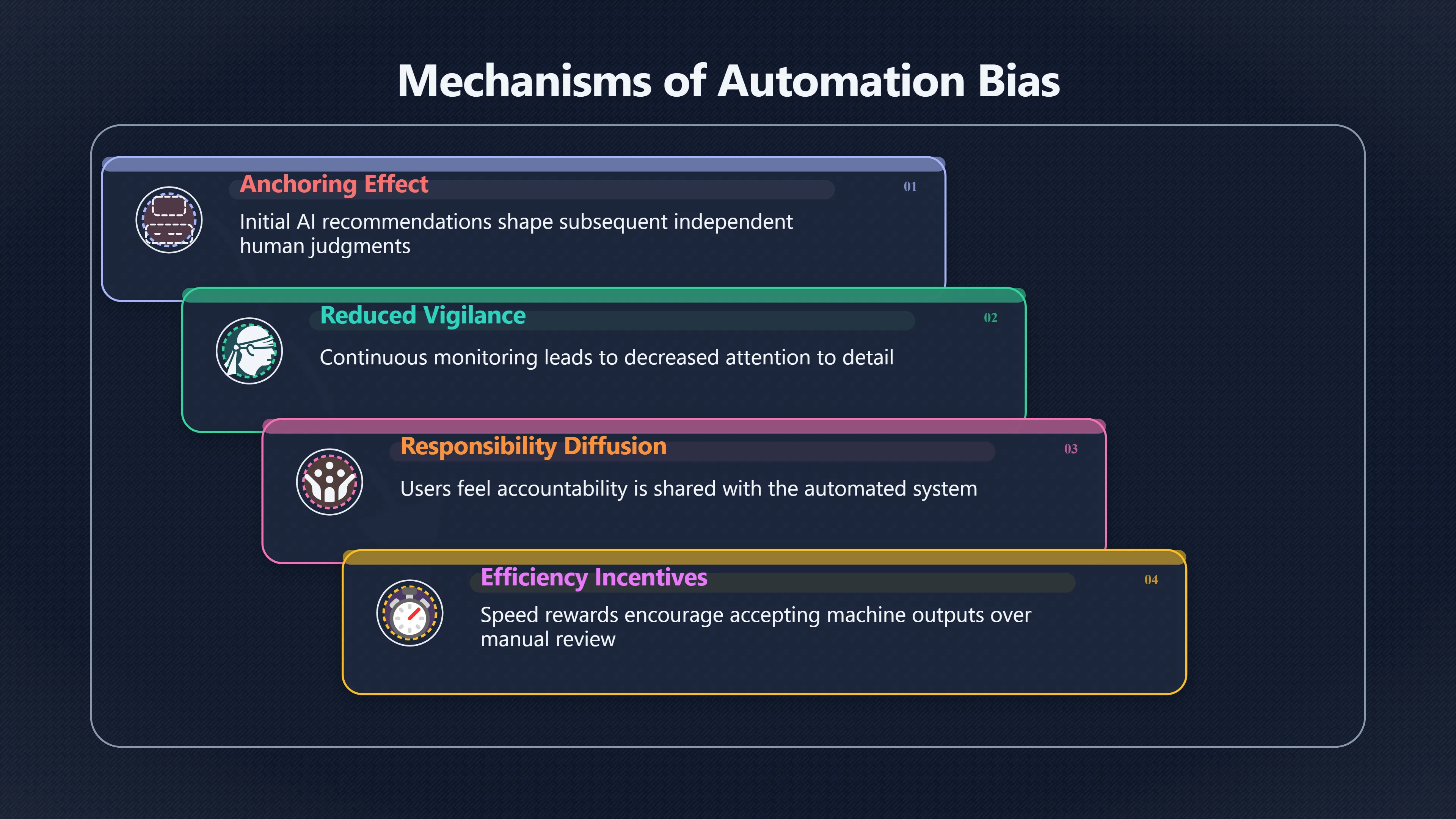
Several reinforcing mechanisms are commonly observed:
- Perceived authority: AI systems are often presented as highly accurate, leading reviewers to assume the recommendation is probably correct.
- Reduced vigilance: Monitoring automated outputs is mentally demanding. Over time, reviewers may pay less attention to details and become less likely to search for contradictory evidence.
- Responsibility diffusion: Individuals may feel that responsibility is shared with the system or the organisation deploying it.
- Efficiency incentives: If reviewers are rewarded for speed, challenging the AI may appear costly while accepting the recommendation appears efficient.[PMC+2NIST AI Resource Center]pmc.ncbi.nlm.nih.govMost studies found that DSS improved user performance overall, evenAutomation bias: a systematic review of frequency, effect…by K Goddard · 2011 · Cited by 1272 — Automation bias appears to be a fai…
The result is a subtle shift in behaviour. Reviewers still believe they are exercising judgement, yet their decisions become increasingly shaped by the system’s recommendation.
Why Expertise Does Not Eliminate the Problem
A common assumption is that automation bias mainly affects inexperienced users. Experience can help, but evidence suggests that expertise alone does not remove the risk.
Studies of clinical decision-support systems show that users frequently benefit from AI assistance overall, yet still accept incorrect recommendations at meaningful rates. Researchers examining AI-assisted clinical decision-making have found that automation bias can compromise diagnostic accuracy, particularly when users place excessive trust in system outputs.[ResearchGate]researchgate.netAutomation Bias in AI-Decision Support: Results from an…Automation bias poses a significant challenge to the effectiveness…
Importantly, expertise changes the form of the problem rather than eliminating it. Experienced reviewers may catch more errors, but they are also vulnerable to workload pressures, trust developed through past system success, and organisational cultures that encourage deference to automated tools. When an AI system is correct most of the time, the occasional error can be especially difficult to detect because reviewers become conditioned to expect reliability.[PMC]pmc.ncbi.nlm.nih.govPMCFrom Trust in Automation to Trust in AI in Healthcareby KKL Wong · 2025 · Cited by 17 — Human–machine trust has shifted over the past three decades from trust in automation to trust in AI…
This creates a difficult trade-off. High-performing AI systems can improve outcomes overall, but their success can simultaneously increase the likelihood that humans overlook rare but consequential mistakes.
Warning Signs That Reviewers Are Rubber-Stamping Outputs
Organisations often assume human review is functioning properly because every case receives a human signature. In practice, several indicators suggest that oversight has become ineffective.
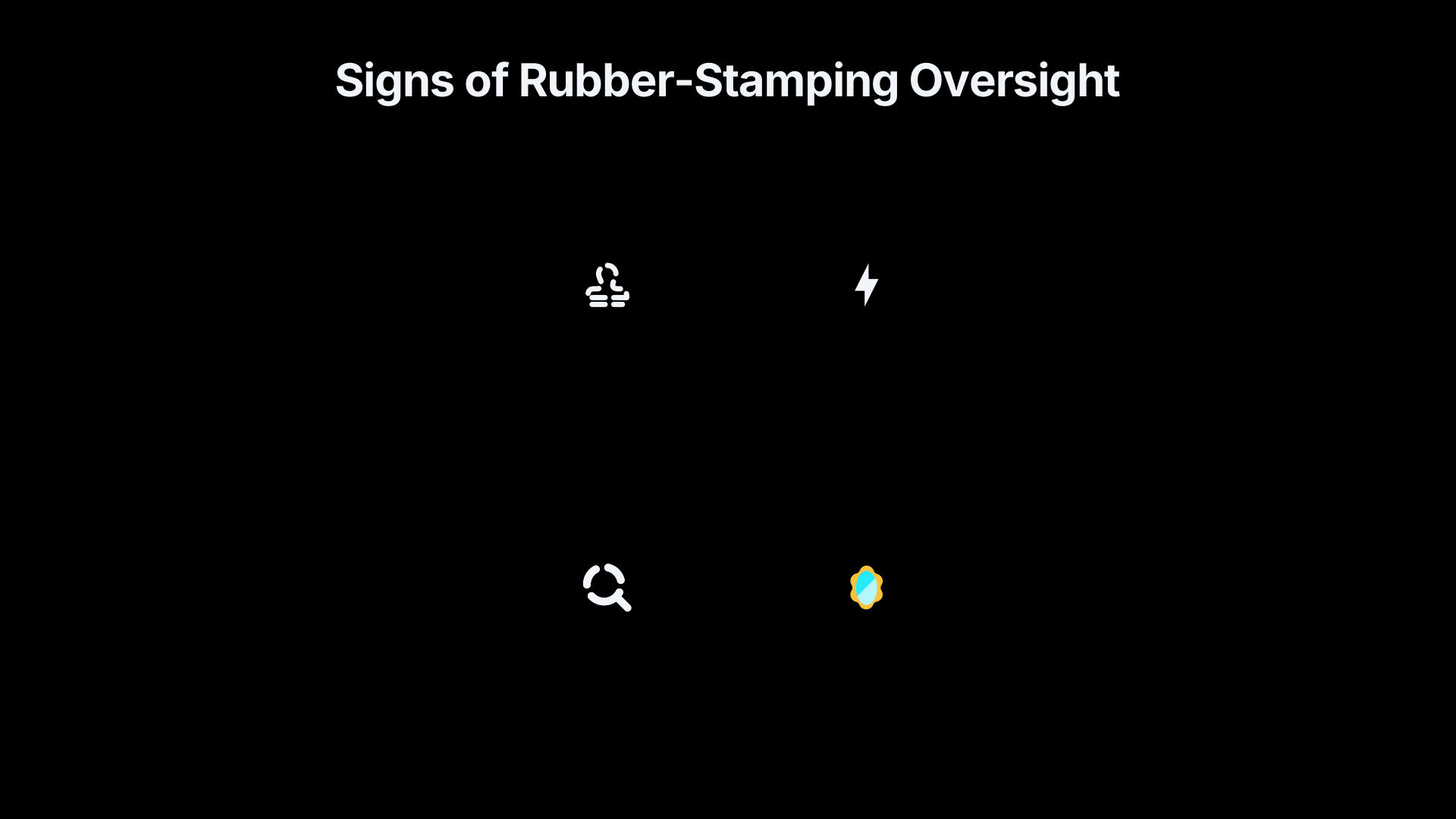
Very Low Override Rates
A near-zero rate of disagreement with AI recommendations may appear reassuring, but it can also indicate excessive reliance. In many environments, some level of disagreement is expected because reviewers have access to contextual information, domain knowledge, or additional evidence not fully captured by the model.
If reviewers almost never challenge the system, organisations should ask whether meaningful evaluation is occurring.
Faster Decisions Without Independent Analysis
Automation bias often appears when reviewers stop generating their own hypotheses and instead evaluate only the AI’s preferred answer. Decisions become faster, but not necessarily safer.
This pattern is especially concerning in domains such as healthcare, law, lending, or hiring, where important contextual factors may not be fully represented in model inputs.[Book Cafe]bookcafe.yuntsg.comBook CafeAutomation Bias and Assistive AI Risk of Harm From AI-Driven…by R Khera · 2023 · Cited by 198 — Clinical decision support too…
Agreement Despite Contradictory Evidence
One of the strongest indicators of automation bias is continued acceptance of AI recommendations even when other information points elsewhere.
Research on decision-support systems has repeatedly shown that users may ignore available evidence that conflicts with automated advice, a phenomenon sometimes described as reduced information seeking and reduced verification effort.[OUP Academic]academic.oup.comOUP AcademicAutomation bias and verification complexity: a systematic reviewby D Lyell · 2017 · Cited by 487 — Automation bias (AB) happe…
Bias Propagating Through Human Review
Recent research in AI-assisted hiring illustrates a particularly troubling pattern. Human reviewers exposed to biased AI recommendations often mirrored those recommendations rather than correcting them. Instead of functioning as a safeguard, human oversight sometimes amplified the bias already present in the system.[The Washington Post]washingtonpost.comThe Washington Post Why you shouldn't count on humans to prevent AI hiring biasAs companies cut human resources staff and turn to large language models (LLMs) to screen job applicants, the study finds that humans wor…
A Concrete Example: Clinical Decision Support
Healthcare provides one of the clearest illustrations of automation bias because the consequences of error are visible and measurable.
Clinical decision-support systems can improve diagnostic performance, help identify patterns, and reduce oversight failures. Yet studies have repeatedly found that clinicians sometimes follow incorrect recommendations even when their initial judgement was correct. Research on AI-assisted pathology and clinical decision support has documented cases where users changed accurate assessments to inaccurate ones after receiving erroneous AI advice.[arXiv]arxiv.orgAutomation Bias in AI-Assisted Medical Decision-Making under Time Pressure in Computational PathologyNovember 1, 2024…
One reason is that AI outputs can create an illusion of objectivity. A numerical score, probability estimate, or ranked recommendation often appears more precise than a human judgement, even when the underlying model has significant limitations.
The challenge is not that clinicians trust technology. The challenge is that trust may become insufficiently calibrated to the actual reliability of the system in a particular case.
Design Choices That Help Reviewers Challenge AI
Automation bias is not inevitable. System design can either encourage passive acceptance or promote critical evaluation.
Require an Independent Initial Assessment
One effective approach is to delay exposure to the AI recommendation until after the reviewer records an initial judgement.
This preserves independent reasoning and reduces anchoring effects. Reviewers can then compare their assessment with the model’s output rather than building their assessment around it.
Show Evidence, Not Just Conclusions
Systems that present only a recommendation encourage acceptance. Systems that expose supporting evidence, uncertainty indicators, and reasoning pathways make it easier for reviewers to evaluate whether the recommendation is justified.
Research on human-AI interaction suggests that carefully designed explanations can reduce over-reliance, although explanations do not automatically improve decision quality and must be designed thoughtfully.[European Data Protection Supervisor]edps.europa.eu2025 09 23 techdispatch 22025 human oversight automated makingExplanations can reduce overreliance on ai systems during decision-making. The EU AI Act's Human…
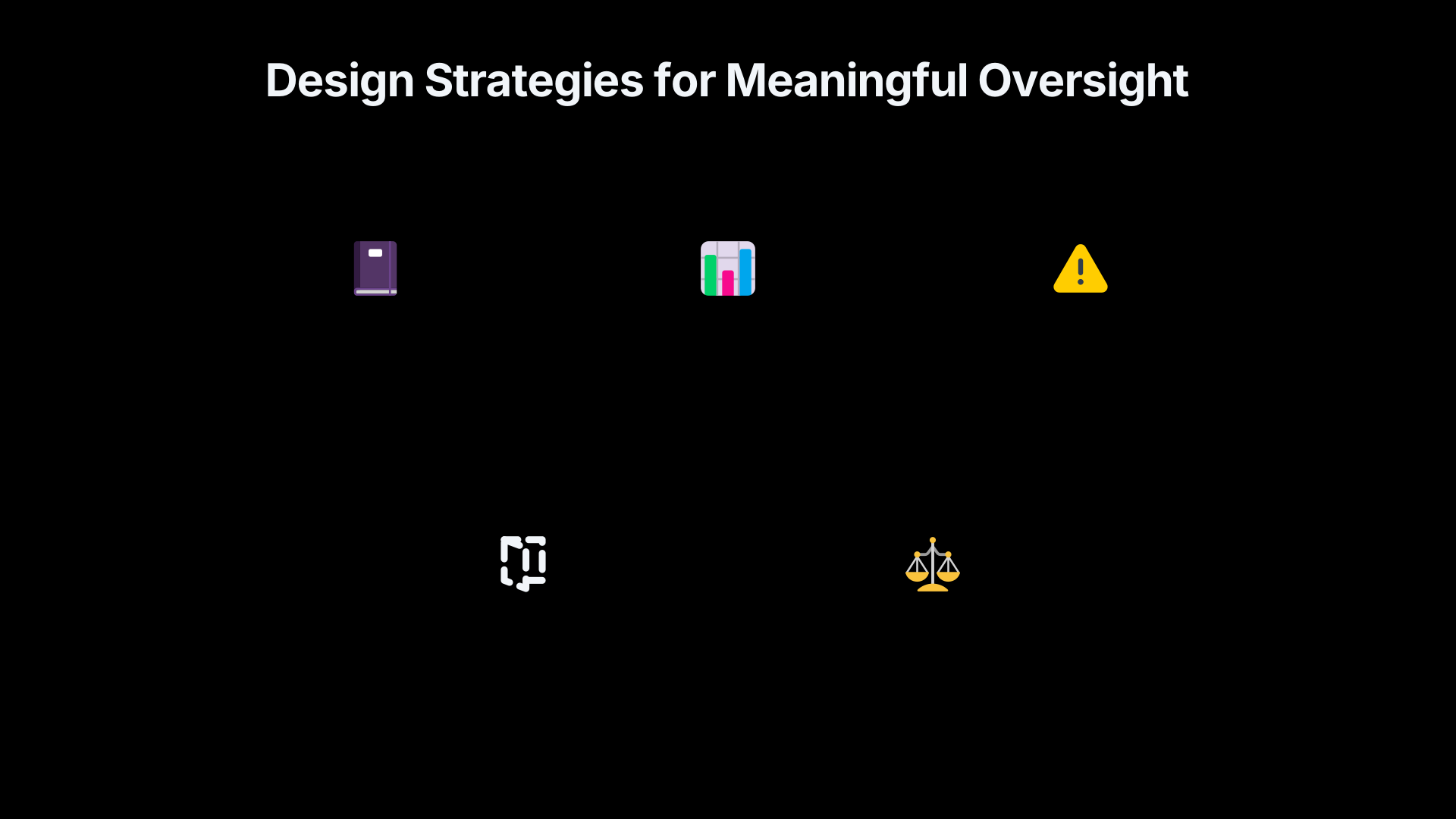
Make Uncertainty Visible
Users are more likely to challenge AI when they understand that outputs vary in reliability.
Confidence estimates, warning flags, known limitations, and alerts about unusual cases can help reviewers recognise when additional scrutiny is needed. The EU AI Act’s oversight requirements explicitly emphasise the need for humans to interpret outputs appropriately and remain aware of over-reliance risks. AI Act Service Desk+2Artificial Intelligence Act[ai-act-service-desk.ec.europa.eu]ai-act-service-desk.ec.europa.euHigh-risk AI systems must be designed to allow human oversight during their operation to minimise risks to health, safety, and fundamenta…
Measure the Quality of Oversight
Many organisations monitor model performance but fail to monitor reviewer behaviour.
Useful oversight metrics include:
- Frequency of human overrides.
- Error detection rates.
- Agreement patterns across reviewers.
- Whether reviewers examine underlying evidence.
- Performance differences when AI recommendations are hidden versus visible.
These measures can reveal whether human review is functioning as a genuine control or merely validating automated outputs.
The Real Test of Human Oversight
The value of human review is not measured by the number of people involved in a workflow. It is measured by whether those people can identify mistakes that the AI system misses.
Automation bias matters because it can create the appearance of accountability without delivering its benefits. A reviewer who routinely accepts AI recommendations may satisfy a procedural requirement for human involvement while providing little protection against harmful outcomes. Effective oversight therefore depends not only on having a human in the loop, but on creating conditions in which that human can think independently, detect errors, and confidently override the machine when necessary. NIST AI Resource Center+2nvlpubs.nist.gov[airc.nist.gov]airc.nist.govAI Resource Center AppC: AI Risk Management and Human-AI Interaction - AIRCThe AI RMF provides opportunities to clearly define and differentiate the various hu…
Amazon book picks
Further Reading
Books and field guides related to Why Humans Over-Trust AI Recommendations. Use these as the next step if you want deeper reading beyond the article.
The Alignment Problem
Examines AI failures, human oversight, and limits of machine recommendations.
Human + Machine
Focuses on effective human-AI collaboration rather than blind reliance.
Decision Intelligence
Addresses how organizations combine AI outputs with human judgment.
Thinking, Fast and Slow
Explains cognitive biases, anchoring, and over-reliance on recommendations that drive automation bias.
eBay marketplace picks
Marketplace Samples
Example marketplace items related to this page. Use the search link to explore similar finds on eBay.


Endnotes
1.
Source: pmc.ncbi.nlm.nih.gov
Title: Most studies found that DSS improved user performance overall, even
Link:https://pmc.ncbi.nlm.nih.gov/articles/PMC3240751/
Source snippet
Automation bias: a systematic review of frequency, effect...by K Goddard · 2011 · Cited by 1272 — Automation bias appears to be a fai...
2.
Source: academic.oup.com
Link:https://academic.oup.com/jamia/article/24/2/423/2631492
Source snippet
OUP AcademicAutomation bias and verification complexity: a systematic reviewby D Lyell · 2017 · Cited by 487 — Automation bias (AB) happe...
3.
Source: researchgate.net
Link:https://www.researchgate.net/publication/389056747_Automation_Bias_in_the_AI_Act_On_the_Legal_Implications_of_Attempting_to_De-Bias_Human_Oversight_of_AI
Source snippet
Automation Bias in the AI Act: On the Legal Implications of...The AIA mandates human oversight for high-risk AI systems and...
4.
Source: link.springer.com
Link:https://link.springer.com/article/10.1007/s00146-025-02422-7
Source snippet
Springer LinkExploring automation bias in human–AI collaborationby G Romeo · 2025 · Cited by 183 — This research systematically investiga...
5.
Source: airc.nist.gov
Title: AI Resource Center App
Link:https://airc.nist.gov/airmf-resources/airmf/appendices/app-c-ai-risk-management-and-human-ai-interaction/
Source snippet
C: AI Risk Management and Human-AI Interaction - AIRCThe AI RMF provides opportunities to clearly define and differentiate the various hu...
6.
Source: researchgate.net
Link:https://www.researchgate.net/publication/383786584_Automation_Bias_in_AI-Decision_Support_Results_from_an_Empirical_Study
Source snippet
Automation Bias in AI-Decision Support: Results from an...Automation bias poses a significant challenge to the effectiveness...
7.
Source: pmc.ncbi.nlm.nih.gov
Title: PMCFrom Trust in Automation to Trust in AI in Healthcare
Link:https://pmc.ncbi.nlm.nih.gov/articles/PMC12562135/
Source snippet
by KKL Wong · 2025 · Cited by 17 — Human–machine trust has shifted over the past three decades from trust in automation to trust in AI...
8.
Source: arxiv.org
Link:https://arxiv.org/abs/2411.00998
Source snippet
Automation Bias in AI-Assisted Medical Decision-Making under Time Pressure in Computational PathologyNovember 1, 2024...
Published: November 1, 2024
9.
Source: nvlpubs.nist.gov
Link:https://nvlpubs.nist.gov/nistpubs/ai/NIST.AI.600-1.pdf
Source snippet
Artificial Intelligence Risk Management Frameworkby N AI · 2024 · Cited by 92 — algorithmic aversion, automation bias, over-reliance, or...
10.
Source: nvlpubs.nist.gov
Link:https://nvlpubs.nist.gov/nistpubs/ai/nist.ai.100-1.pdf
Source snippet
Intelligence Risk Management Framework (AI RMF 1.0)by N AI · 2023 · Cited by 195 — [Understanding]({{ 'understanding/' | relative_url }}) and managing the risks of AI systems wil...
11.
Source: nist.gov
Link:https://www.nist.gov/itl/ai-risk-management-framework
Source snippet
AI Risk Management Framework | NISTNIST has developed a framework to better manage risks to individuals, organizations, and society assoc...
12.
Source: automation.com
Link:https://www.automation.com/
Source snippet
News, Articles & Resources for Industrial...Automation.com publishes news, articles, products & resources on industrial automation topics...
13.
Source: researchgate.net
Link:https://www.researchgate.net/publication/392771285_Exploring_automation_bias_in_human-AI_collaboration_a_review_and_implications_for_explainable_AI
Source snippet
(PDF) Exploring automation bias in human–AI collaborationJul 3, 2025 — This research systematically investigates how AB manifests in thes...
14.
Source: mida.gov.my
Title: It marks a significant shift into
Link:https://www.mida.gov.my/automation-project-initiative-building-a-smarter-future-for-manufacturing/
Source snippet
Automation Project Initiative: Building a Smarter Future for...5 Jun 2024 — Automation is revolutionising global manufacturing, driving...
15.
Source: artificial-intelligence-act.com
Title: Artificial Intelligence Act Article 14 (Proposal 25.11.2022)
Link:https://www.artificial-intelligence-act.com/Artificial_Intelligence_Act_Article_14_%28Proposal_25.11.2022%29.html
Source snippet
Proposal 25.11.2022 | Article 14 - EU AI Act25 Nov 2022 — Human oversight shall aim at preventing or minimising the risks to health, safe...
16.
Source: arxiv.org
Link:https://arxiv.org/abs/2502.10036
Source snippet
Automation Bias in the AI Act: On the Legal Implications of...by J Laux · 2025 · Cited by 36 — This paper examines the legal implication...
17.
Source: artificialintelligenceact.eu
Link:https://artificialintelligenceact.eu/article/14/
Source snippet
Artificial Intelligence ActArticle 14: Human Oversight | EU Artificial Intelligence ActHuman oversight shall aim to prevent or minimise t...
18.
Source: ai-act-service-desk.ec.europa.eu
Link:https://ai-act-service-desk.ec.europa.eu/en/ai-act/article-14
Source snippet
High-risk AI systems must be designed to allow human oversight during their operation to minimise risks to health, safety, and fundamenta...
19.
Source: pubmed.ncbi.nlm.nih.gov
Link:https://pubmed.ncbi.nlm.nih.gov/39234734/
Source snippet
Bias in AI-Decision Support: Results from an...by F Kücking · 2024 · Cited by 62 — This study highlights that non-specialists, who stand...
20.
Source: bookcafe.yuntsg.com
Link:https://bookcafe.yuntsg.com/ueditor/jsp/upload/file/20240201/1706751569146083289.pdf
Source snippet
Book CafeAutomation Bias and Assistive AI Risk of Harm From AI-Driven...by R Khera · 2023 · Cited by 198 — Clinical decision support too...
21.
Source: washingtonpost.com
Title: The Washington Post Why you shouldn’t count on humans to prevent AI [hiring bias]({{ ‘hiring-bias/’ | relative_url }})
Link:https://www.washingtonpost.com/business/2025/11/25/biased-ai-hiring-research-university-of-washington-study/
Source snippet
As companies cut human resources staff and turn to large language models (LLMs) to screen job applicants, the study finds that humans wor...
22.
Source: edps.europa.eu
Title: 2025 09 23 techdispatch 22025 human oversight automated making
Link:https://www.edps.europa.eu/data-protection/our-work/publications/techdispatch/2025-09-23-techdispatch-22025-human-oversight-automated-making
Source snippet
Explanations can reduce overreliance on ai systems during decision-making. The EU AI Act's Human...
23.
Source: Wikipedia
Link:https://en.wikipedia.org/wiki/Automation
Source snippet
AutomationAutomation describes a wide range of technologies that reduce human intervention in processes, mainly by predetermining deci...
24.
Source: dictionary.cambridge.org
Link:https://dictionary.cambridge.org/dictionary/english-chinese-traditional/automation
Source snippet
in Traditional Chinese - Cambridge Dictionarythe use of machines and computers that can operate without needing human control 自動化 office/...
25.
Source: dictionary.cambridge.org
Link:https://dictionary.cambridge.org/dictionary/english/automation
Source snippet
English meaning - Cambridge Dictionarythe use of machines or computers instead of people to do a job, especially in a factory or office...
26.
Source: pmc.ncbi.nlm.nih.gov
Link:https://pmc.ncbi.nlm.nih.gov/articles/PMC11532940/
Source snippet
taxonomies of trustworthy AI - PMC - NIHby CA Makridis · 2024 · Cited by 6 — We evaluate the leading frameworks and provide a holistic pe...
27.
Source: pmc.ncbi.nlm.nih.gov
Link:https://pmc.ncbi.nlm.nih.gov/articles/PMC11119750/
Source snippet
and efforts in managing AI trustworthiness risksby N Polemi · 2024 · Cited by 68 — Human biases, both implicit and explicit, can inadvert...
28.
Source: intelligence.dlapiper.com
Title: artificial intelligence
Link:https://intelligence.dlapiper.com/artificial-intelligence/?c=EU&t=11-human-oversight
Source snippet
oversight in the European Union - AI Laws of...11 Feb 2026 — Article 14 of the EU AI Act deals with human oversight, stating that provid...
29.
Source: edps.europa.eu
Title: eu Tech Dispatch
Link:https://www.edps.europa.eu/system/files/2025-09/25-09-15_techdispatch-human-oversight_en.pdf
Source snippet
can reduce automation bias by promoting more critical [engagement]({{ 'engagement-goals/' | relative_url }}) and meaningful human oversight of AI...Read more...
30.
Source: thedecisionlab.com
Title: automation bias
Link:https://thedecisionlab.com/biases/automation-bias
Source snippet
In a 2017 study exploring the impact of using clinical decision support systems (CDSS)... Automation bias is our tendency to trust outpu...
Additional References
31.
Source: automationanywhere.com
Link:https://www.automationanywhere.com/home
Source snippet
Automation Anywhere: The #1 Provider of Agentic AutomationThe industry's most advanced, most deployed agentic process automation system c...
32.
Source: scrut.io
Link:https://www.scrut.io/glossary/human-ai-configuration
Source snippet
Human-AI Configuration and OversightThe goal is to design for "meaningful human control" to mitigate risks of over-reliance, automation b...
33.
Source: epic.org
Link:https://epic.org/documents/epic-comments-national-institute-of-standards-and-technology-ai-risk-management-framework/
Source snippet
National Institute of Standards and Technology AI Risk...EPIC believes the AI RMF is most effective where it provides clear directions o...
34.
Source: blacksmithinfosec.com
Link:https://blacksmithinfosec.com/nists-ai-risk-management-framework-what-it-is-why-it-exists-and-what-msps-should-know/
Source snippet
NIST's AI Risk Management Framework: What It Is, Why It...4 Feb 2026 — NIST explicitly calls out risks that conventional security models...
35.
Source: cambridge.org
Link:https://www.cambridge.org/core/journals/european-journal-of-risk-regulation/article/automation-bias-in-the-ai-act-on-the-legal-implications-of-attempting-to-debias-human-oversight-of-ai/C97C85015056C09326944DE55CBC4D2C
Source snippet
providers may thus be incentivised to design their AI systems to encourage human oversight...Read more...
36.
Source: euairisk.com
Link:https://euairisk.com/resources/human-oversight-balancing-automation-accountability
Source snippet
Strategies for meaningful oversight, preventing automation bias, and documenting operator competency...
37.
Source: jolt.law.harvard.edu
Title: redefining the standard of human oversight for ai negligence
Link:https://jolt.law.harvard.edu/digest/redefining-the-standard-of-human-oversight-for-ai-negligence
Source snippet
Harvard Journal of Law & TechnologyRedefining the Standard of Human Oversight for AI...9 Feb 2026 — This reflects automation bias, a phe...
38.
Source: cycoresecure.com
Title: nist ai rmf explained 15 faqs ai leader needs answered
Link:https://www.cycoresecure.com/blogs/nist-ai-rmf-explained-15-faqs-ai-leader-needs-answered
Source snippet
NIST AI RMF Explained: 15 FAQs Every AI Leader Needs...5 Jan 2026 — Guide to the NIST AI RMF's four functions — Govern, Map, Measure, Ma...
39.
Source: orca.security
Title: NIS T AI Risk Management Framework (AI RMF) Explained
Link:https://orca.security/resources/blog/nist-ai-risk-management-framework-ai-rmf/
Source snippet
NIST AI Risk Management Framework (AI RMF) ExplainedMay 20, 2026 — The NIST AI Risk Management Framework (AI RMF 1.0) is voluntary guidan...
Published: May 20, 2026
40.
Source: databrackets.com
Title: understanding the nist ai risk management framework
Link:https://databrackets.com/blog/understanding-the-nist-ai-risk-management-framework/
Source snippet
9 Nov 2025 — Human-AI Interaction Risks: Risks related to over-reliance on AI, automation bias, loss of human skills, and inappropriate h...
Topic Tree