Within Shadow AI
Why Banning AI Can Backfire at Work
Strict AI bans can push employees toward hidden workarounds when approved tools do not meet real productivity needs.
On this page
- Why employees keep using AI anyway
- How concealment weakens governance
- When approved alternatives reduce bypassing
Page outline Jump by section
Introduction
Banning artificial intelligence tools may seem like a straightforward way to reduce risk, but in practice it can make workplace AI use harder to detect. When employees believe AI helps them complete tasks faster, meet deadlines, or handle workloads that approved systems cannot support, a strict prohibition often changes where AI is used rather than whether it is used. Instead of working through visible, governed channels, employees may shift to personal accounts, personal devices, or unofficial services that leave fewer traces for security and compliance teams. Research and industry surveys repeatedly show that unauthorised AI use remains widespread, particularly when organisations do not provide approved alternatives that meet real work needs.[euronews]euronews.comMost UK employees use AI at work without permission, Microsoft survey finds | EuronewsOctober 14, 2025…
 This creates a governance paradox: an organisation may appear compliant because official AI usage is low, while actual AI adoption continues out of sight.
Why employees keep using AI anyway
The main reason bans struggle is that many employees see AI as a productivity tool rather than a prohibited technology. If a worker can draft reports, summarise documents, analyse data, or generate code in minutes instead of hours, the practical incentive to use AI can outweigh the perceived risk of breaking policy.
Microsoft-linked workplace research and subsequent reporting found that large numbers of employees use unapproved AI tools at work. Many users report doing so because they are already familiar with consumer AI products or because those tools help them manage heavy workloads more efficiently.[euronews]euronews.comMost UK employees use AI at work without permission, Microsoft survey finds | EuronewsOctober 14, 2025…
A ban is most likely to fail when:
- Approved tools are unavailable or limited.
- Access is restricted to small pilot groups.
- Procurement and approval processes move slowly.
- Employees face pressure to improve productivity.
- Workplace rules explain what is forbidden but not what practical alternatives exist.
In these situations, employees may view AI use as necessary to perform their jobs effectively. The result is not necessarily open resistance to policy. More often, it is quiet adaptation.
How bans push AI use out of sight
The most important governance problem is not simply unauthorised use. It is the loss of visibility.
When employees know that AI use is prohibited, they become less likely to disclose it. Tasks that might otherwise have been performed through monitored enterprise systems can migrate to personal accounts or external services. Governance teams then lose information about which tools are being used, what data is being shared, and which business processes depend on AI-generated outputs.
Security researchers and governance specialists increasingly describe this as a visibility problem rather than merely a policy problem. Several analyses note that prohibition can drive AI activity underground, reducing organisational awareness while leaving the underlying exposure unchanged.[STRATEGEN.AI+2Maxim AI]strategen-ai.comSTRATEGEN.AI Working in the Dark: Shadow AI, Sociotechnical Governance Failure, and the Ethics of Invisible Automation in the Enterprisein the Dark: Shadow AI, Sociotechnical Governance Failure, and the Ethics of Invisible Automation in the Enterprise - Research | STRATEGE…
This hidden use can take several forms:
- Employees logging into public AI services with personal email addresses.
- Work being completed on personal devices outside monitored environments.
- Sensitive information being copied into consumer AI applications.
- Teams informally standardising around unofficial tools without informing IT.
- AI-generated content being presented as entirely human-produced work.
Each of these behaviours reduces the organisation’s ability to assess risk accurately.
Why concealment weakens governance
Governance depends on knowing what is happening. Once AI use becomes hidden, several important controls become less effective.

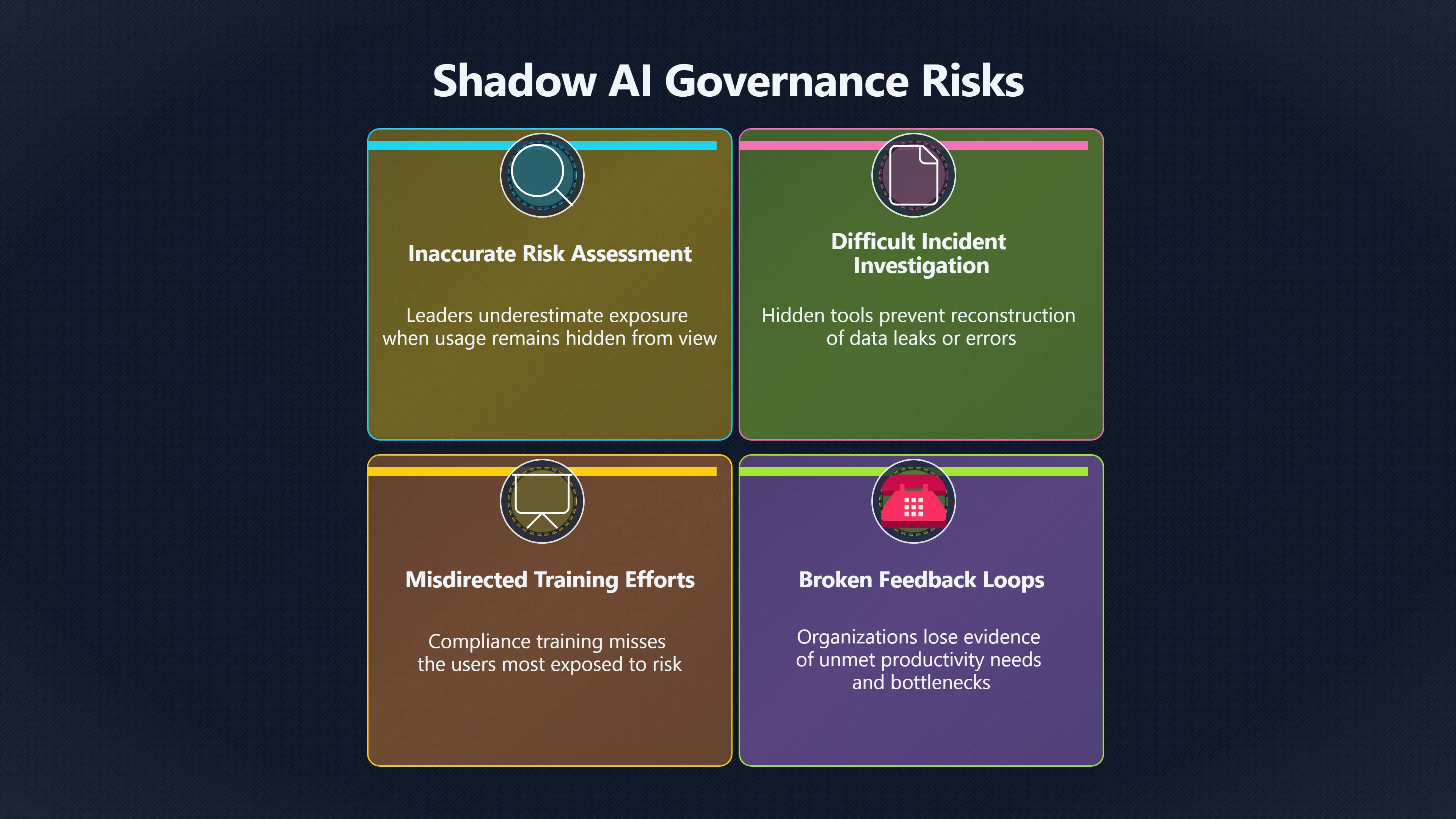
Risk assessments become inaccurate
If leaders believe AI is not being used, they may underestimate exposure to data protection, intellectual property, cybersecurity, or compliance risks. Resources may be allocated to the wrong problems because the organisation lacks an accurate picture of actual behaviour.
Incident investigations become harder
When an error, data leak, or compliance issue occurs, investigators need to understand whether AI contributed to the outcome. Hidden AI use makes it difficult to reconstruct decision-making processes or identify which systems handled sensitive information.
Training reaches the wrong audience
Employees who quietly use unofficial tools are less likely to participate in open discussions about safe practices. Organisations may therefore train compliant users while missing the people most exposed to risk.
Feedback loops disappear
A visible AI programme allows organisations to learn which tasks employees want AI to help with. Hidden use removes that feedback. Leaders see policy compliance numbers but miss evidence about unmet productivity needs and workflow bottlenecks.
The result is a governance system that appears stronger on paper while becoming weaker in practice.
The lesson from shadow IT
The dynamics behind shadow AI resemble earlier experiences with “shadow IT”—the unauthorised use of software and cloud services outside official technology channels.
Many organisations eventually learned that blanket prohibitions rarely eliminated demand. Instead, successful programmes often combined security controls with approved alternatives that addressed the underlying business need. Shadow AI appears to be following a similar pattern. Governance specialists increasingly argue that detection, transparency, and controlled adoption are more effective than attempting to eliminate AI use entirely.[Cybersecurity Essential]cybersecurityessential.comOpen source on cybersecurityessential.com.
The key insight is that employees usually adopt unofficial tools because they solve a problem. If the problem remains, banning the tool does not remove the incentive.
When approved alternatives reduce bypassing
Organisations generally achieve greater visibility when they offer AI systems that employees are willing to use voluntarily.
Surveys show that unauthorised AI use is especially common where workers lack access to enterprise-grade tools that meet their needs. Conversely, governance approaches that provide approved options, clear rules, and practical support reduce the motivation to seek workarounds.[TechRadar+2euronews]techradar.comTech Radar Many workers are using unapproved AI tools at workApproximately 59% of employees admit to using such tools without company authorization, with 75% of them sharing sensitive data including…
Several features make approved alternatives more attractive:
- Comparable functionality to popular consumer AI tools.
- Clear guidance on acceptable uses.
- Reasonable approval timelines for new tools.
- Protection for employees who disclose emerging use cases.
- Training focused on real work tasks rather than abstract compliance requirements.
When employees believe that reporting a useful AI application will lead to evaluation rather than punishment, organisations gain valuable information about how AI is actually being used.

The real governance challenge
The central challenge is not deciding whether AI should be governed. It is deciding how governance can remain effective when AI tools are widely available and easy to access.
A strict ban may reduce visible usage statistics, but it can also reduce organisational awareness. If employees continue using AI through unofficial channels, leaders may end up with less control, not more. Evidence from workplace surveys and governance research suggests that the most sustainable approach is often to reduce the gap between what workers need and what approved systems provide. When that gap narrows, the incentive for shadow AI decreases, and organisations regain the visibility required for meaningful oversight.[Maxim AI+3euronews+3TechRadar]euronews.comMost UK employees use AI at work without permission, Microsoft survey finds | EuronewsOctober 14, 2025…
Amazon book picks
Further Reading
Books and field guides related to Why Banning AI Can Backfire at Work. Use these as the next step if you want deeper reading beyond the article.
Human + Machine
Explains how organizations can channel AI adoption productively instead of resisting it.
Competing in the Age of AI
Shows how AI changes operating models and why governance must evolve with adoption.
Principles of AI Governance and Model Risk Management
Provides frameworks for balancing AI innovation with oversight.
eBay marketplace picks
Marketplace Samples
Example marketplace items related to this page. Use the search link to explore similar finds on eBay.



Endnotes
1.
Source: euronews.com
Link:https://www.euronews.com/next/2025/10/14/most-uk-employees-use-ai-at-work-without-permission-microsoft-survey-finds
Source snippet
Most UK employees use AI at work without permission, Microsoft survey finds | EuronewsOctober 14, 2025...
Published: October 14, 2025
2.
Source: techradar.com
Title: Tech Radar Many workers are using unapproved AI tools at work
Link:https://www.techradar.com/pro/many-workers-are-using-unapproved-ai-tools-at-work-and-sharing-a-lot-of-private-data-they-really-shouldnt
Source snippet
Approximately 59% of employees admit to using such tools without company authorization, with 75% of them sharing sensitive data including...
3.
Source: news.microsoft.com
Link:https://news.microsoft.com/en-cee/2024/05/16/microsoft-and-linkedin-released-2024-work-trend-index-three-out-of-four-people-use-ai-at-work-2/
Source snippet
SourceMicrosoft and LinkedIn released 2024 Work Trend Index: three out of four people use AI at work - CEE Multi-Country News Center...
4.
Source: strategen-ai.com
Link:https://www.strategen-ai.com/research/working-in-the-dark-shadow-ai-sociotechnical-governance-failure-and-the-ethics-of-invisible-[automation
Source snippet
in the Dark: Shadow AI, Sociotechnical Governance Failure, and the Ethics of Invisible Automation in the Enterprise - Research | STRATEGE...
5.
Source: getmaxim.ai
Title: Maxim AIShadow AI in Enterprises: Risks, Governance, and Security
Link:https://www.getmaxim.ai/articles/shadow-ai-in-enterprises-risks-governance-and-security/
6.
Source: microsoft.com
Title: www.microsoft.com [Generative AI]({{ ‘generative-ai/’ | relative_url }}) in Real-World Workplaces
Link:https://www.microsoft.com/en-us/research/wp-content/uploads/2024/07/Generative-AI-in-Real-World-Workplaces.pdf
Source snippet
AI in Real-World WorkplacesApril 15, 2026...
Published: April 15, 2026
7.
Source: news.microsoft.com
Title: handelsblatt berichtet ueber work trend index 2024
Link:https://news.microsoft.com/de-de/handelsblatt-berichtet-ueber-work-trend-index-2024/
Source snippet
Work Trend Index 2024June 13, 2024...
Published: June 13, 2024
8.
Source: cybersecurityessential.com
Link:https://www.cybersecurityessential.com/ai-security/ai-governance/shadow-ai-enterprise-detection-governance/
Additional References
9.
Source: itpro.com
Link:https://www.itpro.com/technology/artificial-intelligence/microsoft-says-71-percent-of-workers-have-used-unapproved-ai-tools-at-work-and-its-a-trend-that-enterprises-need-to-crack-down-on
Source snippet
says 71% of workers have used unapproved AI tools at work – and it’s a trend that enterprises need to crack down on | IT ProOctober 13, 2025...
Published: October 13, 2025
10.
Source: pattrndata.io
Link:https://www.pattrndata.io/questions/risks-of-employees-using-unapproved-ai-tools
Source snippet
are the risks of employees using unapproved AI tools? | AI Governance Questions | Pattrn DataFebruary 18, 2026...
Published: February 18, 2026
11.
Source: youtube.com
Title: Shadow AI Explained: Why It’s a Growing Compliance Risk for Global Teams
Link:https://www.youtube.com/watch?v=JE2v79arm9w
Source snippet
Shadow AI at Work: How Leaders Can Channel It Instead of Fighting It - YouTube Shadow AI at Work: How Leaders Can Channel It Instead of F...
12.
Source: aigovernance.com
Link:https://aigovernance.com/entry/nist-ai-600-1-generative-ai-profile
Source snippet
NIST AI 600-1 Generative AI Profile — Framework Overview & Compliance Guide | AI Governance InstituteJuly 26, 2024...
Published: July 26, 2024
13.
Source: researchportal.helsinki.fi
Title: The shadow banning controversy: perceived governance and algorithmic folklore
Link:https://researchportal.helsinki.fi/en/publications/the-shadow-banning-controversy-perceived-governance-and-algorithm/
Source snippet
University of Helsinki Research PortalMarch 12, 2022...
Published: March 12, 2022
14.
Source: vectra.ai
Title: www.vectra.ai Shadow AI explained: risks, costs, and enterprise governance
Link:https://www.vectra.ai/topics/shadow-ai
Source snippet
AI explained: risks, costs, and enterprise governance...
15.
Source: youtube.com
Link:https://www.youtube.com/watch?v=mcT-aHIua50
Source snippet
How Companies Should Manage Shadow AI (Without Banning AI)...
16.
Source: enz.ai
Title: www.enz.ai Shadow AI: Discover & Govern Unsanctioned AI | Enzai
Link:https://www.enz.ai/blog/shadow-ai-discovery-governance
Source snippet
AI: Discover & Govern Unsanctioned AI | EnzaiApril 3, 2026...
Published: April 3, 2026
17.
Source: youtube.com
Title: Your Employees Are Using AI. Just Not the Way You Think
Link:https://www.youtube.com/watch?v=gDR_-1uX_HE
Source snippet
Microsoft Found 71% Of Workers Breaking AI Rules. Here's What It Means For Your Career...
18.
Source: youtube.com
Title: How Companies Should Manage Shadow AI (Without Banning AI)
Link:https://www.youtube.com/watch?v=9OPlGsn7fNs
Source snippet
Shadow AI Explained: Why It's a Growing Compliance Risk for Global Teams...
Topic Tree