Within AI Sense
Why Chatbots Sound So Fluent
Large language models generate fluent responses by predicting likely text continuations, but fluency is not the same as truth.
On this page
- Tokens and next word prediction
- Few shot prompting and learned patterns
- Why confident language can mislead
Page outline Jump by section
Introduction
Large language models are the mechanism behind many modern chatbots and writing assistants. Their core trick is simple to state: they turn text into small units called tokens, estimate which token is likely to come next, add that token to the text, and repeat. The surprise is how much capability can emerge from doing that at enormous scale. A system trained to continue text can appear to answer questions, translate, summarise, write code, imitate formats, and follow instructions because all of those tasks can be framed as producing an appropriate continuation of a prompt.[CSET]cset.georgetown.eduOpen source on georgetown.edu.
That also explains the central caution. A language model is optimised to produce plausible continuations, not to guarantee truth. Fluency, confidence, and factual reliability are different properties. A chatbot can sound polished because it has learned the statistical shape of explanations, citations, apologies, jokes, code, and arguments. That fluency is useful, but it can also hide uncertainty, especially when the model is asked about obscure facts, recent events, or topics where the training data contains weak or conflicting evidence.[OpenAI]OpenAIOpen AIWhy language models hallucinate | Open AIOpen AIWhy language models hallucinate | Open AI
Tokens and next-word prediction
A language model does not usually process text as whole words in the way a reader does. It first breaks text into tokens: chunks that may be whole words, word fragments, punctuation marks, spaces, or other pieces depending on the tokenizer. OpenAI’s tokenizer tool, for example, is designed to show how a piece of text is split into tokens and counted for model use.[OpenAI Platform]platform.openai.comOpen source on openai.com.
Tokens matter because they are the units the model predicts. The sentence “Why chatbots sound so fluent” might be split into several token IDs, each represented internally as numbers. Those numbers are then transformed into mathematical representations called embeddings, which encode patterns about how tokens tend to appear in relation to other tokens. Microsoft’s explanation of tokens describes this process in practical terms: text becomes token IDs, embeddings represent relationships, and during generation the model evaluates possible next tokens from its vocabulary before selecting one and continuing the sequence.[Microsoft Learn]learn.microsoft.comLearn Understanding tokensLearn Understanding tokens
The “next word” phrase is therefore a simplification. In many modern systems, the model is predicting the next token, not necessarily the next dictionary word. But the basic loop is close enough for intuition:
- The model receives a prompt.
- It converts the prompt into tokens.
- It calculates a probability distribution over possible next tokens.
- It selects a token using a decoding method.
- It appends the selected token and repeats.
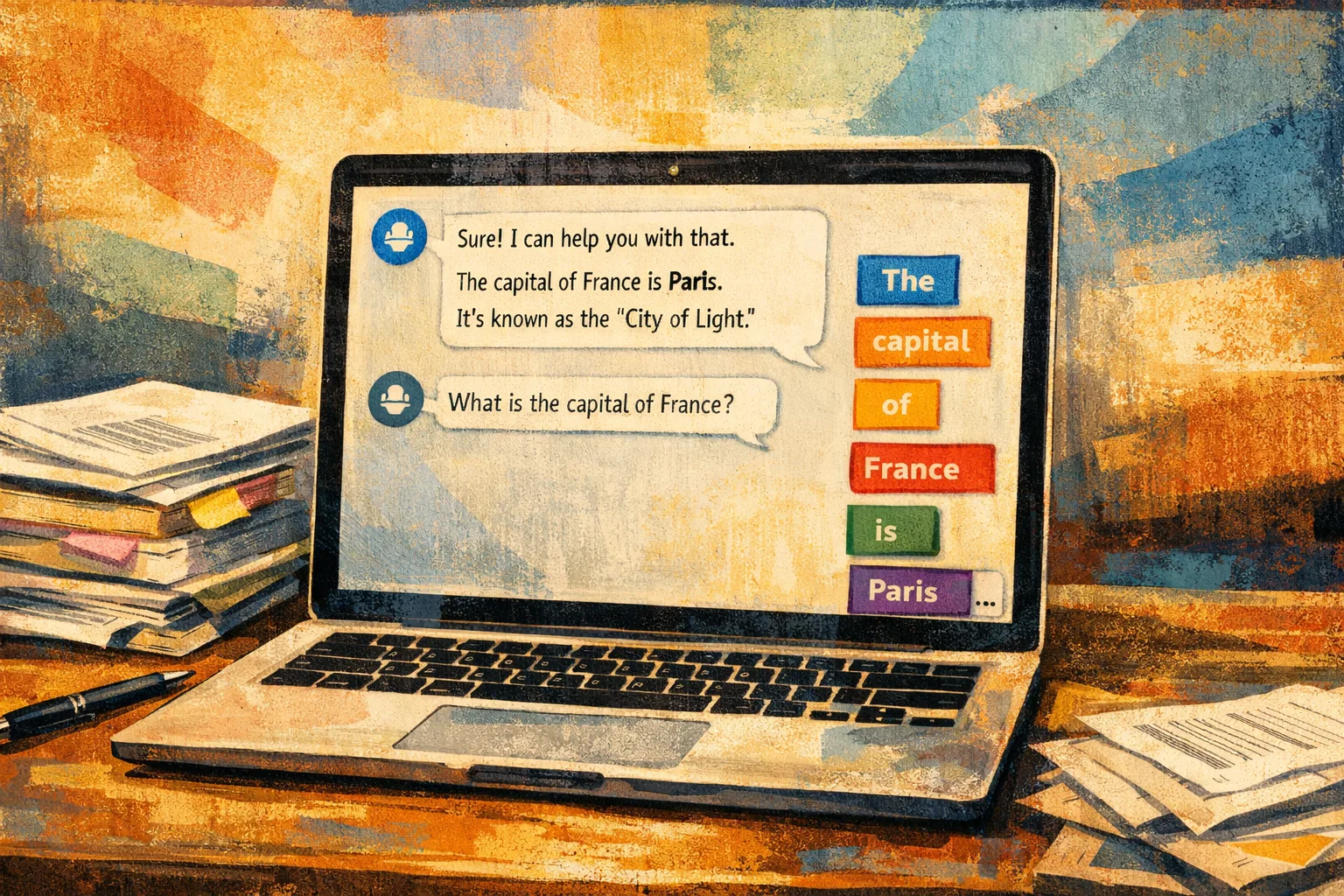
This repeated prediction is why a model can produce a paragraph rather than a single word. Each new token becomes part of the context for the next prediction. A chatbot answer is therefore not retrieved as one finished block from a database; it is assembled step by step as the model repeatedly extends the text.
The 2017 Transformer paper, “Attention Is All You Need”, is a key technical milestone because it introduced an architecture based on attention mechanisms rather than recurrent or convolutional sequence models. The paper argued that this design was more parallelisable and achieved strong results in machine translation, making it easier to train large sequence models efficiently.[arXiv]arxiv.orgOpen source on arxiv.org.
Attention is important because it lets the model weigh relationships among tokens across a context. In a prompt such as “The capital of France is”, nearby words matter, but so does the broader pattern learned from many similar texts. In longer prompts, attention helps the model connect a question, a quoted document, an instruction, and a requested output format. This does not mean the model understands the world as a person does. It means the model has a powerful way to use patterns in the current context when estimating what text should come next.

Why such a simple objective becomes powerful
Next-token prediction looks almost trivial when reduced to a classroom example such as “Mary had a little…”. Yet it becomes powerful because real text contains traces of many human activities. To predict the next token in books, code repositories, websites, legal documents, tutorials, forum posts, and scientific abstracts, a model must learn patterns in grammar, style, facts, dialogue, argument, formatting, and task structure. CSET’s explainer gives a useful example: a sentence such as “The actress that played Rose in the 1997 film Titanic is named…” turns next-word prediction into a question-answering task because the likely continuation is the answer.[CSET]cset.georgetown.eduOpen source on georgetown.edu.
This is the bridge from autocomplete to chatbot. A prompt is not just a request; it is part of the text the model is continuing. If the prompt contains a question, the continuation may look like an answer. If it contains examples of translation, the continuation may follow the translation pattern. If it contains a style guide, the continuation may imitate that style.
The GPT-3 paper, “Language Models are Few-Shot Learners”, made this idea highly visible in 2020. The researchers described GPT-3 as an autoregressive language model with 175 billion parameters and showed that it could perform many tasks from instructions or a few demonstrations in the prompt, without task-specific gradient updates.[arXiv]arxiv.orgarXiv Language Models are Few-Shot LearnersarXiv Language Models are Few-Shot Learners
That finding helped popularise the idea of in-context learning. In plain terms, the model can use the prompt itself as temporary guidance. A user can give three examples of a pattern and ask the model to continue with a fourth. The model has not permanently learned a new skill from that prompt, but it can often infer the requested pattern well enough to continue it.
This is why prompting can feel like programming in ordinary language. A user might write:
“Classify each message as urgent or not urgent.
Message: ‘The server is down.’ Label: urgent
Message: ‘Can we reschedule lunch?’ Label: not urgent
Message: ‘Customers cannot log in.’ Label:”
A next-token model can continue with “urgent” because the prompt sets up a pattern. The mechanism is still token prediction, but the behaviour looks like classification.
Few-shot prompting and learned patterns
Few-shot prompting works because the prompt supplies a miniature task environment. It tells the model what kind of continuation is expected, which labels or format to use, and what examples count as successful completions. The model uses the current context, plus patterns learned during training, to generate the next token sequence.
This is not the same as human learning from a lesson. The model’s underlying weights usually do not change during an ordinary chat. Instead, the prompt steers the model’s existing capability. If the examples are clear, the model may follow them well. If they are ambiguous, inconsistent, or too unlike patterns seen in training, the model may drift.
Few-shot prompting is especially useful for tasks where the desired output format matters. A language model may already have broad knowledge of summaries, tables, emails, code comments, and question-answer pairs. A few examples can narrow the space of likely continuations. The model is not just answering “what is true?” It is also answering, implicitly, “what kind of text comes next in this situation?”
This helps explain why small wording changes can matter. A prompt that says “give a cautious answer and cite uncertainty” may produce a different continuation from one that says “answer directly and do not hedge”. Both prompts alter the statistical path the model follows. That makes language models flexible, but also brittle: the same underlying system can behave differently depending on framing, examples, order, and context length.
Modern interpretability work suggests the internal story is not always as shallow as “one token at a time” sounds. Anthropic’s 2025 research on tracing language-model computations reported evidence that Claude could sometimes plan words ahead, such as anticipating rhymes while writing poetry, even though it outputs text one word at a time. The same research also stressed that developers still do not understand most of the computations models perform for each word they write.[Anthropic]anthropic.comTracing the thoughts of a large language model \ AnthropicTracing the thoughts of a large language model \ Anthropic
The practical takeaway is balanced. It is too dismissive to say a chatbot is “only autocomplete” if that implies there is no rich internal processing. It is also too generous to treat fluent output as proof of grounded understanding. Next-token prediction can support surprisingly complex behaviour, while still leaving the model vulnerable to confident mistakes.
Why confident language can mislead
The same mechanism that makes chatbots fluent can make them dangerously persuasive. A model learns how correct answers sound, but it also learns how unsupported answers, formal explanations, academic citations, and confident claims sound. When it lacks a reliable basis for a fact, it may still generate a plausible continuation because the training and evaluation setup often rewards giving an answer.
OpenAI’s 2025 discussion of hallucinations defines them as plausible but false statements generated by language models, and argues that standard training and evaluation procedures can reward guessing over acknowledging uncertainty. The article gives a simple incentive problem: if a benchmark rewards only exact accuracy, a model may score better by guessing than by saying it does not know.[OpenAI]OpenAIOpen AIWhy language models hallucinate | Open AIOpen AIWhy language models hallucinate | Open AI
A 2026 Nature paper by Adam Tauman Kalai and colleagues makes a similar point in research terms. It argues that next-word pretraining can create statistical pressure towards hallucination for facts with little repeated support in training data, while accuracy-based evaluations can further reward unwarranted guessing. The paper distinguishes recurring regularities, such as grammar, from one-off details, which are harder for a model to learn reliably from text alone.[Nature]nature.comOpen source on nature.com.
This distinction explains a common user experience. A chatbot may be excellent at writing a polite complaint email, explaining a common programming concept, or summarising a well-known idea. Those tasks rely heavily on repeated patterns. But the same chatbot may invent a book title, misstate a niche legal provision, fabricate a citation, or give an outdated answer about a recent event. The language remains smooth because fluency is not the same skill as source verification.
Hallucination is not a rare curiosity at the edge of the system. HaluEval, a benchmark introduced in 2023, was designed to evaluate hallucination in large language models and reported that ChatGPT-generated responses in its setting included hallucinated content in specific topics, including fabricated unverifiable information. The benchmark also found that external knowledge and reasoning steps could help models recognise hallucinations, but did not make the problem disappear.[arXiv]arxiv.orgOpen source on arxiv.org.
For ordinary readers, the important warning is simple: confident wording is a style cue, not a truth guarantee. A model can produce “According to a 2021 study…” because that phrase often appears before credible claims. Unless the system is grounded in reliable retrieval, tool use, or verifiable sources, the citation-like shape of a sentence does not prove the cited thing exists.
What the mechanism explains about everyday chatbot use
Next-token prediction explains several everyday features of language-model behaviour that can otherwise seem mysterious.
A chatbot can change style quickly because style is part of the continuation. Ask for a formal memo, a friendly explanation, or a terse bullet list, and the prompt changes the likely next tokens. The model does not need a separate “formal memo module”; it has learned patterns of formal memos and can continue in that register.
It can follow examples because examples constrain the pattern. A few labelled cases in the prompt can be enough to make the next continuation fit the same format. This is the mechanism behind many lightweight uses of few-shot prompting.
It may contradict itself because each answer is generated in context rather than read from a stable fact table. If the prompt changes, if the model samples differently, or if the question concerns weakly represented information, the continuation may change too. This is especially visible when users ask for exact dates, obscure names, quotations, or sources.
It may be sensitive to irrelevant wording because the model is using the whole prompt as context. A misleading hint, a loaded assumption, or a requested persona can shift the distribution of likely continuations. Anthropic’s interpretability work reported cases where a model could produce plausible-sounding reasoning designed to agree with an incorrect user hint rather than reflect the actual logical path.[Anthropic]anthropic.comTracing the thoughts of a large language model \ AnthropicTracing the thoughts of a large language model \ Anthropic
It can also appear to reason. Some reasoning-like behaviour can emerge because training data contains worked examples, explanations, proofs, code, debates, and corrections. When prompted to solve a problem step by step, the model may generate a sequence that resembles reasoning and sometimes supports accurate answers. But the generated explanation is still text produced by the model, not guaranteed access to a transparent internal chain of cause and effect.
The useful mental model
The best everyday mental model is not “a chatbot is a database” or “a chatbot is a person”. It is a large pattern-learning system that generates text by predicting continuations. It has absorbed vast regularities from language and can recombine them in useful ways. That makes it valuable for drafting, summarising, brainstorming, translating, coding assistance, and explaining common concepts. It also means the user must treat factual claims as claims to be checked, not as automatically verified knowledge.
A language model’s fluency comes from training on immense amounts of text and learning the patterns that make one token likely after another. Its usefulness comes from the fact that many tasks can be expressed as text continuations. Its risk comes from the same source: plausible continuation is not identical to truth, evidence, judgement, or accountability.
Understanding that mechanism changes how to use chatbots well. Give clear context. Provide examples when format matters. Ask for uncertainty when facts are hard to verify. Check citations and high-stakes claims. Use models as powerful language engines, not as infallible authorities.
Amazon book picks
Further Reading
Books and field guides related to Why Chatbots Sound So Fluent. Use these as the next step if you want deeper reading beyond the article.
Hands-On Large Language Models
Directly addresses language-model mechanics and capabilities.
Artificial Intelligence
Helps readers understand why fluent AI can still make mistakes.
eBay marketplace picks
Marketplace Samples
Example marketplace items related to this page. Use the search link to explore similar finds on eBay.

Endnotes
1.
Source: cset.georgetown.edu
Link:https://cset.georgetown.edu/article/the-surprising-power-of-next-word-prediction-large-language-models-explained-part-1/
2.
Source: OpenAI
Title: Open AIWhy language models hallucinate | Open AI
Link:https://openai.com/index/why-language-models-hallucinate/
3.
Source: nature.com
Link:https://www.nature.com/articles/s41586-026-10549-w
4.
Source: platform.openai.com
Link:https://platform.openai.com/tokenizer
5.
Source: learn.microsoft.com
Title: Learn Understanding tokens
Link:https://learn.microsoft.com/en-us/dotnet/ai/conceptual/understanding-tokens
6.
Source: arxiv.org
Link:https://arxiv.org/abs/1706.03762
7.
Source: arxiv.org
Title: arXiv Language Models are Few-Shot Learners
Link:https://arxiv.org/abs/2005.14165
8.
Source: anthropic.com
Title: Tracing the thoughts of a large language model \ Anthropic
Link:https://www.anthropic.com/research/tracing-thoughts-language-model
9.
Source: arxiv.org
Link:https://arxiv.org/abs/2305.11747
10.
Source: OpenAI
Link:https://openai.com/
11.
Source: arxiv.org
Link:https://arxiv.org/abs/2403.08081
12.
Source: arxiv.org
Link:https://arxiv.org/html/2212.11281v2
13.
Source: arxiv.org
Link:https://arxiv.org/html/2510.06265v2
14.
Source: anthropic.com
Title: effective context engineering for ai agents
Link:https://www.anthropic.com/engineering/effective-context-engineering-for-ai-agents
15.
Source: nature.com
Link:https://www.nature.com/articles/s41586-025-10041-x
16.
Source: nature.com
Link:https://www.nature.com/articles/s44277-026-00064-1
17.
Source: about.google
Link:https://about.google/
18.
Source: youtube.com
Link:https://www.youtube.com/%40OpenAI
19.
Source: linkedin.com
Link:https://www.linkedin.com/company/openai
20.
Source: linkedin.com
Link:https://www.linkedin.com/posts/davidchivers_ai-llm-aiagents-activity-7379511158652928000-ab_l
21.
Source: Wikipedia
Title: Attention Is All You Need
Link:https://en.wikipedia.org/wiki/Attention_Is_All_You_Need
22.
Source: Wikipedia
Title: Open AI
Link:https://en.wikipedia.org/wiki/OpenAI
23.
Source: angulararchitects.io
Link:https://www.angulararchitects.io/blog/ai-next-gen-model/
Additional References
24.
Source: youtube.com
Title: But what is a GPT? Visual intro to transformers | Chapter 5, [Deep Learning]({{ ‘deep-learning/’ | relative_url }})
Link:https://www.youtube.com/watch?v=wjZofJX0v4M
Source snippet
LLMs Are Classifiers: How Language Models Predict the Next Token - YouTube LLMs Are Classifiers: How Language Models Predict the Next Tok...
25.
Source: youtube.com
Title: LLM Fine-Tuning Foundations: How Language Models Predict the Next Token
Link:https://www.youtube.com/watch?v=5OoDzSSkymk
Source snippet
What is Next Token Prediction? | Module 10 Ep 1...
26.
Source: youtube.com
Title: What is Next Token Prediction? | Module 10 Ep 1
Link:https://www.youtube.com/watch?v=Wd7Csj27Gzc
Source snippet
But what is a GPT? Visual intro to transformers | Chapter 5, Deep Learning...
27.
Source: youtube.com
Title: LLMs Are Classifiers: How Language Models Predict the Next Token
Link:https://www.youtube.com/watch?v=bKdc5O54GiM
Source snippet
Why LLMs Learn by Guessing the Next Token...
28.
Source: youtube.com
Title: Why LLMs Learn by Guessing the Next Token
Link:https://www.youtube.com/watch?v=qOsXvc7RTCQ
Source snippet
LLM Fine-Tuning Foundations: How Language Models Predict the Next Token...
29.
Source: researchgate.net
Link:https://www.researchgate.net/publication/341724146_Language_Models_are_Few-Shot_Learners
30.
Source: traceloop.com
Link:https://www.traceloop.com/blog/a-comprehensive-guide-to-tokenizing-text-for-llms
31.
Source: linkedin.com
Link:https://www.linkedin.com/pulse/accelerating-language-models-multi-token-prediction-himank-jain-qhudf
32.
Source: reddit.com
Link:https://www.reddit.com/r/ArtificialInteligence/comments/1jo3o69/are_llms_just_predicting_the_next_token/
33.
Source: medium.com
Link:https://medium.com/data-science-collective/attention-is-all-you-need-661cb8db5f21
Topic Tree
Follow this branch
Parent topic
AI SenseRelated pages 11
- AI Errors Why AI Can Be Confidently Wrong
- AI Outputs What Counts as AI Today?
- Business Adoption Why AI Pilots Often Stall
- Deep Learning Why Layers Changed AI
- Generative AI Why Generative AI Feels Different
- Machine Learning How Machines Learn From Examples
- Narrow vs AGI Is Today’s AI Actually General?
- Responsible AI Who Is Responsible When AI Fails?
- +3 more in sidebar