Within Spam filters
Why your spam clicks help the filter learn
When people mark spam or rescue good mail, those labels help filters notice new tricks and adjust to changing attacks.
On this page
- How spam reports become fresh labelled data
- Why changing scams require updated examples
- Where feedback improves and where it can mislead
Page outline Jump by section
Introduction
Spam filters are a useful example of why artificial intelligence often learns from examples rather than relying on fixed rules. Even a well-trained filter becomes less effective if its training data stops changing while spammers continue inventing new tricks. User feedback helps solve this problem. Every time someone marks a message as spam or rescues a legitimate message from the spam folder, they create a new labelled example. Those labels give filtering systems fresh evidence about what people currently consider unwanted or acceptable email. Large email providers explicitly use user feedback as part of their machine-learning systems, allowing filters to adapt as spam campaigns, phishing tactics, and marketing practices evolve.[Google Workspace]workspace.google.comWorkspace An overview of Gmail's spam filtersGoogle WorkspaceAn overview of Gmail's spam filtersMay 28, 2022 — How do Gmail spam filters work? Machine learning powered by user feedba…

How spam reports become fresh labelled data
A machine-learning spam filter needs examples of both spam and legitimate messages. User actions provide a continuous stream of those examples.
When a user clicks “Report spam”, the system gains a message that has been labelled as unwanted by a human. When a user clicks “Not spam” on a message that was incorrectly filtered, the system gains a labelled example in the opposite direction. Gmail states that machine learning uses user feedback and user input as part of its spam-filtering process, and that marking incorrectly classified messages as “Not spam” helps the system better understand preferences and recognise spam more accurately.[Google Workspace]workspace.google.comWorkspace An overview of Gmail's spam filtersGoogle WorkspaceAn overview of Gmail's spam filtersMay 28, 2022 — How do Gmail spam filters work? Machine learning powered by user feedba…
In practice, providers rarely treat a single report as absolute proof. Instead, they aggregate signals from many users. A single complaint might reflect an individual preference, but thousands of similar complaints can indicate that a new spam campaign is spreading.
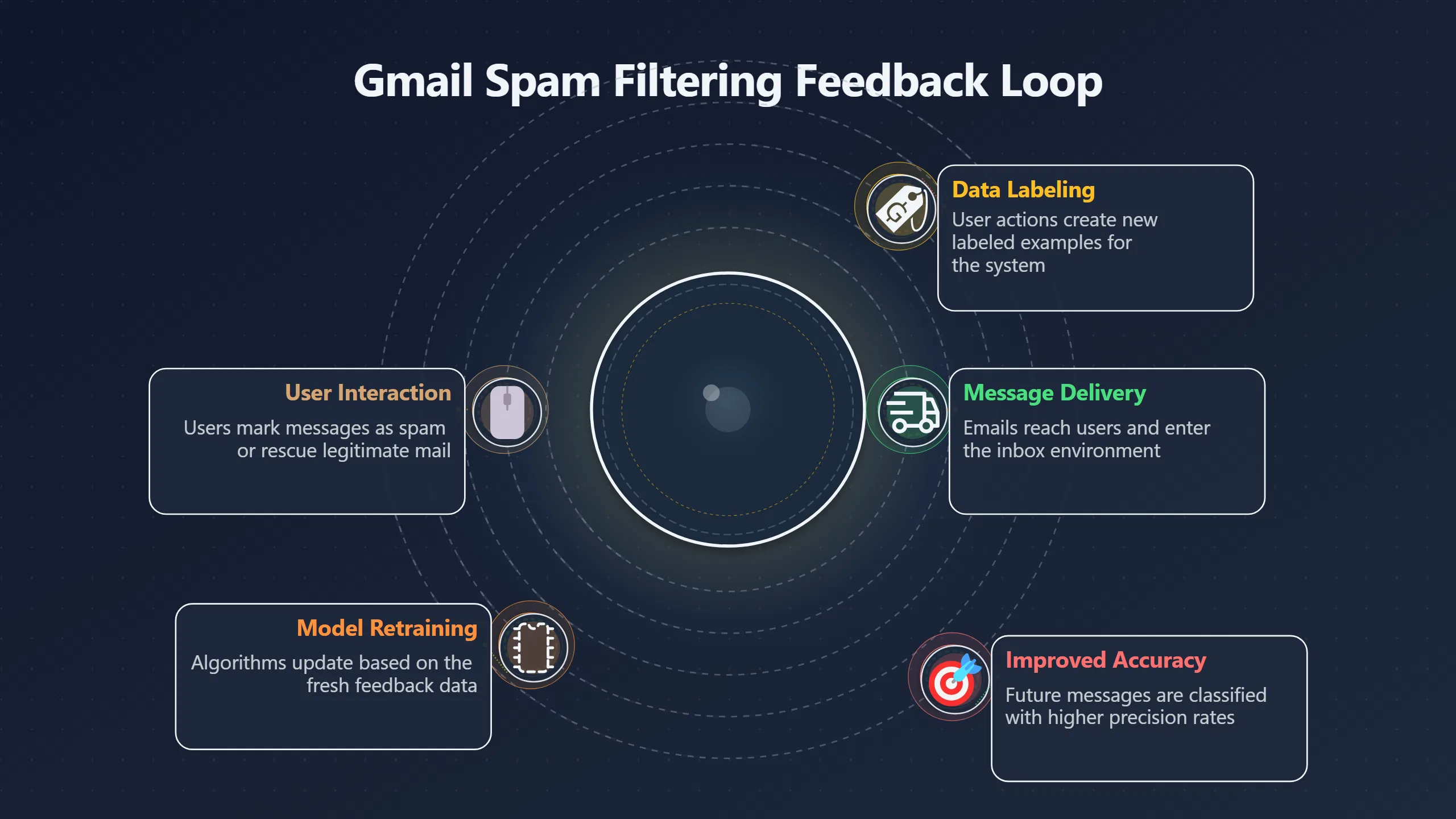
The feedback process typically works as a cycle:
- A message reaches users.
- Some users report it as spam or rescue it from spam.
- The reports become new labelled examples.
- Models are retrained or updated using the new data.
- Future messages with similar patterns become easier to classify.
This continual flow of examples helps the filter keep pace with changing behaviour rather than depending entirely on historical training data. Google Workspace+2Harvard Business School AI Institute[workspace.google.com]workspace.google.comWorkspace An overview of Gmail's spam filtersGoogle WorkspaceAn overview of Gmail's spam filtersMay 28, 2022 — How do Gmail spam filters work? Machine learning powered by user feedba…
Why changing scams require updated examples
Spam is not a fixed category. Attackers constantly alter wording, formatting, links, domains, and delivery methods to avoid detection.
A rule-based filter may block a phrase today, only for attackers to replace it tomorrow with a slightly altered version. Machine-learning systems are more resilient because they can learn broader patterns, but they still require recent examples to recognise emerging tactics. Research on email spam filtering consistently describes this as a continuing “cat-and-mouse” struggle between spammers and defenders.[arXiv]arxiv.orgarXiv Machine Learning for E-mail Spam Filtering: Review,Techniques and TrendsarXiv Machine Learning for E-mail Spam Filtering: Review,Techniques and Trends
User feedback is especially valuable when entirely new campaigns appear. Consider a phishing campaign that uses unfamiliar wording, newly registered websites, or novel formatting. The filter may initially have little evidence about it. Once users begin reporting those messages, the system can connect the reports to common characteristics and adjust its future predictions.
Google has explained that Gmail’s spam filtering uses machine learning powered by user feedback, combining user input with signals such as sender reputation, domains, and authentication data. This combination allows the system to adapt when attackers shift tactics.[Google Workspace]workspace.google.comWorkspace An overview of Gmail's spam filtersGoogle WorkspaceAn overview of Gmail's spam filtersMay 28, 2022 — How do Gmail spam filters work? Machine learning powered by user feedba…
A useful way to think about the process is that user feedback keeps the training dataset current. Without new labels, the model would gradually become a historical snapshot of yesterday’s spam rather than a defence against today’s attacks.
Why “Not spam” clicks matter as much as spam reports
Many people assume the important feedback is reporting junk mail. In reality, correcting mistakes is equally valuable.
Spam filters must balance two competing goals:
- Catch as much spam as possible.
- Avoid hiding legitimate messages.
The second goal is often harder than it appears. An aggressive filter can block more unwanted mail, but it can also hide important messages from employers, banks, schools, charities, or friends.
When users rescue a message from the spam folder, they provide evidence that the filter made a false positive error. Google notes that manually marking messages as “Not spam” helps Gmail learn and improve future decisions.[Google Workspace Help]knowledge.workspace.google.comGmail uses machine learning to better understand your preferences, and to recognize spam. When you manually…Read more…
This feedback helps the system recognise situations where apparent spam signals are actually associated with legitimate communication. Over time, the model learns a more accurate boundary between wanted and unwanted messages.
One person’s spam is another person’s wanted mail
A challenge for spam filtering is that preferences differ between users.
Some people welcome promotional offers, newsletters, or fundraising emails. Others regard the same messages as unwanted. Google has highlighted this problem directly, noting that what counts as spam can vary between individuals.[Google Workspace]workspace.google.comridding gmail of 100 million more spam messages with tensorflowGoogle WorkspaceSpam does not bring us joy—ridding Gmail of 100 million…7 Feb 2019 — TensorFlow helps us catch the spammers who slip t…
Because of this variation, modern filtering systems often use feedback at multiple levels:
- Personal signals help tailor filtering for individual users.
- Aggregate signals help identify widespread spam campaigns.
- Sender reputation signals track whether many recipients consistently complain about a sender.
This layered approach allows the system to learn both broad patterns and user-specific preferences. A marketing email that one user repeatedly marks as spam may be filtered more aggressively for that user without necessarily being blocked for everyone.
Where feedback improves the filter and where it can mislead
User feedback is powerful, but it is not perfect.
How feedback improves performance
Large-scale feedback offers several advantages:
- It provides recent examples of new attacks.
- It captures real-world user preferences.
- It identifies mistakes made by the filter.
- It helps detect patterns that developers did not anticipate.
Because millions of users interact with email every day, providers can gather a huge volume of labelled examples that would be difficult to create manually. This constant supply of data is one reason machine-learning filters can adapt more effectively than systems based only on hand-written rules. Google Workspace+2Harvard Business School AI Institute[workspace.google.com]workspace.google.comWorkspace An overview of Gmail's spam filtersGoogle WorkspaceAn overview of Gmail's spam filtersMay 28, 2022 — How do Gmail spam filters work? Machine learning powered by user feedba…

How feedback can be noisy
Human feedback can also be unreliable.
Users sometimes report legitimate marketing emails as spam simply because they no longer want them. Others fail to report genuine phishing attempts. Some users rarely interact with spam controls at all.
There is also the possibility of coordinated or biased reporting. If enough people deliberately mislabel messages, the feedback signal can become distorted. For that reason, providers generally combine user reports with many other indicators, such as sender reputation, authentication records, message content, delivery patterns, and behavioural signals.[Google Workspace]workspace.google.comWorkspace An overview of Gmail's spam filtersGoogle WorkspaceAn overview of Gmail's spam filtersMay 28, 2022 — How do Gmail spam filters work? Machine learning powered by user feedba…
The goal is not to trust every click blindly but to treat feedback as one important source of evidence among many.
Why user feedback is central to learning-based spam filtering
The key lesson is that a spam filter is not a static piece of software. It is a learning system that depends on a steady flow of new examples.
User reports supply those examples. Marking a message as spam adds evidence about emerging threats. Marking a message as “Not spam” helps correct mistakes and reduce false positives. Together, these actions create a continuously updated dataset that allows machine-learning models to track changing behaviour, adapt to new scams, and remain useful long after their original training. In a world where attackers constantly change tactics, user feedback is one of the main mechanisms that keeps spam filters current rather than frozen in the past.[WIRED+3Google Workspace+3Google Workspace Help]workspace.google.comWorkspace An overview of Gmail's spam filtersGoogle WorkspaceAn overview of Gmail's spam filtersMay 28, 2022 — How do Gmail spam filters work? Machine learning powered by user feedba…
Amazon book picks
Further Reading
Books and field guides related to Why your spam clicks help the filter learn. Use these as the next step if you want deeper reading beyond the article.
Data Science for Business
Illustrates feedback loops and learning from user behaviour.
Hands-on Machine Learning with Scikit-Learn, Keras, and Tenso...
Explains how new labelled data improves model performance.
The Hundred-page Machine Learning Book
Introduces supervised learning and retraining concepts.
Machine Learning for Absolute Beginners
Explains how examples teach machine-learning systems.
eBay marketplace picks
Marketplace Samples
Example marketplace items related to this page. Use the search link to explore similar finds on eBay.



Endnotes
1.
Source: workspace.google.com
Title: Workspace An overview of Gmail’s spam filters
Link:https://workspace.google.com/blog/identity-and-security/an-overview-of-gmails-spam-filters
Source snippet
Google WorkspaceAn overview of Gmail's spam filtersMay 28, 2022 — How do Gmail spam filters work? Machine learning powered by user feedba...
Published: May 28, 2022
2.
Source: knowledge.workspace.google.com
Link:https://knowledge.workspace.google.com/admin/support/troubleshooting/gmail-marks-valid-email-messages-as-spam
Source snippet
Gmail uses machine learning to better understand your preferences, and to recognize spam. When you manually...Read more...
3.
Source: d3.harvard.edu
Link:https://d3.harvard.edu/platform-digit/submission/gmail-ensuring-a-spam-free-inbox-with-machine-learning/
Source snippet
Harvard [Business]({{ 'business-adoption/' | relative_url }}) School AI InstituteGmail: ensuring a spam-free inbox with Machine Learning21 Nov 2015 — If an email is deemed “not spam”...
4.
Source: arxiv.org
Title: arXiv Machine Learning for E-mail Spam Filtering: Review,Techniques and Trends
Link:https://arxiv.org/abs/1606.01042
5.
Source: wired.com
Title: google says ai catches 99 9 percent gmail spam
Link:https://www.wired.com/2015/07/google-says-ai-catches-99-9-percent-gmail-spam/
Source snippet
Google Says Its AI Catches 99.9 Percent of Gmail SpamJul 9, 2015 — Gmail's spam filters don't just curb junk by applying pre-existing rul...
6.
Source: workspace.google.com
Title: ridding gmail of 100 million more spam messages with tensorflow
Link:https://workspace.google.com/blog/product-announcements/ridding-gmail-of-100-million-more-spam-messages-with-tensorflow
Source snippet
Google WorkspaceSpam does not bring us joy—ridding Gmail of 100 million...7 Feb 2019 — TensorFlow helps us catch the spammers who slip t...
7.
Source: play.google.com
Link:https://play.google.com/store/apps/details?hl=en_US&id=com.google.android.gm
Source snippet
Apps on Google PlayThe official Gmail app brings the best of Gmail to your Android phone or tablet with enhanced security protections, mu...
8.
Source: support.google.com
Link:https://support.google.com/mail/answer/8494?co=GENIE.Platform%3DDesktop&hl=en
Source snippet
in to Gmail - ComputerTo open Gmail, you can sign in from a computer or add your account to the Gmail app on your phone or tablet.Read more...
Additional References
9.
Source: medium.com
Link:https://medium.com/%40saniamishra85/spam-email-detection-using-machine-learning-32617c372cdc
Source snippet
Spam Email Detection Using Machine LearningSpam Email Detection Using Machine Learning · Growing Email Volume: With billions of emails se...
10.
Source: github.com
Link:https://github.com/Apaulgithub/oibsip_taskno4
11.
Source: researchgate.net
Link:https://www.researchgate.net/publication/369462107_Email_Spam_Filtering_Methods_Comparison_and_Analysis
12.
Source: microsoft.com
Title: Shop Microsoft 365, Copilot, Teams, Xbox, Windows, Azure, Surface and more
Link:https://www.microsoft.com/en-gb
Source snippet
AI, Cloud, Productivity, Computing, Gaming & AppsExplore Microsoft products and services and support for your home or business...
13.
Source: youtube.com
Link:https://www.youtube.com/microsoft
14.
Source: stackoverflow.com
Title: Publicly Available Spam Filter Training Set [closed]Closed
Link:https://stackoverflow.com/questions/4743996/publicly-available-spam-filter-training-set
Source snippet
This question is seeking recommendations for software libraries, tutorials, tools, books, or other off-site resources. It does not meet S...
15.
Source: dev.to
Link:https://dev.to/synergistdigitalmedia/gmails-2025-spam-filter-doesnt-care-about-your-feelings-a-deliverability-reality-check-1l7k
Source snippet
Gmail's 2025 Spam Filter Doesn't Care About Your FeelingsNov 22, 2025 — Gmail's 2025 algorithm tracks [engagement]({{ 'engagement-goals/' | relative_url }}) with disturbing precision...
16.
Source: youtube.com
Title: What Actually Happens When You Hit “Send”? (Gmail Architecture Explained)
Link:https://www.youtube.com/watch?v=GEH6d589lg8
Source snippet
Definition of Machine Learning (Experience, Task, and Performance) - YouTube Definition of Machine Learning (Experience, Task, and Perfor...
17.
Source: medium.com
Link:https://medium.com/%40bobbyjimenez/catching-recipients-in-a-bad-mood-how-gmails-user-feedback-feeds-its-ai-to-detect-emails-as-spam-865b389cc0af
Source snippet
erves as a robust defense against spam, phishing, and malware.Read more...
18.
Source: office.com
Link:https://www.office.com/
Source snippet
and PowerPoint, plus services like OneDrive, Teams, Outlook, and the...
Topic Tree