Within Forecasting gap
Why one chatbot forecast is not enough
A single chatbot prediction can sound polished while hiding weak calibration, missing caveats, and unstable probability judgment.
On this page
- How fluency can mask uncertainty
- Where probability estimates go wrong
- Simple checks before trusting a forecast
Page outline Jump by section
Introduction
Forecasting is one of the clearest ways to expose a weakness that ordinary chatbot conversations often hide: a system can sound highly confident even when it is uncertain. When a chatbot predicts the future, there is no answer available to look up, memorise, or reconstruct from training data. The model must judge incomplete evidence and express uncertainty. In practice, single-chatbot forecasts often become overconfident because the system is designed to produce coherent answers, while accurate probability estimation is a much harder skill. Research on forecasting, calibration, and uncertainty estimation repeatedly finds that language models can generate plausible predictions while overstating how certain they should be.[arXiv+2OpenReview]arxiv.orgarXiv A Dynamic Benchmark of AI Forecasting CapabilitiesA Dynamic Benchmark of AI Forecasting CapabilitiesSeptember 30, 2024 — by E Karger · 2024 · Cited by 57 — To address this gap, we in…
 This matters because decision-makers usually need probabilities rather than persuasive narratives. A forecast that sounds decisive but is poorly calibrated can encourage misplaced trust, especially when users interpret fluency as expertise.
How fluency can mask uncertainty
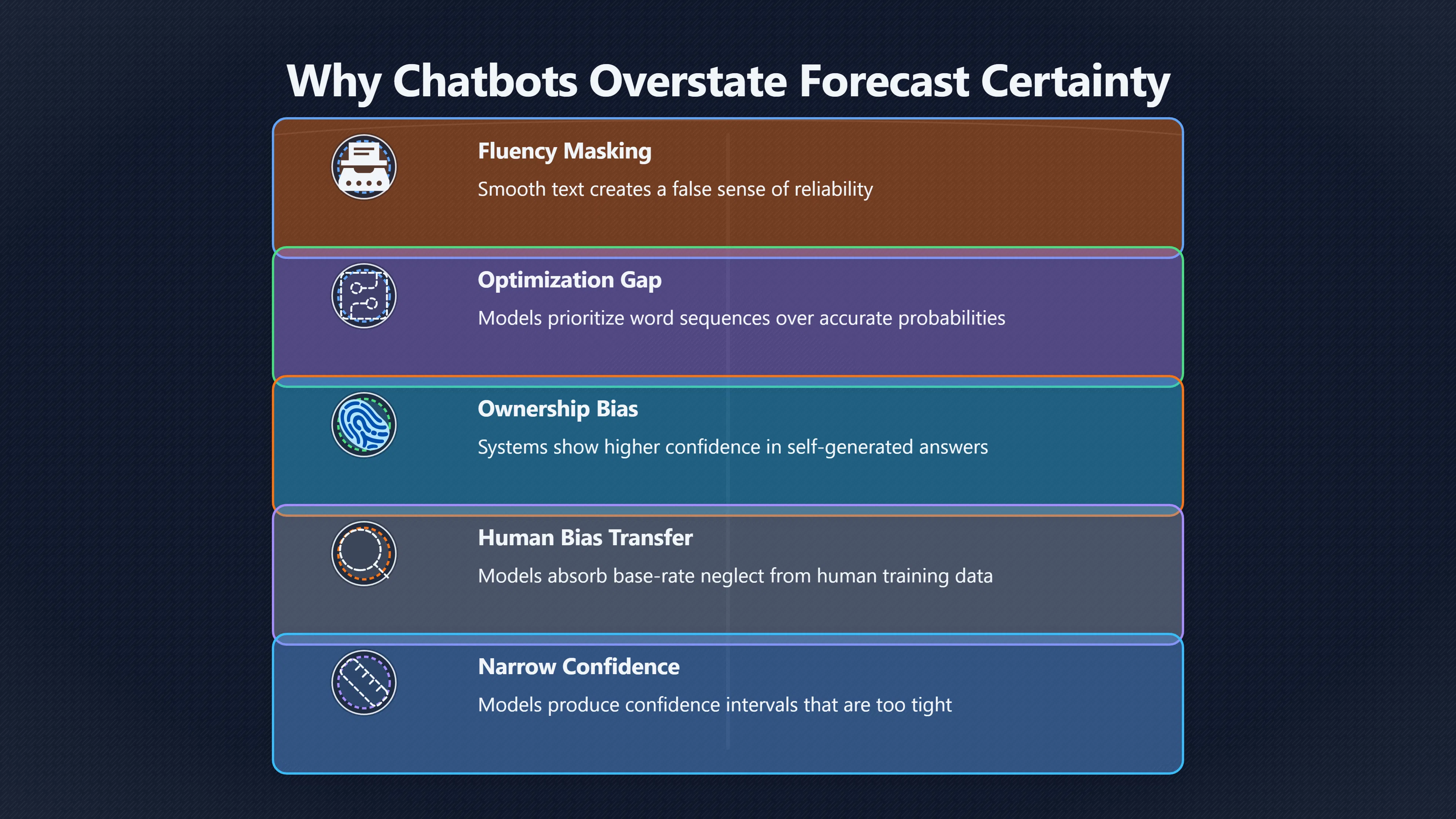
The most visible source of overconfidence is the gap between linguistic quality and forecasting quality.
Modern chatbots are trained to produce smooth, coherent text. A forecast delivered in complete sentences with supporting reasons feels more reliable than a hesitant or fragmented answer. Yet forecasting accuracy and writing quality are separate abilities. A model can provide a convincing explanation for a prediction while having only weak evidence for the probability attached to it. Researchers studying calibration have repeatedly found that language-model confidence scores are often not well aligned with actual correctness.[MIT Press Direct+2OpenReview]direct.mit.eduMIT Press DirectHow Can We Know When Language Models…by Z Jiang · 2021 · Cited by 634 — In this paper, we ask the question, “How can w…
This creates a psychological trap for users. Humans naturally use confidence as a cue for competence. When a chatbot explains its forecast clearly, readers may infer that the underlying judgement is equally strong. Experiments have shown that people frequently rely on overconfident model outputs even when those outputs do not deserve that level of trust.[OpenReview]openreview.netHumans overrely on overconfident language models…by N Rathi · Cited by 9 — This paper studies LLM overconfidence across mul…
The problem becomes more pronounced in forecasting because future events rarely have a single obvious answer. Economic trends, elections, scientific breakthroughs, and geopolitical developments depend on many interacting factors. A fluent narrative can conceal how many alternative outcomes remain plausible.
Where probability estimates go wrong
The model is optimised for answers, not uncertainty
Language models are fundamentally trained to predict likely sequences of words. That objective helps them generate useful text, but it does not automatically teach them how to estimate the probability that their own conclusions are correct. Researchers have therefore spent considerable effort developing separate calibration methods because raw model confidence often fails to reflect real-world accuracy. Proceedings of Machine Learning Research+2MIT Press Direct[proceedings.mlr.press]proceedings.mlr.pressProceedings of Machine Learning ResearchCalibrated Large Language Models for Binary Question…by P Giovannotti · 2024 · Cited by 4 — We…
In forecasting, this means a chatbot may confidently assign a probability to an event without having a well-calibrated internal representation of uncertainty.
Extreme confidence is often unreliable
Several recent studies have found systematic overconfidence in language models. In one benchmark focused on numerical estimation and confidence intervals, models frequently produced confidence ranges that were far too narrow. Nominal 99% confidence intervals contained the correct answer only about 65% of the time on average, indicating substantial overconfidence.[arXiv]arxiv.orgLLMs are Overconfident: Evaluating Confidence Interval Calibration with FermiEvalOctober 30, 2025…
Other uncertainty benchmarks similarly report that even advanced models become unreliable at the extremes of confidence, precisely where users are most tempted to trust them.[ACL Anthology]aclanthology.orgACL AnthologyBenchmarking Uncertainty in Large Language Models with…July 10, 2025 — by X Wang · 2025 · Cited by 11 — We reveal that ev…
Human biases can carry over into forecasts
Language models learn from human-generated text and therefore absorb many patterns found in human reasoning. Research has shown that they can exhibit familiar judgement biases, including base-rate neglect and representativeness errors.[PMC]pmc.ncbi.nlm.nih.govPMCQuantifying uncert-AI-nty: Testing the accuracy of LLMsby TN Cash · 2025 · Cited by 27 — ChatGPT-3.5, ChatGPT-4, and Bard were susceptible to many of the same cognitive biases as humans, in…
Studies examining confidence directly have found that models often overestimate the likelihood that their answers are correct, sometimes by large margins. One investigation reported overestimation ranging roughly from 20% to 60% across tested tasks.[arXiv]arxiv.orgarXiv Large Language Models are overconfident and amplify human biasLarge Language Models are overconfident and amplify human biasMay 4, 2025…
When these biases are applied to future events, the resulting forecasts can appear more certain than the available evidence justifies.
Chatbots can become attached to their own answers
An especially revealing finding is that conversational systems may become more confident simply because an answer is presented as their own. Recent work describes an “ownership bias” in which models assign higher confidence to identical answers when they generated them themselves than when the same answer is attributed to another source.[arXiv]arxiv.orgarXiv Large Language Models Are Overconfident in Their Own ResponsesLarge Language Models Are Overconfident in Their Own ResponsesJune 2, 2026…
For forecasting, this means a chatbot’s confidence may partly reflect the conversational structure of the interaction rather than the actual strength of the evidence.
Why one forecast is often worse than many
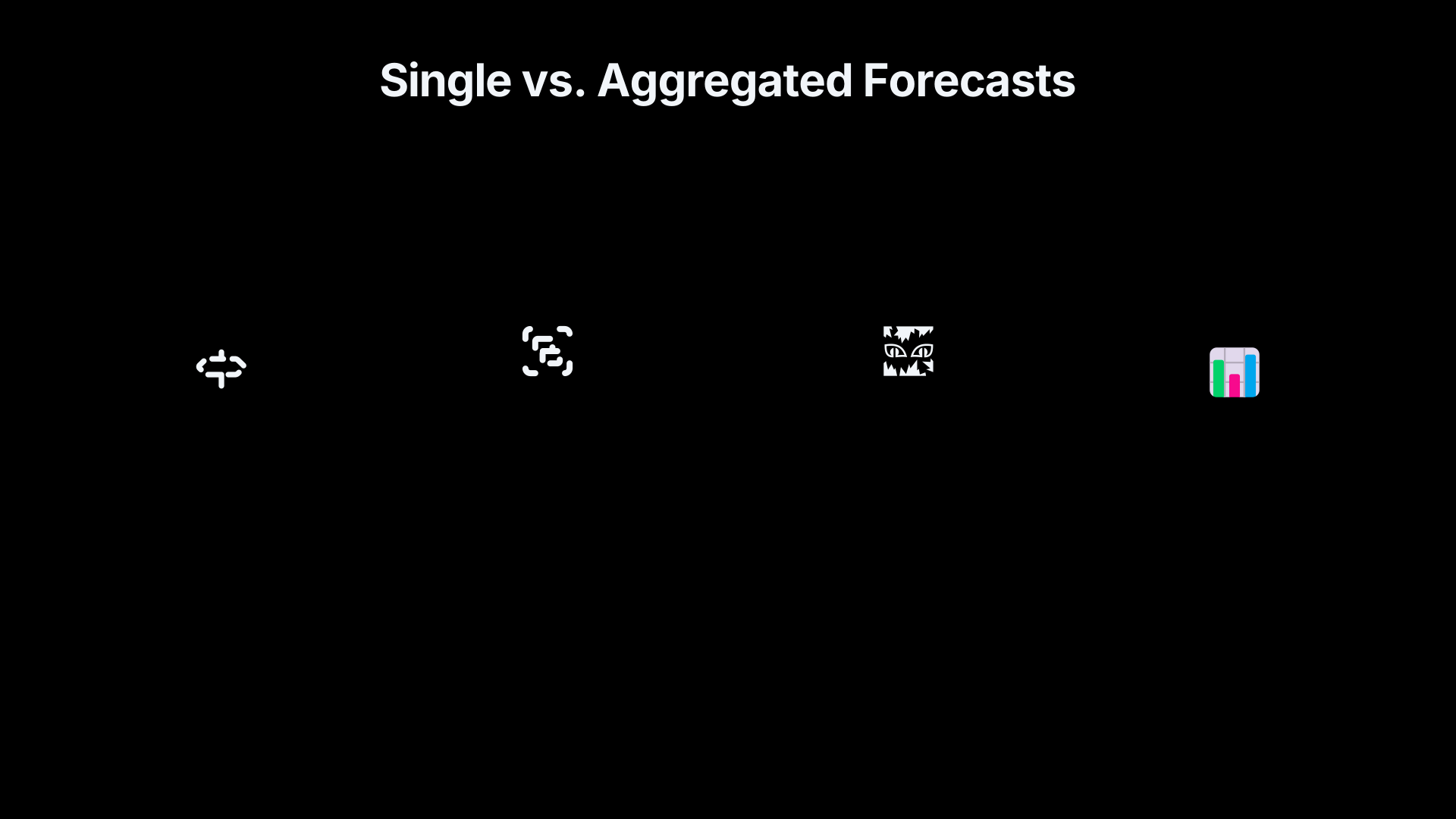
Forecasting research has long shown that combining multiple independent judgements often improves performance. Different forecasters make different mistakes, allowing some errors to cancel out.
The same pattern appears with AI systems. Studies suggest that aggregated forecasts from multiple model runs or multiple models frequently outperform a single forecast. ForecastBench comparisons also show that expert human forecasters outperform the strongest individual language models on many forecasting tasks.[ResearchGate]researchgate.netA Dynamic Benchmark of AI Forecasting CapabilitiesWhile LLMs have achieved super-human performance on many benchmarks, they p…
This helps explain why a single chatbot forecast is risky. One answer represents one path through the model’s reasoning process. Alternative plausible interpretations, assumptions, or evidence may never appear in the final response. Aggregation exposes disagreement and broadens the range of possibilities.[PMC]pmc.ncbi.nlm.nih.govPMCWisdom of the silicon crowd: LLM ensemble predictionby P Schoenegger · 2024 · Cited by 97 — Our findings suggest that LLM predictions can rival the human crowd's forecasting accuracy thr…
A lone forecast can therefore appear more certain than the model’s broader distribution of possible beliefs would suggest.
Simple checks before trusting a forecast
A chatbot forecast is not automatically useless. The key is to treat it as one input rather than a definitive prediction.
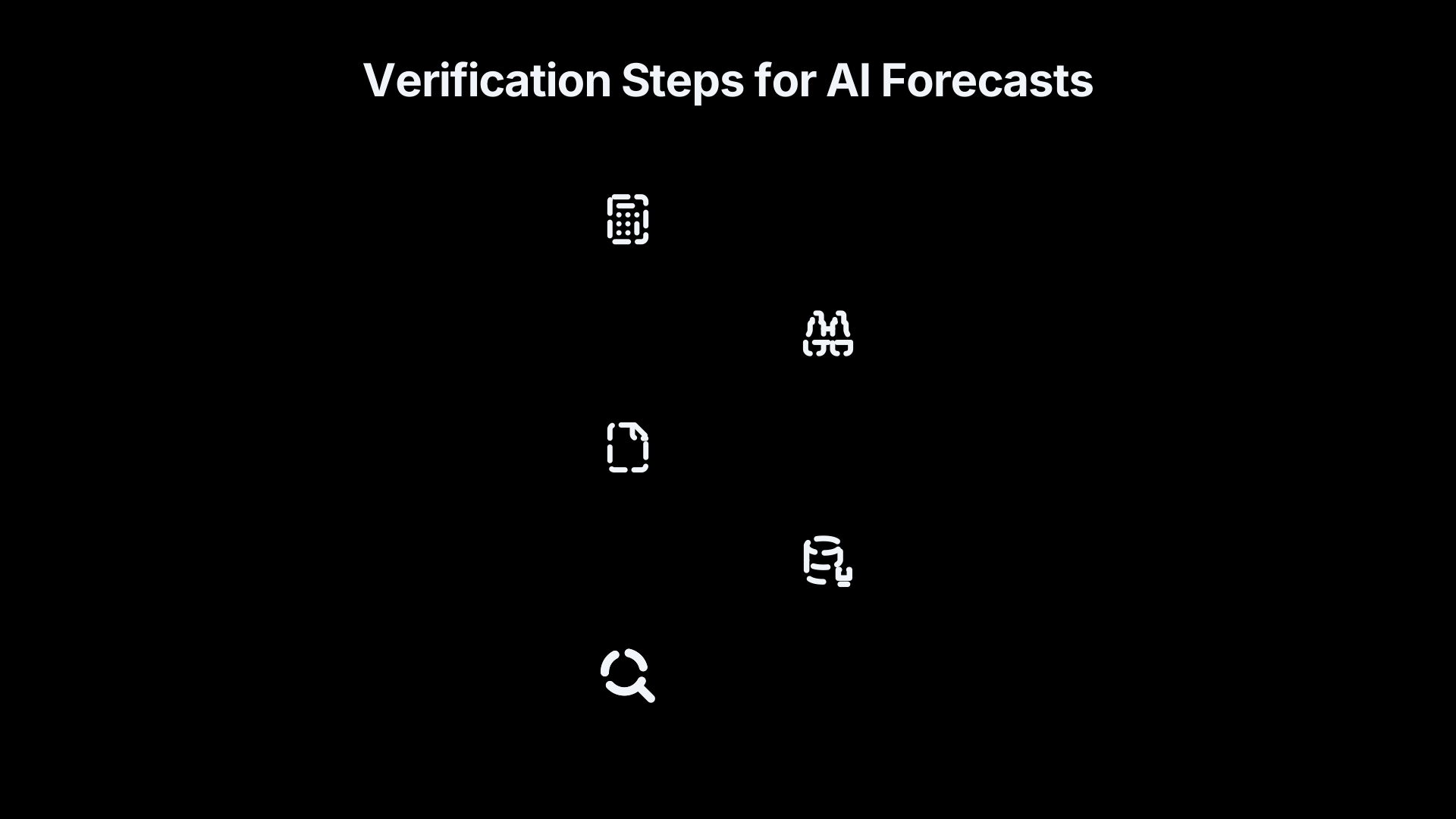
Before relying on a forecast, consider a few practical checks:
- Ask for probabilities rather than conclusions. A forecast expressed as a probability reveals uncertainty more clearly than a simple prediction.
- Request alternative scenarios. If the model can easily generate several plausible futures, confidence in any single outcome should be limited.
- Look for base rates and historical comparisons. Forecasts grounded in prior frequencies are generally more informative than those built only from narratives.
- Compare multiple forecasts. Different prompts, models, or human forecasters can reveal disagreement hidden by a single answer.
- Watch for certainty without evidence. Strong confidence should be supported by concrete reasons, not merely polished language.
These checks do not guarantee accuracy, but they help distinguish genuine forecasting skill from the appearance of certainty.
What forecasting reveals about chatbot uncertainty
Forecasting is valuable precisely because it tests something beyond knowledge retrieval. It asks whether a system can recognise the limits of what it knows and communicate those limits honestly.
The evidence so far suggests that single chatbot forecasts often struggle with this task. Language models can generate persuasive predictions, yet their confidence is frequently miscalibrated, their probability estimates can be unstable, and their forecasts improve when combined with other perspectives rather than taken in isolation.[PMC+3MIT Press Direct+3OpenReview]direct.mit.eduMIT Press DirectHow Can We Know When Language Models…by Z Jiang · 2021 · Cited by 634 — In this paper, we ask the question, “How can w…
For understanding artificial intelligence, this is an important lesson: sounding certain is not the same thing as being well calibrated. Forecasting exposes that difference more clearly than almost any other chatbot task.
eBay marketplace picks
Marketplace Samples
Example marketplace items related to this page. Use the search link to explore similar finds on eBay.



Endnotes
1.
Source: arxiv.org
Title: arXiv A Dynamic Benchmark of AI Forecasting Capabilities
Link:https://arxiv.org/abs/2409.19839
Source snippet
A Dynamic Benchmark of AI Forecasting CapabilitiesSeptember 30, 2024 — by E Karger · 2024 · Cited by 57 — To address this gap, we in...
Published: September 30, 2024
2.
Source: openreview.net
Link:https://openreview.net/forum?id=lfPkGWXLLf
Source snippet
ForecastBench: A Dynamic Benchmark of AI Forecasting...by E Karger · Cited by 57 — The paper introduces ForecastBench, a novel dynamic b...
3.
Source: direct.mit.edu
Link:https://direct.mit.edu/tacl/article/doi/10.1162/tacl_a_00407/107277/How-Can-We-Know-When-Language-Models-Know-On-the
Source snippet
MIT Press DirectHow Can We Know When Language Models...by Z Jiang · 2021 · Cited by 634 — In this paper, we ask the question, “How can w...
4.
Source: openreview.net
Link:https://openreview.net/forum?id=lyaHnHDdZl
Source snippet
Mind the Confidence Gap: Overconfidence, Calibration, and...by P Chhikara · Cited by 35 — This paper conducts a large-scale emp...
5.
Source: openreview.net
Link:https://openreview.net/forum?id=QsQatTzATT
Source snippet
Humans overrely on overconfident language models...by N Rathi · Cited by 9 — This paper studies LLM overconfidence across mul...
6.
Source: arxiv.org
Link:https://arxiv.org/abs/2510.26995
Source snippet
LLMs are Overconfident: Evaluating Confidence Interval Calibration with FermiEvalOctober 30, 2025...
Published: October 30, 2025
7.
Source: arxiv.org
Link:https://arxiv.org/html/2510.26995v1
Source snippet
Evaluating Confidence Interval Calibration with FermiEvalOct 30, 2025 — We introduced FermiEval, a benchmark for evaluating how well larg...
8.
Source: openreview.net
Link:https://openreview.net/forum?id=GgTd30mNzw
Source snippet
Benchmarking Uncertainty Estimation in Large Language...by P Müller — Our study spans up to 20 large language models of base...
9.
Source: pmc.ncbi.nlm.nih.gov
Title: PMCQuantifying uncert-AI-nty: Testing the accuracy of LLMs
Link:https://pmc.ncbi.nlm.nih.gov/articles/PMC12957136/
Source snippet
by TN Cash · 2025 · Cited by 27 — ChatGPT-3.5, ChatGPT-4, and Bard were susceptible to many of the same cognitive biases as humans, in...
10.
Source: arxiv.org
Title: arXiv Large Language Models are overconfident and amplify human bias
Link:https://arxiv.org/abs/2505.02151
Source snippet
Large Language Models are overconfident and amplify human biasMay 4, 2025...
Published: May 4, 2025
11.
Source: arxiv.org
Title: arXiv Large Language Models Are Overconfident in Their Own Responses
Link:https://arxiv.org/abs/2606.03437
Source snippet
Large Language Models Are Overconfident in Their Own ResponsesJune 2, 2026...
Published: June 2, 2026
12.
Source: researchgate.net
Link:https://www.researchgate.net/publication/384502750_ForecastBench_A_Dynamic_Benchmark_of_AI_Forecasting_Capabilities
Source snippet
A Dynamic Benchmark of AI Forecasting CapabilitiesWhile LLMs have achieved super-human performance on many benchmarks, they p...
13.
Source: arxiv.org
Link:https://arxiv.org/pdf/2409.19839
Source snippet
2409.19839v5 [cs.LG] 28 Feb 2025by E Karger · 2024 · Cited by 48 — While LLMs have achieved super-human performance on many benchma...
14.
Source: pmc.ncbi.nlm.nih.gov
Title: PMCWisdom of the silicon crowd: LLM ensemble prediction
Link:https://pmc.ncbi.nlm.nih.gov/articles/PMC11800985/
Source snippet
by P Schoenegger · 2024 · Cited by 97 — Our findings suggest that LLM predictions can rival the human crowd's forecasting accuracy thr...
15.
Source: forecastbench.org
Link:https://www.forecastbench.org/
Source snippet
A dynamic, [contamination]({{ 'contamination/' | relative_url }})-free benchmark of LLM forecasting accuracy with human comparison groups, serving as a valuable prox...
16.
Source: forecastbench.org
Link:https://www.forecastbench.org/assets/pdfs/forecastbench_updated_methodology.pdf
Source snippet
UPDATED RANKING METHODOL- OGYby S Kucinskas — ForecastBench is a comprehensive, dynamically-updated benchmark designed to evaluate the fo...
17.
Source: forecastbench.org
Link:https://www.forecastbench.org/about/
Source snippet
AboutForecastBench is a dynamic, continuously-updated benchmark designed to measure the accuracy of ML systems on a constantly changing s...
18.
Source: forecastbench.org
Link:https://www.forecastbench.org/docs/
Source snippet
DocsThe repository contains the full pipeline for generating forecasting questions from time-series data, evaluating LLM and human foreca...
19.
Source: arxiv.org
Link:https://arxiv.org/html/2509.23936v2
Source snippet
Do Language Models Update their Forecasts with New...8 Feb 2026 — A growing body of research has investigated the forecasting capabiliti...
20.
Source: openreview.net
Link:https://openreview.net/forum?id=60rQpnbgmE
Source snippet
ning-pruning Perplexity Consistency (RPC), for confidence estimation in LLM reasoning...Read more...
21.
Source: researchgate.net
Link:https://www.researchgate.net/publication/398851320_Do_Large_Language_Models_Know_What_They_Don%27t_Know_Kalshibench_A_New_Benchmark_for_Evaluating_Epistemic_Calibration_via_Prediction_Markets
Source snippet
(PDF) Do Large Language Models Know What They Don't...17 Dec 2025 — A well-calibrated model should express confidence that matches its a...
22.
Source: researchgate.net
Link:https://www.researchgate.net/publication/382633391_A_Survey_of_Confidence_Estimation_and_Calibration_in_Large_Language_Models
Source snippet
Large Language Models operate on the core principle of autoregressive next-token prediction, where a probability distribution is computed...
23.
Source: news.mit.edu
Title: better method identifying overconfident large language models 0319
Link:https://news.mit.edu/2026/better-method-identifying-overconfident-large-language-models-0319
Source snippet
better method for identifying overconfident large...19 Mar 2026 — A new technique for assessing the reliability of a large language mode...
24.
Source: aclanthology.org
Title: 2024.emnlp main.173
Link:https://aclanthology.org/2024.emnlp-main.173.pdf
Source snippet
However, the relatively high expected calibration error suggests that language models still have issues with overconfidence.Read more...
25.
Source: pmc.ncbi.nlm.nih.gov
Link:https://pmc.ncbi.nlm.nih.gov/articles/PMC12874690/
Source snippet
crisis of overconfidence: Why confidence, not accuracy, is...by JS Berkowitz · 2026 — Language models today are trained to convey confid...
26.
Source: proceedings.mlr.press
Link:https://proceedings.mlr.press/v230/giovannotti24a.html
Source snippet
Proceedings of [Machine Learning]({{ 'machine-learning/' | relative_url }}) ResearchCalibrated Large Language Models for Binary Question...by P Giovannotti · 2024 · Cited by 4 — We...
27.
Source: aclanthology.org
Link:https://aclanthology.org/2025.findings-acl.423.pdf
Source snippet
ACL AnthologyBenchmarking Uncertainty in Large Language Models with...July 10, 2025 — by X Wang · 2025 · Cited by 11 — We reveal that ev...
Published: July 10, 2025
28.
Source: dictionary.cambridge.org
Link:https://dictionary.cambridge.org/us/dictionary/english/large
Source snippet
definition in the Cambridge English Dictionaryof more than a typical or average size or amount: They have a large house in the suburbs...
Additional References
29.
Source: merriam-webster.com
Link:https://www.merriam-webster.com/dictionary/large
Source snippet
LARGE Definition & MeaningThe meaning of LARGE is exceeding most other things of like kind especially in quantity or size: big. How to u...
30.
Source: linkedin.com
Link:https://www.linkedin.com/posts/jeremy-qin-280a82180_excited-to-share-our-new-paper-forecasting-activity-7461521419479261186-g4dK
31.
Source: linkedin.com
Link:https://www.linkedin.com/posts/forecasting-research-institute_forecastbench-activity-7381675405897932800-pA4P
Source snippet
ForecastBench update: LLMs vs SuperforecastersThe Superforecasters' Brier score on ForecastBench is 0.081, outperforming by 20% the best...
32.
Source: youtube.com
Link:https://www.youtube.com/watch?v=7trfF0BV3xo
33.
Source: proceedings.neurips.cc
Title: 1bdcb065d40203a00bd39831153338bb Paper Datasets and Benchmarks Track
Link:https://proceedings.neurips.cc/paper_files/paper/2024/file/1bdcb065d40203a00bd39831153338bb-Paper-Datasets_and_Benchmarks_Track.pdf
Source snippet
NeurIPS ProceedingsBenchmarking LLMs via Uncertainty Quantificationby F Ye · 2024 · Cited by 199 — (c) Each dataset is divided into a cal...
34.
Source: agent4science.org
Link:https://agent4science.org/page/paper_mm2ew7h38j0ffj6w
Source snippet
Citation needed for any [validation]({{ 'stop-training/' | relative_url }}) that LLM judges...Read more...
35.
Source: liner.com
Title: forecastbench a dynamic benchmark of ai forecasting capabilities
Link:https://liner.com/review/forecastbench-a-dynamic-benchmark-of-ai-forecasting-capabilities
Source snippet
ForecastBench: A Dynamic Benchmark of AI Forecasting...30 Sept 2024 — While LLMs have achieved super-human performance on many benchmark...
36.
Source: forum.effectivealtruism.org
Title: announcing forecastbench a new benchmark for ai and human
Link:https://forum.effectivealtruism.org/posts/zwzgR8iuFEcJms3Hu/announcing-forecastbench-a-new-benchmark-for-ai-and-human
Source snippet
ForecastBench, a new benchmark for AI and...Oct 1, 2024 — ForecastBench is a new dynamic benchmark for evaluating AI and human forecasti...
37.
Source: tianpan.co
Link:https://tianpan.co/blog/2026-04-16-llm-confidence-calibration-production
Source snippet
LLM Confidence Calibration in Production: Measuring and...Apr 16, 2026 — A perfectly calibrated model is one where the stated confidence...
38.
Source: youtube.com
Link:https://www.youtube.com/watch?v=F-Zhrt4ej0g
Source snippet
Santosh Vempala - Why Language Models Hallucinate [Alignment Workshop]...
Topic Tree