Within Recommenders
How Popular Content Becomes Even More Popular
Content that gains early traction can receive extra exposure, making successful items even more visible over time.
On this page
- How popularity signals enter recommendations
- The mechanics of visibility amplification
- Effects on discovery and content diversity
Page outline Jump by section
Introduction
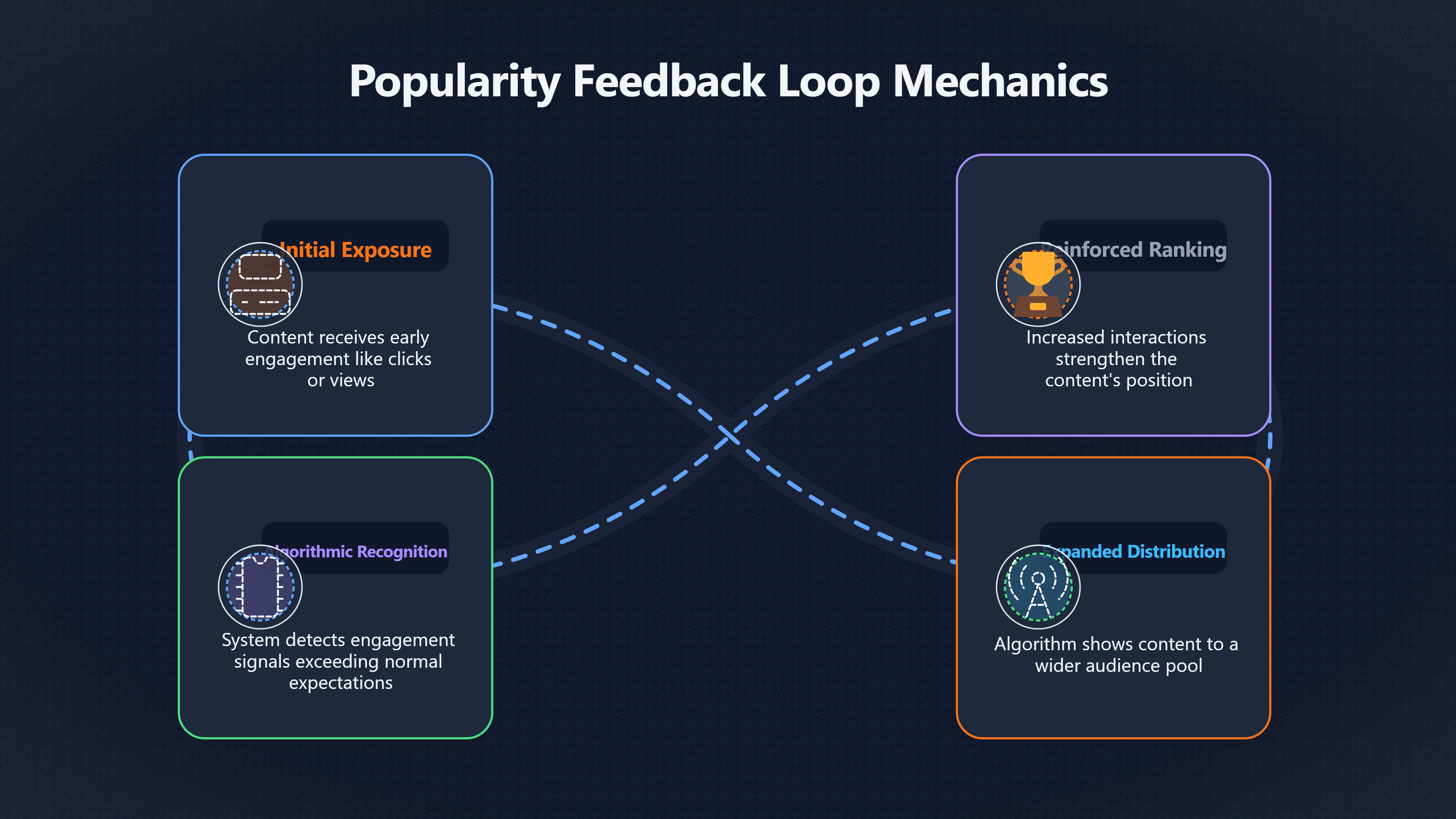
One of the most important ways recommendation systems shape attention is through popularity feedback loops. A feedback loop occurs when content that receives early engagement—such as clicks, views, likes, watch time or shares—is interpreted by an algorithm as a signal of value. The system then exposes that content to more people, creating additional engagement that further strengthens the signal. Over time, a small initial advantage can become a large visibility advantage. Researchers often describe this as a “rich get richer” dynamic in which already-visible content becomes increasingly dominant.[arXiv+2EECS at UC Berkeley]arxiv.orgarXiv Feedback Loop and Bias Amplification in Recommender SystemsarXivFeedback Loop and Bias Amplification in Recommender SystemsJuly 25, 2020
 This mechanism matters because recommendation systems are not simply measuring popularity; they can actively reinforce it. As a result, who receives attention online is often influenced not only by quality or relevance but also by how recommendation systems interpret and amplify early popularity signals.[Knight First Amendment Institute+2Springer]knightcolumbia.orgunderstanding social media recommendation algorithmsThese algorithms are the engine that makes Facebook and YouTube what they are.Read more…
How popularity signals enter recommendations
Recommendation systems rely on behavioural data to estimate what users are likely to engage with next. Among the many signals available, popularity is especially attractive because it is easy to measure. High view counts, strong engagement rates, rapid growth in interactions, and widespread sharing can all indicate that content is resonating with audiences.[Knight First Amendment Institute]knightcolumbia.orgunderstanding social media recommendation algorithmsThese algorithms are the engine that makes Facebook and YouTube what they are.Read more…
From the perspective of an algorithm, popularity can serve several purposes:
- It may act as evidence that content is relevant or interesting.
- It can reduce uncertainty about unfamiliar items.
- It often predicts future engagement better than completely untested content.
- It provides a simple ranking signal when large amounts of content compete for attention.[PMC]pmc.ncbi.nlm.nih.govHow algorithmic popularity bias hinders or promotes qualityby GL Ciampaglia · 2018 · Cited by 258 — Algorithms that favor popular item…
The challenge is that popularity is not a neutral measurement. Once popularity becomes part of ranking decisions, the algorithm begins influencing the very metric it uses. Every recommendation creates new opportunities for engagement, which then become additional evidence supporting future recommendations. Researchers identify this circular process as a core source of recommendation-system feedback loops.[arXiv+2Concurrences]arxiv.orgarXiv Feedback Loop and Bias Amplification in Recommender SystemsarXivFeedback Loop and Bias Amplification in Recommender SystemsJuly 25, 2020
The mechanics of visibility amplification
The amplification process can be understood as a sequence of stages.
- Initial exposure: A piece of content receives some early attention.
- Algorithmic recognition: The system detects engagement signals that exceed expectations.
- Expanded distribution: The content is shown to more users.
- Additional engagement: More exposure produces more interactions.
- Reinforced ranking: The growing engagement strengthens the content’s ranking position.
- Further exposure: The cycle repeats. arXiv+2EECS at UC Berkeley
The important point is that the relationship is often nonlinear. A small advantage at the beginning can lead to disproportionately large differences later because exposure itself generates the data used for future ranking decisions. Research on popularity bias consistently finds that recommendation algorithms tend to recommend already-popular items more frequently than less popular alternatives. Proceedings of Machine Learning Research+2arXiv
Consider two nearly identical videos uploaded at the same time. If one receives slightly stronger early engagement, it may be promoted more aggressively. That additional exposure generates more views, which further improve its engagement statistics. Eventually the difference between the two videos may become enormous despite the original gap being small. This is one reason online attention often appears highly concentrated rather than evenly distributed. PMC
Why concentration emerges so quickly
Digital platforms create conditions that make concentration particularly powerful.
First, users typically see only a tiny fraction of available content. Most attention is focused on items that appear near the top of rankings, feeds or recommendation lists. Moving from the tenth position to the first position can dramatically increase exposure. Knight First Amendment Institute
Second, recommendation systems continuously learn from user behaviour. The data collected today influence recommendations tomorrow. If popular content receives more opportunities to gather interaction data, the system gains increasing confidence in recommending it again. Concurrences
Third, many machine-learning models are trained on historical interaction data. Because popular items already generate more interactions, they become more prominent within training datasets. This can cause algorithms to learn patterns that favour those items even before new recommendations are made. Springer+2arXiv
The result is concentrated visibility: a relatively small number of creators, posts, songs, products or videos receive a disproportionately large share of user attention.
Effects on discovery and content diversity
Popularity feedback loops can create tension between efficiency and discovery.
On one hand, recommending popular content often works well for engagement. Widely appreciated items are more likely to satisfy large numbers of users, making popularity a useful signal. Some studies suggest recommendation systems can also help users discover items beyond the most obvious mainstream choices. ResearchGate
On the other hand, excessive reliance on popularity can reduce the visibility of less-known content. Researchers describe this as popularity bias: the tendency of recommendation systems to favour already-popular items while underrepresenting niche or long-tail content. Springer+2arXiv
Several consequences can follow:
- New creators may struggle to gain initial visibility.
- Niche interests may be served less effectively.
- Users may encounter a narrower range of content.
- Similar recommendation lists may appear across different users.
- A small set of highly visible items can dominate attention. arXiv+2Proceedings of Machine Learning Research
Research examining feedback loops has found that repeated recommendation cycles can reduce aggregate diversity and increase the homogenisation of user experiences. In other words, users may gradually be guided toward similar sets of popular content even when their original interests were more varied. arXiv+2EECS at UC Berkeley
A debated question: popularity versus quality
A common assumption is that popularity and quality are the same thing. In reality, the relationship is more complicated.
High-quality content often becomes popular, but popularity can also arise from timing, network effects, early exposure advantages or random fluctuations. Studies of ranking systems have shown that algorithms favouring popularity can sometimes amplify initial chance differences rather than consistently identifying the highest-quality options. PMC
This does not mean popular content lacks merit. Rather, it means visibility and quality are not perfectly aligned. Once feedback loops begin operating, the amount of attention an item receives may partly reflect previous exposure decisions made by the recommendation system itself. PMC
For this reason, researchers increasingly distinguish between content that is popular because users genuinely prefer it and content that becomes popular partly because algorithms repeatedly place it in front of users. MDPI
Why AI designers pay attention to feedback loops
Understanding popularity feedback loops is important because they reveal that recommendation systems are dynamic systems rather than passive prediction tools. Every recommendation changes the environment from which future learning data are collected. Google Patents
Modern research on recommender systems increasingly examines ways to balance relevance, diversity and fairness. Proposed approaches include intentionally exposing users to a broader range of content, reducing excessive dependence on popularity signals, and measuring long-term effects rather than focusing only on immediate engagement. Springer+2inovex GmbH
The central lesson is that recommendation systems do more than identify what is already popular. By deciding what people see next, they can create self-reinforcing cycles in which visibility generates more visibility. Understanding these feedback loops helps explain why small ranking differences can grow into major disparities in attention across the digital world. arXiv+2Proceedings of Machine Learning Research
eBay marketplace picks
Marketplace Samples
Example marketplace items related to this page. Use the search link to explore similar finds on eBay.




Endnotes
2.
Source: www2.eecs.berkeley.edu
Title: EECS 2022 178
Link:https://www2.eecs.berkeley.edu/Pubs/TechRpts/2022/Archive/EECS-2022-178.pdf
Source snippet
EECS at UC BerkeleyThe Dynamics of Recommender Systemsby K Krauth · 2022 · Cited by 1 — Beyond biased estimation, feedback loops are also...
3.
Source: link.springer.com
Link:https://link.springer.com/article/10.1007/s11257-024-09406-0
Source snippet
A survey on popularity bias in recommender systemsby A Klimashevskaia · 2024 · Cited by 180 — In this paper, we discuss the poten...
4.
Source: arxiv.org
Title: arXiv A Survey on Popularity Bias in Recommender Systems
Link:https://arxiv.org/abs/2308.01118
5.
Source: pmc.ncbi.nlm.nih.gov
Link:https://pmc.ncbi.nlm.nih.gov/articles/PMC6206065/
Source snippet
How algorithmic popularity bias hinders or promotes qualityby GL Ciampaglia · 2018 · Cited by 258 — Algorithms that favor popular item...
6.
Source: awards.concurrences.com
Link:https://awards.concurrences.com/docrestreint.api/pdf/nhad009.pdf
Source snippet
more...
7.
Source: patents.google.com
Link:https://patents.google.com/patent/WO2024249880A1/en
Source snippet
Google PatentsImplementing and maintaining feedback loops in...Some feedback loops in recommender systems have the potential to amplify...
8.
Source: arxiv.org
Link:https://arxiv.org/abs/2504.04752
9.
Source: arxiv.org
Link:https://arxiv.org/abs/2203.00376
10.
Source: researchgate.net
Title: Two anecdotal views exist about such effects.Read more
Link:https://www.researchgate.net/publication/5198144_Blockbuster_Culture%27s_Next_Rise_or_Fall_The_Impact_of_Recommender_Systems_on_Sales_Diversity
Source snippet
The Impact of Recommender Systems on Sales DiversityOctober 1, 2007 — 25 May 2026 — This paper examines the effect of recomme...
Published: October 1, 2007
11.
Source: mdpi.com
Link:https://www.mdpi.com/2078-2489/16/2/151
Source snippet
Popularity Bias in Recommender Systems: The Search for...by F Carnovalini · 2025 · Cited by 21 — While this bias stems from human te...
12.
Source: researchgate.net
Link:https://www.researchgate.net/publication/399768787_Dynamic_feedback_loops_in_recommender_systems_Analyzing_fairness_popularity_bias_and_user_group_disparities
Source snippet
(PDF) Dynamic feedback loops in recommender systemsJan 17, 2026 — Overall, the results demonstrate that feedback loops magnify structural...
13.
Source: inovex.de
Title: fairness in recommender systems how to reduce the popularity bias
Link:https://www.inovex.de/de/blog/fairness-in-recommender-systems-how-to-reduce-the-popularity-bias/
Source snippet
inovex GmbHFairness in Recommender Systems: How to Reduce the...7 Apr 2022 — This article explains the popularity bias in recommender sy...
14.
Source: pmc.ncbi.nlm.nih.gov
Link:https://pmc.ncbi.nlm.nih.gov/articles/PMC12453729/
Source snippet
nih.govEquiRate: balanced rating injection approach for popularity...by M Gulsoy · 2025 · Cited by 1 — A recent study addresses the prob...
15.
Source: researchgate.net
Link:https://www.researchgate.net/publication/346267408_Feedback_Loop_and_Bias_Amplification_in_Recommender_Systems
Source snippet
to algorithmic recommendations; this creates a pernicious feedback loop.Read more...
16.
Source: link.springer.com
Link:https://link.springer.com/article/10.1007/s10844-026-01025-y
Source snippet
fairness, popularity bias, and user group disparitiesby Y Zoralioglu · 2026 · Cited by 1 — This study examines the interplay between popu...
17.
Source: arxiv.org
Link:https://arxiv.org/html/2308.01118v3
Source snippet
A Survey on Popularity Bias in Recommender SystemsIn this paper, we discuss the potential reasons for popularity bias and review existing...
18.
Source: arxiv.org
Link:https://arxiv.org/html/2602.16315v1
Source snippet
Systemic Effects of Feedback Loops in Recommender...18 Feb 2026 — This article introduces a feedback-loop model and a flexible simulatio...
19.
Source: knightcolumbia.org
Title: understanding social media recommendation algorithms
Link:https://knightcolumbia.org/content/understanding-social-media-recommendation-algorithms
Source snippet
These algorithms are the engine that makes Facebook and YouTube what they are.Read more...
20.
Source: proceedings.mlr.press
Link:https://proceedings.mlr.press/v294/kowald25a.html
Source snippet
more...
21.
Source: GOV.UK
Link:https://www.gov.uk/government/publications/research-into-the-impact-of-streaming-services-algorithms-on-music-consumption/the-impact-of-algorithmically-driven-recommendation-systems-on-music-consumption-and-[production
Source snippet
impact of algorithmically driven recommendation...by D Hesmondhalgh · Cited by 60 — The impact of streaming platforms on musical product...
22.
Source: raw.githubusercontent.com
Link:https://raw.githubusercontent.com/mlresearch/v294/main/assets/kowald25a/kowald25a.pdf
Source snippet
Investigating Popularity Bias Amplification in Recommender...by D KOWALD · 2025 · Cited by 3 — Research has demonstrated that recommenda...
Additional References
23.
Source: medium.com
Link:https://medium.com/%40kamalmeet/popularity-bias-in-recommendation-engines-2542d1cdb353
Source snippet
Popularity Bias in Recommendation EnginesThis creates a feedback loop where popular items dominate visibility while others fade into obsc...
24.
Source: Lawfare
Title: exploring tradeoffs in ranking and recommendation algorithms
Link:https://www.lawfaremedia.org/article/exploring-tradeoffs-in-ranking-and-recommendation-algorithms
Source snippet
Tradeoffs in Ranking and Recommendation...by L Arcamona · 2023 — Recommender systems learn what users like, based on users' explicit rat...
25.
Source: medium.com
Link:https://medium.com/music-tomorrow/fairness-in-question-do-music-recommendation-algorithms-value-diversity-9906008939ae
Source snippet
he rich indeed get richer as smaller artists get poorer.Read more...
26.
Source: aman.ai
Link:https://aman.ai/recsys/bias/
Source snippet
Aman's AI Journal • Recommendation Systems • BiasRecommender systems are powerful tools in modern applications, helping to personalize co...
27.
Source: topuniversities.com
Title: Q S Universities Rankings
Link:https://www.topuniversities.com/university-rankings
Source snippet
QS Universities Rankings - Top Global...Explore global leading institutions by region, subject & location ranked as per 6 ranking indica...
28.
Source: Wikipedia
Title: Recommender system
Link:https://en.wikipedia.org/wiki/Recommender_system
Source snippet
Recommender systemA recommender system, also called a recommendation algorithm, recommendation engine, or recommendation platform, is...
29.
Source: dl.acm.org
Link:https://dl.acm.org/doi/10.1145/3564284
Source snippet
ACM Digital LibraryBias and Debias in Recommender System: A Survey...Such feedback loop not only creates biases but also intensifies bia...
30.
Source: youtube.com
Link:https://www.youtube.com/watch?v=D4Us–bvFQo
Source snippet
sms proposed to control this bias, ranging...
31.
Source: youtube.com
Link:https://www.youtube.com/watch?v=Kq8_jLSbMj8
Source snippet
Feedback loops in data systems - Matthieu Ranger...
32.
Source: youtube.com
Title: Your Desires Were Built Before You Called Them Choice
Link:https://www.youtube.com/watch?v=10kDRYLcIHE
Source snippet
Mitigating Popularity Bias in Recommendation: Potential and Limits of Calibration...
Topic Tree