Within Fraud Flags
The missing scorecard for fraud AI
Fraud detection should be judged not only by money saved but also by how often legitimate users are blocked and how quickly errors are fixed.
On this page
- False positive rates and unnecessary payment interruptions
- Group differences, repeat blocks and customer explanations
- Appeal resolution time as a governance metric
Page outline Jump by section
Introduction
Fraud-detection AI is often judged by how much fraud it stops. That measure matters, but it is incomplete. A system that blocks large amounts of fraud can still perform poorly if it repeatedly interrupts legitimate payments, locks customers out of accounts, or forces innocent users into lengthy appeals. The key missing scorecard is the measurement of false positives: instances where an AI system incorrectly identifies legitimate activity as suspicious. In payment systems, these are often called false declines or false rejects.[LSEG]lseg.comUnderstanding False Positives in ScreeningUnderstanding False Positives in Screening - GlossaryIn financial risk management, a false positive refers to an erroneous system ale…
 For customers, a false positive may mean an essential purchase is denied, a transfer is delayed, or a card is temporarily blocked. For banks and merchants, it can mean lost revenue, higher support costs, and damaged trust. Evidence from payment providers and fraud researchers increasingly shows that reducing false positives is not a secondary optimisation goal but a core measure of whether a fraud AI system serves people effectively.[Visa Corporate+2Visa Corporate]corporate.visa.comVisa CorporateThe future of fraud detection: smarter, faster, safer | VisaDiscover how AI and machine learning are reshaping fraud detect…
False-positive rates and unnecessary payment interruptions
The most basic metric is the false-positive rate: the proportion of legitimate transactions that are incorrectly flagged as fraudulent. A fraud model can appear highly successful because it catches many fraudulent transactions, yet still impose substantial costs if it blocks too many genuine customers.
This problem is amplified by the imbalance of fraud datasets. Fraudulent transactions are typically a tiny fraction of all payment activity. As a result, a model can generate large numbers of incorrect alerts even when its overall accuracy appears high. Researchers studying fraud prediction note that false positives have long been a central challenge because legitimate transactions vastly outnumber fraudulent ones.[arXiv]arxiv.orgarXiv Solving the "false positives" problem in fraud predictionSolving the "false positives" problem in fraud predictionOctober 20, 2017…
A useful governance measure is therefore not simply “fraud prevented” but:
- Percentage of legitimate transactions incorrectly flagged.[visaacceptance.com]visaacceptance.com8 ways AI can help your business with fraud preventionBalanced false positive and false negative rates. Payments can be hindered by false positives (legitimate transactions flagged as fraud)…
- Percentage of legitimate transactions ultimately declined.
- Percentage requiring additional verification.
- Number of customers affected per thousand transactions.
These measures capture the real-world burden imposed on customers.
Industry evidence illustrates why this matters. Visa describes false declines as legitimate transactions rejected by a bank or payment processor and highlights them as a major problem in payment systems. The company reports that customers who experience more than three declines on a card become substantially less likely to continue using that payment method.[Visa Corporate]corporate.visa.comtale of two transactionsVisa CorporateA tale of two transactions | VisaFeb 27, 2024 — False declines, also known as false positives, are legitimate transactions…
The financial impact can also be significant. Multiple industry analyses argue that revenue losses from false declines may exceed direct fraud losses in some sectors because every mistaken rejection represents a legitimate sale that would otherwise have occurred.[Riskified+2Paymid]riskified.comHow much does a false decline cost your business?March 17, 2025 — False declines have a hefty price tag. According to INETCO, global losses from false declines reached a stagger…
Why aggregate accuracy can hide the problem
A common mistake is to report only overall model accuracy or fraud-detection rates.
Consider two systems:
- System A catches 95% of fraud but blocks 3% of legitimate customers.
- System B catches 92% of fraud but blocks only 0.5% of legitimate customers.
Depending on transaction volumes and customer value, System B may provide a better overall outcome even though its fraud-detection rate is lower. This is why payment networks increasingly emphasise balancing fraud prevention and approval rates rather than maximising fraud detection alone.[visaacceptance.com]visaacceptance.com8 ways AI can help your business with fraud preventionBalanced false positive and false negative rates. Payments can be hindered by false positives (legitimate transactions flagged as fraud)…
Several major providers now explicitly describe reduction of false declines as a primary performance objective. Visa frames successful fraud detection as a balance between stopping fraud and maintaining seamless legitimate transactions. Mastercard similarly reports efforts to reduce false positives while increasing fraud detection capability.[Visa Corporate+2Visa Corporate]corporate.visa.comVisa CorporateAI solutions for fraud prevention and detection | VisaSee how AI fraud detection helps businesses identify anomalies, stop…
Group differences, repeat blocks and customer explanations
Looking only at an overall false-positive rate can conceal unequal impacts.
A system may perform adequately across the entire customer base while producing disproportionate numbers of false alerts for specific groups. Travellers, customers making unusually large purchases, people with limited transaction histories, or users adopting new devices may be flagged more often because their behaviour differs from learned norms.
For this reason, organisations increasingly examine false-positive rates across customer segments rather than relying on a single headline figure. Relevant measures include:
- False-positive rates by geography.[visaacceptance.com]visaacceptance.com8 ways AI can help your business with fraud preventionBalanced false positive and false negative rates. Payments can be hindered by false positives (legitimate transactions flagged as fraud)…
- False-positive rates by age of account.
- False-positive rates for new versus established customers.
- False-positive rates for different transaction types.
- False-positive rates for customers using accessibility tools or alternative payment patterns.
These breakdowns help identify whether an AI system is placing disproportionate burdens on particular groups.
Another important metric is repeat blocking. A customer incorrectly challenged once may tolerate the inconvenience. Repeated interruptions can create a pattern of exclusion.
Visa reports that repeated declines substantially reduce continued card usage, suggesting that customer experience deteriorates as false-positive events accumulate. Measuring the number of customers who experience multiple incorrect blocks therefore provides a more meaningful picture than measuring individual transactions alone.[Visa Corporate]corporate.visa.comtale of two transactionsVisa CorporateA tale of two transactions | VisaFeb 27, 2024 — False declines, also known as false positives, are legitimate transactions…
The importance of explanations
Customer-facing explanations are also measurable.
When a transaction is interrupted, institutions can track:
- Whether the customer was told a payment was blocked.
- Whether a reason was provided.
- Whether additional verification options were offered.
- Whether the explanation helped resolve the issue.
Poor explanations increase frustration and support costs even when the underlying model is relatively accurate. Research on fraud-detection workflows notes that unnecessary alerts and customer contacts can erode trust and create dissatisfaction, especially when customers do not understand why action was taken.[arXiv]arxiv.orgEnhancing Customer Contact Efficiency with Graph Neural Networks in Credit Card Fraud Detection WorkflowApril 3, 2025…
From a governance perspective, a system that produces fewer false positives but leaves customers confused may still underperform one that combines reasonable detection rates with transparent communication.
Appeal resolution time as a governance metric
A fraud system should not be evaluated solely at the moment of detection. The quality of the correction process matters as well.
Every fraud model makes mistakes. The question is how quickly and effectively those mistakes are repaired.
Appeal resolution time measures the period between a customer reporting a problem and the institution restoring normal access or approving a legitimate transaction. This metric shifts attention from prediction alone to the broader human consequences of automated decision-making.
Useful measures include:
- Median appeal resolution time.
- Percentage of appeals resolved within predefined targets.
- Percentage of blocked transactions overturned.
- Number of customer contacts required before resolution.
- Rate of successful appeals.
These indicators reveal whether an organisation can efficiently correct model errors.
A low false-positive rate is desirable, but even a relatively accurate system can create significant harm if legitimate customers remain blocked for days. Conversely, a system with occasional mistakes may impose less harm if those mistakes are corrected within minutes.
Recent reporting on payment-fraud controls highlights that fraud flags are probabilistic assessments rather than final judgments and that human intervention often remains necessary to reverse incorrect decisions. The effectiveness of that intervention is therefore part of the system’s overall performance.[New Haven Register]nhregister.comA bank representative can override a declined transaction in real time.Read moreNew Haven RegisterYour bank's AI just blocked your payment – what can you do?3 days ago — Call your bank immediately: A fraud flag is pro…
Measuring the full customer journey
The strongest governance frameworks increasingly treat fraud detection as a process rather than a single model output.
Instead of asking only whether the AI correctly identified fraud, organisations can ask:
- Was the transaction flagged?
- Was the flag correct?
- Did the customer experience disruption?
- How quickly was the disruption resolved?
- Did the customer continue using the service afterwards?
This approach recognises that customer harm occurs across the entire journey from alert generation to final resolution.
Evidence from payment providers, fraud-management companies and academic research consistently points to the same conclusion: success cannot be measured solely by fraud losses prevented. False positives, repeated interruptions, unequal impacts across customer groups, and slow appeals all represent costs that must be counted alongside fraud reduction.[arXiv+3Visa Corporate+3visaacceptance.com]corporate.visa.comVisa CorporateThe future of fraud detection: smarter, faster, safer | VisaDiscover how AI and machine learning are reshaping fraud detect…
What a complete fraud-AI scorecard looks like
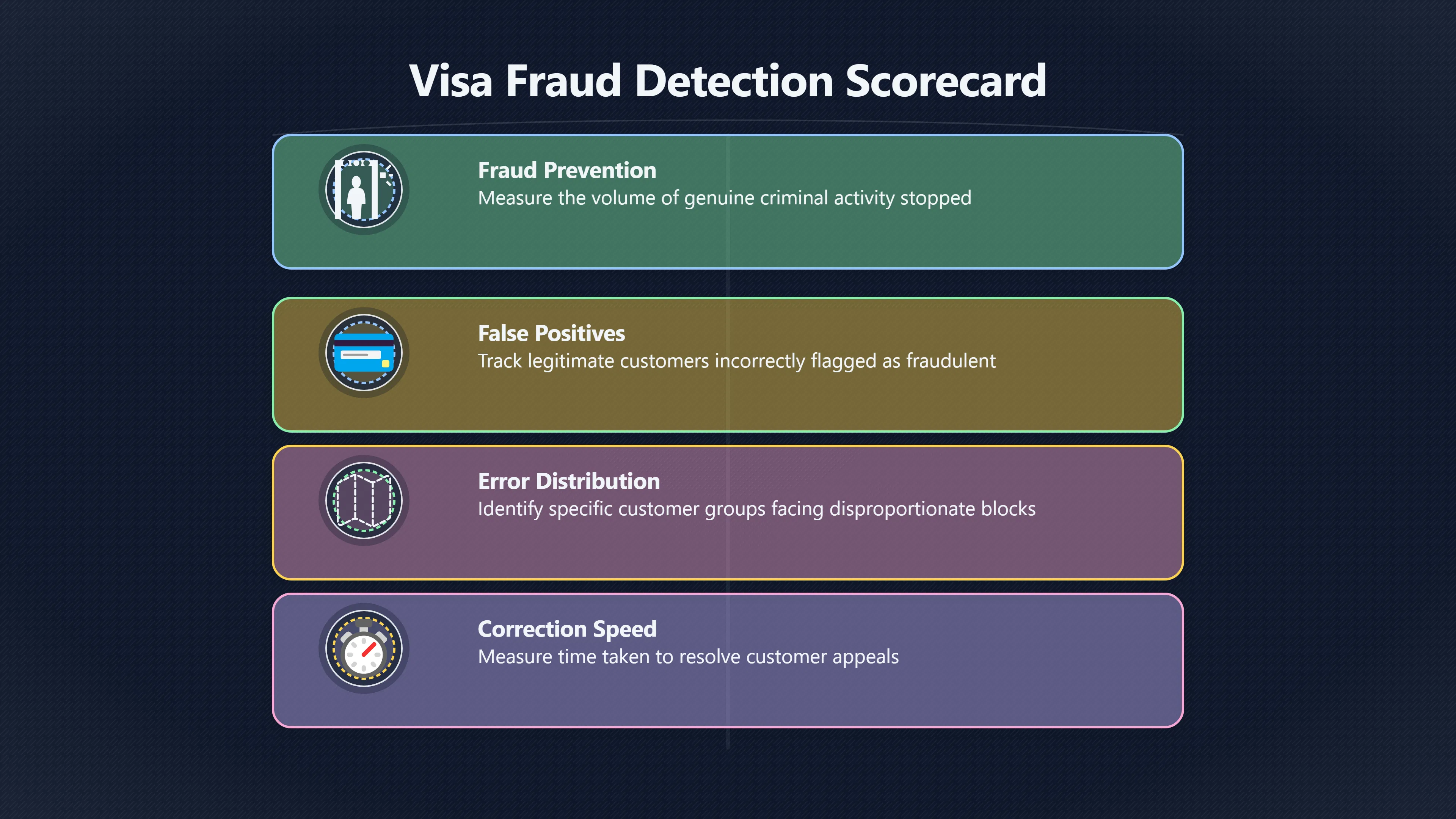
A mature fraud-detection programme therefore tracks four categories simultaneously:
DimensionKey questionFraud detectionHow much genuine fraud is stopped?False positivesHow many legitimate customers are incorrectly flagged?Distribution of errorsAre some customer groups affected more than others?Error correctionHow quickly are mistakes identified and reversed?
This broader scorecard prevents institutions from claiming success based solely on fraud savings while overlooking the experience of legitimate users. In fraud detection AI, a model is not truly effective unless it both stops criminals and minimises unnecessary disruption for the people it is meant to protect.[Visa Corporate+2Visa Corporate]corporate.visa.comVisa CorporateAI solutions for fraud prevention and detection | VisaSee how AI fraud detection helps businesses identify anomalies, stop…
Amazon book picks
Further Reading
Books and field guides related to The missing scorecard for fraud AI. Use these as the next step if you want deeper reading beyond the article.
Machine Learning Advances in Payment Card Fraud Detection
Addresses fraud-detection performance and trade-offs.
Weapons of Math Destruction
Strong fit for discussions of false positives, fairness, and missing performance metrics.
eBay marketplace picks
Marketplace Samples
Example marketplace items related to this page. Use the search link to explore similar finds on eBay.



Endnotes
1.
Source: lseg.com
Title: [Understanding]({{ ‘understanding/’ | relative_url }}) False Positives in Screening
Link:https://www.lseg.com/en/risk-intelligence/glossary/risk-management/false-positive
Source snippet
Understanding False Positives in Screening - GlossaryIn financial risk management, a false positive refers to an erroneous system ale...
2.
Source: corporate.visa.com
Title: tale of two transactions
Link:https://corporate.visa.com/en/sites/visa-perspectives/security-trust/tale-of-two-transactions.html
Source snippet
Visa CorporateA tale of two transactions | VisaFeb 27, 2024 — False declines, also known as false positives, are legitimate transactions...
3.
Source: corporate.visa.com
Link:https://corporate.visa.com/en/solutions/visa-protect/insights/fraud-detection.html
Source snippet
Visa CorporateThe future of fraud detection: smarter, faster, safer | VisaDiscover how AI and machine learning are reshaping fraud detect...
4.
Source: corporate.visa.com
Link:https://corporate.visa.com/en/solutions/visa-protect/insights/ai-fraud-detection.html
Source snippet
Visa CorporateAI solutions for fraud prevention and detection | VisaSee how AI fraud detection helps businesses identify anomalies, stop...
5.
Source: visaacceptance.com
Title: 8 ways AI can help your business with fraud prevention
Link:https://www.visaacceptance.com/en-us/blog/article/2024/eight-ways-ai-can-help.html
Source snippet
Balanced false positive and false negative rates. Payments can be hindered by false positives (legitimate transactions flagged as fraud)...
6.
Source: arxiv.org
Title: arXiv Solving the “false positives” problem in fraud prediction
Link:https://arxiv.org/abs/1710.07709
Source snippet
Solving the "false positives" problem in fraud predictionOctober 20, 2017...
Published: October 20, 2017
7.
Source: riskified.com
Title: How much does a false decline cost your business?
Link:https://www.riskified.com/blog/reduce-false-declines/
Source snippet
March 17, 2025 — False declines have a hefty price tag. According to INETCO, global losses from false declines reached a stagger...
Published: March 17, 2025
8.
Source: paymid.com
Title: The True Cost of False Declines: Recovering Lost Revenue
Link:https://paymid.com/true-cost-false-declines-recovering-revenue/
Source snippet
The True Cost of False Declines: Recovering Lost Revenue - PaymidThe math is startling: merchants decline 58% of all declined trans...
9.
Source: arxiv.org
Link:https://arxiv.org/abs/2504.02275
Source snippet
Enhancing Customer Contact Efficiency with Graph Neural Networks in Credit Card Fraud Detection WorkflowApril 3, 2025...
Published: April 3, 2025
10.
Source: fraud.com
Link:https://www.fraud.com/post/a-major-challenge-false-positives
Source snippet
A Major Challenge – False Positives - Fraud.comSimilarly, Lloyd's reports that fraud costs e-commerce merchants 7.6% of their annual reve...
11.
Source: visaacceptance.com
Title: ai driven fraud management
Link:https://www.visaacceptance.com/en-us/solutions/ai-driven-fraud-management.html
Source snippet
AI-powered fraud and risk management solutionsVisa's AI-powered fraud and risk solutions help you detect threats early, reduce fraud, inc...
12.
Source: visaacceptance.com
Title: accurate risk scoring ai machine learning
Link:https://www.visaacceptance.com/en-us/blog/article/2023/accurate-risk-scoring-ai-machine-learning.html
Source snippet
AI and machine learning now offer more accurate risk scoring5 Dec 2023 — our ML model generates a highly accurate [risk score]({{ 'thresholds/' | relative_url }}) for every tr...
13.
Source: visaacceptance.com
Title: ai driven fraud management
Link:https://www.visaacceptance.com/en/solutions/ai-driven-fraud-management.html
Source snippet
AI-powered fraud and risk management solutionsVisa's AI-powered fraud and risk solutions help you detect threats early, reduce fraud, inc...
14.
Source: usa.visa.com
Link:https://usa.visa.com/about-visa/newsroom/press-releases.releaseId.20661.html
Source snippet
Announces Generative AI-Powered Fraud Solution to...May 7, 2024 — The tool has been able to reduce the false positive rate by 85...
Published: May 7, 2024
15.
Source: corporate.visa.com
Title: payment fraud
Link:https://corporate.visa.com/en/solutions/visa-protect/insights/payment-fraud.html
Source snippet
to detecting and preventing payment fraud | VisaVisa Protect is a comprehensive payment fraud prevention suite that combines artificial i...
16.
Source: fraud.net
Title: bank australia case study
Link:https://www.fraud.net/resources/bank-australia-case-study
Source snippet
Leading Bank Takes Fraud Prevention to the Cloud1 Aug 2020 — Custom machine learning models reduce false positives and analyst burnout, t...
17.
Source: nhregister.com
Title: A bank representative can override a declined transaction in real time.Read more
Link:https://www.nhregister.com/news/article/your-bank-s-ai-just-blocked-your-payment-22276482.php
Source snippet
New Haven RegisterYour bank's AI just blocked your payment – what can you do?3 days ago — Call your bank immediately: A fraud flag is pro...
18.
Source: Wikipedia
Link:https://en.wikipedia.org/wiki/Payment
Source snippet
PaymentA payment is the tender of something of value, such as money or its equivalent, by one party (such as a person or company) to a...
Additional References
19.
Source: chargebacks911.com
Link:https://chargebacks911.com/fraud-prevention-system/
Source snippet
Fraud Prevention Systems: Grading on the Wrong Scorecard?False declines are very common. In fact, the cost of false decline...
20.
Source: disputifier.com
Link:https://www.disputifier.com/post/how-ai-assesses-payment-method-risks
Source snippet
How AI Assesses Payment Method RisksFewer False Positives: Traditional systems flag 98% of legitimate transactions as risky. AI reduces t...
21.
Source: linkedin.com
Link:https://www.linkedin.com/posts/somya-upadhyay23_100daysofproduct-100daysofpm-100daysofproductmanagement-activity-7371276717304221696-KCzV
Source snippet
PayU's AI Fraud Detection: A Real Case Study... merchants while minimizing false declines. Result: – $40B+ processed annually – Fraud rat...
22.
Source: linkedin.com
Link:https://www.linkedin.com/posts/visa_ai-fraud-valueaddedservices-activity-7343986443532296194-5_Kr
Source snippet
Visa's 30-year history of using AI to stop fraudWe've been using AI to to stop fraud for for 30 years. You know we've got uh AI models th...
23.
Source: aws.amazon.com
Link:https://aws.amazon.com/solutions/case-studies/mastercard-ai-ml-testimonial/
Source snippet
Amazon Web Services, Inc.Using AWS AI and ML Services to Detect and Prevent FraudThe solution has enabled Mastercard to detect three time...
24.
Source: linkedin.com
Link:https://www.linkedin.com/posts/fintech-magazine-bizclik_visas-new-ai-fraud-detection-cuts-phishing-activity-7313910204016865280-pLm2
Source snippet
Visa's AI system cuts phishing losses by 90%4 Apr 2025 — AI Solutions For Reducing False Positives In Fraud Detection · AI's Impact on Ri...
25.
Source: risk.lexisnexis.co.uk
Link:https://risk.lexisnexis.co.uk/insights-resources/article/entity-resolution-redefining-false-positive-problem
Source snippet
the False Positive ProblemFalse positive alerts are the bane of compliance teams' lives worldwide. They occur when a legitimate customer'...
26.
Source: www2.clear.sale
Link:https://www2.clear.sale/how-the-wrong-fraud-approach-threatens-revenue-and-reputation
Source snippet
the Wrong Fraud Approach Threatens Revenue and ReputationFalse declines occur when a legitimate transaction is denied by the merchant, us...
27.
Source: lucinity.com
Link:https://lucinity.com/blog/understanding-false-positives-in-transaction-monitoring-what-causes-them-and-how-can-ai-can-reduce-operational-waste
Source snippet
Reducing False Positives in Transaction Monitoring with AI6 Nov 2024 — AI-driven transaction monitoring can reduce false positives by ana...
28.
Source: ibm.com
Link:https://www.ibm.com/think/topics/ai-fraud-detection-in-banking
Topic Tree