Within Deep Learning
Why did Alex Net change AI history?
AlexNet made layered visual representation learning hard to ignore by beating earlier ImageNet approaches at scale.
On this page
- What Image Net measured before Alex Net
- Why depth, GPUs and dropout mattered together
- What the breakthrough did and did not prove
Page outline Jump by section
Introduction
In the history of artificial intelligence, few single results changed opinion as quickly as AlexNet’s victory in the 2012 ImageNet Large Scale Visual Recognition Challenge (ILSVRC). Before that moment, deep neural networks were respected by a small group of researchers but were not the dominant approach in computer vision. After it, deep learning became impossible to ignore. AlexNet did not merely win a benchmark; it outperformed competing systems by such a large margin that many researchers concluded that a different technological path had suddenly become viable. Its success suggested that sufficiently deep neural networks, trained on large datasets with powerful hardware, could learn visual representations more effectively than the hand-crafted feature pipelines that had dominated the field for years.[ACM Digital Library+2NeurIPS Proceedings]dl.acm.orgACM Digital LibraryImageNet classification with deep convolutional neural…by A Krizhevsky · 2012 · Cited by 156222 — We also entered a…
Why did AlexNet change AI history?
The importance of AlexNet was not that it introduced neural networks. Researchers had experimented with neural networks for decades. The breakthrough was that it provided a highly visible demonstration on a benchmark that the wider computer-vision community trusted.
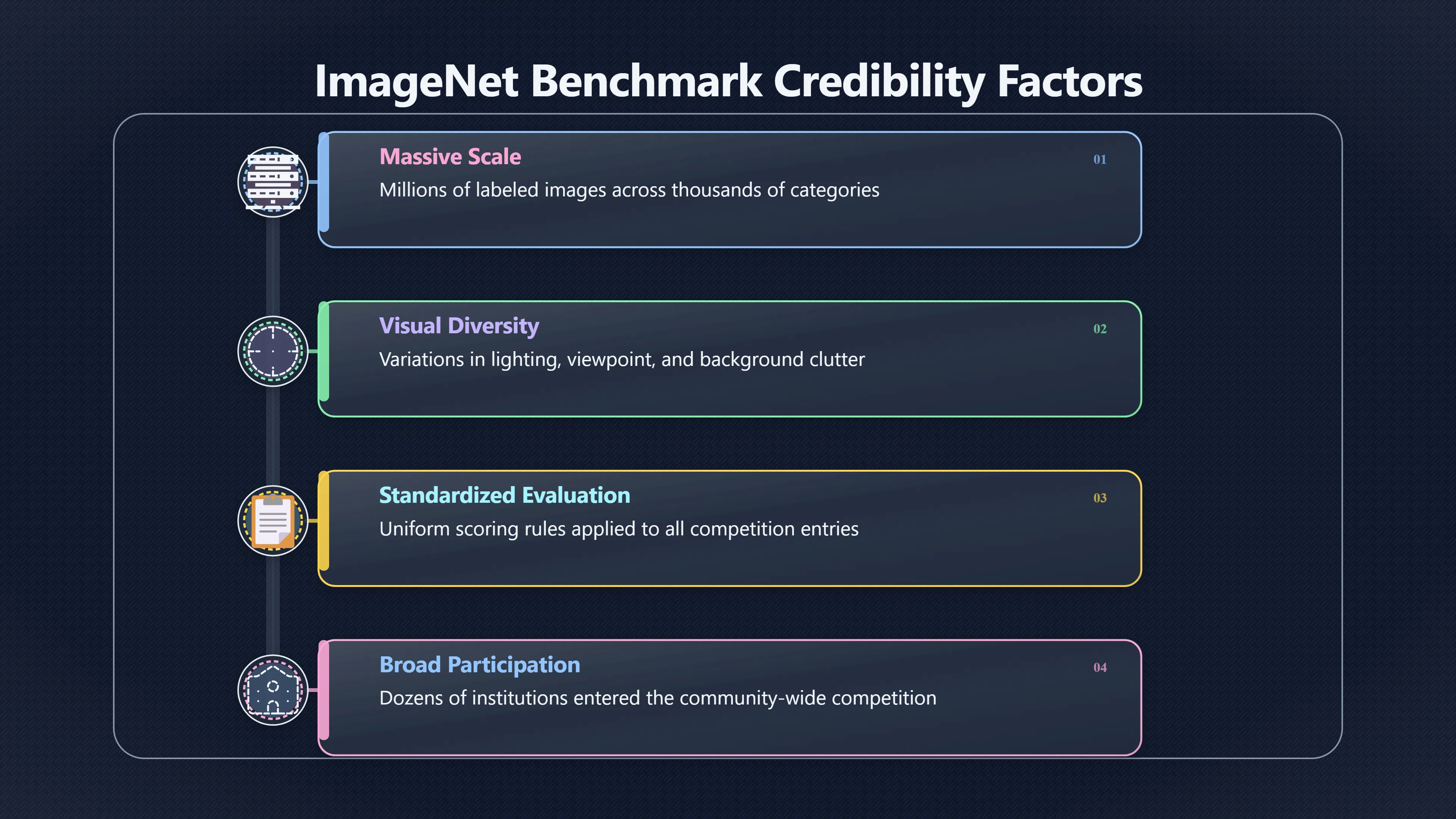
In 2012, the ImageNet challenge asked systems to classify images among 1,000 object categories using a dataset containing more than a million training images. The benchmark was deliberately difficult and had become one of the most important ways of measuring progress in visual recognition.[image-net.org+2image-net.org]image-net.orgLarge Scale Visual Recognition ChallengeThe ImageNet Large Scale Visual Recognition Challenge (ILSVRC) evaluates algorithms for object de…
AlexNet achieved a top-5 error rate of 15.3%, while the second-place system achieved 26.2%. A gap of more than ten percentage points was extraordinary in a field where improvements were often incremental. The result immediately attracted attention because it was not a narrow victory; it was a dramatic leap forward.[ACM Digital Library+2Wikipedia]dl.acm.orgACM Digital LibraryImageNet classification with deep convolutional neural…by A Krizhevsky · 2012 · Cited by 156222 — We also entered a…
The deeper significance was psychological as much as technical. Many researchers had viewed deep neural networks as difficult to train, computationally expensive, and unlikely to outperform carefully engineered feature-based systems. AlexNet provided public evidence that those assumptions were becoming outdated.[Pinecone]pinecone.ioAlexNet and ImageNet: The Birth of Deep LearningAlexNet dominated the competition, and they did it with a deep-layered Convolutio…
What ImageNet measured before AlexNet
To understand why the result mattered, it helps to understand what ImageNet represented.
ImageNet was not a small laboratory dataset. It was a large-scale benchmark designed to test whether a system could recognise thousands of object types under realistic conditions. Images varied in lighting, angle, background clutter and object appearance. Success required more than detecting simple edges or textures.[image-net.org+2arXiv]image-net.orgImageNetImageNet is an image database organized according to the WordNet hierarchy (currently only the nouns), in which each node of the…
Before AlexNet, leading computer-vision systems often depended on hand-designed features such as SIFT descriptors, colour statistics and other engineered representations. Researchers spent considerable effort deciding which visual characteristics should be extracted before classification. Performance improvements typically came from better feature engineering and more sophisticated classifiers rather than from learning representations directly from raw image data.[image-net.org]image-net.orgAll results Task 1 (classification) Mixed selection from High-Level SVM scores and Baseline Scores…
AlexNet challenged that workflow. Instead of relying primarily on manually designed visual descriptors, it learned representations automatically through multiple layers of computation. The benchmark therefore became a test not only of classification accuracy but also of whether representation learning could outperform traditional feature engineering at scale.[NeurIPS Proceedings]proceedings.neurips.cc4824 imagenet classification with deep convolutional neural networksNeurIPS ProceedingsImageNet Classification with Deep Convolutional Neural…by A Krizhevsky · Cited by 154940 — We trained a large, deep…
Why depth, GPUs and dropout mattered together
One reason AlexNet became so influential is that it demonstrated the importance of combining several advances rather than relying on a single innovation.
Depth enabled richer visual representations
The network contained multiple convolutional layers followed by fully connected layers. This depth allowed the model to build increasingly abstract representations from raw pixels. Lower layers could respond to simple visual structures, while deeper layers could combine those signals into more complex patterns useful for recognising objects. The authors argued that the network’s depth was essential to its performance.[NeurIPS Proceedings]proceedings.neurips.cc4824 imagenet classification with deep convolutional neural networksNeurIPS ProceedingsImageNet Classification with Deep Convolutional Neural…by A Krizhevsky · Cited by 154940 — We trained a large, deep…
GPUs made large-scale training practical
Deep networks had existed before 2012, but training them on large datasets was often prohibitively slow. AlexNet exploited graphics processing units (GPUs), which were well suited to the highly parallel calculations required by neural networks. The model was split across two GPUs because a single device could not hold the entire network. This hardware strategy dramatically reduced training time and helped demonstrate that large deep networks could be trained on real-world datasets.[Wikipedia+2neurohive.io]WikipediaAlex NetAlex Net
Dropout helped control overfitting
A large model trained on over a million images still faced the risk of memorising patterns that would not generalise to new data. AlexNet used dropout, a regularisation technique that temporarily removes random units during training. This reduced co-dependence between neurons and improved generalisation. Combined with data augmentation, dropout helped make a very large network practical rather than merely powerful.[Helios 2+2NeurIPS Proceedings]helios2.mi.parisdescartes.frAlex Net12Helios 2ImageNet classification with deep convolutional neural networksby A Krizhevsky · 2017 · Cited by 43703 — To reduce overfitting in…
The combination mattered more than any single ingredient
None of these components alone explains the breakthrough. Depth provided representational power, GPUs supplied the necessary computation, and dropout helped the model generalise. AlexNet became a landmark because it showed that these elements could work together successfully on a benchmark large enough to convince sceptics.[NeurIPS Proceedings+2Dive into Deep Learning]proceedings.neurips.cc4824 imagenet classification with deep convolutional neural networksNeurIPS ProceedingsImageNet Classification with Deep Convolutional Neural…by A Krizhevsky · Cited by 154940 — We trained a large, deep…
What the breakthrough did and did not prove
AlexNet’s success proved several important points.
First, it demonstrated that deep neural networks could achieve state-of-the-art performance on a major real-world benchmark when sufficient data and computing power were available. Second, it showed that learned representations could outperform many hand-crafted feature pipelines. Third, it convinced researchers and companies that investing in deep learning was likely to produce substantial returns. The years immediately following 2012 saw an explosion of research into deeper and more capable neural-network architectures.[ACM Digital Library+2arXiv]dl.acm.orgACM Digital LibraryImageNet classification with deep convolutional neural…by A Krizhevsky · 2012 · Cited by 156222 — We also entered a…
However, the breakthrough did not prove that deep learning had solved vision, let alone intelligence.
AlexNet was highly specialised for image classification. It could recognise patterns in labelled images but did not understand scenes in a human sense, reason about the world, or transfer knowledge broadly across tasks. Its success also depended on large quantities of labelled data and significant computational resources. The result showed that deep learning was a powerful approach, not that it had eliminated all limitations of machine perception.[NeurIPS Proceedings]proceedings.neurips.cc4824 imagenet classification with deep convolutional neural networksNeurIPS ProceedingsImageNet Classification with Deep Convolutional Neural…by A Krizhevsky · Cited by 154940 — We trained a large, deep…
A common misunderstanding is that AlexNet instantly created modern AI. In reality, it served as a turning point. It provided a compelling demonstration that persuaded much of the research community to revisit and expand ideas that had existed for years. The subsequent progress of deep learning came from many later advances, but AlexNet supplied the public proof that large-scale representation learning could deliver results that previous approaches struggled to match.[Wikipedia+2ACM Digital Library]WikipediaAlex NetAlex Net

Why the result became visible beyond computer vision
Many research papers improve benchmarks, yet few become historical milestones. AlexNet became visible because its victory was easy to understand. A respected competition existed, a measurable score was published, and the winning system achieved a surprisingly large improvement. The result created a clear before-and-after moment that could be recognised by researchers, technology companies and eventually the broader public.[ACM Digital Library+2arXiv]dl.acm.orgACM Digital LibraryImageNet classification with deep convolutional neural…by A Krizhevsky · 2012 · Cited by 156222 — We also entered a…
In that sense, AlexNet’s importance lies not only in the architecture itself but in what it revealed. It transformed deep learning from a promising research direction into a demonstrated practical method. For many observers, 2012 was the moment when deep learning stopped being a niche idea and became the central story of modern artificial intelligence.[Wikipedia+2viso.ai]WikipediaAlex NetAlex Net
Amazon book picks
Further Reading
Books and field guides related to Why did AlexNet change AI history?. Use these as the next step if you want deeper reading beyond the article.
Hands-on Machine Learning with Scikit-Learn, Keras, and Tenso...
Includes image-classification and CNN examples inspired by landmark systems.
Deep Learning
Rating: 3.5/5 from 6 Google Books ratings
Covers convolutional networks and the breakthroughs that followed AlexNet.
Computer Vision
Provides context for the shift from handcrafted vision pipelines to deep learning.
eBay marketplace picks
Marketplace Samples
Example marketplace items related to this page. Use the search link to explore similar finds on eBay.




Endnotes
1.
Source: dl.acm.org
Link:https://dl.acm.org/doi/10.5555/2999134.2999257
Source snippet
ACM Digital LibraryImageNet classification with deep convolutional neural...by A Krizhevsky · 2012 · Cited by 156222 — We also entered a...
2.
Source: proceedings.neurips.cc
Title: 4824 imagenet classification with deep convolutional neural networks
Link:https://proceedings.neurips.cc/paper/4824-imagenet-classification-with-deep-convolutional-neural-networks.pdf
Source snippet
NeurIPS ProceedingsImageNet Classification with Deep Convolutional Neural...by A Krizhevsky · Cited by 154940 — We trained a large, deep...
3.
Source: arxiv.org
Link:https://arxiv.org/abs/1409.0575
Source snippet
ImageNet Large Scale Visual Recognition Challengeby O Russakovsky · 2014 · Cited by 55542 — The ImageNet Large Scale Visual Recognit...
4.
Source: image-net.org
Link:https://www.image-net.org/challenges/LSVRC/
Source snippet
Large Scale Visual Recognition ChallengeThe ImageNet Large Scale Visual Recognition Challenge (ILSVRC) evaluates algorithms for object de...
5.
Source: image-net.org
Link:https://www.image-net.org/challenges/LSVRC/2012/
Source snippet
ImageNet Large Scale Visual Recognition Challenge 2012The goal of this competition is to estimate the content of photographs for the purp...
6.
Source: image-net.org
Link:https://www.image-net.org/
Source snippet
ImageNetImageNet is an image database organized according to the WordNet hierarchy (currently only the nouns), in which each node of the...
7.
Source: Wikipedia
Title: Alex Net
Link:https://en.wikipedia.org/wiki/AlexNet
8.
Source: pinecone.io
Link:https://www.pinecone.io/learn/series/image-search/imagenet/
Source snippet
AlexNet and ImageNet: The Birth of Deep LearningAlexNet dominated the competition, and they did it with a deep-layered Convolutio...
9.
Source: image-net.org
Link:https://www.image-net.org/challenges/LSVRC/index.php
Source snippet
One high level...Read more...
10.
Source: image-net.org
Link:https://image-net.org/challenges/LSVRC/2012/results.html
Source snippet
All results Task 1 (classification) Mixed selection from High-Level SVM scores and Baseline Scores...
11.
Source: neurohive.io
Title: Alex Net
Link:https://neurohive.io/en/popular-networks/alexnet-imagenet-classification-with-deep-convolutional-neural-networks/
Source snippet
AlexNet - ImageNet Classification with CNNOct 29, 2018 — The results show that a large, deep convolutional neural network is capable of a...
12.
Source: viso.ai
Link:https://viso.ai/deep-learning/alexnet/
Source snippet
A Revolutionary Deep Learning Architecture29 Apr 2024 — AlexNet is an Image Classification model that transformed deep learning. It was i...
13.
Source: helios2.mi.parisdescartes.fr
Title: Alex Net12
Link:https://helios2.mi.parisdescartes.fr/~lomn/Cours/RNVO/AlexNet12.pdf
Source snippet
Helios 2ImageNet classification with deep convolutional neural networksby A Krizhevsky · 2017 · Cited by 43703 — To reduce [overfitting]({{ 'overfitting/' | relative_url }}) in...
14.
Source: d2l.ai
Title: Dive into Deep Learning8.1
Link:https://d2l.ai/chapter_convolutional-modern/alexnet.html
Source snippet
Deep Convolutional Neural Networks (AlexNet)AlexNet's structure bears a striking resemblance to LeNet, with a number of critical improvem...
15.
Source: mohitjain.me
Link:https://mohitjain.me/2018/06/06/alexnet/
Source snippet
Paper Explanation: ImageNet Classification with Deep...Jun 6, 2018 — AlexNet famously won the 2012 ImageNet LSVRC-2012 competition by a...
Additional References
16.
Source: medium.com
Link:https://medium.com/%40abhishekjainindore24/deep-learning-architecture-2-alexnet-8018f7640161
Source snippet
Deep Learning Architecture 2: Alexnet | by Abhishek JainAlexNet consists of eight layers: five convolutional layers followed by three fu...
17.
Source: medium.com
Link:https://medium.com/%40alriffaud/imagenet-classification-with-deep-convolutional-neural-networks-a-detailed-analysis-of-krizhevsky-d41d6fe418fd
Source snippet
ImageNet Classification with Deep Convolutional Neural...This implementation captures the core of AlexNet's architecture, including conv...
18.
Source: slideshare.net
Link:https://www.slideshare.net/slideshow/alexnetimagenet-classification-with-deep-convolutional-neural-networks-91159705/91159705
Source snippet
AlexNet(ImageNet Classification with Deep Convolutional...The document details the architecture and results of AlexNet, a convolutional...
19.
Source: medium.com
Link:https://medium.com/%40arberzylyftari123/the-paper-that-changed-ai-forever-alexnet-and-the-deep-learning-revolution-f5643ec995af
20.
Source: karan3-zoh.medium.com
Link:https://karan3-zoh.medium.com/paper-summary-imagenet-classification-with-deep-convolutional-neural-networks-41ce6c65960
Source snippet
Architecture Paper Summary | Medium - Karan UppalThis is a revolutionary paper in the find of Deep Learning that introduces the AlexNet m...
21.
Source: itaimle.com
Link:https://www.itaimle.com/index.php/ijaiml/article/download/201/74
Source snippet
p ImageNet Classification with Deep Conby R Sandeep · 2012 — In the 2012 ImageNet Large Scale Visual Recognition Challenge (ILSVRC)...
22.
Source: medium.com
Title: [understanding]({{ ‘understanding/’ | relative_url }}) alexnet the 2012 breakthrough that changed ai forever 7c365cf76969
Link:https://medium.com/%40shivsingh483/understanding-alexnet-the-2012-breakthrough-that-changed-ai-forever-7c365cf76969
Source snippet
Understanding AlexNet: The 2012 Breakthrough That...AlexNet's 15.3% top-5 error rate was unprecedented, drastically outperforming previo...
23.
Source: medium.com
Link:https://medium.com/design-bootcamp/summary-alexnet-caffenet-winner-of-ilsvrc-2012-image-classification-c9ada890663
Source snippet
Summary: AlexNet, CaffeNet — Winner of ILSVRC 2012...ILSVRC (ImageNet Large Scale Visual Recognition Competition), an image classificati...
24.
Source: tomshardware.com
Title: Tom’s Hardware Two GTX 580s in SLI are [responsible]({{ ‘responsible-ai/’ | relative_url }}) for the AI we have today
Link:https://www.tomshardware.com/tech-industry/artificial-intelligence/two-gtx-580s-in-sli-are-responsible-for-the-ai-we-have-today-nvidias-huang-revealed-that-the-invention-of-deep-learning-began-with-two-flagship-fermi-gpus-in-2012
Source snippet
Researchers at the University of Toronto, namely Alex Krizhevsky, Ilya Sutskever, and Geoffrey Hinton, developed AlexNet—an eight-layer c...
25.
Source: researchgate.net
Title: 385379683 Deep Learning in Image Recognition A New Era for Computer Vision
Link:https://www.researchgate.net/publication/385379683_Deep_Learning_in_Image_Recognition_A_New_Era_for_Computer_Vision
Source snippet
Deep Learning in Image Recognition: A New Era for...13 Nov 2024 — This paper explores the advancements in image recognition, spotlightin...
Topic Tree