Within AI Errors
The court case that exposed fake AI law
The Mata v.
On this page
- What went wrong in the filing
- Why legal hallucinations are unusually risky
- What the case changed about verification
Page outline Jump by section
Introduction
Mata v. Avianca became the most famous early example of an AI hallucination causing real-world professional consequences. In 2023, lawyers representing a passenger in a lawsuit against Avianca Airlines submitted a court filing that cited multiple legal cases which did not exist. The citations had been generated by ChatGPT and were accepted by the lawyers without proper verification. When the court investigated, it discovered that the cases were fictional. The incident led to sanctions against the attorneys and quickly became a defining warning about the risks of relying on generative AI for factual research.[Justia]law.justia.comMata v. Avianca, Inc., No. 1:2022cv01461 - Document 55 (S.D.N.Y. 2023):: JustiaJune 22, 2023…
 Within the broader story of artificial intelligence, the case is significant because it demonstrated that AI systems can produce highly convincing false information, complete with fabricated citations, quotations and legal reasoning. Unlike a simple factual mistake, the output looked authentic enough to pass through professional review and enter a federal court record.[IXSOR]ixsor.comMata v. Avianca, Three Years On · IXSORMay 6, 2026…
What went wrong in the filing
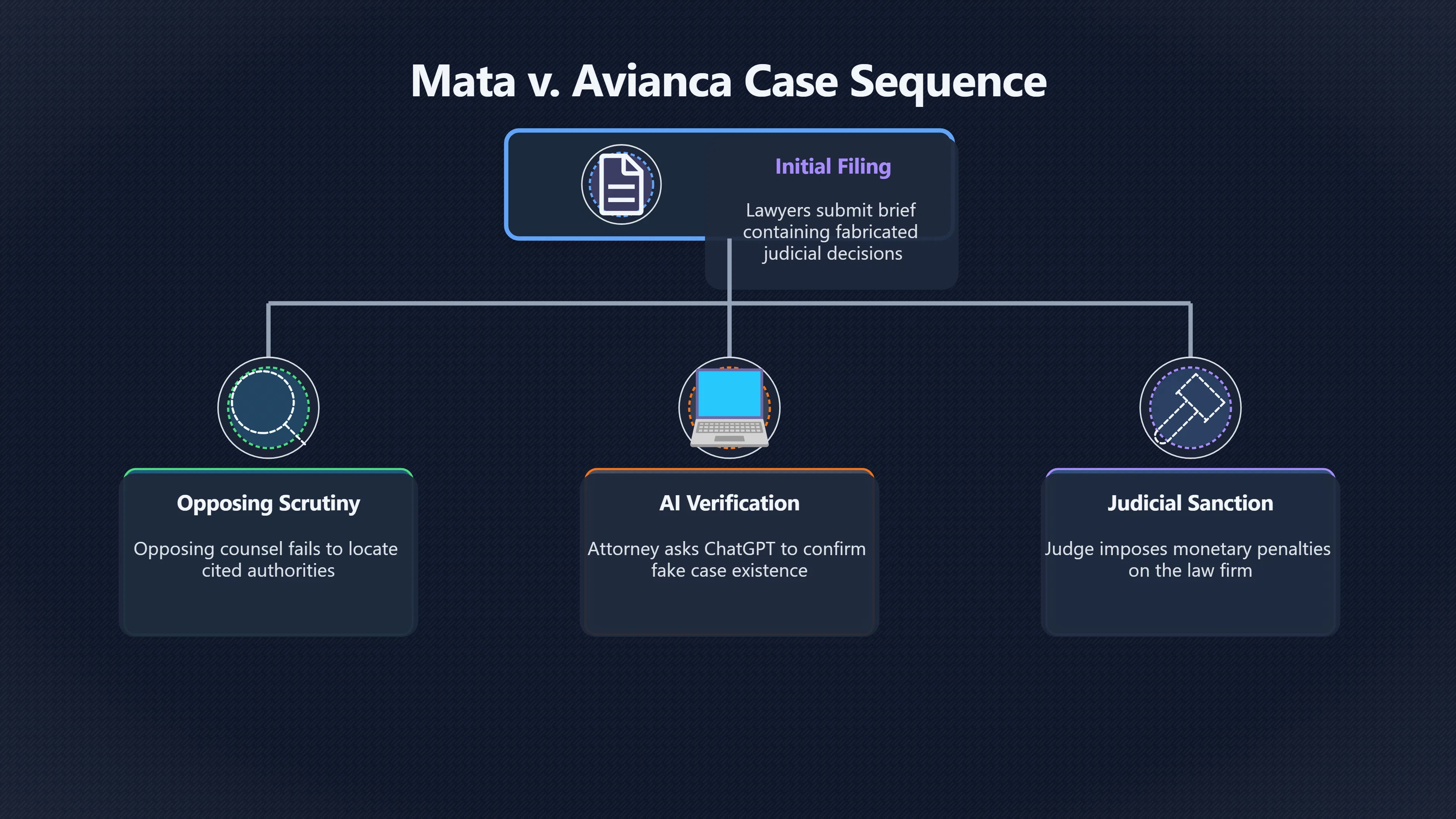
The underlying lawsuit involved claims brought by passenger Roberto Mata against Avianca. During briefing on a procedural issue, plaintiff’s counsel submitted a filing that relied on several supposed judicial decisions. Opposing lawyers and the court were unable to locate those authorities in legal databases, triggering further scrutiny.[Justia]law.justia.comMata v. Avianca, Inc., No. 1:2022cv01461 - Document 55 (S.D.N.Y. 2023):: JustiaJune 22, 2023…
The investigation revealed that attorney Steven Schwartz had used ChatGPT to help conduct legal research. The system generated citations to cases such as Varghese v. China Southern Airlines, Shaboon v. Egyptair and Petersen v. Iran Air. These cases were not merely misquoted or misunderstood; they did not exist at all. ChatGPT also supplied fabricated summaries, quotations and procedural details that made the authorities appear genuine.[AI Wiki]aiwiki.aiAI Wiki AI in law | AI WikiAI WikiAI in law | AI WikiMarch 25, 2026…
A particularly striking aspect of the incident was what happened after the citations were challenged. Rather than independently verifying the authorities through established legal research tools, Schwartz reportedly asked ChatGPT whether the cases were real. The system incorrectly confirmed that they existed and even claimed they could be found in major legal databases. Those assurances were also false.[Responsible AI Labs]responsibleailabs.aiOpen source on responsibleailabs.ai.
Judge P. Kevin Castel concluded that the lawyers had failed in their professional duty to verify the authorities they presented to the court. In June 2023, he sanctioned the attorneys and their law firm, imposing monetary penalties and requiring additional corrective actions.[IXSOR+2AI Wiki]ixsor.comMata v. Avianca, Three Years On · IXSORMay 6, 2026…
Why legal hallucinations are unusually risky
Many AI errors are inconvenient. Legal hallucinations can be much more serious because legal systems depend on verifiable authority. A court filing is expected to cite actual statutes, regulations and judicial opinions. If a lawyer submits invented authorities, judges, opposing parties and clients may all be misled.[American Bar Association]americanbar.orgAmerican Bar Association AI Hallucinations Are Real—and How to Avoid ThemAmerican Bar Association AI Hallucinations Are Real—and How to Avoid Them
The Mata incident exposed several characteristics that make AI-generated legal errors especially dangerous:
- Authority signals can be fabricated. The fake cases included realistic case names, citations and quotations, making them appear trustworthy.[AI Wiki]aiwiki.aiAI Wiki AI in law | AI WikiAI WikiAI in law | AI WikiMarch 25, 2026…
- Confidence can disguise uncertainty. ChatGPT presented the fictional authorities in the same style it would use for genuine cases. Nothing in the text clearly signalled that the information had been invented.[Responsible AI Labs]responsibleailabs.aiOpen source on responsibleailabs.ai.
- Verification shortcuts can fail. Asking the same AI system to verify its own output simply reproduced the original error rather than detecting it.[Responsible AI Labs]responsibleailabs.aiOpen source on responsibleailabs.ai.
- Professional trust is at stake. Courts rely on lawyers to act as gatekeepers who check the accuracy of submitted material. When that process breaks down, confidence in legal proceedings can be damaged.[American Bar Association]americanbar.orgAmerican Bar Association AI Hallucinations Are Real—and How to Avoid ThemAmerican Bar Association AI Hallucinations Are Real—and How to Avoid Them
The case therefore illustrated a broader lesson about large language models: fluency and apparent expertise are not evidence that a statement has been verified against reliable sources.
What the case changed about verification
The immediate impact of Mata v. Avianca was educational. Lawyers, judges and legal organisations suddenly had a concrete example of how generative AI could fail. The incident was widely discussed in legal publications, professional training programmes and court guidance documents.[Legal Mag]legal-mag.comLegal MagLegal Fictions and ChatGPT Hallucinations: ‘Mata v. Avianca’ and Generative AI in the Courts | Legal MagDecember 27, 2023…
Courts and bar associations increasingly emphasised that attorneys remain responsible for everything they submit, regardless of whether a human, a junior colleague or an AI system helped prepare it. The central principle was not that AI tools are forbidden, but that lawyers must independently verify citations and authorities before relying on them.[American Bar Association]americanbar.orgAmerican Bar Association AI Hallucinations Are Real—and How to Avoid ThemAmerican Bar Association AI Hallucinations Are Real—and How to Avoid Them
The influence of the case extended beyond the original dispute. Later courts cited Mata when addressing other examples of fabricated AI-generated legal material. The decision became a reference point in discussions about professional responsibility, legal ethics and AI governance.[American Bar Association]americanbar.orgAmerican Bar Association AI Hallucinations Are Real—and How to Avoid ThemAmerican Bar Association AI Hallucinations Are Real—and How to Avoid Them
Perhaps the most important change was cultural rather than procedural. Before the incident, many users assumed that a confident AI response was likely to be based on real information. After Mata v. Avianca, professionals in law and other evidence-sensitive fields became more aware that AI systems can invent sources, citations and supporting details while maintaining an entirely convincing tone.[IXSOR]ixsor.comMata v. Avianca, Three Years On · IXSORMay 6, 2026…
The lasting lesson from the Avianca case
The enduring importance of Mata v. Avianca is that it transformed the abstract idea of AI hallucination into a concrete, documented event. The problem was not that ChatGPT made a minor mistake. It generated a network of fictional legal authorities that looked authentic enough to enter federal litigation. Human professionals then failed to detect the fabrication before submitting it to a court.[AI Wiki]aiwiki.aiAI Wiki AI in law | AI WikiAI WikiAI in law | AI WikiMarch 25, 2026…
As a result, the case is often cited as the clearest demonstration that generative AI should be treated as a tool for drafting and assistance, not as an unquestioned source of authority. In domains where accuracy depends on precise references and verifiable evidence, independent checking remains essential.[IXSOR]ixsor.comMata v. Avianca, Three Years On · IXSORMay 6, 2026…

Amazon book picks
Further Reading
Books and field guides related to The court case that exposed fake AI law. Use these as the next step if you want deeper reading beyond the article.
Tomorrow's Lawyers
Explores technology's impact on legal work and professional responsibility.
eBay marketplace picks
Marketplace Samples
Example marketplace items related to this page. Use the search link to explore similar finds on eBay.




Endnotes
1.
Source: law.justia.com
Link:https://law.justia.com/cases/federal/district-courts/new-york/nysdce/1%3A2022cv01461/575368/55/
Source snippet
Mata v. Avianca, Inc., No. 1:2022cv01461 - Document 55 (S.D.N.Y. 2023):: JustiaJune 22, 2023...
Published: June 22, 2023
2.
Source: ixsor.com
Link:https://ixsor.com/insights/mata-three-years-on
Source snippet
Mata v. Avianca, Three Years On · IXSORMay 6, 2026...
Published: May 6, 2026
3.
Source: legal-mag.com
Link:https://legal-mag.com/legal-fictions-and-chatgpt-hallucinations-mata-v-avianca-and-generative-ai-in-the-courts/
Source snippet
Legal MagLegal Fictions and ChatGPT Hallucinations: ‘Mata v. Avianca’ and Generative AI in the Courts | Legal MagDecember 27, 2023...
Published: December 27, 2023
4.
Source: americanbar.org
Title: American Bar Association AI Hallucinations Are Real—and How to Avoid Them
Link:https://www.americanbar.org/groups/litigation/resources/newsletters/appellate-practice/ai-hallucinations-real-how-avoid-them/
5.
Source: aiwiki.ai
Title: AI Wiki AI in law | AI Wiki
Link:https://aiwiki.ai/wiki/ai_in_law
Source snippet
AI WikiAI in law | AI WikiMarch 25, 2026...
Published: March 25, 2026
6.
Source: responsibleailabs.ai
Link:https://responsibleailabs.ai/ai-watch/mata-v-avianca-lawyers-sanctioned-for-chatgpt-fabricated-cases
Additional References
7.
Source: youtube.com
Title: The Day AI Entered The Court | The Lawyer Who Cited Cases That Never Existed
Link:http://www.youtube.com/watch?v=CN8wem678cc
Source snippet
Mata v [Avianca fake]({{ 'fake-cases/' | relative_url }}) case law chatgpt lawyer court Episode 5: The Lawyer Who Let AI Hallucinate His Case — Mata v. Avianca Kwiky...
8.
Source: thomsonreuters.com
Title: www.thomsonreuters.com How Harmful Are Errors in AI Research Results?
Link:https://www.thomsonreuters.com/en-us/posts/innovation/how-harmful-are-errors-in-ai-research-results/
Source snippet
Harmful Are Errors in AI Research Results? - Thomson Reuters InstituteAugust 2, 2024...
Published: August 2, 2024
9.
Source: youtube.com
Title: Lawyer files Chat GPT DISASTER in COURT (Mata v. Avianca, Inc.)
Link:http://www.youtube.com/watch?v=GExSDY6Wz9Y
Source snippet
The ChatGPT Fake Cases [Sanctions]({{ 'sanctions/' | relative_url }}) Decision (Mata v. Avianca)...
10.
Source: youtube.com
Title: Lawyers using Chat GPT falsified court case
Link:http://www.youtube.com/watch?v=wcG7s7Nm3EU
Source snippet
The Day AI Entered The Court | The Lawyer Who Cited Cases That Never Existed...
11.
Source: youtube.com
Title: The Chat GPT Fake Cases Sanctions Decision (Mata v. Avianca)
Link:http://www.youtube.com/watch?v=jPtOcsx7ATw
Source snippet
Lawyers using ChatGPT falsified court case...
12.
Source: youtube.com
Title: How to Use Chat GPT to Ruin Your Legal Career
Link:http://www.youtube.com/watch?v=oqSYljRYDEM
Source snippet
Lawyer files ChatGPT DISASTER in COURT (Mata v. Avianca, Inc.)...
13.
Source: texaslawblog.law
Link:https://www.texaslawblog.law/2023/06/sanctions-handed-down-to-lawyers-who-cited-fake-cases-relying-on-chatgpt/
14.
Source: network1consulting.com
Title: Beware Fake Facts: AI Hallucination in [Business]({{ ‘business-adoption/’ | relative_url }})
Link:https://network1consulting.com/a-lawyer-relied-on-chatgpt-to-draft-legal-briefs-in-mata-v-avianca-resulting-in-the-submission-of-fake-case-law-and-court-sanctions-a-warning-to-verify-ai-outputs-and-understand-their-limits/
Source snippet
network1November 12, 2025...
Published: November 12, 2025
15.
Source: law360.com
Title: www.law360.com Mata v. Avianca, Inc
Link:https://www.law360.com/cases/6216208e06646f03ab3490fe/articles
Source snippet
v. Avianca, Inc.July 5, 2023...
Published: July 5, 2023
Topic Tree