Within AI Outputs
When an AI prediction changes what happens next
AI predictions often look like neutral scores, but they can trigger checks, warnings, referrals, prices or refusals.
On this page
- What counts as a prediction in AI systems
- How risk scores shape human and automated decisions
- Why predicted outputs need context, oversight and appeal
Page outline Jump by section
Introduction
Many AI systems do not make final decisions. Instead, they make predictions: estimates about what is likely to be true now or happen in the future. A model might predict the risk of fraud, the chance that a borrower will miss repayments, the likelihood that a medical scan contains signs of disease, or the probability that a customer will cancel a subscription. These predictions often appear as scores, rankings, labels or probabilities rather than direct instructions. Yet they can have immediate effects on people’s lives because organisations use them to decide what happens next.[NIST Publications+2NIST AI Resource Center]nvlpubs.nist.govai.100 1NIST PublicationsArtificial Intelligence Risk Management Framework (AI RMF 1.0)by N AI · 2023 · Cited by 229 — The AI RMF refers to an AI…
 Understanding this step—from prediction to consequence—is essential for understanding artificial intelligence. The prediction itself is a statistical estimate. The consequence arises when people, institutions or automated systems act on that estimate. A risk score may trigger extra scrutiny, a warning, a referral, a price adjustment, a delay, a benefit, or a refusal. The prediction is only one part of the process, but it can strongly shape the path that follows.
What counts as a prediction in AI systems?
An AI prediction is an inference about something that is not directly known. The system uses patterns found in data to estimate an outcome, category or probability.
Common examples include:
- A spam filter predicting whether an email is unwanted.
- A credit model predicting the risk of default.
- A fraud system predicting whether a transaction is suspicious.
- A medical model predicting the likelihood of disease.
- A predictive policing system estimating where crime may occur.[algorithmwatch.org]algorithmwatch.orgban predictive policing aiaAlgorithmWatch signs statement on ban of predictive…1 Mar 2022 — The signatories call for a full prohibition of predictive and profili…
- A recruitment tool predicting which applicants may succeed in a role.[NIST Publications+2NIST AI Resource Center]nvlpubs.nist.govai.100 1NIST PublicationsArtificial Intelligence Risk Management Framework (AI RMF 1.0)by N AI · 2023 · Cited by 229 — The AI RMF refers to an AI…
These outputs are often expressed numerically. A score of 0.8 may mean an estimated 80% likelihood of an event. A ranking may place one person or application ahead of another. A label may classify something as high risk or low risk.
What matters is that the prediction reduces uncertainty for a decision-maker. Once a prediction exists, someone can use it to prioritise attention, allocate resources or restrict access. The prediction therefore becomes part of a wider decision process rather than remaining a neutral piece of information.
How risk scores shape human and automated decisions
The most important mechanism is surprisingly simple. An organisation defines thresholds and actions around a prediction.
For example:
- An AI system generates a risk score.
- The score is compared with a threshold.
- A person or automated process responds.
- The response changes what happens to an individual.
A fraud detection system may automatically freeze transactions above a certain score. A healthcare system may refer patients for further testing when predicted risk exceeds a threshold. A lender may require additional evidence from applicants whose scores indicate greater uncertainty. In each case, the prediction becomes operational through rules attached to it.[ComplexDiscovery]complexdiscovery.comComplex Discovery A Satisfactory Explanation?NIST Proposes Four Principles…The output is the result of a query to an AI system. The output of a system varies by task. A loan appli…
Importantly, consequences do not require full automation. Human decision-makers often receive AI-generated scores as advisory information. Research has shown that risk assessments can change how people weigh risk and make judgments, even when humans retain formal authority over the final decision. The presence of a score can alter attention, priorities and perceptions of acceptable risk.[arXiv]arxiv.orgAlgorithmic Risk Assessments Can Alter Human Decision-Making Processes in High-Stakes Government ContextsDecember 9, 2020…
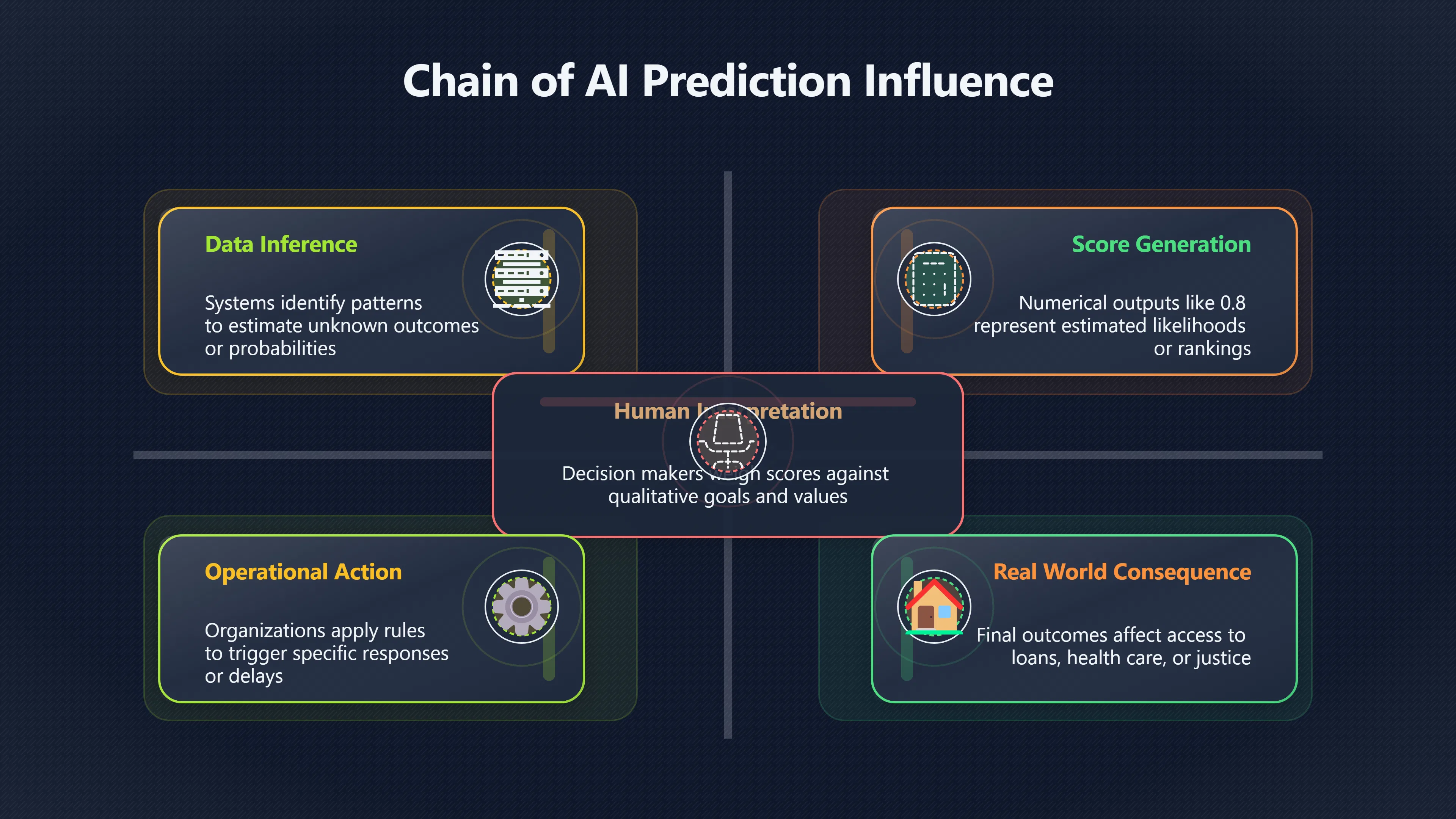
This creates a chain of influence:
Prediction → Interpretation → Action → Consequence
The prediction may not decide, but it can significantly influence the decision-maker who does.
Why a score can feel more objective than it really is
Numbers often carry an aura of precision. A risk score expressed as 73 out of 100 can appear more authoritative than a qualitative judgement, even though both involve uncertainty.
This effect matters because predictions are estimates, not facts. A model does not know whether a person will commit fraud, develop a disease or repay a loan. It estimates probabilities based on historical data and statistical patterns. Treating predictions as certainties can encourage excessive trust in automated outputs. Researchers and regulators have repeatedly warned that AI-generated assessments should be understood within their operational context rather than viewed as infallible indicators of reality.[NIST AI Resource Center+2Securiti]airc.nist.govAI Resource Center AI Risks and TrustworthinessNIST AI Resource CenterAI Risks and Trustworthiness - AIRC - NIST AI Resource CenterThe decision to commission or deploy an AI system sho…

When predictions change opportunities and outcomes
The consequences of AI predictions often become visible through resource allocation.
A prediction can determine:
- Who receives attention first.
- Who is investigated.
- Who gains access to services.
- Who receives additional support.
- Who faces restrictions or delays.
- How resources are distributed across a population.
In healthcare, a prediction may help identify patients who need urgent intervention. In this context, predictive systems can produce beneficial consequences by directing scarce resources towards those most likely to need them.
In other contexts, consequences can be more controversial. Credit scoring systems influence access to loans and financial products. Predictive policing systems can influence where police resources are deployed. Criminal justice risk assessment tools may affect detention, supervision or sentencing decisions. In all these areas, the prediction becomes consequential because institutions act on it.[arXiv+3Springer+3UK Parliament Committees]link.springer.comPredictive policing and algorithmic fairness | Syntheseby TW Hung · 2023 · Cited by 80 — This paper examines racial discriminatio…
The key point is that the social impact comes from the combination of prediction and policy. The same score could lead to very different outcomes depending on the rules attached to it.
Why prediction errors matter
Every predictive system makes mistakes.
Two common error types are:
- False positives: predicting a problem that does not actually exist.
- False negatives: failing to predict a problem that does exist.
A fraud system that incorrectly flags legitimate transactions creates inconvenience and potential financial harm. A medical model that misses a genuine illness can delay treatment. A credit model that wrongly identifies someone as high risk may affect their access to financial opportunities.[RoAI Institute]roaiinstitute.comRo AI Institute Executive Guide to AI Risk: Managing Automated DecisionsRoAI InstituteExecutive Guide to AI Risk: Managing Automated DecisionsJuly 8, 2025 — Example: Predictive maintenance fails to detect equi…
Because predictions trigger actions, errors can propagate through institutions. The consequence is often experienced not as a statistical mistake but as a practical outcome: a delayed payment, an additional inspection, a rejected application or a missed opportunity.
This is one reason why debates about AI often focus less on predictive accuracy alone and more on the real-world effects of errors.
Why predicted outputs need context, oversight and appeal
A prediction rarely contains all the information needed for a fair decision. Human situations involve competing values, exceptions and contextual factors that may not be captured in the data used by a model.
Research on algorithmic risk assessments suggests that improving prediction accuracy does not automatically improve decision quality. Human decisions often involve balancing risk against other goals such as fairness, proportionality, public interest or individual circumstances. When predictive systems shift attention towards a single measurable risk, they can unintentionally change broader policy outcomes.[arXiv]arxiv.orgAlgorithmic Risk Assessments Can Alter Human Decision-Making Processes in High-Stakes Government ContextsDecember 9, 2020…
For this reason, many governance frameworks emphasise:
- Human oversight.
- Transparency about how predictions are used.
- Monitoring for unfair impacts.
- Procedures for review and challenge.
- Careful evaluation of the context in which predictions influence decisions.[NIST AI Resource Center+2ssm-italia.eu]airc.nist.govAI Resource Center AI Risks and TrustworthinessNIST AI Resource CenterAI Risks and Trustworthiness - AIRC - NIST AI Resource CenterThe decision to commission or deploy an AI system sho…
Appeal mechanisms are especially important because individuals may need a way to contest decisions influenced by inaccurate or misleading predictions. Without meaningful review, a statistical estimate can become difficult to challenge once it is embedded in organisational processes.
The central lesson: predictions are not consequences, but they create them
An AI prediction is not the same thing as a decision. It is an estimate generated from available data. However, predictions gain power when organisations build actions around them. A score can trigger investigations, referrals, approvals, denials, prioritisation or monitoring. Once that happens, a statistical output becomes part of a social process that affects real people.
Understanding AI therefore requires looking beyond the prediction itself. The crucial question is not only whether a model is accurate, but also what happens when people and institutions act on its output. That is the point where machine-generated estimates become real-world consequences. NIST AI Resource Center+2NIST AI Resource Center[airc.nist.gov]airc.nist.govAI Resource Center ExecutiveNIST AI Resource CenterExecutive Summary - AIRC - NIST AI Resource CenterThe AI RMF refers to an AI system as an engineered or machine-ba…
Amazon book picks
Further Reading
Books and field guides related to When an AI prediction changes what happens next. Use these as the next step if you want deeper reading beyond the article.
Prediction Machines
Directly explains prediction as the central function of many AI systems and how predictions drive decisions.
The Alignment Problem
Covers prediction, learning systems, and the human consequences of AI outputs.
Power and Prediction
Examines how organisations change when AI predictions become embedded in workflows.
Weapons of Math Destruction
Shows how predictive models influence consequential outcomes in society.
eBay marketplace picks
Marketplace Samples
Example marketplace items related to this page. Use the search link to explore similar finds on eBay.




Endnotes
1.
Source: nvlpubs.nist.gov
Title: ai.100 1
Link:https://nvlpubs.nist.gov/nistpubs/ai/nist.ai.100-1.pdf
Source snippet
NIST PublicationsArtificial Intelligence Risk Management Framework (AI RMF 1.0)by N AI · 2023 · Cited by 229 — The AI RMF refers to an AI...
2.
Source: airc.nist.gov
Title: AI Resource Center Executive
Link:https://airc.nist.gov/airmf-resources/airmf/0-ai-rmf-1-0/
Source snippet
NIST AI Resource CenterExecutive Summary - AIRC - NIST AI Resource CenterThe AI RMF refers to an AI system as an engineered or machine-ba...
3.
Source: csrc.nist.gov
Title: Computer Security Resource Centerartificial intelligence
Link:https://csrc.nist.gov/glossary/term/artificial_intelligence
Source snippet
NIST Computer Security Resource Centerartificial intelligence - Glossary | CSRCDefinitions: A machine-based system that can, for a given...
4.
Source: link.springer.com
Link:https://link.springer.com/article/10.1007/s11229-023-04189-0
Source snippet
Predictive policing and algorithmic fairness | Syntheseby TW Hung · 2023 · Cited by 80 — This paper examines racial discriminatio...
5.
Source: complexdiscovery.com
Title: Complex Discovery A Satisfactory Explanation?
Link:https://complexdiscovery.com/a-satisfactory-explanation-nist-proposes-four-principles-for-explainable-ai-systems/
Source snippet
NIST Proposes Four Principles...The output is the result of a query to an AI system. The output of a system varies by task. A loan appli...
6.
Source: arxiv.org
Link:https://arxiv.org/abs/2012.05370
Source snippet
Algorithmic Risk Assessments Can Alter Human Decision-Making Processes in High-Stakes Government ContextsDecember 9, 2020...
Published: December 9, 2020
7.
Source: arxiv.org
Link:https://arxiv.org/abs/2109.01443
8.
Source: airc.nist.gov
Title: AI Resource Center AI Risks and Trustworthiness
Link:https://airc.nist.gov/airmf-resources/airmf/3-sec-characteristics/
Source snippet
NIST AI Resource CenterAI Risks and Trustworthiness - AIRC - NIST AI Resource CenterThe decision to commission or deploy an AI system sho...
9.
Source: securiti.ai
Title: nist ai risk management framework
Link:https://securiti.ai/nist-ai-risk-management-framework/
Source snippet
Explained17 Aug 2023 — This framework provides a structured approach to identify, assess, and mitigate the risks associated with AI syste...
10.
Source: committees.parliament.uk
Link:https://committees.parliament.uk/writtenevidence/79911/html/
Source snippet
UK Parliament CommitteesALG0030 - Evidence on Algorithms in decision-makingThe Supreme Court of Wisconsin has recently ruled on the chall...
11.
Source: arxiv.org
Link:https://arxiv.org/abs/2205.13505
Source snippet
Flipping the Script on Criminal Justice Risk Assessment: An actuarial model for assessing the risk the federal sentencing system pos...
12.
Source: ssm-italia.eu
Link:https://ssm-italia.eu/wp-content/uploads/2025/02/JuLIA_handbook-Justice_final.pdf
Source snippet
ARTIFICIAL INTELLIGENCE, JUDICIAL DECISION-MAKING...mitigation of risks and impacts to ensure that AI systems respect human rights, the...
13.
Source: nist.gov
Link:https://www.nist.gov/
Source snippet
National Institute of Standards and TechnologyNIST promotes U.S. innovation and industrial competitiveness by advancing measurement scien...
14.
Source: securiti.ai
Title: Understanding the Role of NIST AI Guidelines in Mitigating
Link:https://securiti.ai/cybersecurity-in-nist-ai-guidelines/
Source snippet
May 21, 2024 — This blog delves into how NIST AI guidelines aim to mitigate the cybersecurity risks associated with AI, providing a frame...
Published: May 21, 2024
15.
Source: link.springer.com
Link:https://link.springer.com/article/10.1007/s44163-026-01040-6
Source snippet
erosion of equality and remedy in algorithmic decision...by B Johari · 2026 · Cited by 1 — This article develops a dual erosion framewor...
16.
Source: digital.gov.au
Link:https://www.digital.gov.au/policy/ai/AI-technical-standard/technical-standard-governments-use-artificial-intelligence-key-terms
Source snippet
n AI system to select actions by examining their possible consequences using the...Read more...
17.
Source: roaiinstitute.com
Title: Ro AI Institute Executive Guide to AI Risk: Managing Automated Decisions
Link:https://roaiinstitute.com/your-ai-is-making-critical-[business
Source snippet
RoAI InstituteExecutive Guide to AI Risk: Managing Automated DecisionsJuly 8, 2025 — Example: Predictive maintenance fails to detect equi...
Published: July 8, 2025
18.
Source: GOV.UK
Title: main report cdei review into bias in algorithmic decision making
Link:https://www.gov.uk/government/publications/cdei-publishes-review-into-bias-in-algorithmic-decision-making/main-report-cdei-review-into-bias-in-algorithmic-decision-making
Source snippet
into bias in algorithmic decision-making27 Nov 2020 — This review considers the impact that an increasing use of algorithmic tools is hav...
19.
Source: algorithmwatch.org
Title: ban predictive policing aia
Link:https://algorithmwatch.org/en/ban-predictive-policing-aia/
Source snippet
AlgorithmWatch signs statement on ban of predictive...1 Mar 2022 — The signatories call for a full prohibition of predictive and profili...
20.
Source: digital.nsw.gov.au
Title: nsw.gov.ausimplified AI definitions from leading standards
Link:https://www.digital.nsw.gov.au/policy/artificial-intelligence/a-common-understanding-simplified-ai-definitions-from-leading
Source snippet
Digital NSWA recommendation system is an AI system that suggests personalized content or products to users based on their preferences and...
21.
Source: assets.publishing.service.gov.uk
Title: publishing.service.gov.uk Landscape
Link:https://assets.publishing.service.gov.uk/media/5d31c30a40f0b64a8099e21d/Landscape_Summary_-_Bias_in_Algorithmic_Decision-Making.pdf
Source snippet
Summary: Bias in Algorithmic Decision-Makingby M Rovatsos — Calibration: An algorithm is well-calibrated if the risk scores it gives to...
Additional References
22.
Source: researchgate.net
Link:https://www.researchgate.net/publication/400119651_Bias_Fairness_and_Explainability_in_AI-Driven_Credit_Scoring_A_Critical_Review_of_Algorithmic_Governance_in_Financial_Risk_Assessment
Source snippet
Bias, Fairness, and Explainability in AI-Driven Credit Scoring31 Jan 2026 — This narrative review condenses recent research on bias detec...
23.
Source: medium.com
Link:https://medium.com/%40adnanmasood/ai-system-harms-case-studies-in-bias-misinformation-and-accountability-319bde873e57
Source snippet
AI System Harms & Case Studies in Bias, Misinformation...Cases like risk scoring in criminal justice, algorithmic hiring screens, welfar...
24.
Source: autoriteitpersoonsgegevens.nl
Link:https://www.autoriteitpersoonsgegevens.nl/en/system/files?file=2025-11%2FSummary+call+for+input+AI+systems+for+social+scoring.pdf
Source snippet
AI systems for social scoringThere are concerns about the possible discriminatory effects of social scoring systems. In addition, there i...
25.
Source: linkedin.com
Link:https://www.linkedin.com/pulse/nist-ai-risk-management-framework-best-practices-dr-sunando-roy-k82gf
Source snippet
NIST AI Risk Management Framework: Best Practices for...The NIST AI RMF 1.0 is a voluntary, flexible, and non-prescriptive framework des...
26.
Source: jlsda.com
Link:https://jlsda.com/index.php/lsda/article/view/324
Source snippet
The Legal Implications of Predictive Policing AlgorithmsThe review concludes by emphasizing the need for robust regulatory reforms ground...
27.
Source: europarl.europa.eu
Link:https://www.europarl.europa.eu/RegData/etudes/BRIE/2025/775861/EPRS_BRI%282025%29775861_EN.pdf
Source snippet
intelligence in asylum procedures in the EUAI tools could be used in different stages of the asylum process, including initial translatio...
28.
Source: datacrossroads.nl
Link:https://datacrossroads.nl/2025/11/06/making-sense-of-ai-regulations-and-frameworks-understanding-[risk-based
Source snippet
Making Sense of AI Regulations and Frameworks6 Nov 2025 — This article explores risk-based AI regulations—how they classify systems by ri...
29.
Source: thoropass.com
Link:https://www.thoropass.com/blog/nist-ai-rmf
Source snippet
The NIST defines AI as the capability of a machine to perform tasks that would typically require human intelligence. This...Read more...
30.
Source: avolutionsoftware.com
Link:https://www.avolutionsoftware.com/our-resources/nist-ai-risk-management-framework-rmf/
Source snippet
These characteristics help organizations assess whether an AI system can be relied...Read more...
31.
Source: holisticai.com
Link:https://www.holisticai.com/blog/ai-definition-comparison
Source snippet
ions, decisions, and content; It is generally accepted that humans play a role in...Read more...
Topic Tree