Within Predictions
What happens when an AI prediction is wrong?
False positives and false negatives matter because model mistakes can turn into delays, denials, missed care or extra scrutiny.
On this page
- False positives and false negatives in everyday systems
- How errors propagate through organisational processes
- Why accuracy alone does not measure real harm
Page outline Jump by section
Introduction
AI predictions are never perfect. A model that estimates fraud risk, disease risk or the likelihood of loan default will inevitably make mistakes. The crucial question is not whether errors occur, but what happens when organisations act on those errors. A false alarm can delay a payment, trigger an investigation or deny access to a service. A missed warning can allow fraud to proceed, leave a medical condition undetected or expose people to preventable risks. The practical harm comes from the decisions and processes attached to a prediction, not from the prediction alone. Research and governance frameworks such as the NIST AI Risk Management Framework emphasise that AI risks arise from the interaction between technical performance, human judgement and organisational systems rather than from model accuracy in isolation.[NIST Publications+2NIST]nvlpubs.nist.govai.100 1Comments on the AI RMF Playbook may be sent via email to AIframework@nist.gov at any time…
 Understanding why prediction errors become real-world harms is essential for understanding artificial intelligence. The same statistical error can be relatively harmless in one setting and highly consequential in another depending on how institutions respond to it.
False positives and false negatives in everyday systems
The two most common prediction errors are false positives and false negatives.
A false positive occurs when a system predicts a problem that is not actually present. A false negative occurs when a system fails to detect a problem that does exist. Every predictive system faces a trade-off between these error types. Reducing one often increases the other. NIST guidance therefore encourages organisations to measure and document both kinds of error rather than relying on a single accuracy score.[EPIC]epic.orgFraming the Risk Management Framework: Actionable…Apr 13, 2023 — Measure and document performance criteria such as accuracy (false…
In practice, the harms are often very different:
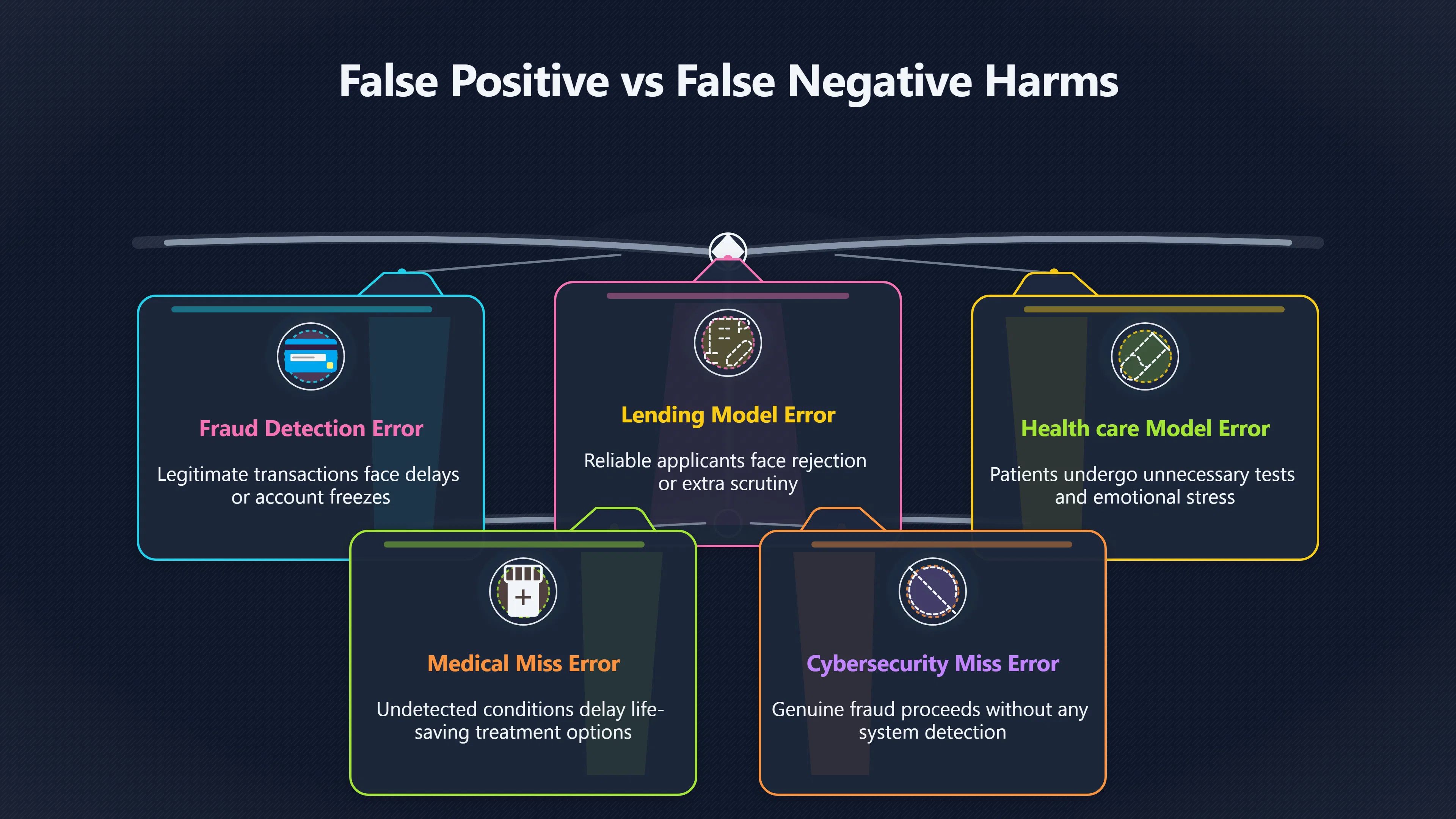
- A fraud detection system may incorrectly flag a legitimate transaction, delaying access to money or creating inconvenience for customers.
- A lending model may wrongly classify a reliable applicant as high risk, leading to rejection or additional scrutiny.
- A healthcare model may incorrectly identify a patient as high risk, resulting in unnecessary tests and anxiety.
- A medical prediction system may miss signs of disease, delaying treatment that could have improved outcomes.
- A fraud system may fail to detect genuine fraud, allowing financial losses to continue.[LSEG+2The Payments Association]lseg.comUnderstanding False Positives in ScreeningUnderstanding False Positives in Screening - GlossaryIn financial risk management, a false positive refers to an erroneous system ale…
The significance of an error depends on its consequences. In some applications, a false positive is mainly an inconvenience. In others, it can affect employment, healthcare, financial access or public services. Likewise, some false negatives merely reduce efficiency, while others can create serious safety risks. Studies of fraud detection and cybersecurity repeatedly show that organisations often assign different costs to different error types because the consequences are not symmetrical.[MDPI]mdpi.comReducing False Negatives in Ransomware Detectionby R Bold · 2022 · Cited by 52 — The risk of a false negative in this type of system…
How errors spread through organisational processes
Prediction errors rarely remain isolated events. Once a prediction enters an organisational workflow, it can influence multiple decisions.
Consider a fraud score that incorrectly identifies a customer as suspicious. The score may trigger an automatic transaction freeze. The freeze may then require manual review. During review, staff may begin from the assumption that the system identified a genuine problem. Additional documentation may be requested, causing delays and frustration. Even if the final decision is eventually corrected, the person affected has already experienced consequences.
This chain illustrates an important point: harms often arise from the process surrounding an error rather than from the error itself.
A similar pattern appears in healthcare. A risk model may trigger extra testing, referrals or monitoring. If the prediction is wrong, the patient may face unnecessary procedures, additional costs or emotional stress. Conversely, a missed risk prediction can prevent a patient from receiving attention when it is most needed.
Researchers increasingly describe these outcomes as sociotechnical harms because they emerge from interactions between technology, people and institutions rather than from software alone. AI governance literature emphasises that assessing impacts requires examining the full decision environment, including workflows, incentives and oversight mechanisms.[Trilateral Research+2arXiv]trilateralresearch.comTrilateral Research A survey of artificial intelligence risk assessmentTrilateral ResearchA survey of artificial intelligence risk assessment…December 16, 2021 — While risk assessment is about identificati…

When people trust the score too much
Prediction errors can become more damaging when people place excessive confidence in AI outputs.
Studies of automation bias show that decision-makers may treat algorithmic recommendations as more reliable than they really are. When a risk score appears objective or mathematically precise, staff may be less likely to challenge it. As a result, incorrect predictions can gain influence beyond their actual reliability.[EIMT]eimt.edu.euwhat is automation bias in ai securityWhat is Automation Bias in AI Security9 Feb 2026 — Automation bias is exactly that risk. It happens when people stop questioning AI d…
This does not mean that humans simply follow AI blindly. Rather, predictions can shape attention and expectations. A reviewer presented with a “high-risk” label may examine information differently from a reviewer who sees no warning. The error therefore influences subsequent human judgement even when a person retains formal authority over the final decision.
Why accuracy alone does not measure real harm
A common misunderstanding is that a highly accurate model automatically produces acceptable outcomes.
Accuracy measures how often a system is correct overall. Harm depends on who experiences mistakes, how serious those mistakes are and what actions follow them. Two systems can have identical accuracy while producing very different social consequences.
Imagine two models that are each 95% accurate. One is used to recommend films. The other is used to prioritise medical reviews. The same error rate carries very different implications because the consequences of mistakes differ dramatically.
Even within the same application, overall accuracy can hide important details. A model may perform well for most people but make substantially more mistakes for particular groups because of data limitations, representation problems or historical biases. NIST and OECD guidance therefore stress evaluating fairness, validity, reliability and impact alongside raw predictive performance.[NIST+3Scrut+3OECD]scrut.ioFairness and bias (NIST AI RMF)Learn how the NIST AI RMF addresses unfair or discriminatory outcomes through data quality, testing…
For this reason, responsible AI evaluation often asks questions such as:
- Who bears the cost of errors?
- Which error type is considered most harmful?
- Are some groups affected more often than others?
- Can decisions be reviewed or appealed?
- Are there safeguards when predictions are uncertain?
These questions focus on consequences rather than statistics alone.
Why institutions determine the severity of harm
Prediction models create estimates, but organisations determine what those estimates mean in practice.
A system that merely flags cases for additional review creates a different level of risk from a system that automatically denies access to services. Likewise, providing an appeal process can reduce harm even when prediction errors still occur. Human oversight, transparency and opportunities for correction can all influence whether mistakes become lasting consequences. NIST’s risk-management approach treats these governance decisions as central elements of AI safety and trustworthiness.[NIST+2NIST Publications]nist.govAI Risk Management Framework | NISTNIST has developed a framework to better manage risks to individuals, organizations, and society a…
This means that harmful outcomes are not solely technical failures. They are often the result of institutional choices about thresholds, automation, review procedures and accountability. Predictive models will always make some mistakes. The real challenge is deciding how much power those mistakes are allowed to have over people’s lives.
The key takeaway
AI prediction errors become practical harms when organisations attach actions to predictions. False positives can lead to delays, scrutiny and denial of opportunities. False negatives can allow risks, fraud or medical problems to go unnoticed. The severity of these harms depends not only on model performance but also on organisational design, human oversight and the consequences attached to each prediction. Understanding AI therefore requires looking beyond whether a prediction is correct and examining what happens when it is wrong.
Amazon book picks
Further Reading
Books and field guides related to What happens when an AI prediction is wrong?. Use these as the next step if you want deeper reading beyond the article.
Prediction Machines
Explains prediction trade-offs and the organisational consequences of prediction quality.
The Alignment Problem
Covers bias, mistakes, and unintended outcomes arising from machine learning systems.
The Signal and the Noise
Explains prediction uncertainty, error rates, and why forecasts can fail.
Weapons of Math Destruction
Shows how prediction errors can create significant harms when organisations rely on flawed models.
eBay marketplace picks
Marketplace Samples
Example marketplace items related to this page. Use the search link to explore similar finds on eBay.

Endnotes
1.
Source: nvlpubs.nist.gov
Title: ai.100 1
Link:https://nvlpubs.nist.gov/nistpubs/ai/nist.ai.100-1.pdf
Source snippet
Comments on the AI RMF Playbook may be sent via email to AIframework@nist.gov at any time...
2.
Source: nist.gov
Link:https://www.nist.gov/itl/ai-risk-management-framework
Source snippet
AI Risk Management Framework | NISTNIST has developed a framework to better manage risks to individuals, organizations, and society a...
3.
Source: arxiv.org
Link:https://arxiv.org/abs/2401.15229
4.
Source: epic.org
Link:https://epic.org/framing-the-risk-management-framework-actionable-instructions-by-nist-in-the-measure-section-of-the-ai-rmf/
Source snippet
Framing the Risk Management Framework: Actionable...Apr 13, 2023 — Measure and document performance criteria such as accuracy (false...
5.
Source: nvlpubs.nist.gov
Title: AI.600 1
Link:https://nvlpubs.nist.gov/nistpubs/ai/NIST.AI.600-1.pdf
Source snippet
NIST PublicationsArtificial Intelligence Risk Management Frameworkby N AI · 2024 · Cited by 118 — Evaluate the rate of false positives an...
6.
Source: lseg.com
Title: Understanding False Positives in Screening
Link:https://www.lseg.com/en/risk-intelligence/glossary/risk-management/false-positive
Source snippet
Understanding False Positives in Screening - GlossaryIn financial risk management, a false positive refers to an erroneous system ale...
7.
Source: mdpi.com
Link:https://www.mdpi.com/2076-3417/12/24/12941
Source snippet
Reducing False Negatives in Ransomware Detectionby R Bold · 2022 · Cited by 52 — The risk of a false negative in this type of system...
8.
Source: arxiv.org
Link:https://arxiv.org/pdf/2403.15646
Source snippet
Application of the NIST AI Risk Management Framework to...by N Swaminathan · 2024 · Cited by 20 — The framework can be used to iden...
9.
Source: eimt.edu.eu
Title: what is automation bias in ai security
Link:https://www.eimt.edu.eu/what-is-automation-bias-in-ai-security
Source snippet
What is Automation Bias in AI Security9 Feb 2026 — Automation bias is exactly that risk. It happens when people stop questioning AI d...
10.
Source: scrut.io
Link:https://www.scrut.io/glossary/fairness-and-bias-nist-ai-rmf
Source snippet
Fairness and bias (NIST AI RMF)Learn how the NIST AI RMF addresses unfair or discriminatory outcomes through data quality, testing...
11.
Source: oecd.org
Link:https://www.oecd.org/content/dam/oecd/en/publications/reports/2022/02/oecd-framework-for-the-classification-of-ai-systems_336a8b57/cb6d9eca-en.pdf
Source snippet
2019), the first set of AI standards that governments pledged to incorporate...Read more...
12.
Source: oecd.org
Title: component 4
Link:https://www.oecd.org/en/publications/2026/02/oecd-due-diligence-guidance-for-responsible-ai_7831bb49/full-report/component-4.html
Source snippet
OECD Due Diligence Guidance for Responsible AI19 Feb 2026 — Identify risks of the AI system facilitating or advocating for outcomes that...
13.
Source: nist.gov
Link:https://www.nist.gov/cyberframework
Source snippet
Cybersecurity Framework | NISTby N Keller · 2013 · Cited by 11 — Cybersecurity Framework helping organizations to better understand and i...
14.
Source: nvlpubs.nist.gov
Title: NIST.AI.100 2e2025
Link:https://nvlpubs.nist.gov/nistpubs/ai/NIST.AI.100-2e2025.pdf
Source snippet
[Machine Learning]({{ 'machine-learning/' | relative_url }}): A Taxonomy and Terminology...by A Vassilev · 2025 · Cited by 39 — This NIST Trustworthy and Responsible AI report prov...
15.
Source: epic.org
Title: comments to nist on managing the risks of misuse with ai foundation models
Link:https://epic.org/documents/epic-comments-to-nist-on-managing-the-risks-of-misuse-with-ai-foundation-models/
Source snippet
EPIC Comments to NIST on Managing the Risks of Misuse...Sep 9, 2024 — And model bias can hinder misuse risk mitigation directly as well...
16.
Source: mdpi.com
Link:https://www.mdpi.com/2227-9091/13/10/198
Source snippet
Application of Standard Machine Learning Models for...by D Farahmandazad · 2025 · Cited by 2 — In this paper, we present a comprehensive...
17.
Source: oecd.ai
Title: risk thresholds consultation
Link:https://oecd.ai/en/site/ai-futures/discussions/risk-thresholds-consultation
Source snippet
Public consultation on AI risk thresholds10 Sept 2024 — However, compute thresholds alone should generally not determine which mitigation...
18.
Source: thepaymentsassociation.org
Link:https://thepaymentsassociation.org/article/ai-and-fraud-prevention-the-hidden-risks-of-false-positives-and-black-box-models/
Source snippet
The Payments AssociationAI and fraud prevention: The hidden risks of false positives...4 Sept 2025 — Poor explainability and excessive f...
19.
Source: trilateralresearch.com
Title: Trilateral Research A survey of artificial intelligence risk assessment
Link:https://www.trilateralresearch.com/wp-content/uploads/2022/01/A-survey-of-AI-Risk-Assessment-Methodologies-full-report.pdf
Source snippet
Trilateral ResearchA survey of artificial intelligence risk assessment...December 16, 2021 — While risk assessment is about identificati...
Published: December 16, 2021
Additional References
20.
Source: linkedin.com
Link:https://www.linkedin.com/posts/joseph-kamara_aigovernance-riskassessment-activity-7440139482458329088-dOzb
Source snippet
AI Governance: Separate Risk, Impact, and Algorithmic...Your AI risk assessment and your AI impact assessment are not the same thing. Th...
21.
Source: pwc.co.uk
Link:https://www.pwc.co.uk/forensic-services/assets/impact-of-ai-on-fraud-and-scams.pdf
Source snippet
Impact of Artificial Intelligence on Fraud and ScamsMachine learning techniques are generally already embedded in our fraud detection sys...
22.
Source: hyperproof.io
Link:https://hyperproof.io/navigating-the-nist-ai-risk-management-framework/
Source snippet
Navigating the NIST AI Risk Management FrameworkWhen it comes to reliability, NIST says it is a “goal for overall correctness” when an AI...
23.
Source: linkedin.com
Link:https://www.linkedin.com/pulse/understanding-nist-ai-rmf-managing-risk-beyond-tom-wechsler-vh2se
Source snippet
Understanding the NIST AI RMF: Managing AI Risk Beyond...NIST AI RMF focuses on AI risks, trustworthiness, fairness, transparency, valid...
24.
Source: thoropass.com
Link:https://www.thoropass.com/blog/nist-ai-rmf
Source snippet
Understanding the NIST AI Risk Management FrameworkFor example, these KPIs might include the accuracy of AI models, the frequency of fals...
25.
Source: site.unibo.it
Link:https://site.unibo.it/hypermodelex/en/publications/2024-04-01-nist-ai-risk-management-genai.pdf/%40%40download/file/2024-04-01-NIST-AI-RISK-MANAGEMENT-GENAI.pdf
Source snippet
Intelligence Risk Management FrameworkEvaluate the rate of false positives and false negatives in content [provenance]({{ 'provenance/' | relative_url }}), as well as true pos...
26.
Source: bundeswirtschaftsministerium.de
Link:https://www.bundeswirtschaftsministerium.de/Redaktion/DE/Downloads/M-O/oecd-due-diligence-guidance-for-responsible-ai.pdf?__blob=publicationFile&v=1
Source snippet
AI systems by establishing principles and policy guidelines that foster innovation while addressing risks.Read more...
27.
Source: researchgate.net
Link:https://www.researchgate.net/publication/401252625_National_Institute_of_Standards_and_Technology_NIST_2023_AI_risk_management_framework_AI_RMF_10_US_Department_of_Commerce
Source snippet
U.S. Department of... data privacy and algorithmic bias, stressing the need for transparent AI...Read more...
28.
Source: ijpsjournal.com
Link:https://www.ijpsjournal.com/article/healthcare-predictive-modeling-for-identifying-fraud-in-medical-insurance-claims
Source snippet
d fraud detection towards improved accuracy, explainability, and real-time fraud...Read more...
29.
Source: pmc.ncbi.nlm.nih.gov
Title: PMCHealthcare insurance fraud detection using data mining
Link:https://pmc.ncbi.nlm.nih.gov/articles/PMC11046758/
Source snippet
Anomaly detection, Clustering, and classification can detect fraudulent insurance claims [21]. After...Read mor...
Topic Tree