Within Data Readiness
Who owns the truth AI uses?
AI systems need clear source authority because conflicting files, spreadsheets and policies can otherwise produce inconsistent answers.
On this page
- Why employees resolve document conflicts better than AI by default
- Source ownership, approval paths and authoritative systems
- How permissions and governance shape safe retrieval
Page outline Jump by section
Introduction
One of the most important questions in production AI is deceptively simple: when several business systems disagree, which one should the AI believe?
 Employees often resolve these conflicts instinctively. A finance manager knows that the enterprise resource planning (ERP) system overrides a spreadsheet. A human resources specialist knows that the approved policy portal matters more than an old PDF stored on a shared drive. AI systems do not possess this organisational context unless it is explicitly designed into their retrieval process. As a result, they can produce confident answers based on outdated, duplicated or unofficial information.
This is why many AI deployments encounter problems even when retrieval technology works correctly. The issue is not finding information; it is determining which information has authority. Organisations that fail to define authoritative sources, ownership rules and approval paths frequently discover that their AI systems reproduce internal disagreements rather than business truth. Effective governance therefore requires more than data access—it requires a clear definition of which source wins when conflicts occur.[ibm.com]ibm.comData governanceData governance
Why employees resolve document conflicts better than AI by default
When humans encounter contradictory information, they rely on informal organisational knowledge.
Consider a common example. A customer asks about a refund policy. The AI retrieves:
- A policy PDF from two years ago.
- A recent department spreadsheet.
- A customer-service handbook.
- A policy page on the official intranet.
A human employee may immediately recognise that the intranet policy is the approved version and that the spreadsheet was only used during a temporary transition. The AI, however, may see four documents containing similar language and treat them as equally credible.
This problem is amplified because organisations often store the same operational facts across multiple systems. Product specifications may appear in marketing documents, ERP records, sales presentations and supplier databases. Employee procedures may exist in knowledge bases, training materials and archived documents. Without explicit authority signals, AI retrieval systems can rank sources based on relevance rather than organisational legitimacy.
Many retrieval failures described in enterprise AI deployments stem from this distinction. The system successfully finds information but lacks the governance framework needed to determine which information should be trusted. Enterprise AI governance literature increasingly treats authority, provenance and traceability as essential controls rather than optional enhancements.[TechStrata AI+2arXiv]techstrata.comTech Strata AIORiele AI Platform | Tech Strata | Tech Strata AITech Strata AIORiele AI Platform | Tech Strata | Tech Strata AI
Source ownership, approval paths and authoritative systems
The most reliable approach is to define authoritative systems of record for important business domains.
A system of record is the designated source that owns a particular category of information. Examples include:
Business areaTypical authoritative sourceEmployee recordsHuman resources information systemFinancial dataERP or finance platformProduct inventoryInventory management systemCustomer contractsContract management repositoryCorporate policiesApproved policy management platform
The key principle is that AI should not decide authority on its own. The organisation should define it.
In mature environments, authoritative status is supported by ownership and approval processes. A document is not trusted merely because it exists. It becomes authoritative because:
- A responsible owner is assigned.
- Changes require approval.
- Publication follows defined workflows.
- Previous versions are archived.
- Audit trails record modifications.
When these controls exist, AI systems can use governance metadata alongside document content. Instead of asking only “Which document matches the query?”, the system can also ask:
- Who owns this information?
- Has it been approved?
- Is it the latest version?
- Is it designated as authoritative?
Data governance frameworks increasingly emphasise metadata, cataloguing and controlled asset management precisely because these signals help distinguish trusted sources from unverified content.[ibm.com]ibm.comData governanceData governance
Authority is often domain-specific
A common mistake is assuming a single source can be authoritative for everything.
In reality, authority varies by business function.
For example:
- The sales team may own pricing guidance.
- Legal may own contract language.
- Finance may own revenue recognition rules.
- Human resources may own leave policies.
An AI assistant answering enterprise questions may therefore need a hierarchy of authority rather than one universal source of truth.
Well-governed retrieval systems often maintain source-priority rules that determine which repositories take precedence for specific question types. This prevents a highly relevant but unofficial document from outranking the approved source. Governance architectures increasingly incorporate policy layers that enforce these decisions before information reaches the model.[IBM Research]research.ibm.comgovernance by construction for generalist agentsIBM ResearchGovernance by Construction for Generalist Agents for ACM CAIS 2026 - IBM Research…

What happens when no source owns the truth?
Many organisations discover that nobody formally owns certain information.
Operational procedures may have evolved through email conversations. Product knowledge may reside in personal spreadsheets. Important business rules may exist only in team documents that were never formally approved.
When AI is connected to such environments, conflicting answers become inevitable because the conflict already exists inside the organisation.
Typical warning signs include:
- Multiple versions of the same policy.
- Documents without named owners.
- Shared folders containing duplicate files.
- Contradictory departmental guidance.
- No approval history or publication process.
In these situations, AI often acts as a diagnostic tool. Rather than creating inconsistency, it exposes inconsistency that was previously hidden behind human judgement and tribal knowledge.
This is one reason enterprise AI projects frequently trigger broader data-governance initiatives. Before organisations can automate knowledge retrieval, they often need to decide who actually owns critical knowledge assets.[ibm.com]ibm.comData governanceData governance

How permissions and governance shape safe retrieval
Authority alone is insufficient. AI must also respect permissions.
An authoritative source may contain sensitive information that only certain employees are allowed to view. For example, salary data in an HR system may be the official record, but most staff should not have access to it.
Safe enterprise retrieval therefore combines two separate decisions:
- Is this the authoritative source?
- Is this user permitted to see it?
Both conditions must be satisfied before information is presented.
Modern governance approaches increasingly emphasise policy enforcement, role-based controls, auditability and human oversight mechanisms. Rather than allowing models unrestricted access to all data, governance layers mediate retrieval and enforce organisational rules before answers are generated. This reduces the risk of exposing sensitive information while preserving access to trusted knowledge.[IBM Research+2TechRadar]research.ibm.comgovernance by construction for generalist agentsIBM ResearchGovernance by Construction for Generalist Agents for ACM CAIS 2026 - IBM Research…
A useful mental model is that authority answers the question “Which source is correct?” while permissions answer the question “Who is allowed to know?”
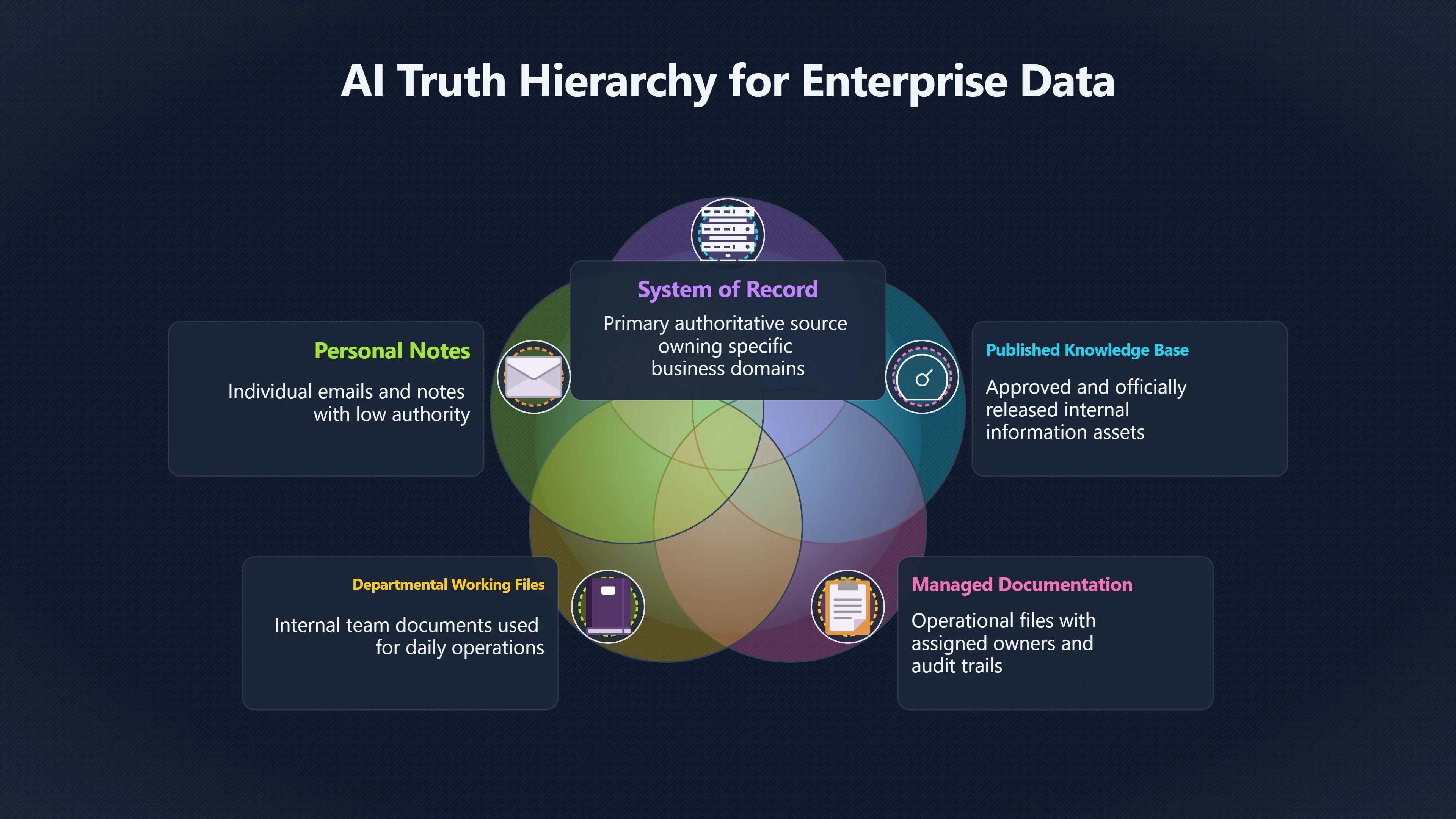
A practical hierarchy for AI truth
Organisations seeking reliable AI answers often establish a hierarchy similar to the following:
- Approved system of record.
- Approved and published knowledge base.
- Managed operational documentation with assigned ownership.
- Departmental working documents.
- Personal files, emails and notes.
The lower a source sits in the hierarchy, the less authority it should carry during retrieval.
This approach mirrors how experienced employees already operate. They may consult working documents for context, but they rely on approved systems when making final decisions. AI systems become more trustworthy when they follow the same governance logic.
The central lesson is that production AI does not merely require access to information. It requires a defined answer to a governance question: who owns the truth? Until an organisation can answer that question, even highly capable AI models may struggle to provide consistent and reliable responses.[ibm.com+2IBM Research]ibm.comData governanceData governance
Amazon book picks
Further Reading
Books and field guides related to Who owns the truth AI uses?. Use these as the next step if you want deeper reading beyond the article.
The Data Governance Imperative
Explains authoritative data, accountability and governance structures.
Data Governance
Directly addresses ownership, authority, stewardship and trusted sources.
Data Science for Business
Helps readers understand how data quality and source selection affect outcomes.
Competing in the Age of AI
Shows how organisations create trusted digital operating models.
eBay marketplace picks
Marketplace Samples
Example marketplace items related to this page. Use the search link to explore similar finds on eBay.



Endnotes
1.
Source: ibm.com
Title: Data governance
Link:https://www.ibm.com/docs/en/watsonx/wdi/2.2.x?topic=data-governance
2.
Source: research.ibm.com
Title: governance by construction for generalist agents
Link:https://research.ibm.com/publications/governance-by-construction-for-generalist-agents
Source snippet
IBM ResearchGovernance by Construction for Generalist Agents for ACM CAIS 2026 - IBM Research...
3.
Source: techstrata.com
Title: Tech Strata AIORiele AI Platform | Tech Strata | Tech Strata AI
Link:https://techstrata.com/platform
4.
Source: arxiv.org
Link:https://arxiv.org/abs/2602.11301
5.
Source: developer.ibm.com
Link:https://developer.ibm.com/components/watsonx-governance/articles/
Source snippet
Articles - IBM Developer...
6.
Source: arxiv.org
Title: arXiv RAG-Driven Data Quality Governance for Enterprise ERP Systems
Link:https://arxiv.org/abs/2511.16700
7.
Source: techradar.com
Title: Tech Radar3 risks hindering enterprise-ready AI
Link:https://www.techradar.com/pro/3-risks-hindering-enterprise-ready-ai-and-how-low-code-workflows-help
Source snippet
Agentic AI systems, which operate autonomously with minimal human oversight, face three primary risks: 1. **Lack of Transparency**: These...
8.
Source: techradar.com
Link:https://www.techradar.com/pro/why-confidential-ai-is-the-next-big-thing-for-enterprise
Source snippet
With regulatory expectations tightening (e.g., HIPAA updates, SEC scrutiny), enterprises demand AI systems that not only produce safe out...
9.
Source: arxiv.org
Link:https://arxiv.org/abs/2510.25863
Source snippet
AAGATE: A NIST AI RMF-Aligned Governance Platform for Agentic AIOctober 29, 2025...
Published: October 29, 2025
Additional References
10.
Source: nist.gov
Link:https://www.nist.gov/publications/reducing-risks-posed-[synthetic
Source snippet
Risks Posed by Synthetic Content An Overview of Technical Approaches to Digital Content Transparency | NISTNovember 20, 2024...
Published: November 20, 2024
11.
Source: youtube.com
Link:https://www.youtube.com/watch?v=p23X7ThA7N8
Source snippet
What Enterprise Leaders Need to Know About Hybrid Data and AI...
12.
Source: youtube.com
Title: Conflict RAG: The Ultimate Guide to Fixing AI Hallucinations
Link:https://www.youtube.com/watch?v=wytpfp0OIoc
Source snippet
Building GitHub for Product Management: How Momental Uses AI to Find Merge Conflicts in Strategy...
13.
Source: youtube.com
Title: What Enterprise Leaders Need to Know About Hybrid Data and AI
Link:https://www.youtube.com/watch?v=7k9q0HkNDNs
Source snippet
How to Get LLM Answers With Sources - Advanced RAG Tutorial...
14.
Source: nist.gov
Title: www.nist.gov A I Standards and Guidelines Group | NIST
Link:https://www.nist.gov/itl/ai/ai-standards-and-guidelines-group
Source snippet
Standards and Guidelines Group | NIST...
15.
Source: youtube.com
Title: Top-Down Governance, Bottom-Up Architecture
Link:https://www.youtube.com/watch?v=FoqrIQQl2H4
Source snippet
ConflictRAG: The Ultimate Guide to Fixing AI Hallucinations...
16.
Source: nist.gov
Title: www.nist.gov Data & informatics | NIST
Link:https://www.nist.gov/data-informatics
Source snippet
& informatics | NIST...
17.
Source: airc.nist.gov
Title: NIS T AI Resource Center
Link:https://airc.nist.gov/
Source snippet
NIST AI Resource Center - AIRC...
18.
Source: eab-compliance.eu
Title: EAB Compliance [EU AI Act]({{ ‘eu-ai-act/’ | relative_url }}) Compliance Platform · EAB Compliance
Link:https://www.eab-compliance.eu/
19.
Source: 365ui.com
Title: Superagent Private AI Systems
Link:https://365ui.com/
Source snippet
Superagent Private AI Systems...
Topic Tree