Within Tokenization
Why one split can change an AI answer
Small changes in where a prompt meets token boundaries can shift what a chatbot treats as the most likely next answer.
On this page
- How token boundaries shape next token probabilities
- Why partial tokens create unstable continuations
- Examples from code, compounds, and no space scripts
Page outline Jump by section
Introduction
A chatbot does not predict the next word. It predicts the next token. That distinction becomes important when the boundary between tokens falls in an awkward place. Two prompts that look almost identical to a human can produce different internal token sequences, and those different sequences can shift the probabilities assigned to possible continuations. In some cases, a model becomes less confident about the continuation that would otherwise be the obvious answer. Recent research has shown that these effects are not merely theoretical: partial or misaligned token boundaries can significantly distort next-token probabilities, especially in code, compound-rich languages, and writing systems that do not rely on spaces.[OpenReview]openreview.netOpen Review Are you going to finish that?A Practical Study of the…by H Xu — This paper quantifies the tokenization boundary problem in realistic prompts across three domains w…
 Within the broader topic of how tokenisation shapes chatbot answers, this mechanism explains why seemingly tiny changes in text formatting, spacing, or word segmentation can alter the response a user receives.
How token boundaries shape next-token probabilities
Language models are trained on sequences of tokens produced by a tokenizer such as Byte Pair Encoding (BPE) or a related subword method. Common strings often become single tokens, while rarer strings are represented as several smaller pieces.[Hugging Face]huggingface.coHugging FaceTokenization algorithmsTransformers support three subword tokenization algorithms: Byte pair encoding (BPE), Unigram, and Wor…
When a model generates text, it calculates a probability distribution over all possible next tokens. The current token sequence is therefore the context from which every prediction is made. If the tokenizer splits a phrase differently, the model is no longer conditioning on exactly the same sequence of units.[Wikipedia]WikipediaTop-p samplingTop-p sampling
The key point is that the model has learned statistical relationships between token sequences during training. A token that frequently appears after a particular token sequence may receive a high probability. But if a word is split differently, the preceding sequence changes, and so does the probability landscape.
For example:
- A familiar word stored as one token may strongly suggest a particular continuation.
- The same visible text, represented as several subword fragments, may spread probability across more alternatives.
- A prompt ending inside a token can leave the model in a state that differs from any complete token sequence it commonly saw during training.[fast.ai]fast.aiconsider tokens that, if re-tokenized, would have high probability—Let's Build the GPT Tokenizer: A Complete Guide to…16 Oct 2025 — This tutorial covers the process of tokenization in large language mo…
The result is that token boundaries are not passive bookkeeping. They directly influence what the model considers likely to come next.
Why partial tokens create unstable continuations
The most striking version of this phenomenon is known as the partial token problem. It occurs when the text presented to the model effectively ends in the middle of what would normally be a larger token.[OpenReview]openreview.netOpen Review Are you going to finish that?A Practical Study of the…by H Xu — This paper quantifies the tokenization boundary problem in realistic prompts across three domains w…
Imagine that a tokenizer normally represents a frequent string as a single token. If a prompt stops halfway through that string, the model cannot simply treat it as the familiar token it learned during training. Instead, it must operate from a different tokenisation state.
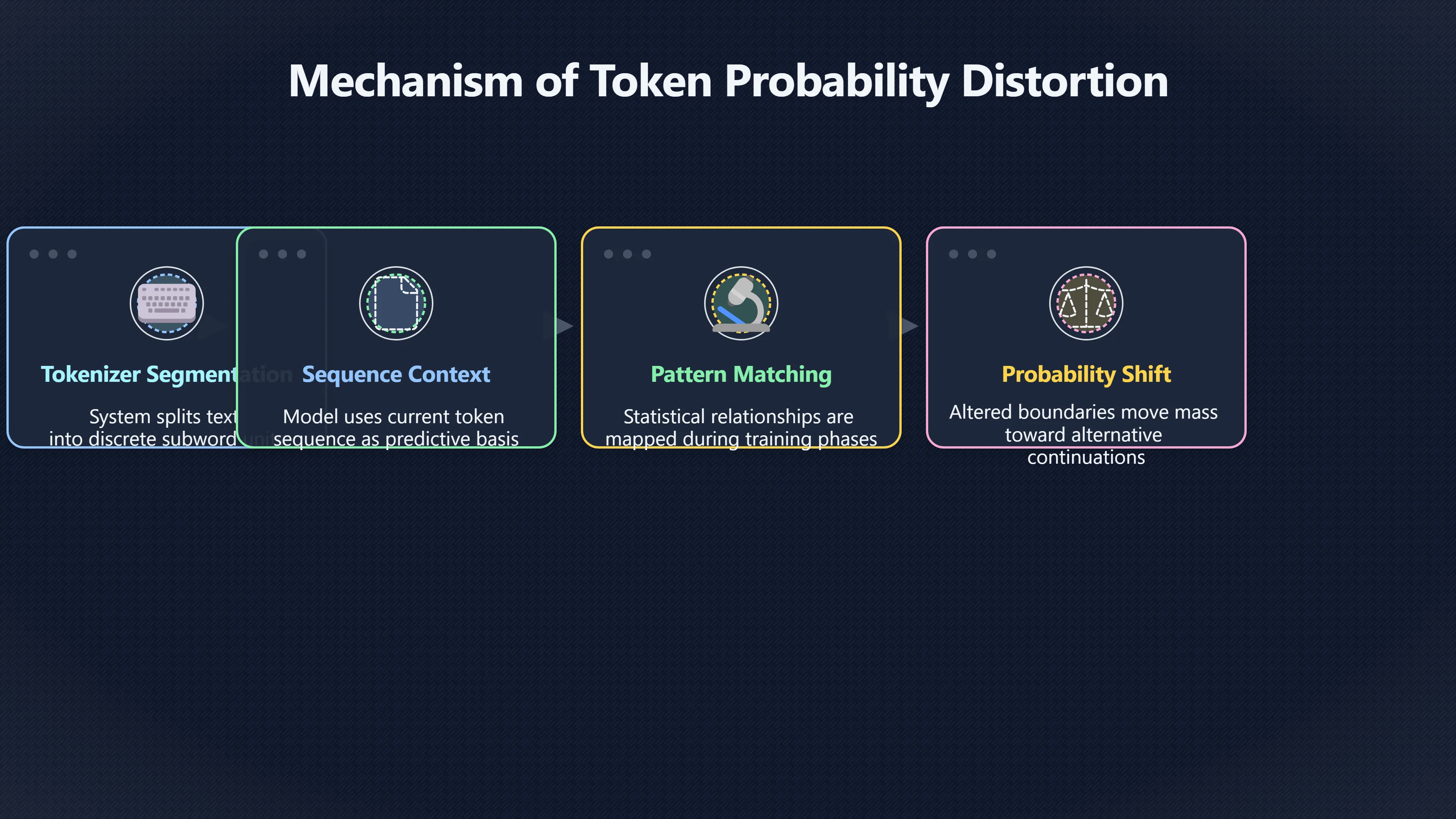
Research examining realistic prompts found that this can produce dramatic probability distortions. In affected cases, frontier language models assigned vastly lower probability to the correct continuation than when the prompt was adjusted to align cleanly with token boundaries. Surprisingly, the distortion did not disappear in larger models and sometimes became more pronounced.[OpenReview]openreview.netOpen Review Are you going to finish that?A Practical Study of the…by H Xu — This paper quantifies the tokenization boundary problem in realistic prompts across three domains w…
The mechanism is straightforward:
- The tokenizer creates a sequence that differs from the model’s most familiar representation.
- The model computes probabilities from that altered sequence.
- Statistical patterns learned during training no longer match as cleanly.
- Probability mass shifts toward alternative continuations.
From the user’s perspective, the answer may appear unexpectedly hesitant, unusual, or off-target even though the visible prompt seems perfectly reasonable.
Examples from code, compounds, and no-space scripts
Code
Programming languages often contain long identifiers, punctuation-heavy structures, and naming conventions that do not align neatly with token boundaries. A variable name may be tokenised into several pieces, with boundaries falling inside meaningful syntactic units. Research on tokenisation boundary problems identifies code as one of the domains where these misalignments are especially common.[OpenReview]openreview.netOpen Review Are you going to finish that?A Practical Study of the…by H Xu — This paper quantifies the tokenization boundary problem in realistic prompts across three domains w…
This helps explain why code-completion systems can sometimes behave differently when a programmer types one additional character. The extra character may trigger a different tokenisation, changing which completions appear most probable.
Compound words
Languages that build long compound words create similar challenges. A compound may correspond to several subword tokens, and boundaries between meaningful word parts do not always match tokenizer boundaries. When this happens, the model’s learned patterns for the complete compound are fragmented across multiple token pieces.[OpenReview]openreview.netOpen Review Are you going to finish that?A Practical Study of the…by H Xu — This paper quantifies the tokenization boundary problem in realistic prompts across three domains w…
As a result, continuations can become more sensitive to exactly where the text ends.
Writing systems without spaces
Languages such as Chinese do not use spaces in the same way English does. Human readers can recognise word boundaries, but tokenizers may segment text differently. Recent work found that a substantial proportion of natural word boundaries in Chinese do not coincide with token boundaries, meaning a prompt can end at a complete word while still ending inside a larger token structure from the model’s perspective.[OpenReview]openreview.netOpen Review Are you going to finish that?A Practical Study of the…by H Xu — This paper quantifies the tokenization boundary problem in realistic prompts across three domains w…
This creates opportunities for probability distortions even when the user’s text looks perfectly natural.
Why the effect can look surprising to users
Humans think in terms of words, phrases, and meanings. Language models operate on token sequences. Most of the time these views align closely enough that the difference is invisible. The unusual cases arise when visible language structure and token structure diverge.
A user might reasonably assume that:
- adding a character should only slightly affect the answer;
- ending at a complete word should be safe;
- different spellings or formatting choices should preserve the same prediction.
In reality, those changes can alter token boundaries. Because prediction happens at the token level, a small visible edit may move the model into a different probability state.[fast.ai]fast.aiconsider tokens that, if re-tokenized, would have high probability—Let's Build the GPT Tokenizer: A Complete Guide to…16 Oct 2025 — This tutorial covers the process of tokenization in large language mo…
This is one reason why prompt wording sometimes feels unexpectedly sensitive. The effect is not always about meaning. Sometimes it is about where the tokenizer decided to place its invisible cuts.
What this reveals about chatbot behaviour
Awkward token splits matter because language models learn and generate through token sequences rather than through words as humans understand them. When a prompt ends at an inconvenient boundary, the model’s probability calculations can become distorted, causing different continuations to rise or fall in likelihood. Recent studies show that this is a real and measurable mechanism rather than a theoretical curiosity, particularly in code, highly compounding languages, and scripts without spaces.[OpenReview+2arXiv]openreview.netOpen Review Are you going to finish that?A Practical Study of the…by H Xu — This paper quantifies the tokenization boundary problem in realistic prompts across three domains w…
Understanding this mechanism helps explain a broader lesson about artificial intelligence: some visible changes in chatbot answers originate not from reasoning differences, but from the hidden way text is segmented before the model ever begins predicting the next token.
Amazon book picks
Further Reading
Books and field guides related to Why one split can change an AI answer. Use these as the next step if you want deeper reading beyond the article.
Build a Large Language Model (From Scratch)
Explains token boundaries and subword tokenization.
Speech and Language Processing: Pearson New International Edi...
Explains language segmentation and representation.
Natural Language Processing with Transformers
Provides practical tokenization examples.
eBay marketplace picks
Marketplace Samples
Example marketplace items related to this page. Use the search link to explore similar finds on eBay.


Endnotes
1.
Source: openreview.net
Title: Open Review Are you going to finish that?
Link:https://openreview.net/forum?id=b7KgXWA7gq
Source snippet
A Practical Study of the...by H Xu — This paper quantifies the [tokenization]({{ 'tokenization/' | relative_url }}) boundary problem in realistic prompts across three domains w...
2.
Source: arxiv.org
Link:https://arxiv.org/abs/2601.23223
3.
Source: Wikipedia
Title: Byte-pair encoding
Link:https://en.wikipedia.org/wiki/Byte-pair_encoding
4.
Source: Wikipedia
Title: Top-p sampling
Link:https://en.wikipedia.org/wiki/Top-p_sampling
5.
Source: fast.ai
Title: consider tokens that, if re-tokenized, would have high probability—
Link:https://www.fast.ai/posts/2025-10-16-karpathy-tokenizers
Source snippet
Let's Build the GPT Tokenizer: A Complete Guide to...16 Oct 2025 — This tutorial covers the process of tokenization in large language mo...
6.
Source: arxiv.org
Title: arXiv Impact of Tokenization on Language Models: An Analysis for Turkish
Link:https://arxiv.org/abs/2204.08832
7.
Source: arxiv.org
Title: arXiv Are you going to finish that?
Link:https://arxiv.org/html/2601.23223v2
Source snippet
A Practical Study of the Partial...2 Feb 2026 — In this section, we motivate our study of the partial token problem by quantifying how o...
8.
Source: arxiv.org
Link:https://arxiv.org/html/2410.09303v2
Source snippet
Exact Byte-Level Probabilities from Tokenized Language...11 Apr 2025 — This work studies how tokenization impacts model performance by a...
9.
Source: arxiv.org
Link:https://arxiv.org/html/2504.00178v1
Source snippet
Boundless Byte Pair Encoding: Breaking the Pre-...31 Mar 2025 — Pre-tokenization is a crucial step in preparing text for language models...
10.
Source: huggingface.co
Link:https://huggingface.co/docs/transformers/tokenizer_summary
Source snippet
Hugging FaceTokenization algorithmsTransformers support three subword tokenization algorithms: Byte pair encoding (BPE), Unigram, and Wor...
Additional References
11.
Source: medium.com
Link:https://medium.com/%40suvraadeep/tokenization-demystified-building-tokenizers-for-language-models-9cd18cb26dab
Source snippet
Building Tokenizers for Language Models | by SuvradeepThe GPT-4 model utilizes the BPE (Byte Pair Encoding) tokenization method, with a v...
12.
Source: gregrobison.medium.com
Link:https://gregrobison.medium.com/a-comparative-analysis-of-byte-level-and-token-level-transformer-models-in-natural-language-9fb4331b6acc
Source snippet
Comparative Analysis of Byte-Level and Token-Level...This report provides an in-depth comparative analysis of these two dominant paradig...
13.
Source: connorjdavis.com
Link:https://www.connorjdavis.com/p/language-modeling-part-7-bpe-tokenization
Source snippet
In the previous post, we trained a one-layer transformer for maximizing the likelihood of the next token...Read more...
14.
Source: machinelearningplus.com
Link:https://machinelearningplus.com/nlp/build-bpe-tokenizer-from-scratch-python/
Source snippet
Get it wrong, and your model receives garbage. Understand it well, and you can save money on every...Read more...
15.
Source: direct.mit.edu
Title: Tokenization as Finite State Transduction
Link:https://direct.mit.edu/coli/article/51/4/1119/132855/Tokenization-as-Finite-State-Transduction
Source snippet
as Finite-State TransductionTokenization is the first step in modern neural language model pipelines where an input text is converted to...
16.
Source: seantrott.substack.com
Title: tokenization in large language models
Link:https://seantrott.substack.com/p/tokenization-in-large-language-models
Source snippet
in large language models, explainedBPE starts out by creating tokens for all the basic symbols used in a tokenizer's training text, e.g...
17.
Source: biorxiv.org
Title: 2024.09.09.612081v2.full text
Link:https://www.biorxiv.org/content/10.1101/2024.09.09.612081v2.full-text
Source snippet
A Comparison of Tokenization Impact in [Attention]({{ 'attention/' | relative_url }}) Based...17 Sept 2024 — This study explores the impact of tokenization in attention-base...
18.
Source: machinelearningmastery.com
Title: tokenizers in language models
Link:https://machinelearningmastery.com/tokenizers-in-language-models/
Source snippet
12 Sept 2025 — In this article, we will explore common tokenization algorithms used in modern LLMs, their implementation, and how to use...
19.
Source: youtube.com
Link:https://www.youtube.com/watch?v=UHuNkAZl4Dg
Source snippet
Let's build the GPT Tokenizer - YouTube Andrej Karpathy · 1.1M views...
20.
Source: youtube.com
Title: Technical Breakdown: Why Subword Tokenization is the LLM Gold Standard
Link:https://www.youtube.com/watch?v=Q-gZYvVGX-k
Source snippet
Tokenization: The Only Video You’ll Ever Need. #aiexplained #chatgpt #tokenization #llmexplained...
Topic Tree