Within Shadow AI
When Invisible AI Starts Making Business Decisions
Unofficial AI summaries, code and recommendations can quietly shape decisions without validation, audit trails or clear accountability.
On this page
- How unofficial outputs enter daily work
- Why plausible errors are hard to catch
- Review standards that make AI use visible
Page outline Jump by section
Introduction
Hidden AI workflows emerge when employees begin using generative AI to create summaries, recommendations, forecasts, code, analyses or draft decisions outside approved processes. Unlike traditional shadow IT, these workflows do not simply move information between systems. They can actively reshape the content that managers, analysts and decision-makers see. As a result, business decisions may be influenced by AI-generated interpretations long before leaders realise AI was involved.
 This risk is closely tied to shadow AI adoption. Research from Microsoft and LinkedIn found that most workplace AI users bring their own AI tools into work environments, often because organisations have not yet provided clear AI strategies or approved alternatives. When unofficial AI outputs become embedded in reports, spreadsheets, presentations and software projects, decisions can be influenced by systems that lack validation, audit trails and clear accountability.[Source+2Source]news.microsoft.comSourceMicrosoft and LinkedIn release the 2024 Work Trend Index on the state of AI at work - SourceMay 8, 2024…
When Invisible AI Starts Making Business Decisions
The most important feature of a hidden AI workflow is that the final decision may appear human-made even when AI substantially shaped it.
A manager reading a market analysis may not realise that key findings were generated by a public chatbot. A sales forecast might incorporate AI-generated assumptions copied from a prompt response. A software team may deploy code that originated from an unofficial AI assistant. By the time the work reaches an approval stage, the AI contribution has often been stripped of its original context.
This creates a governance problem that differs from ordinary automation. Traditional software generally follows predefined rules. Generative AI creates new content, interpretations and recommendations. Those outputs can alter priorities, influence judgements and shape organisational actions without leaving an obvious record of how conclusions were reached.[moxo.com]moxo.comOpen source on moxo.com.
The danger is not that every AI output is wrong. The danger is that decision-makers may be unable to distinguish between verified evidence and plausible AI-generated material once the content has been blended into normal business documents.
How Unofficial Outputs Enter Daily Work
Hidden AI workflows rarely begin as formal projects. They usually emerge through small productivity shortcuts.
Common pathways include:
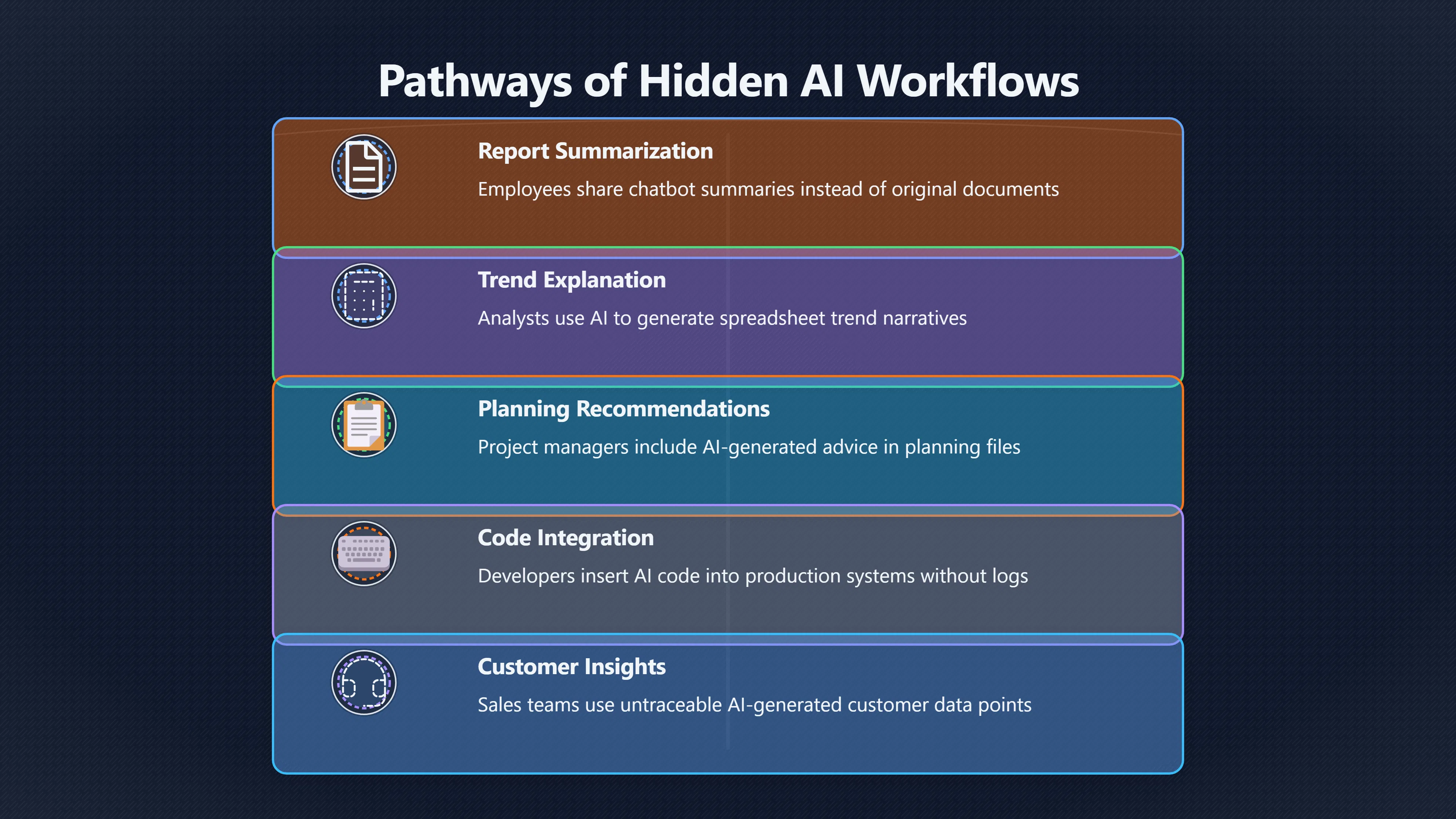
- An employee asks a chatbot to summarise a lengthy report and shares the summary rather than the original document.
- A financial analyst uses AI to generate explanations for unusual trends in a spreadsheet.
- A project manager requests AI-generated recommendations and includes them in planning documents.
- A developer incorporates AI-generated code into production systems without documenting its origin.
- A sales team uses AI-generated customer insights that cannot be traced back to verified data sources.
Each individual action may seem harmless. The problem appears when multiple unofficial outputs become chained together.
For example, an AI summary may feed into an AI-generated presentation, which then informs an executive meeting. The final decision may rest on several layers of machine-generated interpretation, none of which received formal review.
Governance specialists increasingly describe this as a visibility problem. AI policies may exist on paper, but organisations lose oversight when information moves across disconnected tools, copied text, exported files and undocumented prompts. Audit trails weaken as AI-generated content passes from one system to another.[LinkedIn]linkedin.comOpen source on linkedin.com.
Why Plausible Errors Are Hard to Catch
Many business controls were designed to identify obvious mistakes. Generative AI often produces a different category of error: information that looks reasonable, professional and internally consistent while still being incorrect.
This characteristic makes hidden AI workflows particularly difficult to detect.
Confidence without evidence
Generative AI systems can provide detailed explanations even when supporting evidence is weak or absent. Employees under time pressure may accept these explanations because they appear coherent and authoritative.
When copied into reports, the distinction between verified analysis and generated narrative can disappear. Managers reviewing the final document may evaluate writing quality rather than factual accuracy.
Loss of source transparency
Traditional business analysis usually allows reviewers to trace claims back to underlying data. Hidden AI workflows often break that chain.
An AI-generated recommendation may cite no sources. Even when it is directionally correct, reviewers may struggle to determine:
- Which data informed the output.
- Whether information was current.
- Which assumptions were made.
- Whether contradictory evidence existed.
Without traceability, validation becomes expensive and is frequently skipped.
Automation bias
Research across decision-support technologies has repeatedly shown that people tend to place excessive trust in machine-generated outputs, particularly when systems appear sophisticated. In workplace settings, AI-generated recommendations can gain credibility simply because they were produced quickly and presented confidently.
The result is not blind trust in every response. Instead, people often lower their level of scrutiny, especially when the output aligns with expectations or helps resolve uncertainty.
Small Errors Can Become Strategic Errors
A hidden AI workflow may begin with a minor factual mistake but produce much larger organisational consequences.
Consider a scenario in which AI generates an inaccurate summary of customer feedback. Product managers rely on that summary when prioritising features. Development teams allocate resources accordingly. Marketing plans are built around the resulting roadmap.
The original error may have been small, but the organisation’s response amplifies it.
This amplification effect becomes more significant when AI outputs influence:
- Hiring decisions.
- Supplier selection.
- Risk assessments.
- Investment planning.
- Pricing strategies.
- Product development priorities.
Because these decisions often involve multiple layers of review, organisations may assume quality assurance already exists. Yet if every reviewer sees only the AI-influenced output rather than the underlying evidence, the review process may merely reinforce the same mistake.
Some governance experts argue that AI failures often originate less from model defects than from weak operational processes, unclear decision architecture and inadequate oversight mechanisms. In practice, organisations frequently discover problems only after outputs have already influenced actions.[intellisync.io]intellisync.ioWhy AI fails in SMBs: workflow ambiguity, context loss, and missing governance | IntelliSyncApril 7, 2026…

Why Managers Often Miss Hidden AI Influence
Leaders frequently assume they would know if AI was affecting important decisions. In reality, hidden workflows are difficult to observe.
Several factors contribute:
- Employees may not consider AI assistance significant enough to mention.
- AI-generated content becomes mixed with human-written material.
- Organisations often track software usage but not content provenance.
- Existing approval processes focus on outcomes rather than production methods.
- Staff may fear being judged for relying on AI and therefore avoid disclosure.
Microsoft and LinkedIn research found that many workers use AI independently of official programmes, reflecting a gap between organisational governance and employee behaviour. When that gap grows, managers can lose visibility into how analyses, recommendations and work products are actually created.[Source+2Axios]news.microsoft.comSourceMicrosoft and LinkedIn release the 2024 Work Trend Index on the state of AI at work - SourceMay 8, 2024…
The result is a paradox: organisations may believe decisions are entirely human-driven while AI-generated reasoning is already influencing important choices throughout the business.
Review Standards That Make AI Use Visible
The goal is not necessarily to eliminate AI assistance. In many cases, AI improves productivity and helps employees process information more efficiently. The challenge is making AI influence visible enough to evaluate.
Several review practices reduce the risk of hidden decision-making workflows.
Require provenance for significant recommendations
When a report contains major recommendations, reviewers should know:
- Whether AI contributed to the analysis.
- Which tools were used.
- What source material informed the output.
- Which claims were independently verified.
This creates accountability without prohibiting legitimate AI use.

Separate evidence from interpretation
Teams can require that factual evidence, underlying data and AI-generated interpretation remain clearly distinguished.
Doing so allows reviewers to challenge conclusions without reconstructing the entire workflow.
Preserve prompts and output histories
For higher-impact decisions, maintaining records of prompts, model outputs and revisions helps establish an audit trail.
Emerging AI governance frameworks increasingly emphasise traceability, documentation and risk management as foundations for trustworthy AI use.[NIST+2NIST]nist.govai rmf development request informationAI RMF Development | NISTJanuary 26, 2023…
Review decision processes, not only outcomes
Many organisations evaluate final recommendations but not how those recommendations were produced.
A stronger approach examines the workflow itself:
- Who created the analysis?
- Which AI systems contributed?
- What verification occurred?
- Where human judgement entered the process?
This shifts governance from detecting mistakes after the fact to understanding how decisions are formed.
Visibility Is More Important Than Prohibition
Hidden AI workflows become dangerous not because AI is present, but because its influence is invisible.
When unofficial AI-generated summaries, recommendations and analyses enter routine business processes, organisations can lose the ability to distinguish verified reasoning from machine-generated interpretation. Decisions may still appear rational and well documented while resting on assumptions that nobody has checked.
As shadow AI adoption grows, the central governance challenge is therefore not merely controlling access to tools. It is ensuring that whenever AI shapes a business decision, its role remains visible, reviewable and accountable.[moxo.com+2LinkedIn]moxo.comOpen source on moxo.com.
Amazon book picks
Further Reading
Books and field guides related to When Invisible AI Starts Making Business Decisions. Use these as the next step if you want deeper reading beyond the article.
The Alignment Problem
Highlights risks when AI outputs shape important human decisions.
Competing in the Age of AI
Explains how AI becomes embedded in organizational decision processes.
eBay marketplace picks
Marketplace Samples
Example marketplace items related to this page. Use the search link to explore similar finds on eBay.


Endnotes
1.
Source: news.microsoft.com
Link:https://news.microsoft.com/2024/05/08/microsoft-and-linkedin-release-the-2024-work-trend-index-on-the-state-of-ai-at-work/?level=0
Source snippet
SourceMicrosoft and LinkedIn release the 2024 Work Trend Index on the state of AI at work - SourceMay 8, 2024...
Published: May 8, 2024
2.
Source: news.microsoft.com
Link:https://news.microsoft.com/en-cee/2024/05/16/microsoft-and-linkedin-released-2024-work-trend-index-three-out-of-four-people-use-ai-at-work-2/
Source snippet
SourceMicrosoft and LinkedIn released 2024 Work Trend Index: three out of four people use AI at work - CEE Multi-Country News Center...
3.
Source: axios.com
Title: employees bring their own ai microsoft linkedin
Link:https://www.axios.com/2024/05/08/employees-bring-their-own-ai-microsoft-linkedin
Source snippet
This independent use reflects rapid adoption of AI tools among employees but also underscores fears of job insecurity—53% of AI users wor...
4.
Source: moxo.com
Link:https://www.moxo.com/blog/ai-governance-in-business-process-automation
5.
Source: linkedin.com
Link:https://www.linkedin.com/posts/anishmohile_ai-governance-does-not-fail-only-in-policy-activity-7465265825118232577-d6-S
6.
Source: intellisync.io
Link:https://www.intellisync.io/en/blog/why-ai-fails-in-smbs-workflow-ambiguity-context-loss-and-missing-governance
Source snippet
Why AI fails in SMBs: workflow ambiguity, context loss, and missing governance | IntelliSyncApril 7, 2026...
Published: April 7, 2026
7.
Source: news.microsoft.com
Title: handelsblatt berichtet ueber work trend index 2024
Link:https://news.microsoft.com/de-de/handelsblatt-berichtet-ueber-work-trend-index-2024/
Source snippet
SourceWork Trend Index 2024...
8.
Source: nist.gov
Title: ai rmf development request information
Link:https://www.nist.gov/itl/ai-risk-management-framework/ai-rmf-development-request-information
Source snippet
AI RMF Development | NISTJanuary 26, 2023...
Published: January 26, 2023
9.
Source: nist.gov
Link:https://www.nist.gov/node/1731521
Source snippet
NIST Risk Management Framework Aims to Improve Trustworthiness of Artificial Intelligence | NIST...
10.
Source: linkedin.com
Title: shadow ai explosion why enterprises losing control patrick upmann mkfzf
Link:https://www.linkedin.com/pulse/shadow-ai-explosion-why-enterprises-losing-control-patrick-upmann-mkfzf
Source snippet
SHADOW AI EXPLOSION – WHY ENTERPRISES ARE LOSING CONTROLNovember 18, 2025...
Published: November 18, 2025
Additional References
11.
Source: reddit.com
Link:https://www.reddit.com/r/OpenAI/comments/1lwzcl1/microsoft_study_reveals_which_jobs_ai_is_actually/
Source snippet
Study Reveals Which Jobs AI is Actually Impacting Based on 200K Real ConversationsJuly 11, 2025...
Published: July 11, 2025
12.
Source: youtube.com
Title: EP 37 — Digital Turbine’s Vivek Menon on Why Shadow AI Has Lapped Shadow IT
Link:https://www.youtube.com/watch?v=eGQJJlkMJjA
Source snippet
What is Shadow AI and How to Prevent This Threat in AI Security - YouTube What is Shadow AI and How to Prevent This Threat in AI Security...
13.
Source: reddit.com
Title: [responsible ai]({{ ‘responsible-ai/’ | relative_url }}) model evaluations 9 weeks of llm
Link:https://www.reddit.com/r/NISTControls/comments/1tubu2e/responsible_ai_model_evaluations_9_weeks_of_llm/
Source snippet
AI Model Evaluations: 9 weeks of LLM red-team data, mapped directly to NIST AI RMFJune 2, 2026...
Published: June 2, 2026
14.
Source: youtube.com
Title: Board Signal # 30 Shadow AI Is the Governance Risk No One Is Talking About
Link:https://www.youtube.com/watch?v=UknGamyzHYQ
Source snippet
EP 37 — Digital Turbine's Vivek Menon on Why Shadow AI Has Lapped Shadow IT...
15.
Source: youtube.com
Title: What is Shadow AI and How to Prevent This Threat in AI Security
Link:https://www.youtube.com/watch?v=H6DQigWli8g
Source snippet
Board Signal # 30 Shadow AI Is the Governance Risk No One Is Talking About...
16.
Source: m.youtube.com
Title: What Happens When AI Starts Making Decisions Without You?
Link:https://m.youtube.com/watch?v=hSRwTE1yJEQ
Source snippet
What is Shadow AI and How to Prevent This Threat in AI Security...
17.
Source: youtube.com
Title: Shadow AI: The Invisible Risk Your Company Is Ignoring
Link:https://www.youtube.com/watch?v=FbNmlsmxPlg
Source snippet
What Happens When AI Starts Making Decisions Without You?...
18.
Source: organisedfriction.co.uk
Link:https://www.organisedfriction.co.uk/your-organisation-has-an-ai-operating-model-it-just-doesnt-know-it-yet/
19.
Source: polidex.ai
Title: You Can’t Audit a System Prompt | Polidex
Link:https://polidex.ai/problem/audit-trail
Topic Tree