Within Risk Standards
Why AI Governance Cannot Stop at Launch
ISO-style AI management systems turn responsible AI into an ongoing routine of ownership, monitoring, review, and improvement.
On this page
- Why deployed AI systems can change over time
- How responsibilities and reviews survive staff turnover
- Continuous improvement through incidents, feedback, and audits
Page outline Jump by section
Introduction
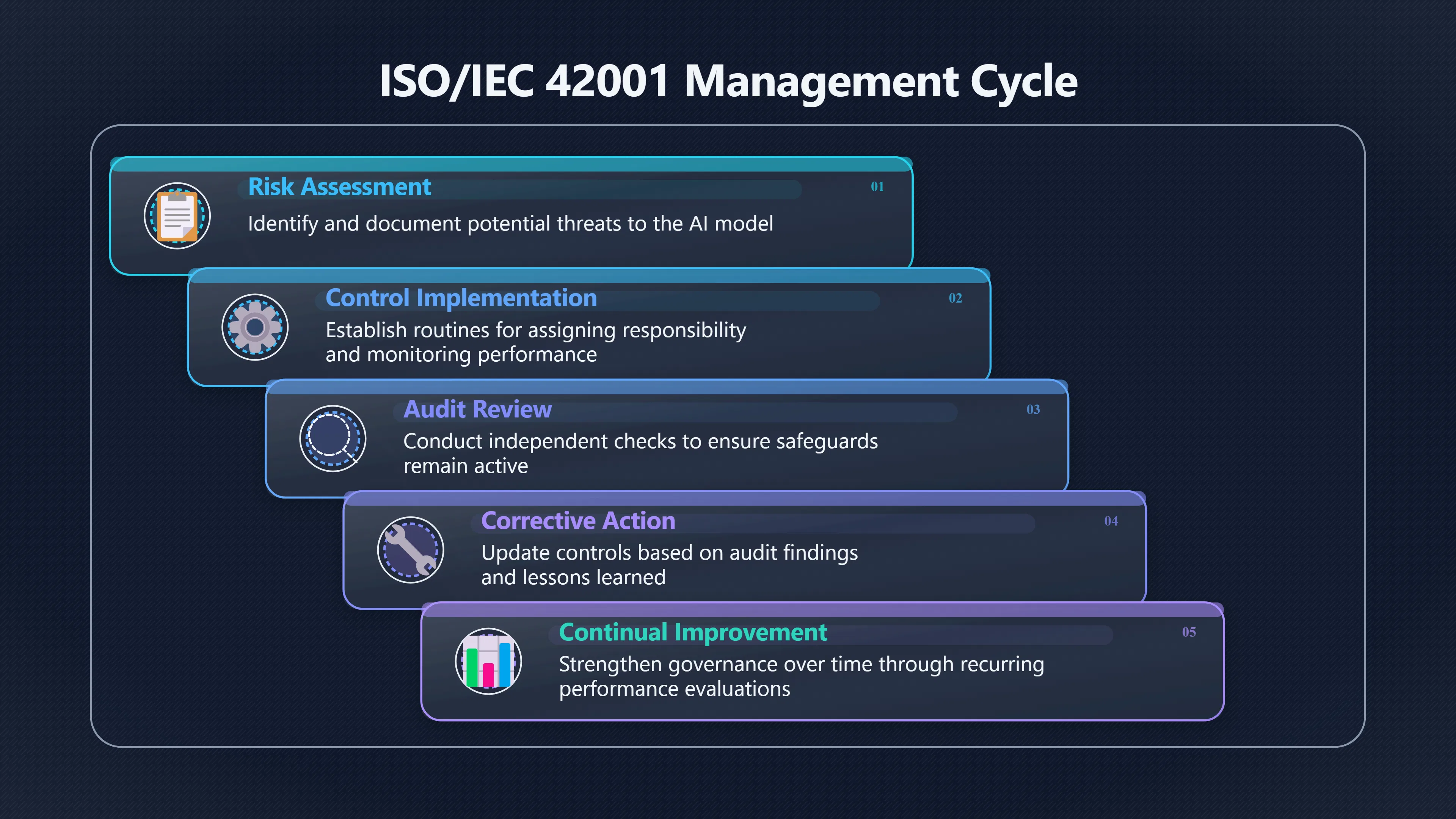
AI safeguards can fade long before anyone notices. A model that performed well during testing may behave differently months later because user behaviour changes, new data patterns emerge, software components are updated, or the organisation itself changes. That is why modern AI governance increasingly focuses on management systems rather than one-time approval processes. A management system creates routines for assigning responsibility, monitoring performance, reviewing risks, recording decisions, and improving controls throughout an AI system’s life. Rather than treating governance as a hurdle before deployment, it treats governance as an ongoing operational function. This approach is reflected in standards such as ISO/IEC 42001 and in guidance from organisations including NIST and the OECD, all of which emphasise that AI risks must be managed across the full lifecycle rather than only during development.[SG Systems Global+2OECD.AI]sgsystemsglobal.comiso iec 42001 ai management systemSource details in endnotes.

Why Deployed AI Systems Can Change Over Time
One of the central assumptions behind AI management systems is that deployment is not the end of the story. AI systems operate in environments that continue to evolve after release.
Changes can occur for many reasons:
- User behaviour may shift in ways not represented in training data.
- New products, policies, or business processes may alter how the system is used.
- External conditions may change, making previous assumptions inaccurate.
- Models may experience performance degradation or drift over time.
- New security threats or misuse patterns may emerge.
The OECD’s definition of AI systems explicitly notes that some systems exhibit varying levels of adaptiveness after deployment, highlighting that behaviour and impacts cannot always be fully predicted at launch.[OECD.AI]oecd.aiOpen source on oecd.ai.
Recent NIST research on monitoring deployed AI systems reinforces this point. NIST argues that pre-deployment testing occurs in controlled conditions, while real-world operation introduces unforeseen outputs, dynamic inputs, and unexpected consequences that can only be observed after deployment. The organisation identifies post-deployment monitoring as a critical requirement for trustworthy AI operation.[NIST]nist.govSource details in endnotes.
This creates a practical governance challenge. An organisation may have followed every development-stage procedure correctly and still face new risks once the system is exposed to real users and real environments. Management systems exist to ensure that safeguards remain active when those changes occur.
How Responsibilities and Reviews Survive Staff Turnover
A common weakness in technology governance is dependence on individual employees. When developers, managers, or compliance specialists leave, important knowledge often leaves with them.
Management-system standards address this problem by institutionalising responsibility rather than attaching it solely to particular people. ISO/IEC 42001 requires organisations to define governance structures, maintain documented information, establish roles and responsibilities, and keep records that allow decisions and controls to be traced over time.[iTeh Standards]standards.iteh.aisist en iso iec 42001 2026Source details in endnotes.
In practice, this means governance should not depend on a single expert remembering why a model was approved. Instead, organisations maintain:
- Documented risk assessments.
- Records of testing and validation.
- Defined ownership for AI systems.
- Escalation and incident procedures.
- Audit trails showing what decisions were made and why.
The value of this approach becomes apparent during organisational change. A new manager can review documented controls. An internal auditor can examine historical decisions. A governance committee can evaluate whether assumptions remain valid. Knowledge becomes embedded in organisational processes rather than remaining informal or personal.[SG Systems Global]sgsystemsglobal.comiso iec 42001 ai management systemSource details in endnotes.
This continuity is one reason management systems are widely used in fields such as quality management, information security, and safety management. AI governance applies the same principle: safeguards remain in place because they are part of the organisation’s operating system rather than the preferences of current staff.
Continuous Improvement Through Incidents, Feedback, and Audits
Management systems are designed to learn from experience. Their purpose is not only to maintain controls but also to improve them.
ISO/IEC 42001 adopts the familiar management-system concept of continual improvement. The standard includes requirements for performance evaluation, audits, corrective actions, and recurring reviews intended to strengthen governance over time.[iTeh Standards]standards.iteh.aien iso iec 42001 2026Source details in endnotes.
Three feedback channels are particularly important.

Incidents Reveal Risks That Testing Missed
Real-world incidents often expose weaknesses that were not visible during development.
An AI system may generate unexpected outputs, produce inaccurate recommendations in rare circumstances, or interact with users in ways that designers did not anticipate. When incidents occur, a management system provides a structured process for investigating causes, assigning corrective actions, documenting lessons learned, and updating controls.[SG Systems Global]sgsystemsglobal.comiso iec 42001 ai management systemSource details in endnotes.
Without such a process, organisations risk treating incidents as isolated mistakes rather than signals of a deeper governance problem.
User Feedback Shows How Systems Behave in Practice
Developers observe systems from the inside. Users experience them from the outside.
Complaints, appeals, user reports, and operational feedback can reveal issues that technical testing misses. NIST’s work on deployed-system monitoring highlights the importance of human-factor monitoring and understanding human-AI interactions in operational settings.[NIST]nist.govnew report challenges monitoring deployed ai systemsSource details in endnotes.
For example, a model may achieve strong accuracy metrics while still confusing users, generating distrust, or creating operational burdens. Feedback mechanisms help governance teams detect these issues before they become larger failures.
Audits Test Whether Governance Still Works
Monitoring focuses on system behaviour. Audits focus on whether the governance process itself remains effective.
An audit may ask:
- Are required reviews occurring on schedule?
- Are incidents being recorded consistently?
- Are risk assessments being updated?
- Have responsibilities been assigned correctly?
- Are monitoring controls functioning as intended?
ISO-style management systems rely on recurring audits because organisations often drift away from documented procedures over time. Audits provide an independent check that safeguards remain active rather than existing only on paper.[iTeh Standards]standards.iteh.aien iso iec 42001 2026Source details in endnotes.
Monitoring Turns Governance into a Living Process
The most visible feature of an AI management system is continuous monitoring.
According to NIST, effective monitoring extends beyond technical performance and may include functionality, operational reliability, human factors, security, compliance, and broader impacts. Monitoring is intended to answer a simple question: is the system still behaving as expected in the real world?[NIST]nist.govnew report challenges monitoring deployed ai systemsSource details in endnotes.
This broader view matters because AI failures are not always technical failures. A model can remain statistically accurate while creating new compliance risks, introducing unfair outcomes, or generating unforeseen social impacts. Monitoring therefore becomes a governance activity rather than merely an engineering activity.
ISO/IEC 42001 similarly emphasises metrics, review processes, incident tracking, change management, and governance oversight. Performance data, audit findings, user feedback, and operational events are expected to feed back into management reviews, creating an ongoing cycle of evaluation and improvement.[SG Systems Global]sgsystemsglobal.comiso iec 42001 ai management systemSource details in endnotes.
Why Governance Must Continue After Launch
The most important contribution of AI management systems is cultural rather than technical. They change the question from “Was this AI system safe when we launched it?” to “How do we know it remains safe, effective, and accountable today?”
That shift reflects a broader understanding found across modern AI governance frameworks. The OECD’s lifecycle approach, NIST’s emphasis on post-deployment monitoring, and ISO/IEC 42001’s focus on continual improvement all assume that AI risks evolve over time. Governance therefore cannot be a one-time approval event. It must be an ongoing organisational capability that survives changing technology, changing staff, and changing operating conditions.[iTeh Standards+3OECD.AI+3OECD.AI]oecd.aiOpen source on oecd.ai.
Amazon book picks
Further Reading
Books and field guides related to Why AI Governance Cannot Stop at Launch. Use these as the next step if you want deeper reading beyond the article.
Artificial Intelligence
Explains AI limitations that make ongoing governance necessary.
Atlas of AI
Examines long-term impacts and accountability challenges after deployment.
The Alignment Problem
Explores how systems drift from intended goals and require oversight.
eBay marketplace picks
Marketplace Samples
Example marketplace items related to this page. Use the search link to explore similar finds on eBay.




Endnotes
1.
Source: oecd.ai
Link:https://oecd.ai/en/ai-principles
2.
Source: oecd.ai
Link:https://oecd.ai/en/ai-publications/advancing-accountability
Source snippet
Advancing accountability in AI: Governing and managing risks throughout the lifecycle for trustworthy AI - OECD.AIFebruary 23, 2023...
Published: February 23, 2023
3.
Source: nist.gov
Link:https://www.nist.gov/publications/challenges-monitoring-deployed-ai-systems-center-ai-standards-and-innovation
Source snippet
"NIST[https://www.nist.gov/publications/challenges-monitoring-deployed-ai-systems-center-ai-standards-and-innovation..."](https://www.nist.gov/publications/challenges-monitoring-deployed-ai-systems-center-ai-standards-and-innovation...")...
4.
Source: nist.gov
Title: new report challenges monitoring deployed ai systems
Link:https://www.nist.gov/news-events/news/2026/03/new-report-challenges-monitoring-deployed-ai-systems
Source snippet
"NIST[https://www.nist.gov/news-events/news/2026/03/new-report-challenges-monitoring-deployed-ai-systems..."](https://www.nist.gov/news-events/news/2026/03/new-report-challenges-monitoring-deployed-ai-systems...")...
5.
Source: standards.iteh.ai
Title: sist en iso iec 42001 2026
Link:https://standards.iteh.ai/catalog/standards/sist/5d5e4bcc-4862-4e7e-9470-7d3fd65ec5fc/sist-en-iso-iec-42001-2026
Source snippet
"iTeh Standards[https://standards.iteh.ai/catalog/standards/sist/5d5e4bcc-4862-4e7e-9470-7d3fd65ec5fc/sist-en-iso-iec-42001-2026..."](https://standards.iteh.ai/catalog/standards/sist/5d5e4bcc-4862-4e7e-9470-7d3fd65ec5fc/sist-en-iso-iec-4...
6.
Source: standards.iteh.ai
Title: en iso iec 42001 2026
Link:https://standards.iteh.ai/catalog/standards/cen/adc675e8-4669-4965-b4c1-c8f724832217/en-iso-iec-42001-2026
Source snippet
"iTeh Standards[https://standards.iteh.ai/catalog/standards/cen/adc675e8-4669-4965-b4c1-c8f724832217/en-iso-iec-42001-2026..."](https://standards.iteh.ai/catalog/standards/cen/adc675e8-4669-4965-b4c1-c8f724832217/en-iso-iec-42001-2026...")...
7.
Source: oecd.ai
Title: OEC D AI Principles
Link:https://oecd.ai/en/dashboards/policy-initiatives/oecd-ai-principles-9705
Source snippet
Principles - OECD.AIJuly 9, 2025...
Published: July 9, 2025
8.
Source: oecd.org
Title: www.oecd.org Scoping the OECD AI principles (EN)
Link:https://www.oecd.org/content/dam/oecd/en/publications/reports/2019/11/scoping-the-oecd-ai-principles_71e1b6dc/d62f618a-en.pdf
Source snippet
the OECD AI principles (EN)May 16, 2025...
Published: May 16, 2025
9.
Source: oecd.org
Link:https://www.oecd.org/content/dam/oecd/en/publications/reports/2023/10/the-state-of-implementation-of-the-oecd-ai-principles-four-years-on_b9f13b5c/835641c9-en.pdf
Source snippet
state of implementation of the OECD AI Principles four years on (EN)May 13, 2025...
Published: May 13, 2025
10.
Source: oecd.org
Title: advancing accountability in ai 2448f04b en
Link:https://www.oecd.org/en/publications/advancing-accountability-in-ai_2448f04b-en.html
Source snippet
accountability in AI | OECDFebruary 23, 2023...
Published: February 23, 2023
11.
Source: sgsystemsglobal.com
Title: iso iec 42001 ai management system
Link:https://sgsystemsglobal.com/glossary/iso-iec-42001-ai-management-system/
Source snippet
"SG Systems Global[https://sgsystemsglobal.com/glossary/iso-iec-42001-ai-management-system/..."](https://sgsystemsglobal.com/glossary/iso-iec-42001-ai-management-system/...")...
12.
Source: Wikipedia
Title: IEC 42001
Link:https://en.wikipedia.org/wiki/ISO/IEC_42001
Source snippet
ISO/IEC 42001...
Additional References
13.
Source: al-ice.ai
Title: NIS T — Monitoring deployed AI systems in [production]({{ ‘retrieval-failures/’ | relative_url }}) — al-ice.ai
Link:https://al-ice.ai/posts/2026/03/nist-monitoring-deployed-ai-systems/
Source snippet
NIST — Monitoring deployed AI systems in production — al-ice.aiMarch 28, 2026...
Published: March 28, 2026
14.
Source: youtube.com
Link:https://www.youtube.com/watch?v=O4iKEr5AIi4
Source snippet
Episode 10: NIST AI RMF & ISO 42001 Explained for AAIR Candidates...
15.
Source: reddit.com
Link:https://www.reddit.com/r/MachineLearningJobs/comments/1puel95/is_iso_42001_worth_it_seems_useless_and_without_a/
Source snippet
ISO 42001 worth? It seems useless and without a future, am I wrong?December 24, 2025...
Published: December 24, 2025
16.
Source: youtube.com
Link:https://www.youtube.com/watch?v=UtlDSoRnUf0
Source snippet
ISO/IEC 42001 for AI Architects: AIMS to Audit Readiness | Module 1.1...
17.
Source: youtube.com
Title: Data Governance Simplified
Link:https://www.youtube.com/watch?v=AmKvE6V7bEc
Source snippet
ISO/IEC 42001:2023 Explained | Information Technology — Artificial Intelligence...
18.
Source: scrut.io
Title: www.scrut.io Continuous AI Monitoring in NIST AI RMF
Link:https://www.scrut.io/glossary/continuous-monitoring-and-improvement-nist-ai-rmf
Source snippet
AI Monitoring in NIST AI RMF...
19.
Source: youtube.com
Link:https://www.youtube.com/watch?v=FEXNiu04-Yc
Source snippet
Data Governance Simplified...
20.
Source: youtube.com
Link:https://www.youtube.com/watch?v=YdPyeVvYtzs
Topic Tree