Within Prompt Loops
Why AI drafts still need a human editor
Human review catches errors, weak reasoning, and mismatched intent that prompt refinement alone cannot reliably prevent.
On this page
- Where generated outputs can go wrong
- How review changes the user's creative role
- Checks before publishing or deploying AI assisted work
Page outline Jump by section
Introduction
Prompt iteration has become a defining feature of AI-assisted creation. A user writes an instruction, receives a draft, refines the prompt, and generates a new version. This process can dramatically accelerate writing, design, coding, and content production. Yet prompt refinement alone cannot guarantee that an output is accurate, appropriate, useful, or aligned with the creator’s intentions.
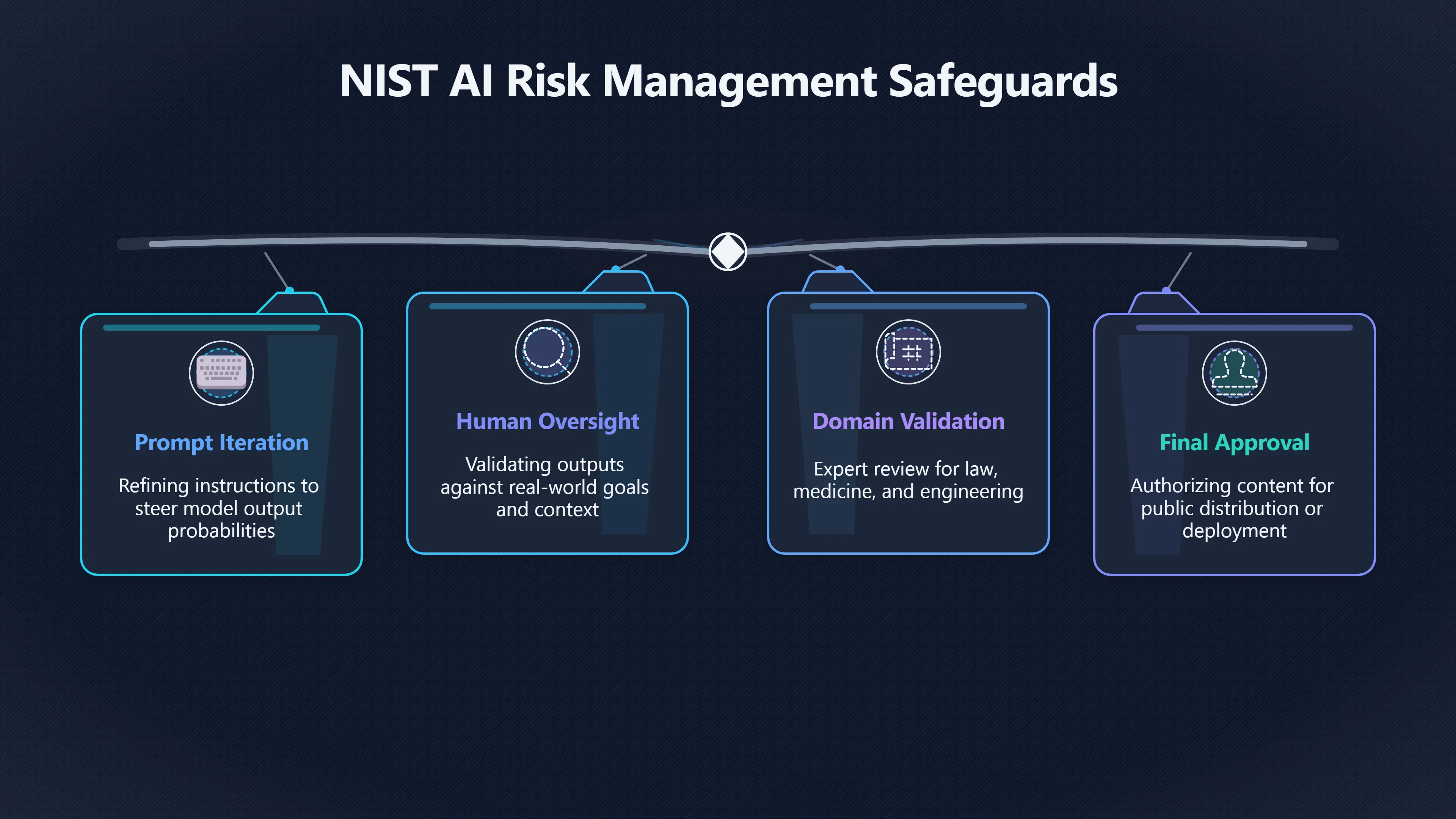
 Human review remains essential because generative AI systems do not truly understand the meaning, context, or consequences of what they produce. They generate outputs by predicting patterns, which can result in factual errors, invented details, misleading reasoning, stylistic inconsistencies, or content that misses the original goal. Even as AI tools become more capable, major risk-management frameworks continue to emphasise human oversight and validation as a core safeguard.[NIST Publications+2NIST]nvlpubs.nist.govPublications Artificial Intelligence Risk Management FrameworkNIST PublicationsArtificial Intelligence Risk Management FrameworkMarch 24, 2025 — by N AI · 2024 · Cited by 144 — NIST, which has conduc…
In modern creative workflows, the role of the creator increasingly shifts from producing every element directly to supervising, evaluating, correcting, and approving AI-generated drafts. The value of human review is not merely quality control; it is the mechanism that keeps AI-generated work connected to human judgement.
Where Generated Outputs Can Go Wrong
Prompt iteration improves results, but it does not eliminate the underlying limitations of generative models.
One common problem is factual inaccuracy. Large language models can produce information that sounds convincing while being partially or completely false. Researchers and industry experts continue to describe these failures as hallucinations: generated statements, references, events, or explanations that have no factual basis. Recent reporting and technical analyses suggest that even advanced models can still produce subtle inaccuracies that become harder, not easier, for users to detect because the writing appears highly confident and coherent.[Live Science+2Financial Times]livescience.comLive Science AI hallucinates more frequently as it gets more advancedOpenAI's latest reasoning models, o3 and o4-mini, showed higher hallucination rates than earlier versions, sparking concerns about the re…
Creative work also involves intent, which AI systems frequently misunderstand. A prompt may specify a target audience, tone, or purpose, yet the output can still drift away from what the creator actually wants. An article may sound persuasive but miss the central argument. A marketing campaign may follow stylistic instructions while failing to reflect a brand’s identity. A generated image may satisfy technical requirements but communicate the wrong emotional message.
Another issue is weak reasoning. AI systems can generate chains of explanation that appear logical while containing hidden assumptions, unsupported conclusions, or contradictions. Because these weaknesses are often embedded within otherwise fluent prose, they can escape notice unless a human actively reviews the content. NIST’s Generative AI Profile specifically highlights the need to review generated outputs for validity and safety rather than assuming the model’s reasoning is reliable.[University of Bologna]site.unibo.it2024 04 01 NIST AI RISK MANAGEMENT GENAIUniversity of BolognaArtificial Intelligence Risk Management Framework13 Apr 2024 — Review GAI system outputs for validity and safety: Re…
Creative outputs can also contain:
- Misleading summaries that omit important context.
- Inconsistent style across sections of a project.
- Fabricated citations or references.
- Copyright or attribution concerns.
- Cultural, ethical, or reputational issues that were not apparent in the prompt.
- Content that technically follows instructions but fails to achieve the intended creative effect.
These problems are not always visible during generation. They often emerge only when a person examines the output in relation to real-world goals and expectations.
Why Better Prompting Is Not Enough
A common assumption is that sufficiently detailed prompts can eliminate most AI errors. Better prompts certainly improve outcomes, but they do not remove the need for review.
The reason is simple: prompting influences probabilities rather than guaranteeing correctness. A highly detailed instruction can reduce ambiguity, yet the model still generates content based on statistical prediction rather than genuine understanding. Two outputs generated from nearly identical prompts may differ significantly in quality, accuracy, or suitability.
Research on human-centred AI workflows has found that prompt optimisation alone cannot reliably replace validation. Studies examining automated annotation and evaluation tasks show that AI performance can vary substantially across contexts, even when prompts are carefully designed. Human-generated validation remains necessary because AI outputs can diverge from human judgement in important ways despite extensive prompt tuning.[arXiv]arxiv.orgKeeping Humans in the Loop: Human-Centered Automated Annotation with Generative AISeptember 14, 2024…
There is also a practical limitation. Creators often do not know every requirement at the start of a project. New constraints emerge during drafting, editing, and audience testing. Human reviewers notice these gaps because they understand the broader purpose of the work, not merely the prompt that produced it.
In other words, prompting helps steer generation, but review determines whether the destination is actually correct.
How Review Changes the User’s Creative Role
AI-assisted creation changes what creators spend their time doing.
Instead of constructing every sentence, image element, or code block from scratch, creators increasingly act as directors, editors, and evaluators. Their expertise shifts towards identifying strengths and weaknesses in generated outputs and deciding which elements deserve to be kept, modified, or discarded.
This supervisory role requires skills that AI does not possess:
Judging Meaning Rather Than Pattern Matching
An AI system can imitate styles and structures, but it cannot independently determine whether a piece of work genuinely fulfils a human objective. A human editor can ask questions such as:
- Does this communicate the intended message?
- Will the audience interpret this correctly?
- Does the argument make sense?
- Is the emotional tone appropriate?
These questions depend on context, values, and goals rather than statistical prediction.
Recognising Subtle Errors
As AI systems become more fluent, mistakes often become more difficult to spot. Rather than obvious nonsense, errors may appear as small distortions hidden within otherwise persuasive content. Human reviewers provide the contextual awareness needed to detect these issues.[Live Science]livescience.comLive Science AI hallucinates more frequently as it gets more advancedOpenAI's latest reasoning models, o3 and o4-mini, showed higher hallucination rates than earlier versions, sparking concerns about the re…
Adding Original Judgement
Creative work is not merely the production of content. It also involves deciding what should exist in the first place. Human reviewers contribute taste, strategy, ethics, and originality. They choose which ideas deserve emphasis, which narratives resonate with audiences, and which directions align with broader goals.
This is why many organisations increasingly describe successful AI adoption as a human-in-the-loop process rather than a fully automated one. The human contribution shifts, but it does not disappear.[NIST Publications+2livingsecurity.com]nvlpubs.nist.govPublications Artificial Intelligence Risk Management FrameworkNIST PublicationsArtificial Intelligence Risk Management FrameworkMarch 24, 2025 — by N AI · 2024 · Cited by 144 — NIST, which has conduc…
Checks Before Publishing or Deploying AI-Assisted Work
The importance of review becomes most obvious at the point where AI-generated work leaves the drafting stage and enters the real world.
Before publication, distribution, or deployment, creators typically need to verify more than grammar and formatting.
Accuracy Checks
Any factual claim, statistic, quotation, citation, or reference should be verified against trustworthy sources. AI-generated references and summaries deserve particular scrutiny because models can fabricate supporting details while presenting them confidently.[Live Science+2LogicGate Risk Cloud]livescience.comLive Science AI hallucinates more frequently as it gets more advancedOpenAI's latest reasoning models, o3 and o4-mini, showed higher hallucination rates than earlier versions, sparking concerns about the re…
Intent and Audience Checks
Reviewers should confirm that the work matches its intended audience and objective. A technically correct output can still fail if it uses the wrong tone, assumes the wrong level of knowledge, or promotes an unintended message.
Consistency Checks
Long projects often contain inconsistencies introduced across multiple generations. Human editors can identify contradictions, duplicated ideas, shifting terminology, or changes in style that weaken the final product.
Ethical and Reputational Checks
AI systems may generate content that is biased, insensitive, misleading, or potentially damaging to an organisation’s reputation. Human review helps identify issues that are difficult to encode as prompt instructions alone. Risk-management guidance for generative AI repeatedly emphasises human accountability for evaluating such outcomes.[NIST Publications+2NIST]nvlpubs.nist.govPublications Artificial Intelligence Risk Management FrameworkNIST PublicationsArtificial Intelligence Risk Management FrameworkMarch 24, 2025 — by N AI · 2024 · Cited by 144 — NIST, which has conduc…
Domain-Specific Validation
In specialised fields such as law, medicine, research, finance, engineering, or software development, subject-matter expertise remains critical. AI can accelerate drafting and exploration, but experts must still verify outputs before they are relied upon in professional settings. Studies of AI-assisted code review, for example, show that human reviewers provide contextual understanding, testing insight, and quality feedback that automated systems frequently miss.[arXiv]arxiv.orgarXiv Human-AI Synergy in Agentic Code ReviewHuman-AI Synergy in Agentic Code ReviewMarch 16, 2026…
Human Review as the Real Quality Control Layer
The growth of generative AI has not eliminated the need for human expertise. Instead, it has moved expertise to a different stage of the workflow.
Prompt iteration helps creators generate possibilities quickly, but human review determines which possibilities become finished work. It catches hallucinations, identifies weak reasoning, checks alignment with goals, and applies contextual judgement that AI systems cannot reliably reproduce. Frameworks for AI risk management increasingly treat human oversight not as an optional extra but as a central control mechanism for trustworthy use of generative systems.[NIST Publications+2University of Bologna]nvlpubs.nist.govPublications Artificial Intelligence Risk Management FrameworkNIST PublicationsArtificial Intelligence Risk Management FrameworkMarch 24, 2025 — by N AI · 2024 · Cited by 144 — NIST, which has conduc…
As AI-assisted creation becomes more common, the most valuable skill may not be generating more content. It may be knowing how to evaluate, refine, and approve the content that AI generates. Human review remains the bridge between a plausible draft and a trustworthy final result.
Amazon book picks
Further Reading
Books and field guides related to Why AI drafts still need a human editor. Use these as the next step if you want deeper reading beyond the article.
Human + Machine
Discusses effective human review and collaboration alongside AI systems.
The Alignment Problem
Explains why AI systems require human supervision and evaluation.
Weapons of Math Destruction
Illustrates risks of unchecked algorithmic outputs and decision-making.
eBay marketplace picks
Marketplace Samples
Example marketplace items related to this page. Use the search link to explore similar finds on eBay.



Endnotes
1.
Source: nvlpubs.nist.gov
Title: Publications Artificial Intelligence Risk Management Framework
Link:https://nvlpubs.nist.gov/nistpubs/ai/NIST.AI.600-1.pdf
Source snippet
NIST PublicationsArtificial Intelligence Risk Management FrameworkMarch 24, 2025 — by N AI · 2024 · Cited by 144 — NIST, which has conduc...
Published: March 24, 2025
2.
Source: nist.gov
Link:https://www.nist.gov/itl/ai-risk-management-framework
Source snippet
or generative AI risk management that best aligns with...Read more...
3.
Source: logicgate.com
Link:https://www.logicgate.com/blog/understanding-the-nist-ai-rmf-framework/
Source snippet
Understanding the NIST AI RMF Framework | LogicGate Risk CloudNovember 24, 2025 — It identifies unique risks posed by generative AI—such...
Published: November 24, 2025
4.
Source: arxiv.org
Link:https://arxiv.org/abs/2409.09467
Source snippet
Keeping Humans in the Loop: Human-Centered Automated Annotation with Generative AISeptember 14, 2024...
Published: September 14, 2024
5.
Source: livingsecurity.com
Title: nist ai risk management oversight
Link:https://www.livingsecurity.com/blog/nist-ai-risk-management-oversight
Source snippet
A Guide to Human Oversight Controls for AIFeb 10, 2026 — Build safer, more accountable AI systems with strong human oversight controls. T...
6.
Source: arxiv.org
Title: arXiv Human-AI Synergy in Agentic Code Review
Link:https://arxiv.org/abs/2603.15911
Source snippet
Human-AI Synergy in Agentic Code ReviewMarch 16, 2026...
Published: March 16, 2026
7.
Source: nist.gov
Link:https://www.nist.gov/
Source snippet
National Institute of Standards and TechnologyNIST promotes U.S. innovation and industrial competitiveness by advancing measurement scien...
8.
Source: arxiv.org
Link:https://arxiv.org/html/2501.02725v3
Source snippet
Artificial Intelligence in Creative Industries: Advances Prior...5 Jun 2025 — One of the exciting aspects of using LLMs in the creative...
9.
Source: site.unibo.it
Title: 2024 04 01 NIST AI RISK MANAGEMENT GENAI
Link:https://site.unibo.it/hypermodelex/en/publications/2024-04-01-nist-ai-risk-management-genai.pdf/%40%40download/file/2024-04-01-NIST-AI-RISK-MANAGEMENT-GENAI.pdf
Source snippet
University of BolognaArtificial Intelligence Risk Management Framework13 Apr 2024 — Review GAI system outputs for validity and safety: Re...
10.
Source: livescience.com
Title: Live Science AI hallucinates more frequently as it gets more advanced
Link:https://www.livescience.com/technology/artificial-intelligence/ai-hallucinates-more-frequently-as-it-gets-more-advanced-is-there-any-way-to-stop-it-from-happening-and-should-we-even-try
Source snippet
OpenAI's latest reasoning models, o3 and o4-mini, showed higher hallucination rates than earlier versions, sparking concerns about the re...
11.
Source: ft.com
Link:https://www.ft.com/content/7a4e7eae-f004-486a-987f-4a2e4dbd34fb
Source snippet
These errors arise from the probabilistic way the models predict the next word in a sentence, sometimes leading to plausible yet incorrec...
12.
Source: youtube.com
Link:https://www.youtube.com/NIST
Source snippet
industry and science can produce the improved products, services, and technologies of...Read more...
13.
Source: techgov.intelligence.org
Title: comments on nist ai rmf generative artificial intelligence profile nist ai 600 1
Link:https://techgov.intelligence.org/research/comments-on-nist-ai-rmf-generative-artificial-intelligence-profile-nist-ai
Source snippet
We suggest including risks from misaligned AI...
Additional References
14.
Source: linkedin.com
Link:https://www.linkedin.com/top-content/artificial-intelligence/ai-tools-for-content-creation/ai-content-creation-with-human-oversight/
Source snippet
AI Content Creation with Human OversightAI content creation with human oversight means using artificial intelligence to generate written...
15.
Source: vaf.be
Link:https://www.vaf.be/files/Onderzoek/human-in-the-loop_may-2025.pdf
Source snippet
HUMAN IN THE LOOP – AI and the Film Value Chainby DRA FINNEY — Finney guides us through the many wonders and challenges that AI is bringi...
16.
Source: adeptiv.ai
Link:https://adeptiv.ai/nist-generative-ai/
Source snippet
NIST Generative AI Profile ExplainedIt focuses on assigning clear ownership for GenAI risk decisions, defining acceptable uses of generat...
17.
Source: darktrace.com
Link:https://www.darktrace.com/cyber-ai-glossary/national-institute-of-standards-and-technology-nist
Source snippet
What is NIST? | Definition & ExamplesThe National Institute of Standards and Technology (NIST) is the federal technology agency that deve...
18.
Source: modelop.com
Link:https://www.modelop.com/ai-governance/ai-regulations-standards/nist-ai-rmf
19.
Source: blog.adobe.com
Link:https://blog.adobe.com/en/publish/2024/10/08/adobes-ai-creative-frontier-study-reveals-creators-views-opportunities-risks-generative-ai
Source snippet
adobe.comAdobe's AI and the Creative Frontier Study Reveals...8 Oct 2024 — 90 percent of creators said they believe generative AI tools...
20.
Source: linkedin.com
Title: hal 9000 case end to end ai risk oversight using nist sangita sridar wtqjc
Link:https://www.linkedin.com/pulse/hal-9000-case-end-to-end-ai-risk-oversight-using-nist-sangita-sridar-wtqjc
Source snippet
How HAL 9000 Exposes AI Risks—and How the NIST AI RMF Can PrMay 8, 2025 — In this article, I explore how the NIST AI Risk Management Fram...
Published: May 8, 2025
21.
Source: youtube.com
Link:https://www.youtube.com/watch?v=NSlXQ2bwFF0
22.
Source: blacksmithinfosec.com
Link:https://blacksmithinfosec.com/nists-ai-risk-management-framework-what-it-is-why-it-exists-and-what-msps-should-know/
Source snippet
NIST's AI Risk Management Framework: What It Is, Why It Exists, and...February 4, 2026 — NIST developed the AI RMF to help organizations...
Published: February 4, 2026
23.
Source: averi.ai
Title: balancing creativity and ai human oversight in ai generated content
Link:https://www.averi.ai/blog/balancing-creativity-and-ai-human-oversight-in-ai-generated-content
Source snippet
Human Oversight In AI-Generated Content12 Sept 2025 — Companies implementing systematic AI oversight achieve 67% better content performan...
Topic Tree