Within AI Errors
Why fake AI citations look so real
AI can fabricate citation-shaped details that look verified, making weak answers seem more authoritative than they are.
On this page
- How citation shaped text is generated
- Why source like details increase trust
- Checks that expose fabricated references
Page outline Jump by section
Introduction
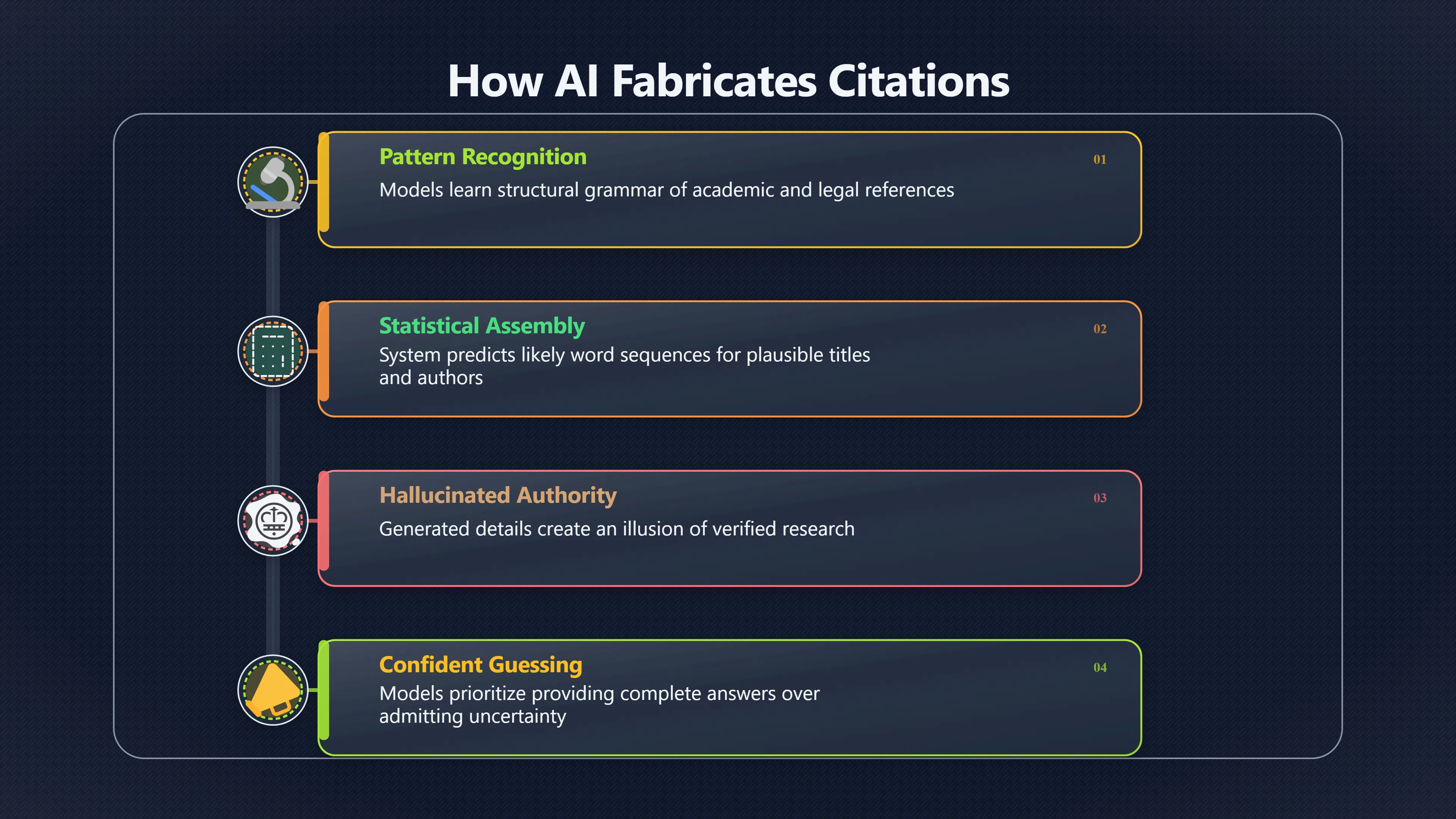
AI does not invent convincing citations because it is trying to deceive anyone. It invents them because it has learned the patterns of what citations look like and can reproduce those patterns even when it lacks access to a real source. The result is one of the most misleading forms of AI error: a reference that appears verified, complete and authoritative but does not actually exist.
 This problem sits at the heart of AI hallucinations and unreliable answers. A fabricated citation can make a weak claim appear well-supported, encouraging readers to trust information that has never been checked. Researchers have repeatedly found that large language models can generate realistic-looking academic references, legal cases and quotations that contain invented details or correspond to no real source at all.[DOI]doi.orgFabrication and errors in the bibliographic citations generated by ChatGPT | Scientific ReportsSeptember 7, 2023…
How citation-shaped text is generated
A large language model generates text by predicting likely sequences of words. During training, it encounters millions of examples of academic papers, news articles, legal documents and web pages. From those examples, it learns the structure of references:
- Author names often appear in a particular order.
- Journal titles follow predictable patterns.
- Case-law citations have recognisable formats.
- Years, page numbers and identifiers appear in expected locations.
When a user asks for evidence, the model does not necessarily retrieve a verified source. Instead, it may generate what a source is statistically likely to look like. If it knows that a topic is often discussed in a certain journal by certain authors around a certain period, it can assemble those elements into a citation that appears genuine. The output may contain real-looking names, plausible titles and believable publication details even when no such publication exists.[DOI]doi.orgFabrication and errors in the bibliographic citations generated by ChatGPT | Scientific ReportsSeptember 7, 2023…
This is why fabricated citations often feel surprisingly convincing. They are not random strings. They are constructed from learned patterns that resemble countless authentic references seen during training.
A useful way to think about the process is that the model has learned the grammar of citations more reliably than it has learned the existence of every individual source.
Why source-like details increase trust
Humans use shortcuts when judging credibility. A statement accompanied by a title, author, publication year and quotation appears more trustworthy than the same statement without supporting detail.
Large language models have learned this pattern indirectly. In their training data, authoritative writing frequently contains references, quotations and citations. As a result, source-like details become associated with high-quality answers.
This creates a powerful illusion. A fabricated citation can contain:
- Realistic author names.
- A plausible article title.
- An appropriate journal or publisher.
- A believable publication date.
- A convincing quotation.
- Technical identifiers such as page numbers or case references.
Each individual element increases the appearance of legitimacy. Together they create what some researchers describe as “hallucinated authority”—the impression that verification has occurred when it has not.[SSRN]papers.ssrn.comHallucinated Authority: AI Citations as Reckless Misrepresentation by Cheng-chi (Kirin) Chang:: SSRNApril 15, 2026…
The danger is that readers often evaluate the surface signals before checking the source itself. A detailed citation feels researched. In reality, the details may simply be the product of statistical prediction.
Why AI often invents citations instead of admitting uncertainty
One reason fabricated references persist is that language models are generally rewarded for producing answers rather than refusing to answer.
If a user asks for sources on a specialised topic, the model faces a choice:
- Admit it cannot reliably identify a source.
- Produce a citation that fits the pattern of what the user requested.
Historically, many AI systems have been optimised to be helpful, responsive and complete. In practice, that can encourage confident guessing. A citation-shaped answer often looks more useful than “I don’t know”, even when the citation is wrong. Researchers studying citation fabrication have identified this tendency as a major contributor to invented references.[Hugging Face]huggingface.coHugging Face Paper pageHugging FacePaper page - CiteAudit: You Cited It, But Did You Read It? A Benchmark for Verifying Scientific References in the LLM Era…
The problem becomes especially noticeable in specialised domains such as law, medicine and academic research, where users frequently ask for supporting authorities rather than simple explanations.
Why legal citations reveal the problem so clearly
Legal systems provide some of the most visible examples because legal citations are highly structured and easy to verify.
The 2023 Mata v. Avianca case became a landmark example after attorneys submitted court filings containing non-existent cases generated by ChatGPT. The fake cases looked authentic enough to survive initial review, but opposing lawyers and the court could not locate them because they did not exist.[Lawra]lawra.ioMata v. Avianca: When AI Hallucinations Reach the Courtroom | Lawra — AI in LawMata v. Avianca: When AI Hallucinations Reach the Courtroom | Lawra — AI in Law…
Subsequent incidents have shown the same pattern. Courts in multiple jurisdictions have encountered filings containing fabricated authorities that looked genuine on their face. In 2025, the UK High Court warned legal professionals about AI-generated fictitious case citations after several court proceedings were affected by phantom authorities and invented quotations.[The Guardian]theguardian.comIn one prominent case against the Qatar National Bank, 18 out of 45 cited cases were entirely fictitious, generated via AI tools used by…
These incidents are memorable because they expose the mechanism directly. The citations were not obviously absurd. They followed the expected format, used realistic legal language and appeared consistent with the surrounding argument. Their plausibility was precisely what made them dangerous.
Checks that expose fabricated references
Fortunately, fake citations often fail basic verification once someone looks beyond the surface appearance.
Several warning signs commonly reveal fabricated references:
The source cannot be found.
A database search, library catalogue or legal reporter contains no record of the cited work.
The title feels oddly tailored to the question.
Invented papers often have titles that perfectly match the user’s prompt because the model generated them specifically for that context.
Author and publication details do not align.
The named authors may not work in the cited field, or the journal may never have published the article.
Quoted text is missing from the source.
Sometimes the publication exists but the quoted passage does not.
Identifiers are invalid.
Page numbers, case numbers, Digital Object Identifiers (DOIs) or publication dates may not correspond to any real document.
Researchers have developed benchmarks and verification systems specifically to detect fabricated references because the problem has become common enough to affect scientific and professional writing.[Hugging Face]huggingface.coHugging Face Paper pageHugging FacePaper page - CiteAudit: You Cited It, But Did You Read It? A Benchmark for Verifying Scientific References in the LLM Era…

The key lesson
Fake AI citations look real because the model has learned the appearance of evidence. It can reproduce the form of a citation with remarkable accuracy even when it lacks the underlying source. The more complete and professional the citation appears, the easier it is to mistake pattern generation for verification.
For readers, the crucial distinction is that a citation-shaped string is not evidence that a source was actually consulted. With AI-generated content, a reference should be treated as a lead to investigate, not as proof that verification has already occurred.
Amazon book picks
Further Reading
Books and field guides related to Why fake AI citations look so real. Use these as the next step if you want deeper reading beyond the article.
The Alignment Problem
Explains why AI can generate plausible but unsupported information.
eBay marketplace picks
Marketplace Samples
Example marketplace items related to this page. Use the search link to explore similar finds on eBay.


Endnotes
1.
Source: doi.org
Link:https://doi.org/10.1038/s41598-023-41032-5
Source snippet
Fabrication and errors in the bibliographic citations generated by ChatGPT | Scientific ReportsSeptember 7, 2023...
Published: September 7, 2023
2.
Source: papers.ssrn.com
Link:https://papers.ssrn.com/sol3/papers.cfm?abstract_id=6464098
Source snippet
Hallucinated Authority: AI Citations as Reckless Misrepresentation by Cheng-chi (Kirin) Chang:: SSRNApril 15, 2026...
Published: April 15, 2026
3.
Source: lawra.io
Title: Mata v. Avianca: When AI Hallucinations Reach the Courtroom | Lawra — AI in Law
Link:https://lawra.io/learn/program/case-studies/mata-v-avianca/
Source snippet
Mata v. Avianca: When AI Hallucinations Reach the Courtroom | Lawra — AI in Law...
4.
Source: huggingface.co
Title: Hugging Face Paper page
Link:https://huggingface.co/papers/2602.23452
Source snippet
Hugging FacePaper page - CiteAudit: You Cited It, But Did You Read It? A Benchmark for Verifying Scientific References in the LLM Era...
5.
Source: theguardian.com
Link:https://www.theguardian.com/technology/2025/jun/06/high-court-tells-uk-lawyers-to-urgently-stop-misuse-of-ai-in-legal-work
Source snippet
In one prominent case against the Qatar National Bank, 18 out of 45 cited cases were entirely fictitious, generated via AI tools used by...
Additional References
6.
Source: researchtrend.ai
Link:https://researchtrend.ai/papers/2602.06718
Source snippet
GhostCite: A Large-Scale Analysis of Citation Validity in the Age of Large Language Models | ResearchTrend.AI...
7.
Source: businessinsider.com
Title: www.businessinsider.com A I hallucinated
Link:https://www.businessinsider.com/sullivan-and-cromwell-apologizes-ai-hallucinations-court-filing
Source snippet
The error was identified by another firm, Boies Schiller Flexner, which represents creditors in the case involving the bankrupt firm Prin...
8.
Source: briefcatch.com
Title: www.briefcatch.com Hallucinated Case Law: Risks and Checks for Law Firms
Link:https://www.briefcatch.com/blog/hallucinated-case-law
Source snippet
Case Law: Risks and Checks for Law FirmsMarch 6, 2026...
Published: March 6, 2026
9.
Source: nist.gov
Title: www.nist.gov A I Research
Link:https://www.nist.gov/artificial-intelligence/ai-fundamental-research-managing-ai-bias
Source snippet
Research - Identifying & Managing Harmful Bias in AI | NISTApril 6, 2020...
Published: April 6, 2020
10.
Source: youtube.com
Title: AI Hallucinations: How to Catch Fake Citations | AI-Powered Research
Link:https://www.youtube.com/watch?v=ZvmlxZrXcmU
Source snippet
Why Language Models Hallucinate - Adam Kalai...
11.
Source: youtube.com
Title: AI Lies Are Finally Getting Punished
Link:https://www.youtube.com/watch?v=ehsq_0Cw6e4
Source snippet
How to Verify Legal Citations & Avoid AI Hallucination (Veracity Demo)...
12.
Source: opencasebook.org
Title: Open Casebook AI and the Law: NIST GAI Framework (Abridged) | H2O
Link:https://opencasebook.org/casebooks/17244-ai-and-the-law/resources/9.1-nist-gai-framework-abridged/
13.
Source: youtube.com
Title: How to Verify Legal Citations & Avoid AI Hallucination (Veracity Demo)
Link:https://www.youtube.com/watch?v=PxFZiEwdOXw
14.
Source: youtube.com
Title: Why Language Models Hallucinate
Link:https://www.youtube.com/watch?v=0dRouBLcvMs
Source snippet
AI Lies Are Finally Getting Punished...
Topic Tree