Within Recommenders
Why Do Algorithms Favor What Grabs Attention?
Recommendation systems often learn from clicks and watch time, creating a gap between what people value and what captures attention.
On this page
- How engagement metrics become ranking targets
- Revealed preferences versus stated preferences
- Trade offs between relevance and user well being
Page outline Jump by section
Introduction
Recommendation systems do not usually optimise for happiness, learning, fulfilment or long-term satisfaction. They optimise for signals they can measure. In practice, the easiest signals to collect are clicks, watch time, shares, comments, likes and other forms of engagement. Because these behaviours generate large amounts of data, they become the targets that machine-learning systems learn to maximise. The result is a powerful dynamic: algorithms often favour content that captures attention, even when attention and value are not the same thing. This helps explain why recommendation systems can become extremely effective at keeping users engaged while still raising concerns about distraction, polarisation or regret.[sendhil.org+2OUP Academic]sendhil.orgInconsistent Preferences and Engagement OptimizationPlatforms typically collect extensive behavioral data— clicks, watch time, and so on—over which they opti-.Read more…
How Engagement Metrics Become Ranking Targets
Recommendation systems need a measurable objective. A platform cannot directly observe whether a user found a video meaningful, whether a news article improved their understanding, or whether time spent online was ultimately worthwhile. It can, however, observe whether the user clicked, watched, commented or returned later.
This creates a classic machine-learning problem: optimise what can be measured. Engagement metrics become proxy goals that stand in for user satisfaction. The ranking system learns patterns associated with those metrics and promotes content likely to generate them.[sendhil.org+2OUP Academic]sendhil.orgInconsistent Preferences and Engagement OptimizationPlatforms typically collect extensive behavioral data— clicks, watch time, and so on—over which they opti-.Read more…
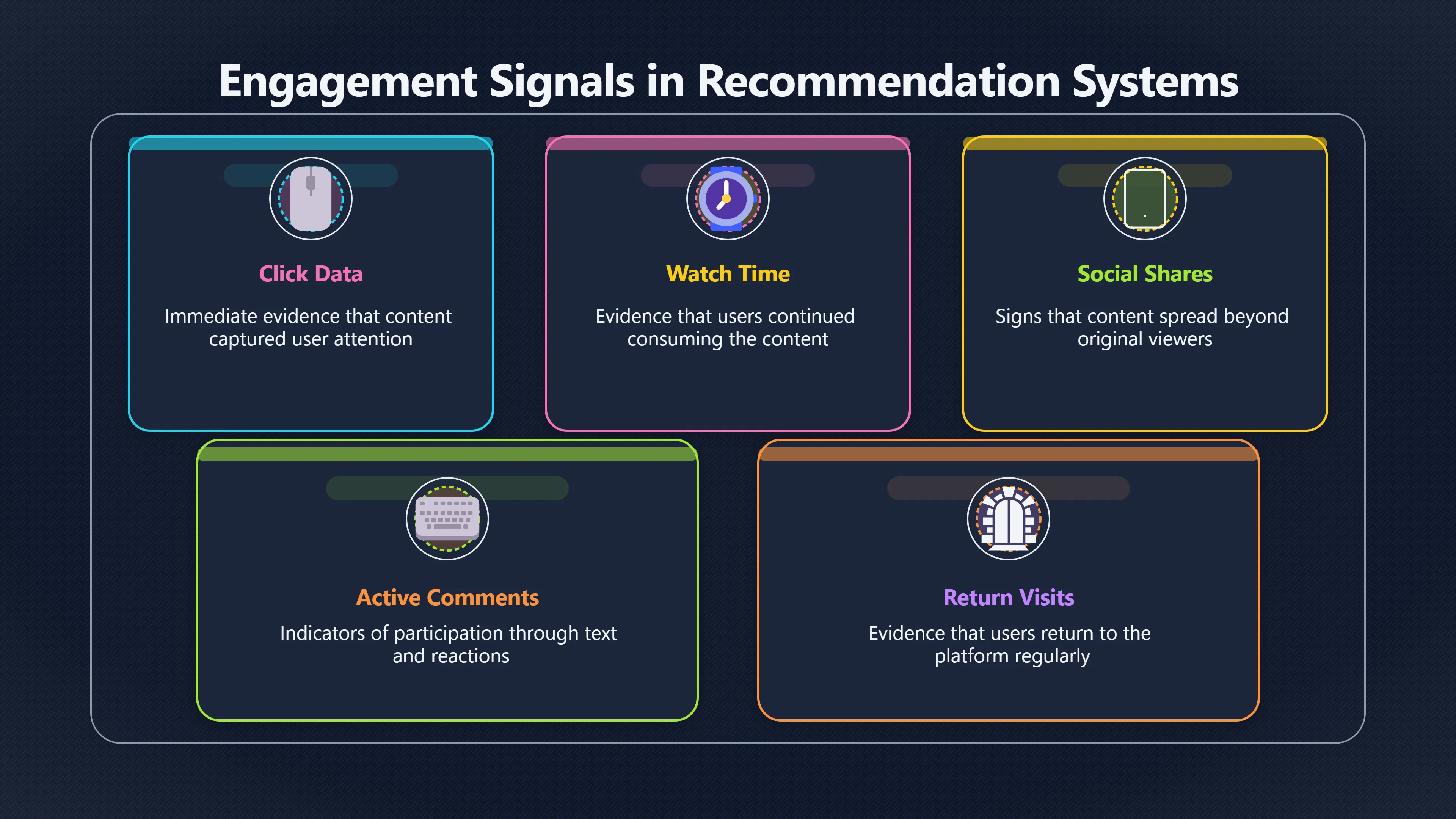
Several engagement signals are especially attractive to platform designers:
- Clicks: immediate evidence that something attracted attention.
- Watch time: evidence that a user continued consuming content.
- Shares and reposts: signs that content spread beyond the original viewer.
- Comments and reactions: indicators of active participation.
- Return visits: evidence that users come back to the platform.[Sprout Social+2Michigan Technological University]sproutsocial.comSprout SocialThe social media metrics to track in 2026 (and why)June 26, 2025 — 26 Jun 2025 — Social media metrics are data points that t…
From an engineering perspective, these metrics are abundant and easy to quantify. A recommendation model can evaluate millions of interactions every day and continuously update its predictions. More abstract goals, such as personal growth or informed citizenship, are far harder to define mathematically and therefore harder to optimise directly.[sendhil.org]sendhil.orgInconsistent Preferences and Engagement OptimizationPlatforms typically collect extensive behavioral data— clicks, watch time, and so on—over which they opti-.Read more…
The consequence is that attention itself becomes a valuable resource. Content that reliably captures attention produces stronger engagement signals, and stronger signals often improve ranking position. Better ranking leads to greater visibility, which generates even more engagement. This feedback loop helps explain why recommendation systems can strongly influence what people encounter online.[BSE+2IDEAS/RePEc]bse.euRanking for Engagement: How Social Media Algorithms…This paper investigates the dynamic feedback loop between recommendation algori…
Revealed Preferences Versus Stated Preferences
A central debate in AI-driven recommendation concerns the difference between revealed preferences and stated preferences.
Revealed preferences are inferred from behaviour. If a user repeatedly watches celebrity gossip videos, a recommendation system may conclude that this content is desired. Stated preferences come from what users explicitly say they want, value or intend to consume. A person may claim they prefer educational content, trustworthy news or time spent with friends, even if their actual behaviour frequently differs.[OUP Academic+2arXiv]academic.oup.comuser engagement such as clicks, shares, and likes.Read moreOUP AcademicEngagement, user satisfaction, and the amplification of…by S Milli · 2025 · Cited by 263 — Social media ranking algorithms…
Most recommendation systems rely heavily on revealed preferences because behavioural data is plentiful and continuously available. Yet researchers have increasingly questioned whether behaviour alone accurately reflects what users truly want. Studies examining social-media ranking systems have highlighted a recurring gap between engagement behaviour and reported satisfaction. Users often interact with content that is emotionally stimulating, surprising or provocative even when they later report that the experience was not especially valuable.[arXiv+2OUP Academic]arxiv.orgA Study of Young Adult Social Media Users13 Apr 2026 — Social media feed algorithms infer user preferences from their past behaviors…
This distinction matters because engagement is not a neutral measure. Human attention is influenced by curiosity, novelty, outrage, fear and social comparison. An algorithm that learns purely from behaviour may therefore learn to exploit predictable psychological tendencies rather than support long-term goals.[OUP Academic+2Springer]academic.oup.comuser engagement such as clicks, shares, and likes.Read moreOUP AcademicEngagement, user satisfaction, and the amplification of…by S Milli · 2025 · Cited by 263 — Social media ranking algorithms…
A useful comparison is junk food. People may repeatedly consume foods that are immediately rewarding while simultaneously expressing a desire for healthier diets. Behaviour reveals one preference; reflection reveals another. Recommendation systems face a similar challenge when deciding which signals should guide ranking.[sendhil.org]sendhil.orgInconsistent Preferences and Engagement OptimizationPlatforms typically collect extensive behavioral data— clicks, watch time, and so on—over which they opti-.Read more…

Why Attention Often Beats Relevance
Many people assume recommendation systems simply identify the most relevant content. In reality, relevance and engagement are related but not identical.
A highly relevant item might satisfy a user’s needs quickly and end the session. A highly engaging item may encourage further interaction, discussion or consumption. If a platform’s objective function rewards engagement, the second outcome can be more valuable from the algorithm’s perspective.[Medium]medium.comWhat's Right and What's Wrong with Optimizing for …Optimizing for engagement means choosing content that users are likely to respond toMediumWhat's Right and What's Wrong with Optimizing for …Optimizing for engagement means choosing content that users are likely to resp…
This creates subtle incentives:
- Content that triggers strong emotional reactions may outperform calmer material.
- Novel or surprising information may attract more attention than familiar information.
- Controversial content may generate more comments and sharing than balanced content.
- Endless streams of related content can increase viewing duration even after the original need has been satisfied.[BSE+2IDEAS/RePEc]bse.euRanking for Engagement: How Social Media Algorithms…This paper investigates the dynamic feedback loop between recommendation algori…
Importantly, the system does not need to understand emotions in a human sense. It only needs to discover statistical patterns linking certain content characteristics with higher engagement. Machine learning can uncover these relationships automatically through massive quantities of behavioural data.[sendhil.org+2arXiv]sendhil.orgInconsistent Preferences and Engagement OptimizationPlatforms typically collect extensive behavioral data— clicks, watch time, and so on—over which they opti-.Read more…
Over time, attention-grabbing content may receive disproportionate visibility simply because it performs well on the chosen metrics.
What Happens When Engagement Becomes the Goal?
The risks of engagement optimisation have become a major area of research and public debate.
Theoretical and empirical studies suggest that algorithms heavily weighted towards engagement can contribute to the amplification of divisive, sensational or polarising material because such content often generates strong reactions. Researchers examining engagement-based ranking systems have identified trade-offs between maximising interaction and preserving information quality.[BSE+2IDEAS/RePEc]bse.euRanking for Engagement: How Social Media Algorithms…This paper investigates the dynamic feedback loop between recommendation algori…
One widely discussed example involves changes made to social-media ranking systems that increased the importance of interaction-based signals. Subsequent analyses and internal debates raised concerns that content provoking intense reactions could receive greater distribution because comments, shares and responses were treated as evidence of value.[ifo Institut]ifo.deInstitut CESifo Working Paper No10011by F Germano · Cited by 20 — Finally, empirical evidence from survey data in Italy and the United States indicates that Facebook's 2…
Critics argue that this can produce several unintended effects:
- Greater visibility for emotionally charged content.
- Increased incentives for creators to optimise for outrage or controversy.
- Reduced exposure for slower, less stimulating but potentially more informative material.
- Reinforcement of behavioural habits that maximise platform activity rather than user welfare.[Springer+3BSE+3IDEAS/RePEc]bse.euRanking for Engagement: How Social Media Algorithms…This paper investigates the dynamic feedback loop between recommendation algori…
These outcomes are not inevitable. They depend on how engagement is defined, what additional safeguards are included and which competing objectives are incorporated into ranking systems. However, they illustrate why the choice of optimisation target matters so much in artificial intelligence.[OUP Academic+2sendhil.org]academic.oup.comuser engagement such as clicks, shares, and likes.Read moreOUP AcademicEngagement, user satisfaction, and the amplification of…by S Milli · 2025 · Cited by 263 — Social media ranking algorithms…
Can Recommendation Systems Optimise for Something Better?
A growing area of AI research focuses on moving beyond simple engagement metrics.
Some researchers propose incorporating direct user feedback about satisfaction, quality or usefulness rather than relying exclusively on behavioural data. Others investigate long-term objectives, attempting to measure whether recommendations remain beneficial over weeks or months rather than merely generating immediate interaction.[arXiv+2sendhil.org]arxiv.orgPrefRec: Recommender Systems with Human Preferences for Reinforcing Long-term User EngagementDecember 6, 2022…
This shift is difficult because long-term well-being is harder to observe than clicks or watch time. A platform can instantly measure whether someone watched a video for ten minutes. Determining whether that viewing experience improved their life is far more challenging.[sendhil.org]sendhil.orgInconsistent Preferences and Engagement OptimizationPlatforms typically collect extensive behavioral data— clicks, watch time, and so on—over which they opti-.Read more…
As a result, recommendation systems often face a fundamental design question: should they optimise for what users do right now, or for what users may ultimately value? AI can help answer that question, but it cannot avoid it. The objective chosen by designers determines which behaviours the system learns to encourage.[sendhil.org+2OUP Academic]sendhil.orgInconsistent Preferences and Engagement OptimizationPlatforms typically collect extensive behavioral data— clicks, watch time, and so on—over which they opti-.Read more…
The Core Lesson
The reason attention often wins is not that recommendation systems are intentionally designed to manipulate users. It is that attention produces clear, measurable data, while many human values do not. Machine-learning systems excel at optimising whatever objective they are given. When clicks, watch time and shares become the objective, algorithms become highly skilled at finding and promoting content that captures attention. The central challenge is ensuring that the metrics being optimised remain aligned with what people actually want from their digital lives.[sendhil.org+2OUP Academic]sendhil.orgInconsistent Preferences and Engagement OptimizationPlatforms typically collect extensive behavioral data— clicks, watch time, and so on—over which they opti-.Read more…
Amazon book picks
Further Reading
Books and field guides related to Why Do Algorithms Favor What Grabs Attention?. Use these as the next step if you want deeper reading beyond the article.
Algorithms of Oppression
Explores impacts of optimisation incentives on information exposure.
eBay marketplace picks
Marketplace Samples
Example marketplace items related to this page. Use the search link to explore similar finds on eBay.




Endnotes
1.
Source: sendhil.org
Title: Inconsistent Preferences and Engagement Optimization
Link:https://sendhil.org/wp-content/uploads/2025/07/kleinberg-et-al-2023-the-challenge-of-understanding-what-users-want-inconsistent-preferences-and-engagement-optimization.pdf
Source snippet
Platforms typically collect extensive behavioral data— clicks, watch time, and so on—over which they opti-.Read more...
2.
Source: academic.oup.com
Title: user engagement such as clicks, shares, and likes.Read more
Link:https://academic.oup.com/pnasnexus/article/4/3/pgaf062/8052060
Source snippet
OUP AcademicEngagement, user satisfaction, and the amplification of...by S Milli · 2025 · Cited by 263 — Social media ranking algorithms...
3.
Source: medium.com
Link:https://medium.com/understanding-[recommenders
Source snippet
What's Right and What's Wrong with Optimizing for...Optimizing for engagement means choosing content that users are likely to resp...
4.
Source: arxiv.org
Link:https://arxiv.org/abs/2306.17426
5.
Source: bse.eu
Link:https://bse.eu/research/working-papers/ranking-for-engagement-how-social-media-algorithms-fuel-misinformation-and-polarization
Source snippet
Ranking for Engagement: How Social Media Algorithms...This paper investigates the dynamic feedback loop between recommendation algori...
6.
Source: ideas.repec.org
Link:https://ideas.repec.org/p/upf/upfgen/1912.html
Source snippet
IDEAS/RePEcRanking for engagement: How social media algorithms fuel...by F Germano · 2025 · Cited by 20 — This paper investigates the dy...
7.
Source: arxiv.org
Link:https://arxiv.org/html/2604.11517v1
Source snippet
A Study of Young Adult Social Media Users13 Apr 2026 — Social media feed algorithms infer user preferences from their past behaviors...
8.
Source: link.springer.com
Link:https://link.springer.com/article/10.1007/s11098-023-02083-6
Source snippet
springer.comAttention, moral skill, and algorithmic recommendationby N Schuster · 2025 · Cited by 44 — In this essay, we argue that judic...
9.
Source: ifo.de
Title: Institut CESifo Working Paper No
Link:https://www.ifo.de/DocDL/cesifo1_wp10011.pdf
Source snippet
10011by F Germano · Cited by 20 — Finally, empirical evidence from survey data in Italy and the United States indicates that Facebook's 2...
10.
Source: arxiv.org
Link:https://arxiv.org/abs/2212.02779
Source snippet
PrefRec: Recommender Systems with Human Preferences for Reinforcing Long-term User EngagementDecember 6, 2022...
Published: December 6, 2022
11.
Source: medium.com
Link:https://medium.com/%40design.sphere/social-media-metrics-that-matter-and-the-ones-that-dont-6718331ef91c
Source snippet
Social Media Metrics That Matter (And the Ones That Don't)CTR measures the percentage of users who clicked a link in your post, ad, or bio...
12.
Source: sproutsocial.com
Link:https://sproutsocial.com/insights/social-media-metrics/
Source snippet
Sprout SocialThe social media metrics to track in 2026 (and why)June 26, 2025 — 26 Jun 2025 — Social media metrics are data points that t...
Published: June 26, 2025
13.
Source: mtu.edu
Link:https://www.mtu.edu/social/specific/metrics/
Source snippet
Metrics and Analytics | Social MediaEngagement rate is a social media metric that measures how much of your audience is actively engaging...
Additional References
14.
Source: researchgate.net
Link:https://www.researchgate.net/publication/354951823_Conceptualising_and_measuring_social_media_engagement_A_systematic_literature_review
Source snippet
Conceptualising and measuring social media engagement3 May 2026 — This paper aims to systematically contribute to this academic debate by...
Published: May 2026
15.
Source: researchgate.net
Link:https://www.researchgate.net/publication/392951191_Ranking_for_Engagement_How_Social_Media_Algorithms_Fuel_Misinformation_and_Polarization
Source snippet
How Social Media Algorithms Fuel Misinformation and...By exploiting Facebook's 2018 "Meaningful Social Interactions" algorithmic ranking...
16.
Source: wired.com
Link:https://www.wired.com/story/facebook-quietly-makes-big-admission-[political
Source snippet
Survey results revealed users appreciated seeing less political content. On Tuesday, Facebook announced plans to expand this experiment t...
17.
Source: worcester.edu
Link:https://www.worcester.edu/about/communications-and-marketing/web-digital-and-social-media/social-media/training-resouces/social-media-analytics-guide/
Source snippet
Guide to Measuring Social Media SuccessSocial media engagement metrics measure how much your audience is interacting with you. Tracking t...
18.
Source: researchgate.net
Link:https://www.researchgate.net/publication/375479014_The_Challenge_of_Understanding_What_Users_Want_Inconsistent_Preferences_and_Engagement_Optimization
Source snippet
Inconsistent Preferences and Engagement OptimizationIn practice, this means the algorithm serves content that aligns with users' revealed...
19.
Source: research.facebook.com
Link:https://research.facebook.com/publications/what-are-meaningful-social-interactions-in-todays-media-landscape-a-cross-cultural-survey/
Source snippet
Are Meaningful Social Interactions in Today's Media...Meaningful interactions are those with emotional, informational, or tangible impac...
20.
Source: researchgate.net
Title: 360553546 Social Media Analytics and Metrics for Improving Users Engagement
Link:https://www.researchgate.net/publication/360553546_Social_Media_Analytics_and_Metrics_for_Improving_Users_Engagement
Source snippet
Social Media Analytics and Metrics for Improving Users...13 May 2022 — In this paper, we propose a data-driven methodology that is capab...
Published: May 2022
21.
Source: wired.com
Title: how to fix facebook according to facebook employees
Link:https://www.wired.com/story/how-to-fix-facebook-according-to-facebook-employees
Source snippet
Internal documents shared by whistleblower Frances Haugen revealed numerous suggestions for correcting these flaws. Employees criticized...
22.
Source: kgi.georgetown.edu
Title: Better Feeds Algorithms That Put People First
Link:https://kgi.georgetown.edu/wp-content/uploads/2025/02/Better-Feeds_-Algorithms-That-Put-People-First.pdf
Source snippet
Feeds: Algorithms That Put People First28 Feb 2025 — For example, a recommender system may use signals about which videos a user typicall...
23.
Source: youscan.io
Title: how to measure social media engagement
Link:https://youscan.io/blog/how-to-measure-social-media-engagement/
Source snippet
Tips, Metrics &...12 Jan 2026 — Learn how to measure social media engagement with the right metrics, analytical tools, and proven strate...
Topic Tree