Within Few shot prompts
When few shot prompts start to drift
Ambiguous, easy, or inconsistent examples can make a model start confidently and then wander away from the intended pattern.
On this page
- Why unclear demonstrations send mixed signals
- How edge cases expose weak prompt rules
- How realistic examples reduce drift
Page outline Jump by section
Introduction
Few-shot prompting works because examples act like temporary task rules. However, those rules are often less stable than they appear. A prompt may produce excellent results for the first few cases and then gradually wander away from the intended pattern, a phenomenon often described as output drift. Drift occurs when the examples do not clearly define the task, when they contain hidden inconsistencies, or when new inputs expose gaps in the pattern the model inferred from the demonstrations. Research on in-context learning repeatedly shows that model behaviour can be highly sensitive to the choice, ordering, and structure of examples, even when the underlying task remains unchanged.[Prompting Guide+2arXiv]promptingguide.aiPrompting GuideFew-Shot Prompting1 Feb 2026 — Few-shot prompting can be used as a technique to enable in-context learning where we provid…
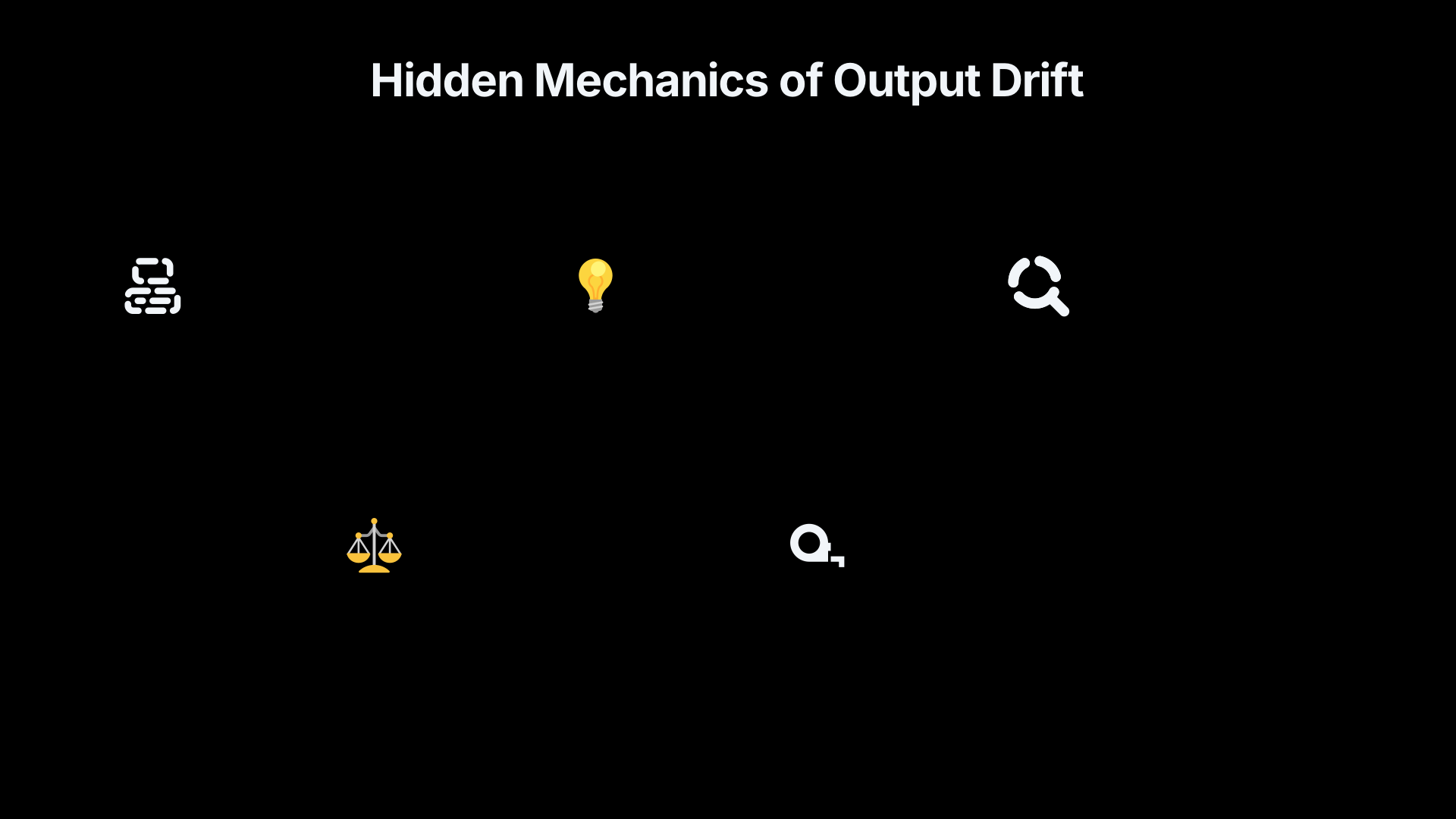 Understanding this limitation is important because few-shot prompting often creates an illusion of reliability. The model may appear to have learned a rule, but in reality it is following a temporary interpretation assembled from the examples currently visible in the prompt. When that interpretation is incomplete or ambiguous, outputs can begin to drift.
Why unclear demonstrations send mixed signals
Few-shot examples do more than define a task. They also communicate assumptions about format, tone, categories, priorities, and exceptions. When those signals are inconsistent, the model must decide which pattern matters most.
Consider a sentiment-classification prompt where two examples use the labels “Positive” and “Negative”, but a third example uses a phrase such as “Mostly Positive”. The model now receives conflicting evidence about whether the task requires strict categories or flexible descriptions. Early responses may still look correct, but later outputs can begin introducing new labels or formats because the prompt never established a single clear rule.
Researchers studying in-context learning have found that performance is highly sensitive to demonstration selection and ordering. Different example sets can produce substantially different results even when they describe the same task. In some cases, models appear to follow the surface structure of demonstrations more strongly than the intended input-to-output relationship.[ResearchGate+2arXiv]researchgate.netResearch Gate What Makes In-Context Learning Work?Request PDFJanuary 1, 2022 — 2 Jun 2026 — Few-shot prompting includes a small set of input-output examples in the prompt to demonstrate…
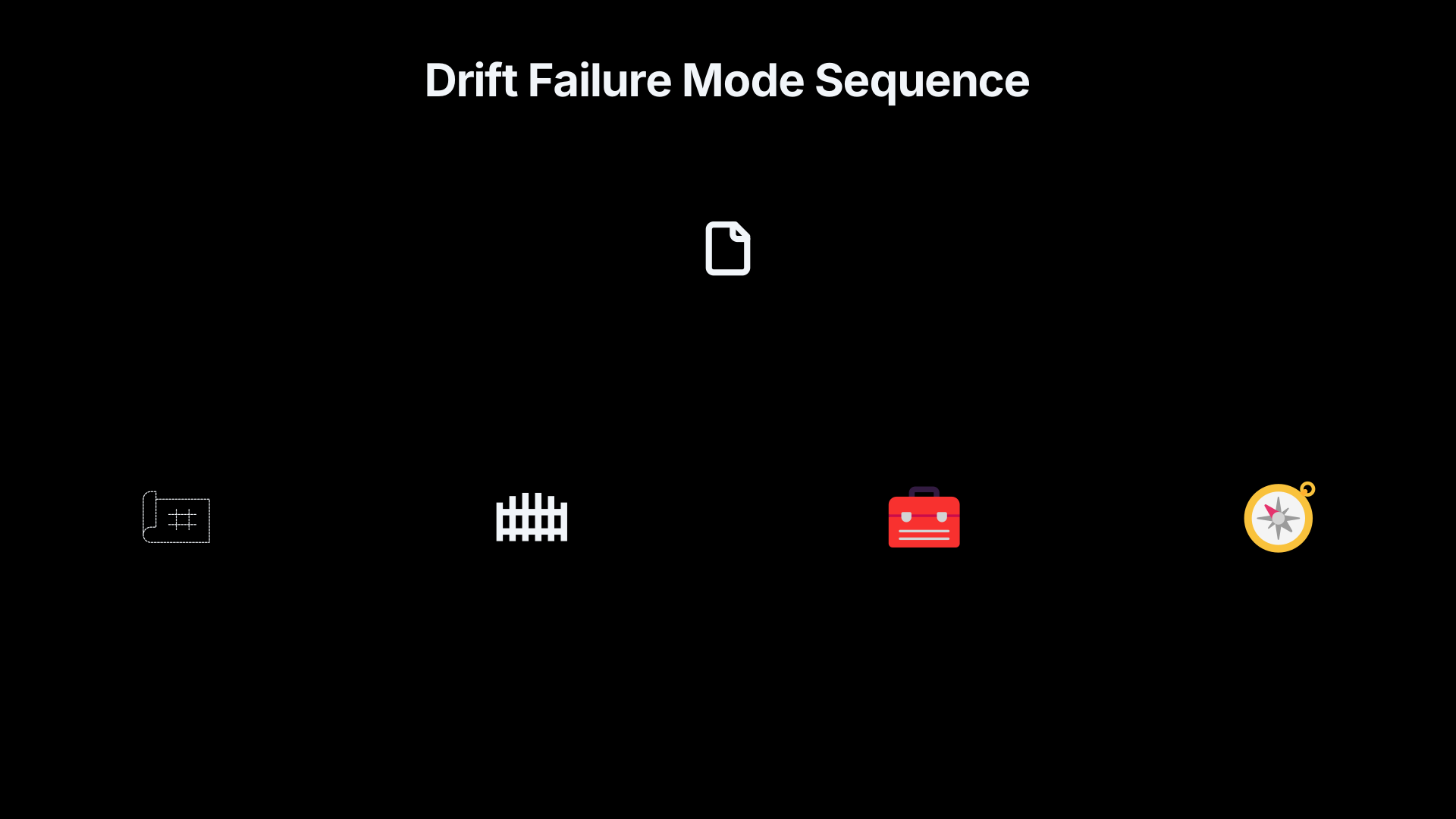
This creates a common failure mode:
- The first examples seem internally consistent.
- The model infers a provisional rule.
- A later input does not fit neatly into that rule.
- The model improvises.
- The improvisation becomes a new pattern that influences subsequent outputs.
From a user’s perspective, the model appears to “lose focus”. In practice, it is often revealing that the original demonstrations did not fully specify the task.
How edge cases expose weak prompt rules
Drift often becomes visible only when the prompt encounters a difficult or unusual input.
A few-shot prompt may work perfectly on straightforward examples because all demonstrations point toward the same interpretation. Problems emerge when a new case sits near a decision boundary. At that point the model must determine whether the examples represent a rigid rule or merely a trend.
For example, imagine examples that classify customer feedback as either positive or negative:
- “Excellent service” → Positive
- “Terrible experience” → Negative
- “Fast delivery” → Positive
Now consider the input: “The product works, but customer support never replied.”
The demonstrations never showed mixed sentiment. The model must invent a strategy. One response might classify it as negative. Another might introduce a neutral category. A third might produce a longer explanation. Each outcome reflects uncertainty about the hidden rule rather than uncertainty about the language itself.
Studies of prompt sensitivity have shown that predictions are often less reliable precisely when they are sensitive to changes in demonstrations or prompt structure. Small modifications to examples can produce disproportionately large changes in outputs, indicating that the model’s inferred rule is fragile.[arXiv]arxiv.orgarXiv On the Relation between Sensitivity and Accuracy in In-context LearningarXiv On the Relation between Sensitivity and Accuracy in In-context Learning
Edge cases therefore act as stress tests. They reveal whether the few-shot examples captured the full task or only the easiest portion of it.
When the model learns the wrong pattern
A particularly subtle form of drift occurs when the model focuses on the wrong feature entirely.
Research has found that models can sometimes rely heavily on demonstration format, label distribution, or other superficial characteristics rather than the intended reasoning process. If every positive example happens to be longer than every negative example, the model may partially associate length with sentiment. If all examples follow the same wording style, stylistic cues may influence future predictions.[ResearchGate]researchgate.netResearch Gate What Makes In-Context Learning Work?Request PDFJanuary 1, 2022 — 2 Jun 2026 — Few-shot prompting includes a small set of input-output examples in the prompt to demonstrate…
The resulting outputs can appear correct for several examples before gradually diverging when those accidental correlations no longer hold.

How realistic examples reduce drift
The strongest defence against drift is not necessarily adding more examples. It is providing better examples.
High-quality demonstrations make the temporary task rules easier to infer because they expose the boundaries of the task rather than only its simplest cases. Research on example selection shows that the choice of demonstrations significantly affects few-shot performance, and that carefully selected examples can improve both stability and accuracy.[OpenReview]openreview.netExample selection is quite important for few-shot…Read more…
Several practices help reduce drift:
Use consistent outputs.
If the task requires a fixed format, every demonstration should follow it exactly. Consistency reduces opportunities for the model to invent alternative structures.
Include borderline cases.
Examples that sit near decision boundaries help clarify what should happen when inputs are ambiguous. They prevent the model from overgeneralising from only easy cases.[Tetrate]tetrate.ioFew-Shot Learning for LLMs: Examples and…Some research suggests that including challenging or ambiguous examples improves few-s…
Cover meaningful variation.
A prompt that includes only one style of input may encourage narrow pattern matching. Diverse examples help communicate which features are essential and which are incidental.
Avoid accidental patterns.
Demonstrations should not unintentionally correlate unrelated features with outcomes. Otherwise the model may learn shortcuts rather than the intended rule.
Test with unseen cases.
A prompt that works only on examples similar to its demonstrations is vulnerable to drift. Evaluating against new and unusual inputs helps expose weaknesses before deployment.
Why drift matters for understanding AI
Output drift highlights an important truth about few-shot prompting: the model is not simply executing instructions. It is constructing a temporary interpretation of the task from whatever evidence the prompt provides.
That interpretation can be surprisingly powerful, allowing new behaviours without retraining. Yet it can also be surprisingly fragile. Research on in-context learning consistently shows sensitivity to example choice, ordering, label balance, and prompt structure. Small changes in demonstrations can lead to meaningful changes in behaviour.[arXiv+2arXiv]arxiv.orgarXiv Fairness-guided Few-shot Prompting for Large Language ModelsarXiv Fairness-guided Few-shot Prompting for Large Language Models
For readers trying to understand artificial intelligence, output drift is a useful reminder that few-shot prompting does not create permanent knowledge or guaranteed rules. It creates a temporary working theory inside the model’s current context. When the examples are clear, realistic, and well balanced, that theory can remain stable. When they are ambiguous or incomplete, the model may begin confidently following a pattern that slowly drifts away from what the user intended.
eBay marketplace picks
Marketplace Samples
Example marketplace items related to this page. Use the search link to explore similar finds on eBay.


Endnotes
1.
Source: arxiv.org
Link:https://arxiv.org/pdf/2507.22887
Source snippet
A Positional Bias of In-Context Learningby K Cobbina · 2025 · Cited by 10 — In-context learning (ICL) is a critical emerging capability o...
2.
Source: arxiv.org
Title: arXiv Fairness-guided Few-shot Prompting for Large [Language Models]({{ ‘language-models/’ | relative_url }})
Link:https://arxiv.org/abs/2303.13217
3.
Source: researchgate.net
Title: Research Gate What Makes In-Context Learning Work?
Link:https://www.researchgate.net/publication/372929181_Rethinking_the_Role_of_Demonstrations_What_Makes_In-Context_Learning_Work
Source snippet
Request PDFJanuary 1, 2022 — 2 Jun 2026 — Few-shot prompting includes a small set of input-output examples in the prompt to demonstrate...
Published: January 1, 2022
4.
Source: arxiv.org
Title: arXiv On the Relation between Sensitivity and Accuracy in In-context Learning
Link:https://arxiv.org/abs/2209.07661
5.
Source: openreview.net
Link:https://openreview.net/forum?id=D8oHQ2qSTj
Source snippet
Example selection is quite important for few-shot...Read more...
6.
Source: tetrate.io
Link:https://tetrate.io/learn/ai/few-shot-learning-llms
Source snippet
Few-Shot Learning for LLMs: Examples and...Some research suggests that including challenging or ambiguous examples improves few-s...
7.
Source: arxiv.org
Link:https://arxiv.org/html/2507.23211v1
Source snippet
Enhancing Few-Shot In-Context Learning by Leveraging...31 Jul 2025 — We propose a novel method that utilizes Negative samples to better...
8.
Source: arxiv.org
Link:https://arxiv.org/abs/2402.10353
Source snippet
Prompt-Based Bias Calibration for Better Zero/Few-Shot...by K He · 2024 · Cited by 13 — In this work, we propose a null-input prompting...
9.
Source: researchgate.net
Link:https://www.researchgate.net/publication/378885725_Mitigating_Word_Bias_in_Zero-shot_Prompt-based_Classifiers
Source snippet
Mitigating Word Bias in Zero-shot Prompt-based ClassifiersWe present ZMT (Zero-Shot Multi-Task Learning), a framework that jointly optimi...
10.
Source: researchgate.net
Link:https://www.researchgate.net/publication/381189669_Batch_Calibration_Rethinking_Calibration_for_In-Context_Learning_and_Prompt_Engineering?_tp=eyJjb250ZXh0Ijp7InBhZ2UiOiJzY2llbnRpZmljQ29udHJpYnV0aW9ucyIsInByZXZpb3VzUGFnZSI6bnVsbCwic3ViUGFnZSI6bnVsbH19
Source snippet
Rethinking Calibration for In-Context Learning and Prompt...In the few-shot setup, we further extend BC to allow it to learn the context...
11.
Source: openreview.net
Link:https://openreview.net/forum?id=YPIA7bgd5y
Source snippet
In-Context Learning Learns Label Relationships but Is Not...by J Kossen · Cited by 102 — In this paper, we provide novel insights into ho...
12.
Source: promptingguide.ai
Link:https://www.promptingguide.ai/techniques/fewshot
Source snippet
Prompting GuideFew-Shot Prompting1 Feb 2026 — Few-shot prompting can be used as a technique to enable in-context learning where we provid...
Additional References
13.
Source: merriam-webster.com
Link:https://www.merriam-webster.com/dictionary/in
Source snippet
IN Definition & Meaning6 days ago — The meaning of IN is —used as a function word to indicate inclusion, location, or position within lim...
14.
Source: github.com
Link:https://github.com/dqxiu/icl_paperlist
Source snippet
Paper List for In-context LearningFantastically ordered prompts and where to find them: Overcoming few-shot prompt order sensitivity. Yao...
15.
Source: apxml.com
Link:https://apxml.com/courses/prompt-engineering-agentic-workflows/chapter-2-advanced-prompting-agent-control/few-shot-examples-agent-guidance
Source snippet
Utilizing Few-Shot Examples for Agent GuidanceApply few-shot learning principles within prompts to guide and adapt agent behavior with mi...
16.
Source: wordwebonline.com
Link:https://www.wordwebonline.com/en/IN
Source snippet
in, In, in-, IN, ins- WordWeb dictionary definitionLocated in; surrounded by · Part of; a member of · At or after a particular a period o...
17.
Source: collinsdictionary.com
Link:https://www.collinsdictionary.com/dictionary/english/in
Source snippet
inside; within · 2. at a place where there is · 3. indicating a state, situation, or condition · 4. before or when (a period of...Read more...
18.
Source: sambanova.ai
Title: many shot prompting a practical guide to icl
Link:https://sambanova.ai/blog/many-shot-prompting-a-practical-guide-to-icl
Source snippet
Many-Shot Prompting: A Practical Guide to In-Context...Apr 22, 2026 — We ran thousands of experiments on many-shot in-context learning (...
19.
Source: sandgarden.com
Link:https://www.sandgarden.com/learn/few-shot-prompting
Source snippet
more predictable outcomes—especially useful in practical, real-world...
20.
Source: medium.com
Link:https://medium.com/%40anicomanesh/mastering-few-shot-and-zero-shot-learning-in-llms-a-deep-dive-into-cross-domain-generalization-b33f779f5259
Source snippet
st a few input-output examples in the prompt. Typically...
21.
Source: youtube.com
Link:http://www.youtube.com/watch?v=mW0Cb3UCNBQ
Source snippet
Rethinking the Role of Demonstrations What Makes In Context Learning Work James...
22.
Source: comet.com
Link:https://www.comet.com/site/blog/few-shot-prompting/
Source snippet
Few-Shot Prompting for Agentic Systems: Teaching by Example7 Mar 2026 — Few-shot prompting is a method that gives an LLM 2-5 examples to...
Topic Tree