Within Human Review
Can the Human Really Say No?
Override authority only protects people when reviewers have permission, time, training, and institutional support to reject the machine.
On this page
- Formal authority versus practical authority
- Workload and culture barriers to disagreement
- Training reviewers to spot system failure modes
Page outline Jump by section
Introduction
Human oversight only protects people when the human reviewer can genuinely reject, reverse, or halt an AI-driven decision. In many organisations, a person is formally included in the process, yet practical conditions make disagreement unlikely. The reviewer may face tight deadlines, heavy caseloads, performance targets, limited information, or a workplace culture that treats the system as the default authority. In those circumstances, override power becomes symbolic rather than real.
 Meaningful oversight in high-risk AI systems therefore depends on more than a technical “human in the loop” requirement. It requires authority, resources, training, and organisational support. Regulators, researchers, and human-factors specialists increasingly emphasise that the critical question is not whether a human can theoretically intervene, but whether they can realistically do so when it matters. AI Act Service Desk+2Responsible AI Platform[ai-act-service-desk.ec.europa.eu]ai-act-service-desk.ec.europa.euAI Act Service Desk Article 14: Human oversight | AI Act Service DeskAI Act Service DeskArticle 14: Human oversight | AI Act Service DeskJune 13, 2024…
Can the Human Really Say No?
A useful test for oversight is simple: if the AI system makes a recommendation that appears questionable, can the reviewer reject it without penalty, delay, or procedural obstacles?
The European Union’s AI Act explicitly treats this as a core requirement for high-risk systems. Human overseers should be able to understand system limitations, recognise automation bias, interpret outputs, disregard recommendations, override results, and stop system operation where necessary. The law does not describe oversight as passive observation; it describes active authority. AI Act Service Desk+2Responsible AI Platform[ai-act-service-desk.ec.europa.eu]ai-act-service-desk.ec.europa.euAI Act Service Desk Article 14: Human oversight | AI Act Service DeskAI Act Service DeskArticle 14: Human oversight | AI Act Service DeskJune 13, 2024…
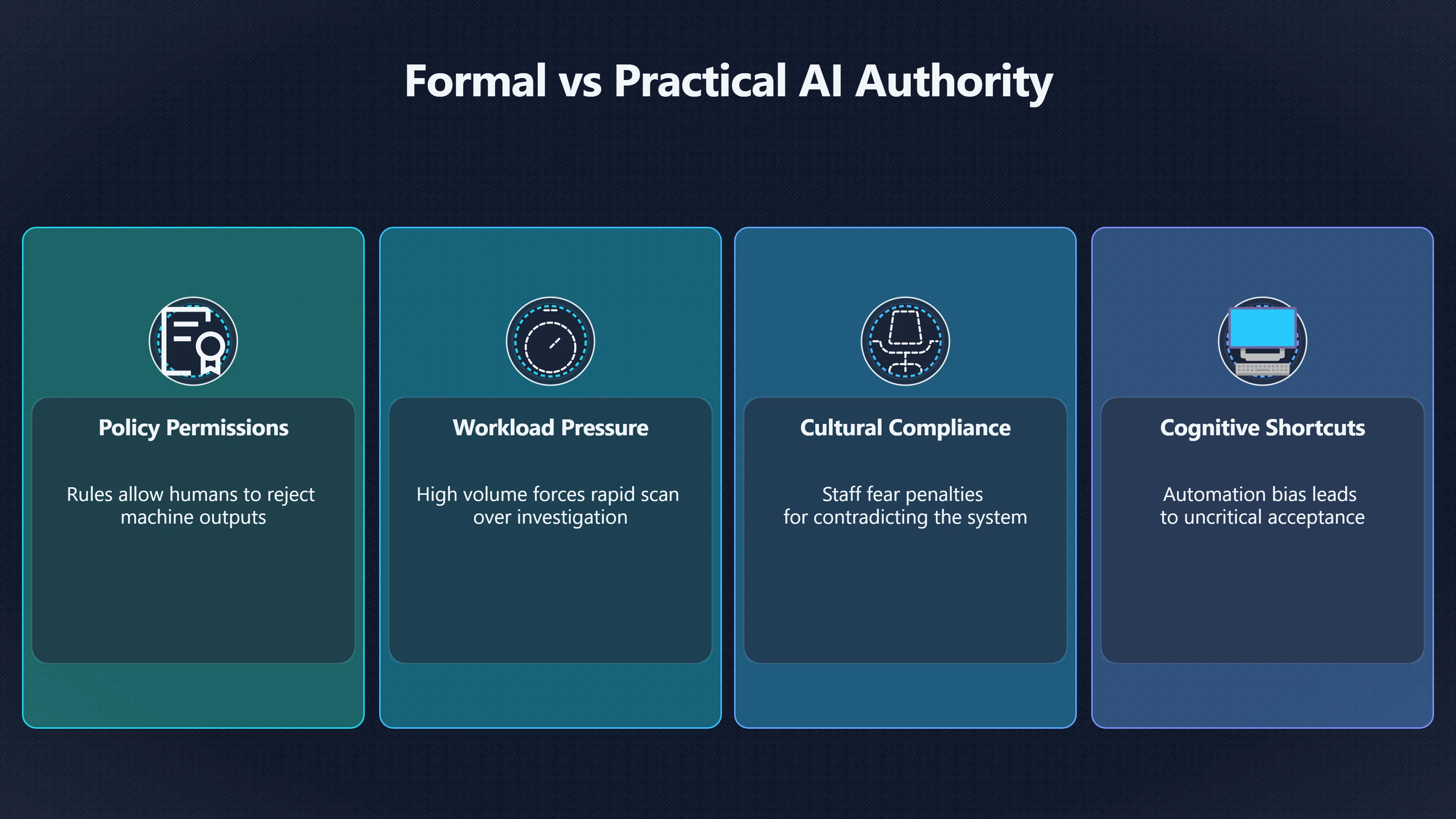
In practice, however, organisations often confuse formal authority with practical authority. A policy manual may state that staff can override the system, but the real question is whether they can do so without facing negative consequences.
Formal authority versus practical authority
Formal authority exists when organisational rules permit a human to reject an AI recommendation.
Practical authority exists when people can actually exercise that right.
The difference becomes clear when examining everyday workplace pressures:
- A loan officer may technically be allowed to overrule a risk score, but may need extensive documentation every time they do so.
- A healthcare professional may be permitted to challenge a clinical support system, yet face severe time pressure during patient care.
- A public-sector worker may have override authority on paper, but be evaluated on consistency with algorithmic recommendations.
When these pressures accumulate, the AI recommendation becomes the default outcome. Human review survives as a procedural step while genuine judgement disappears. Data-protection guidance in both Europe and the United Kingdom has repeatedly warned that a decision is not meaningfully human simply because a person signs off on it. Rubber-stamping does not constitute real oversight.[ICO]ico.org.ukICOHow do we ensure individual rights in our AI systems? | ICOICOHow do we ensure individual rights in our AI systems? | ICO
A useful indicator of genuine authority is whether overrides occur in practice. If a system processes thousands of decisions and reviewers almost never disagree with it, organisations should ask whether the AI is extraordinarily accurate or whether the review process has become largely ceremonial.
Why Workload Often Defeats Oversight
Even competent reviewers struggle to challenge automated systems when workload is high.
Research on automation bias—the tendency to place excessive trust in automated recommendations—has consistently found that reliance on automation increases when people face time pressure, complex tasks, or competing demands on attention. Under these conditions, accepting the machine’s recommendation becomes a cognitive shortcut.[PMC]pmc.ncbi.nlm.nih.govJune 16, 2011…
This creates a structural problem for high-risk AI deployments. Organisations often introduce AI specifically to increase efficiency and process more cases. Yet the faster the workflow becomes, the less time reviewers have to independently verify outputs.
A reviewer handling hundreds of cases per day may:
- Scan recommendations rather than investigate them.
- Focus attention only on unusual cases.
- Assume the system is probably correct because challenging every output is impossible.
- Use AI outputs as a starting point for judgement rather than conducting an independent assessment.
At that point, human oversight remains present in a legal or organisational sense but loses much of its protective value. Researchers studying decision-support systems in healthcare, public administration, and other domains have repeatedly identified workload and time constraints as major contributors to automation bias.[PMC+2ResearchGate]pmc.ncbi.nlm.nih.govJune 16, 2011…
When Organisational Culture Discourages Disagreement
Override power also depends on workplace culture.
Many organisations unintentionally reward compliance with AI recommendations. Staff may learn that following the system creates fewer problems than questioning it. If disagreements require additional paperwork, managerial approval, or lengthy justification, reviewers receive a clear signal about preferred behaviour.
The result is not necessarily blind obedience. More often, it is a gradual shift in incentives. The safest professional choice becomes agreeing with the machine.
Several factors can reinforce this dynamic:
- Managers treating algorithmic outputs as objective facts.
- Performance metrics focused on speed and throughput.
- Fear of being blamed for overriding a recommendation that later proves correct.
- Assumptions that complex AI systems are more knowledgeable than human reviewers.
The challenge is especially severe when reviewers do not fully understand the system. If people perceive the AI as possessing expertise beyond their own, they may hesitate to intervene even when they notice warning signs. Studies of automated decision-making have found that perceived machine expertise can discourage human intervention and strengthen reliance on system outputs.[edps.europa.eu]edps.europa.eu2025 09 23 techdispatch 22025 human oversight automated making frTechDispatch #2/2025 - Human Oversight of Automated Decision-Making | European Data Protection SupervisorSeptember 23, 2025…
The lesson is that oversight cannot be created solely through software design. Institutions must actively support disagreement. Staff need to know that challenging the system is part of their role, not evidence that they are obstructing efficiency.
Training Reviewers to Spot System Failure Modes
A reviewer cannot effectively override a system if they do not know how it can fail.
Many AI systems perform well most of the time but exhibit predictable weaknesses. Examples include unusual cases that differ from training data, situations involving missing information, changing real-world conditions, or populations underrepresented during development.
Meaningful oversight therefore requires training that goes beyond operating instructions. Reviewers should understand:
- The system’s intended purpose.
- Known limitations and uncertainty patterns.
- Typical error modes.
- Situations requiring escalation or additional scrutiny.
- Signs that the system is operating outside its validated environment.
European regulatory guidance increasingly links human oversight to competence and training. High-risk AI systems are expected to be accompanied by information enabling overseers to understand capabilities, limitations, and risks of over-reliance. Deployers are expected to assign trained and authorised personnel rather than simply inserting any available employee into the workflow. AI Act Service Desk+2Responsible AI Platform[ai-act-service-desk.ec.europa.eu]ai-act-service-desk.ec.europa.euAI Act Service Desk Article 14: Human oversight | AI Act Service DeskAI Act Service DeskArticle 14: Human oversight | AI Act Service DeskJune 13, 2024…
Training also helps counter automation bias. Research has found that users are less likely to over-rely on automated recommendations when they understand system limitations, remain accountable for outcomes, and receive information that supports independent evaluation rather than unquestioning acceptance.[PMC]pmc.ncbi.nlm.nih.govJune 16, 2011…

Signs That Override Power Is Genuine
Real override authority tends to leave visible organisational traces.
Indicators that oversight is functioning include:
- Reviewers regularly exercise override rights when justified.
- Override decisions are monitored for quality rather than discouraged.
- Staff receive explicit training on system weaknesses.
- AI outputs are accompanied by supporting evidence and uncertainty information.
- Escalation paths exist for disputed recommendations.
- Reviewers have enough time to conduct meaningful assessment.
- Senior management publicly supports justified disagreement with the system.
By contrast, warning signs of symbolic oversight include near-universal acceptance of AI outputs, extremely rapid review times, lack of training on system limitations, and organisational cultures that treat disagreement as an exception requiring extraordinary justification.
The distinction matters because high-risk AI governance ultimately depends on human judgement remaining capable of correcting machine error. A person who technically possesses override authority but lacks time, confidence, information, or institutional backing does not provide a meaningful safeguard. Oversight becomes real only when humans are empowered not merely to observe AI decisions, but to challenge them and prevail when necessary. PMC+3AI Act Service Desk+3Responsible AI Platform[ai-act-service-desk.ec.europa.eu]ai-act-service-desk.ec.europa.euAI Act Service Desk Article 14: Human oversight | AI Act Service DeskAI Act Service DeskArticle 14: Human oversight | AI Act Service DeskJune 13, 2024…
Amazon book picks
Further Reading
Books and field guides related to Can the Human Really Say No?. Use these as the next step if you want deeper reading beyond the article.
Weapons of Math Destruction
Provides examples where humans failed to challenge flawed systems.
eBay marketplace picks
Marketplace Samples
Example marketplace items related to this page. Use the search link to explore similar finds on eBay.




Endnotes
1.
Source: ai-act-service-desk.ec.europa.eu
Title: AI Act Service Desk Article 14: Human oversight | AI Act Service Desk
Link:https://ai-act-service-desk.ec.europa.eu/en/ai-act/article-14
Source snippet
AI Act Service DeskArticle 14: Human oversight | AI Act Service DeskJune 13, 2024...
Published: June 13, 2024
2.
Source: ico.org.uk
Title: ICOHow do we ensure individual rights in our AI systems? | ICO
Link:https://ico.org.uk/for-organisations/uk-gdpr-guidance-and-resources/artificial-intelligence/guidance-on-ai-and-data-protection/how-do-we-ensure-individual-rights-in-our-ai-systems/?search=synthetic
3.
Source: pmc.ncbi.nlm.nih.gov
Link:https://pmc.ncbi.nlm.nih.gov/articles/PMC3240751/
Source snippet
June 16, 2011...
Published: June 16, 2011
4.
Source: researchgate.net
Link:https://www.researchgate.net/publication/358515845Human-AI_Interactions_in_Public_Sector_Decision-Making%27Automation_Bias%27and%27Selective_Adherence%27_to_Algorithmic_Advice
5.
Source: edps.europa.eu
Title: 2025 09 23 techdispatch 22025 human oversight automated making fr
Link:https://www.edps.europa.eu/data-protection/our-work/publications/techdispatch/2025-09-23-techdispatch-22025-human-oversight-automated-making_fr
Source snippet
TechDispatch #2/2025 - Human Oversight of Automated Decision-Making | European Data Protection SupervisorSeptember 23, 2025...
Published: September 23, 2025
6.
Source: aiactblog.nl
Title: [Responsible AI]({{ ‘responsible-ai/’ | relative_url }}) Platform Article 14 AI Act: official text and human oversight
Link:https://www.aiactblog.nl/en/ai-act/artikel/14
Additional References
7.
Source: colab.ws
Link:https://colab.ws/articles/10.1136%2Famiajnl-2011-000089
Source snippet
Automation bias: a systematic review of frequency, effect mediators, and mitigators | CoLabJanuary 1, 2012...
Published: January 1, 2012
8.
Source: reddit.com
Link:https://www.reddit.com/r/legaltech/comments/1s09ze3/eu_ai_act_the_gap_between_we_have_traces_and_we/
Source snippet
AI Act: the gap between “we have traces” and “we can hand evidence to a reviewer”March 22, 2026...
Published: March 22, 2026
9.
Source: reddit.com
Link:https://www.reddit.com/r/u_Companial/comments/1tikxs0/a_lot_of_companies_still_underestimate_what_the/
Source snippet
lot of companies still underestimate what the [EU AI Act]({{ 'eu-ai-act/' | relative_url }}) is actually changingMay 20, 2026...
Published: May 20, 2026
10.
Source: nist.gov
Title: www.nist.gov A I Risk Management Framework
Link:https://www.nist.gov/node/1674691
Source snippet
Risk Management Framework - Engage | NISTApril 9, 2025...
Published: April 9, 2025
11.
Source: youtube.com
Title: Audit Trails and AI Transparency
Link:https://www.youtube.com/watch?v=tiDTHaytcRQ
Source snippet
2 AI Oversight vs. Liability: The Governance Blueprint...
12.
Source: youtube.com
Title: Stop Automation Drift: 5 Rules for Human–AI Decision Rights
Link:https://www.youtube.com/watch?v=2taHNzCUNmc
Source snippet
EU AI Act Compliance Practical Guide | Evidence Chains for High-Risk AI...
13.
Source: reddit.com
Title: www.reddit.com When Should AI Override Human Decisions?
Link:https://www.reddit.com/r/QuestionClass/comments/1tdvbcf/when_should_ai_override_human_decisions/
Source snippet
Should AI Override Human Decisions?May 15, 2026...
Published: May 15, 2026
14.
Source: youtube.com
Title: EU AI Act Compliance Practical Guide | Evidence Chains for High-Risk AI
Link:https://www.youtube.com/watch?v=ltp7yZr0c-M
Source snippet
Webinar: Human Oversight in the EU AI Act...
15.
Source: youtube.com
Title: Webinar: Human Oversight in the EU AI Act
Link:https://www.youtube.com/watch?v=ZNv_55fV-mw
Source snippet
Audit Trails and AI Transparency - Regulatory Compliance under the EU AI Act...
16.
Source: cir.nii.ac.jp
Link:https://cir.nii.ac.jp/crid/1364233270256055552
Topic Tree