Within AI Errors
Why sourced AI answers can still mislead
Retrieval can reduce hallucinations, but AI may still misread sources, omit key context or attach the wrong claim to real evidence.
On this page
- Retrieval failures before the answer
- Misreading and misattribution after retrieval
- Questions to ask of grounded answers
Page outline Jump by section
Introduction
Retrieval-augmented generation (RAG) was introduced to address one of the most visible weaknesses of large language models: hallucination. Instead of relying solely on patterns learned during training, a RAG system retrieves documents, passages or database records and uses them as evidence when generating an answer. This often improves factual accuracy, but it does not eliminate error.
 A grounded answer can still be wrong even when it cites real documents. The failure may occur before the answer is generated, when the system retrieves incomplete or irrelevant material, or afterwards, when the model misreads, misattributes or overgeneralises from the retrieved evidence. Researchers increasingly distinguish between “having sources” and “using sources correctly”. A citation can show where information came from, but it does not guarantee that the information was interpreted accurately.[Hugging Face]huggingface.coHugging Face Paper pageHugging FacePaper page - A Reality Check on Context Utilisation for Retrieval-Augmented GenerationDecember 22, 2024…
For anyone trying to understand artificial intelligence, this is an important shift. The key question is no longer only whether an AI system invented evidence. It is also whether it understood the evidence it found.
Retrieval failures before the answer
Many errors originate before the language model starts composing a response. If the wrong material enters the system, the final answer may be misleading even when every statement appears tied to a source.
One common problem is retrieval mismatch. A user asks a specific question, but the search component retrieves passages that are related rather than directly relevant. Because language models are designed to produce complete answers, they may confidently build a response from nearby but incorrect evidence.
Research evaluating RAG systems in medical question-answering found that retrieval failures accounted for most observed errors. Problems included insufficiently specific context, fragmented information and missing document structure, causing the system to confuse distinct medical procedures or overlook critical distinctions.[PMC]pmc.ncbi.nlm.nih.govSeptember 2, 2025…
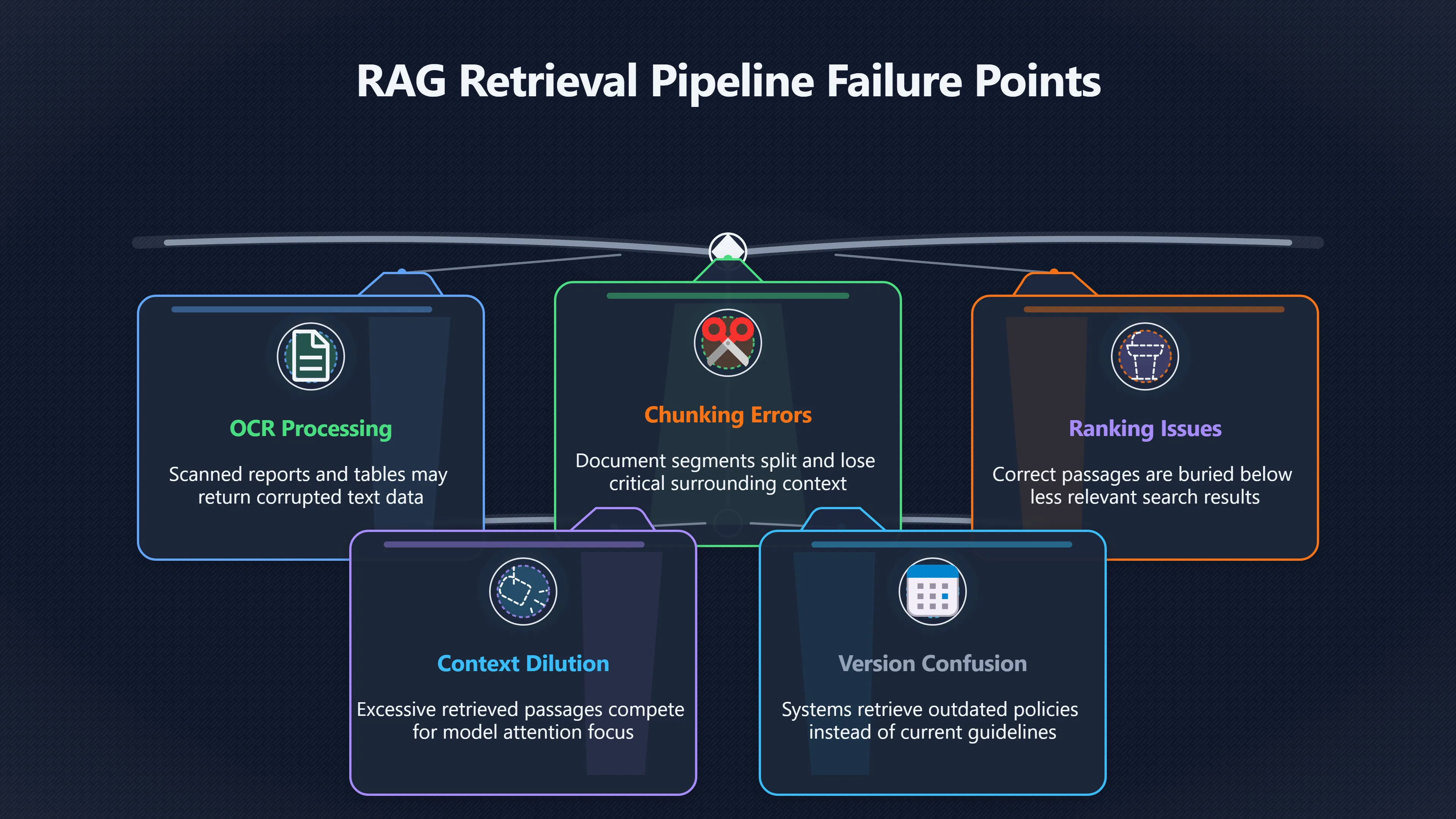
Document processing can introduce another layer of failure. Many enterprise systems ingest PDFs, scanned reports and tables through optical character recognition (OCR). If a table is partially unreadable, a footnote disappears or a heading is assigned to the wrong section, the retrieval system may faithfully return corrupted information. Later stages cannot easily recover what was lost.[ResearchGate]researchgate.netOpen source on researchgate.net.
Other retrieval-stage problems include:
- Chunking errors: a document is split into passages, but important context spans multiple chunks and becomes separated.
- Ranking errors: the correct passage is retrieved but placed below less relevant passages, reducing the chance that the model will use it.
- Context dilution: too many retrieved passages compete for attention, causing crucial evidence to be buried.
- Document-version confusion: the system retrieves an outdated policy, regulation or guideline instead of the current version.
- Structural blindness: tables, appendices, diagrams and footnotes may contain essential information that retrieval systems handle poorly.[Hugging Face+2MDPI]huggingface.coHugging Face Paper pageHugging FacePaper page - A Reality Check on Context Utilisation for Retrieval-Augmented GenerationDecember 22, 2024…
These failures illustrate a practical reality: grounding is only as reliable as the retrieval pipeline that supplies the evidence.
Misreading and misattribution after retrieval
Even when the correct document is retrieved, the language model may still misuse it.
This is the stage many users find most surprising. The source is present, the citation is genuine and the answer appears supported. Yet closer inspection reveals that the model has attached the wrong claim to the right document.
When the evidence is present but misunderstood
Researchers studying RAG systems have repeatedly observed reasoning failures in which models misinterpret valid context. In one medical evaluation, models occasionally retrieved the relevant information but applied it incorrectly, such as misunderstanding threshold values or extrapolating beyond what the source actually stated.[PMC]pmc.ncbi.nlm.nih.govSeptember 2, 2025…
This happens because retrieval does not replace the language model’s reasoning process. The model still has to decide:
- Which passages matter most.
- How different passages relate to one another.
- Whether exceptions override general rules.
- Whether a statement is descriptive, conditional or hypothetical.
- How much uncertainty remains.
A model may therefore read a document and arrive at a conclusion that a human expert would reject.
The problem of unsupported synthesis
Grounded systems often combine information from several sources into a single answer. This can be useful, but it creates opportunities for subtle errors.
For example, one document may state that a policy applies in a specific circumstance, while another describes a broader rule. The model may merge the two and present a conclusion that appears reasonable but is not explicitly supported by either source.
Researchers examining context use in RAG systems have found that models do not always utilise retrieved information as effectively as expected. The presence of relevant context does not guarantee faithful incorporation into the final answer.[Hugging Face]huggingface.coHugging Face Paper pageHugging FacePaper page - A Reality Check on Context Utilisation for Retrieval-Augmented GenerationDecember 22, 2024…
This creates a distinctive failure mode: the answer is not fabricated, yet it is still misleading.
Real citations, wrong attribution
Another risk is citation misalignment. The answer contains a genuine citation, but the cited passage does not actually support the claim being made.
Governance frameworks for AI increasingly emphasise that citations should support specific claims rather than merely point to generally related material. A source that discusses a topic is not necessarily evidence for every statement made about that topic.[air-governance-framework.finos.org]air-governance-framework.finos.orgFINO S AI Governance FrameworkFINO S AI Governance Framework
In practice, users often see:
- A correct source attached to an exaggerated claim.
- A citation supporting only part of a sentence.
- A cited document that contains an exception omitted from the summary.
- A source that is relevant to the topic but not to the specific conclusion.
The result is a misleading appearance of verification.
Why citations alone do not solve the problem
Many AI products now highlight sources as a trust signal. This is valuable, but it can create a false sense of security.
A citation answers one question: where did the system get information? It does not automatically answer another: did the system interpret that information correctly?
This distinction matters because retrieval and reasoning are separate processes. A model may retrieve excellent evidence and still misunderstand it. Conversely, it may retrieve mediocre evidence and present it with impressive confidence.
Researchers and governance organisations increasingly stress the importance of attribution fidelity—the degree to which an AI-generated claim is genuinely supported by the cited source. Simply displaying links is not enough. Users need confidence that claims and evidence remain correctly aligned.[air-governance-framework.finos.org]air-governance-framework.finos.orgFINO S AI Governance FrameworkFINO S AI Governance Framework
The challenge is particularly important in domains such as law, medicine, compliance and scientific research, where small wording differences can change the meaning of a document.
Questions to ask of grounded answers
When reviewing a sourced AI response, the safest approach is not to ask whether it has citations but whether those citations genuinely support the answer.
Useful questions include:
Did the AI retrieve the right document?
A citation to a related document is not necessarily evidence for the claim being made.
Does the cited passage directly support the conclusion?
Look for the exact wording rather than relying on the model’s summary.
Were important exceptions omitted?
Policies, regulations and technical documents often contain caveats that disappear during summarisation.
Is the answer combining multiple sources?
If so, check whether the synthesis follows logically from the source material or introduces unsupported connections.
Could document structure matter?
Tables, footnotes, appendices and figure captions often contain critical details that AI systems may miss or misread.
Would a human reader reach the same conclusion?
A citation is strongest when an independent reader can follow the evidence and arrive at a similar interpretation.
The implementation challenge
The next generation of grounded AI systems is increasingly focused on improving not just retrieval quality but evidence use. Researchers are exploring better reranking methods, citation alignment techniques, context-aware reasoning and evaluation frameworks that measure whether answers are actually supported by retrieved passages rather than merely accompanied by them.[Semantic Scholar]semanticscholar.orgJuly 16, 2024…
The broader lesson is that grounding reduces one class of hallucination but introduces a different implementation challenge. An AI system can be connected to the correct documents, provide real citations and still produce a misleading answer. Reliability depends not only on finding evidence but also on interpreting it faithfully. In practice, the difference between those two tasks is where many of the most important remaining errors occur.[Hugging Face+2PMC]huggingface.coHugging Face Paper pageHugging FacePaper page - A Reality Check on Context Utilisation for Retrieval-Augmented GenerationDecember 22, 2024…
Amazon book picks
Further Reading
Books and field guides related to Why sourced AI answers can still mislead. Use these as the next step if you want deeper reading beyond the article.
Artificial Intelligence
Explains limitations in understanding, reasoning, and context use.
Co-Intelligence
Emphasises checking sourced AI outputs rather than trusting citations alone.
The Alignment Problem
Explores errors that persist even when systems use external information.
eBay marketplace picks
Marketplace Samples
Example marketplace items related to this page. Use the search link to explore similar finds on eBay.

Endnotes
1.
Source: air-governance-framework.finos.org
Title: FINO S AI Governance Framework
Link:https://air-governance-framework.finos.org/mitigations/mi-13_providing-citations-and-source-traceability-for-ai-generated-information.html
2.
Source: pmc.ncbi.nlm.nih.gov
Link:https://pmc.ncbi.nlm.nih.gov/articles/PMC13009108/
Source snippet
September 2, 2025...
Published: September 2, 2025
3.
Source: researchgate.net
Link:https://www.researchgate.net/publication/386419255_OCR_Hinders_RAG_Evaluating_the_Cascading_Impact_of_OCR_on_Retrieval-Augmented_Generation
4.
Source: mdpi.com
Link:https://www.mdpi.com/2504-2289/9/12/320
Source snippet
A Systematic Literature Review of Retrieval-Augmented Generation: Techniques, Metrics, and Challenges...
5.
Source: huggingface.co
Title: Hugging Face Paper page
Link:https://huggingface.co/papers/2412.17031
Source snippet
Hugging FacePaper page - A Reality Check on Context Utilisation for Retrieval-Augmented GenerationDecember 22, 2024...
Published: December 22, 2024
6.
Source: semanticscholar.org
Link:https://www.semanticscholar.org/paper/Mindful-RAG%3A-A-Study-of-Points-of-Failure-in-Agrawal-Kumarage/a546fa44c110c33a3280f31090f96f5b886ac44f
Source snippet
July 16, 2024...
Published: July 16, 2024
Additional References
7.
Source: sciencedirect.com
Link:https://www.sciencedirect.com/science/article/pii/S0163445326001143
Source snippet
antibiotic chatbot: Evaluation of a retrieval-augmented generation approach for providing guideline-based antimicrobial advice - ScienceD...
8.
Source: computerworld.com
Link:https://www.computerworld.com/article/4010160/despite-its-ubiquity-rag-enhanced-ai-still-poses-accuracy-and-safety-risks.html
Source snippet
Despite its ubiquity, RAG-enhanced AI still poses accuracy and safety risks – Computerworld...
9.
Source: reddit.com
Link:https://www.reddit.com/r/LLMDevs/comments/1s2tmf6/when_did_rag_stop_being_a_retrieval_problem_and/
Source snippet
did RAG stop being a retrieval problem and started becoming a selection problemMarch 24, 2026...
Published: March 24, 2026
10.
Source: pure.qub.ac.uk
Link:https://pure.qub.ac.uk/en/publications/a-systematic-literature-review-of-retrieval-augmented-generation-/
Source snippet
Queen's University BelfastDecember 12, 2025...
Published: December 12, 2025
11.
Source: youtube.com
Title: Why Most Production RAG Systems Fail (Even When Metrics Look Fine)
Link:https://www.youtube.com/watch?v=nrkDls9ETPU
Source snippet
4 Hidden Reasons Your RAG Is Giving [Wrong Answers]({{ 'wrong-answers/' | relative_url }})...
12.
Source: youtube.com
Title: Why most RAG systems fail at Retrieval (not Generation)
Link:https://www.youtube.com/watch?v=TOFnW5UdiEg
Source snippet
Why Most Production RAG Systems Fail (Even When Metrics Look Fine)...
13.
Source: ai.jmir.org
Title: JMI R AI
Link:https://ai.jmir.org/2026/1/e83206
Source snippet
JMIR AI - Evaluation of a Retrieval-Augmented Generation Chatbot for Antimicrobial Resistance Research: Comparative Analysis of Large Lan...
14.
Source: youtube.com
Title: Seven RAG Failures and How to Solve Them
Link:https://www.youtube.com/watch?v=8wTTl7DZtpk
Source snippet
Is Your RAG Pipeline Failing? How to Stop AI [Hallucinations]({{ 'hallucinations/' | relative_url }})...
15.
Source: youtube.com
Title: 4 Hidden Reasons Your RAG Is Giving Wrong Answers
Link:https://www.youtube.com/watch?v=zSouH6JdvkQ
Source snippet
Seven RAG Failures and How to Solve Them...
16.
Source: aihandbook.io
Title: What Is Retrieval Augmented Generation (RAG)?
Link:https://www.aihandbook.io/generative-ai-handbook/what-is-rag/
Source snippet
AI Handbook...
Topic Tree