Within Model Cards
Why AI paperwork is not enough
Datasheets and model cards can expose risks, but they cannot replace testing, audits, monitoring, or evidence that the claims are complete and true.
On this page
- What documentation can reveal but not fix
- How checklist compliance can become superficial
- Why audits and monitoring need stronger evidence
Page outline Jump by section
Introduction
Dataset datasheets and model cards are valuable because they make AI systems less opaque. They can reveal where data came from, how a model was trained, what tests were performed, and which limitations developers already know about. However, documentation alone cannot make an AI system safe. A model card can describe risks, but it cannot prove that all risks have been found, that reported results are accurate, or that the system will behave safely once deployed in the real world. Transparency is useful, but safety depends on evidence, verification, and ongoing accountability. Documentation is therefore best understood as a starting point for safety governance rather than a substitute for it.[NVIDIA Developer]developer.nvidia.comDeveloper Enhancing AI Transparency and Ethical ConsiderationsNVIDIA DeveloperEnhancing AI Transparency and Ethical Considerations…September 19, 2022 — 19 Sept 2022 — Learn about the importance of…

What documentation can reveal but not fix
Datasheets and model cards help organisations ask better questions before deployment. They can expose gaps in training data, identify intended and unintended uses, disclose known biases, and summarise evaluation results. This information helps reviewers judge whether a system is appropriate for a specific context.[NVIDIA Developer]developer.nvidia.comDeveloper Enhancing AI Transparency and Ethical ConsiderationsNVIDIA DeveloperEnhancing AI Transparency and Ethical Considerations…September 19, 2022 — 19 Sept 2022 — Learn about the importance of…
The problem is that documentation is descriptive rather than corrective. A model card can state that a facial recognition system performs worse on certain demographic groups, but the statement itself does not remove the disparity. A datasheet can disclose that a dataset under-represents particular populations, but disclosure does not create missing data or improve model performance.
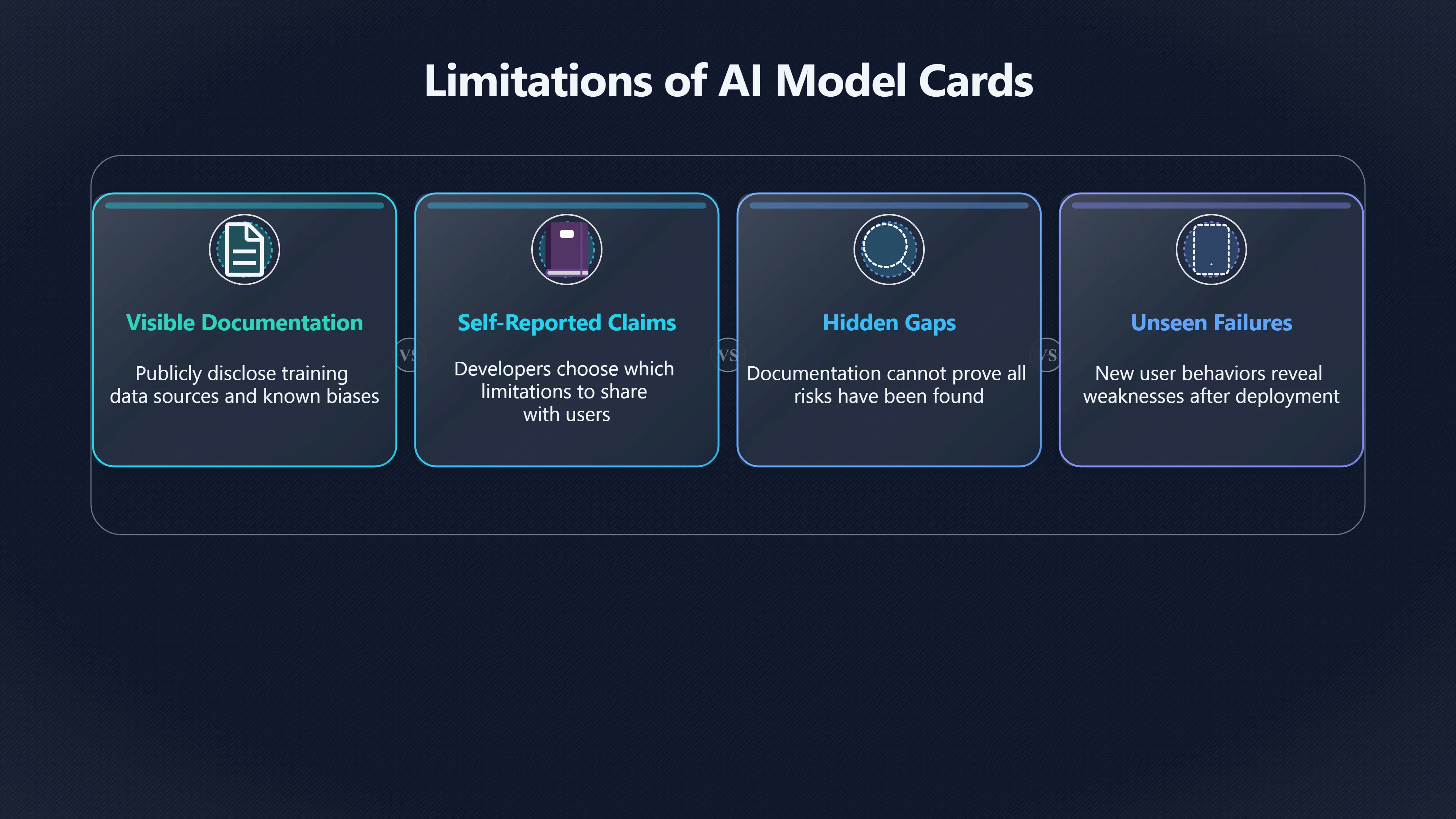
Documentation also depends heavily on what developers know and choose to report. AI systems often encounter unexpected situations after deployment. New user behaviour, changing environments, and previously unseen inputs can reveal weaknesses that were not apparent during development. Even detailed documentation cannot guarantee that every relevant failure mode has already been identified. This is one reason why risk-management frameworks emphasise continuous measurement and management rather than relying solely on transparency documents.[NIST Publications]nvlpubs.nist.govPublications Artificial Intelligence Risk Management FrameworkNIST PublicationsArtificial Intelligence Risk Management FrameworkMarch 24, 2025 — by N AI · 2024 · Cited by 144 — As GAI covers risks of…
Another limitation is that documentation may be incomplete or inaccurate. Readers usually have to trust that reported evaluations were conducted properly and that important limitations were not omitted. Unless independent testing or auditing verifies the claims, documentation remains largely self-reported evidence.
How checklist compliance can become superficial
A recurring criticism of AI governance is that documentation requirements can encourage a “paper compliance” mindset. Organisations may focus on producing the required forms while paying less attention to whether the underlying system is actually trustworthy.
Model cards were originally proposed as tools for transparency and informed decision-making, not as proof of safety. Yet in practice, there is a risk that stakeholders treat the existence of documentation as evidence that sufficient safeguards already exist. A well-designed document can create an impression of diligence even when testing is limited or weaknesses remain unresolved.[IAPP.org]iapp.org5 things to know about AI model cardsNovember 13, 2023 — 23 Aug 2023 — While model cards are a great example of transparency in AI, there…
This problem is familiar in other regulated industries. Completing a checklist is easier than demonstrating that a process consistently works. In AI, organisations may document fairness metrics, robustness tests, or intended-use restrictions without establishing strong mechanisms to verify those claims in operation.
Several researchers and governance specialists have argued that transparency tools are only meaningful when they are connected to measurable criteria and external review. Documentation can describe a model’s behaviour, but without independent validation there is often no way to determine whether the description is complete or accurate. Studies examining AI governance under the European regulatory framework have similarly highlighted the challenge of translating high-level requirements into verifiable evidence rather than relying on declarations alone.[arXiv]arxiv.orgConformity Assessments and Post-market Monitoring: A Guide to the Role of Auditing in the Proposed European AI RegulationNovember 9…

Why audits and monitoring need stronger evidence
If documentation identifies potential risks, audits and monitoring are intended to test whether those risks are being managed effectively.
An audit goes beyond reading a model card. Auditors may inspect training procedures, reproduce evaluations, examine governance processes, review incident records, or test the system against additional scenarios. The goal is to determine whether documented claims are supported by evidence. This shifts the focus from “What does the developer say?” to “What can be independently verified?”[arXiv]arxiv.orgConformity Assessments and Post-market Monitoring: A Guide to the Role of Auditing in the Proposed European AI RegulationNovember 9…
Monitoring addresses a different problem: AI systems can change in practice even when the underlying model remains unchanged. User populations evolve, operating environments shift, and new forms of misuse emerge. A model that appeared acceptable during pre-deployment testing may become unreliable months later.
Because of this, modern governance frameworks increasingly require post-deployment oversight. The NIST AI Risk Management Framework treats risk management as an ongoing process involving governance, measurement, and continuous management rather than a one-time documentation exercise.[NIST Publications]nvlpubs.nist.govPublications Artificial Intelligence Risk Management FrameworkNIST PublicationsArtificial Intelligence Risk Management FrameworkMarch 24, 2025 — by N AI · 2024 · Cited by 144 — As GAI covers risks of…
The same logic appears in the European Union’s AI regulatory approach. High-risk AI systems are not expected merely to maintain technical documentation; providers are also required to establish post-market monitoring systems that collect and analyse evidence about real-world performance after deployment. The framework combines documentation with conformity assessment, incident reporting, monitoring, and enforcement mechanisms because documentation alone is not considered sufficient to demonstrate safety. AI Act Service Desk+3Digital Strategy Europe+3AI Act Service Desk[digital-strategy.ec.europa.eu]digital-strategy.ec.europa.euDigital Strategy Europe AI Act | Shaping Europe's digital futureDigital Strategy EuropeAI Act | Shaping Europe's digital future - European UnionThe AI Act is the first-ever legal framework on AI, which…
Transparency is useful only when it creates accountability
The strongest argument for documentation is not that it guarantees safety, but that it makes accountability possible. Organisations cannot meaningfully evaluate, audit, or regulate a system if they have no information about how it was built.
However, transparency becomes valuable only when it leads to action. If a model card reveals poor performance for a particular population, someone must decide whether additional testing, retraining, restrictions, or deployment changes are necessary. If a datasheet exposes weaknesses in a dataset, those weaknesses must be addressed rather than merely recorded.
This distinction is crucial. Documentation answers the question, “What do we know about this system?” Safety requires answering a harder question: “What evidence shows that the system is performing acceptably in the real world?” The first question can often be addressed with paperwork. The second requires testing, auditing, monitoring, incident reporting, and mechanisms that hold organisations responsible when documented assurances fail.[NIST Publications+2arXiv]nvlpubs.nist.govPublications Artificial Intelligence Risk Management FrameworkNIST PublicationsArtificial Intelligence Risk Management FrameworkMarch 24, 2025 — by N AI · 2024 · Cited by 144 — As GAI covers risks of…
Amazon book picks
Further Reading
Books and field guides related to Why AI paperwork is not enough. Use these as the next step if you want deeper reading beyond the article.
AI Snake Oil
Directly addresses why documentation and claims are insufficient without evidence and validation.
Atlas of AI
Examines structural issues that transparency documents alone cannot solve.
Responsible AI in the Enterprise
Focuses on verification, governance, auditing, and operational controls beyond paperwork.
Weapons of Math Destruction
Shows how documented systems can still create harmful outcomes in practice.
eBay marketplace picks
Marketplace Samples
Example marketplace items related to this page. Use the search link to explore similar finds on eBay.




Endnotes
1.
Source: developer.nvidia.com
Title: Developer Enhancing AI Transparency and Ethical Considerations
Link:https://developer.nvidia.com/blog/enhancing-ai-transparency-and-ethical-considerations-with-model-card/
Source snippet
NVIDIA DeveloperEnhancing AI Transparency and Ethical Considerations...September 19, 2022 — 19 Sept 2022 — Learn about the importance of...
Published: September 19, 2022
2.
Source: nvlpubs.nist.gov
Title: Publications Artificial Intelligence Risk Management Framework
Link:https://nvlpubs.nist.gov/nistpubs/ai/NIST.AI.600-1.pdf
Source snippet
NIST PublicationsArtificial Intelligence Risk Management FrameworkMarch 24, 2025 — by N AI · 2024 · Cited by 144 — As GAI covers risks of...
Published: March 24, 2025
3.
Source: iapp.org
Link:https://iapp.org/news/a/5-things-to-know-about-ai-model-cards
Source snippet
5 things to know about AI model cardsNovember 13, 2023 — 23 Aug 2023 — While model cards are a great example of transparency in AI, there...
Published: November 13, 2023
4.
Source: arxiv.org
Link:https://arxiv.org/abs/2111.05071
Source snippet
Conformity Assessments and Post-market Monitoring: A Guide to the Role of Auditing in the Proposed European AI RegulationNovember 9...
Published: November 9, 2021
5.
Source: arxiv.org
Link:https://arxiv.org/abs/2403.16808
6.
Source: arxiv.org
Title: arXiv Safe and Certifiable AI Systems: Concepts, Challenges, and Lessons Learned
Link:https://arxiv.org/abs/2509.08852
7.
Source: arxiv.org
Link:https://arxiv.org/pdf/2509.20394
Source snippet
Blueprints of Trust: AI System Cards for End‑to‑...by H Sidhpurwala · 2025 · Cited by 3 — This paper introduces the Hazard-Aware System...
8.
Source: arxiv.org
Link:https://arxiv.org/pdf/2601.08869
Source snippet
Paper Blueprint “AI Deployment Authorisationby DD Saparning · 2026 — Model cards, audits, and transparency reports provide information bu...
9.
Source: nist.gov
Link:https://www.nist.gov/document/ai-rmf-rfi-comments-national-artificial-intelligence-institute
Source snippet
NIST AI Risk Management Framework RFI ResponsesRisks cannot be properly identified or otherwise managed without first identifying and tra...
10.
Source: digital-strategy.ec.europa.eu
Title: Digital Strategy Europe AI Act | Shaping Europe’s digital future
Link:https://digital-strategy.ec.europa.eu/en/policies/regulatory-framework-ai
Source snippet
Digital Strategy EuropeAI Act | Shaping Europe's digital future - European UnionThe AI Act is the first-ever legal framework on AI, which...
11.
Source: ai-act-service-desk.ec.europa.eu
Link:https://ai-act-service-desk.ec.europa.eu/en/ai-act/article-72
Source snippet
Providers shall establish and document a post-market monitoring system in a manner that is proportionate to the nature of the AI technolo...
12.
Source: ai-act-service-desk.ec.europa.eu
Link:https://ai-act-service-desk.ec.europa.eu/en/ai-act/article-43
Source snippet
AI Act Service DeskAI Act Service Desk - Article 43: Conformity assessmentFor high-risk AI systems covered by existing EU legislation lis...
13.
Source: european-union.europa.eu
Link:https://european-union.europa.eu/index_en
Source snippet
Union: Your gateway to the EU, News, Highlights7 hours ago — Discover how the EU functions, its principles, priorities; find out about it...
14.
Source: european-union.europa.eu
Link:https://european-union.europa.eu/principles-countries-history/eu-countries_en
Source snippet
countries | European UnionFind out more about EU countries, their government and economy, their role in the EU, use of the euro, membersh...
Additional References
15.
Source: pmc.ncbi.nlm.nih.gov
Link:https://pmc.ncbi.nlm.nih.gov/articles/PMC8569069/
Source snippet
Assessments and Post-market Monitoring - PMCby J Mökander · 2021 · Cited by 281 — In this article, we describe and discuss the two primar...
16.
Source: aibuzz.blog
Title: ai model cards explained
Link:https://aibuzz.blog/ai-model-cards-explained/
Source snippet
Document AI for Trust (2026)5 Jun 2026 — AI model cards document an AI system's purpose, performance, risks, and limitations for transpar...
17.
Source: artificialintelligenceact.eu
Link:https://artificialintelligenceact.eu/high-level-summary/
Source snippet
summary of the AI ActA smaller section handles limited risk AI systems, subject to lighter transparency obligations: developers and deplo...
18.
Source: impetora.com
Title: conformity assessment
Link:https://impetora.com/[eu-ai-act
Source snippet
EU AI Act conformity assessment: routes (2026) - Impetora27 Apr 2026 — The post-market monitoring plan is part of the technical documenta...
19.
Source: linkedin.com
Link:https://www.linkedin.com/pulse/why-ai-model-cards-foundation-enterprise-transparency-sneh-lata-9sdee
Source snippet
AI Model Cards for Enterprise AI TransparencyAI model cards provide structured transparency for enterprise AI systems. Learn why they are...
20.
Source: linkedin.com
Link:https://www.linkedin.com/pulse/eu-ai-act-conformity-assessment-what-providers-must-do-zunic-maric-0dfof
Source snippet
EU AI Act Conformity Assessment: What Providers Must Do...Under Article 72, the post-market monitoring system must be documented in the...
21.
Source: linkedin.com
Link:https://www.linkedin.com/pulse/your-ai-monitoring-plan-document-capability-patrick-sullivan-ydppc
Source snippet
Your AI Monitoring Plan Is a Document, Not a CapabilityThe first cross-cutting challenge documented in NIST AI 800-4 is the absence of tr...
22.
Source: openlayer.com
Title: eu ai act post market monitoring requirements
Link:https://www.openlayer.com/blog/post/eu-ai-act-post-market-monitoring-requirements
Source snippet
EU AI Act post-market monitoring guide April 202624 Apr 2026 — The EU AI Act's post-market monitoring requirements go into effect April 2...
Published: April 2026
23.
Source: optro.ai
Title: what is a model card report your guide to responsible ai
Link:https://optro.ai/blog/what-is-a-model-card-report-your-guide-to-responsible-ai
Source snippet
Here's How a Model Card Report Supports Responsible AI12 Feb 2026 — Learn what a model card report is and how it supports responsible AI...
24.
Source: orca.security
Title: nist ai risk management framework ai rmf
Link:https://orca.security/resources/blog/nist-ai-risk-management-framework-ai-rmf/
Source snippet
NIST AI Risk Management Framework (AI RMF) Explained20 May 2026 — Learn how the NIST AI Risk Management Framework (AI RMF) helps organiza...
Published: May 2026
Topic Tree