Within Speech cues
How Deep Layers Learn What Matters
Later layers in deep speech models increasingly represent linguistic content while reducing sensitivity to recording conditions.
On this page
- Early acoustic features
- Building invariant speech representations
- Stable cues across speakers and microphones
Page outline Jump by section
Introduction
Modern speech-recognition systems do not become robust to noise simply because they are large. They become robust because deeper layers gradually transform raw sound into representations that emphasise linguistic content and suppress irrelevant variation. As speech passes through a deep network, information about background sounds, microphone characteristics and individual speaker traits becomes less prominent, while information useful for identifying phonemes, syllables and words becomes easier to separate. Researchers often describe this process as learning invariant representations—internal patterns that remain stable even when the same word is spoken by different people or recorded under different conditions.[arXiv]arxiv.orgarXiv Untangling in Invariant Speech RecognitionUntangling in Invariant Speech RecognitionMarch 3, 2020…
 Within the broader challenge of handling noisy voices, this mechanism is crucial. A speech recogniser succeeds not because it perfectly cleans the audio, but because later layers learn which aspects of the signal consistently predict words and which aspects can safely be ignored.[ar5iv]ar5iv.labs.arxiv.orgAnalyzing hidden…This paper is the first study analyzing the end-to-end speech recognition model by demonstrating what each layer hear…
Early Acoustic Features
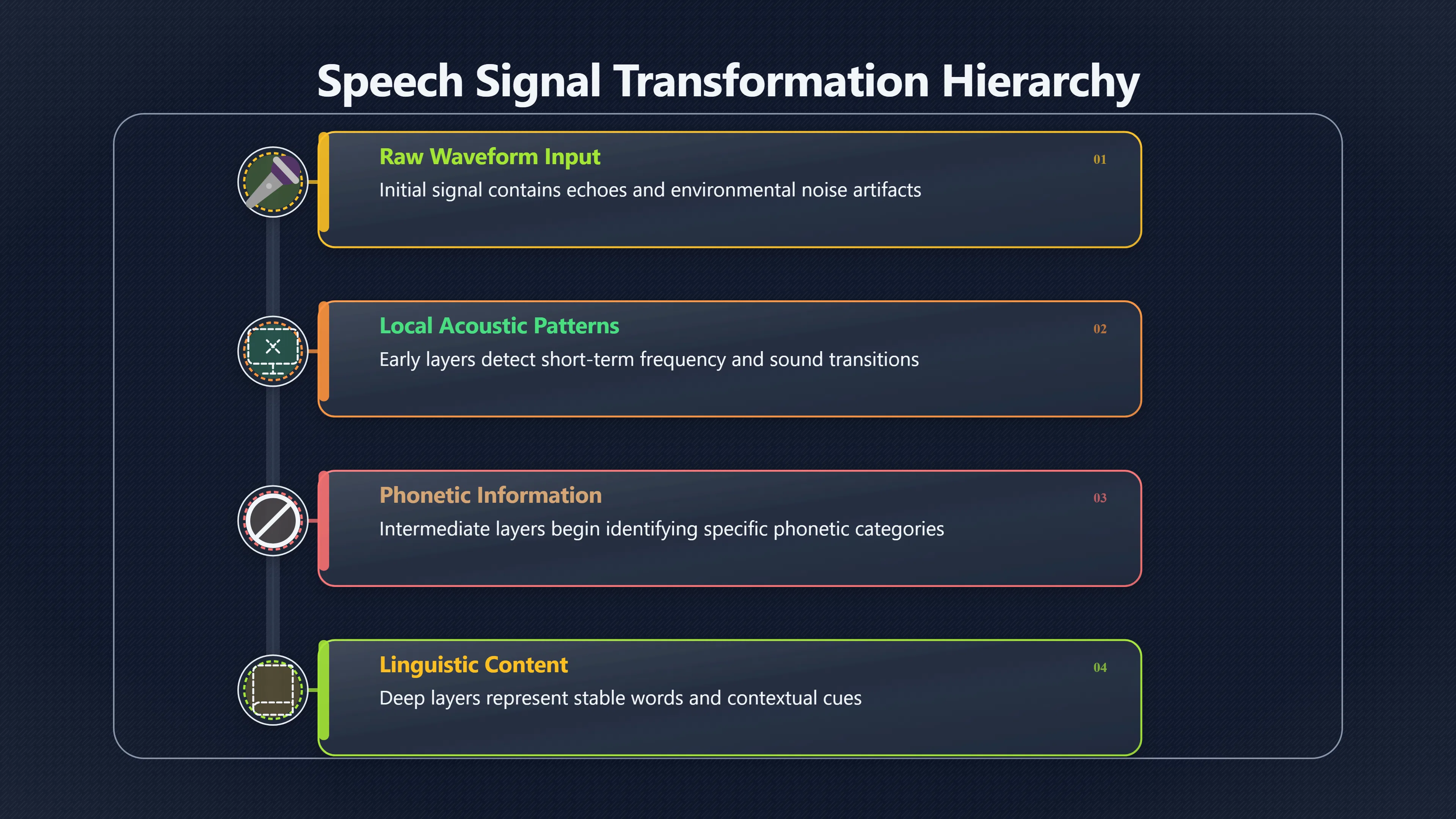
At the input stage, a speech network receives a mixture of useful and useless information. The acoustic signal contains speech sounds, but it also contains echoes, recording artefacts, environmental noise and speaker-specific characteristics such as pitch and vocal tract shape.
The first layers of a deep model generally respond to local acoustic patterns. They detect short-term frequency structures, transitions between sounds and other low-level properties that are still strongly affected by recording conditions. At this stage, the network has not yet determined which variations correspond to words and which are merely incidental differences in how the speech was captured.[NeurIPS Papers]papers.neurips.ccNeur IPS Papers Analyzing Hidden Representations in End-toNeurIPS PapersAnalyzing Hidden Representations in End-to-…February 13, 2018 — by Y Belinkov · Cited by 128 — Interestingly, the deeper…
Because these early representations remain close to the raw waveform, they are sensitive to many forms of distortion. Two recordings of the same word may look quite different internally if they come from different speakers or microphones. The deeper layers must therefore perform additional transformations before a stable linguistic representation emerges.[arXiv]arxiv.orgFeature Learning in Deep Neural Networksby D Yu · 2013 · Cited by 339 — In this paper we demonstrated through speech recognition exp…
Building Invariant Speech Representations
The key mechanism is repeated transformation. Each layer receives the representation produced by the previous layer and learns to retain information that helps predict the correct transcript while discarding information that does not contribute to recognition accuracy.
During training, the network encounters many examples of the same words spoken under different conditions. If a feature consistently changes when the speaker changes but does not alter the word identity, the learning process gradually reduces its importance. Conversely, if a feature reliably distinguishes one phoneme or word from another, later layers amplify its influence. Over millions of training examples, this creates representations that are increasingly organised around linguistic content rather than surface acoustics.[arXiv+2arXiv]arxiv.orgarXiv Untangling in Invariant Speech RecognitionUntangling in Invariant Speech RecognitionMarch 3, 2020…
Researchers studying speech-recognition hierarchies have found evidence that nuisance factors such as speaker identity are progressively discarded as signals move upward through the network, while words and phonetic categories become more separable. In the language of representation learning, the network is “untangling” relevant and irrelevant sources of variation.[arXiv]arxiv.orgarXiv Untangling in Invariant Speech RecognitionUntangling in Invariant Speech RecognitionMarch 3, 2020…
An intuitive analogy is sorting a collection of photographs. At first, images may be grouped by lighting conditions or camera type. After repeated reorganisation, they become grouped by the objects they contain. Deep speech networks perform a similar reorganisation of sound, moving from acoustics toward meaning-bearing speech structures.

Why Depth Matters
A shallow model has limited opportunities to reorganise information. It may detect useful patterns, but it struggles to separate multiple overlapping sources of variation simultaneously.
Deeper networks provide a sequence of processing stages in which increasingly abstract distinctions can emerge. Lower layers capture sound structure. Intermediate layers begin identifying phonetic information. Higher layers can represent broader linguistic patterns and contextual cues that remain relatively stable across speakers and environments.[NeurIPS Papers]papers.neurips.ccNeur IPS Papers Analyzing Hidden Representations in End-toNeurIPS PapersAnalyzing Hidden Representations in End-to-…February 13, 2018 — by Y Belinkov · Cited by 128 — Interestingly, the deeper…
Studies of deep speech models have repeatedly shown that higher layers contain more invariant and discriminative features than lower layers. As depth increases, representations become better aligned with the recognition task and less dependent on the exact acoustic form of the input.[arXiv]arxiv.orgFeature Learning in Deep Neural Networksby D Yu · 2013 · Cited by 339 — In this paper we demonstrated through speech recognition exp…
This does not mean that deeper layers completely erase acoustic information. Some lower-level details remain available because they can still help recognition. The important point is that the balance changes: linguistic information becomes easier to access than noise-related information.
Stable Cues Across Speakers and Microphones
One of the clearest demonstrations of this phenomenon comes from research examining what information remains inside hidden layers. Investigators have shown that representations in later layers become increasingly insensitive to speaker variability while preserving information needed to identify speech content.[arXiv]arxiv.orgarXiv Untangling in Invariant Speech RecognitionUntangling in Invariant Speech RecognitionMarch 3, 2020…
Consider the word “tomorrow” spoken by a child, an adult and an elderly speaker. The raw acoustic signals differ substantially. Pitch ranges differ, pronunciation varies and recording devices may colour the sound. Yet the linguistic structure underlying the word remains similar. Deep networks learn representations that respond to these common linguistic elements rather than the superficial differences.[SRI]sri.comTable 5 presents the r++,- values from the test set obtained.Read more…
The same principle applies to microphones and recording environments. A microphone may boost certain frequencies or introduce noise, but those effects generally do not change the identity of the spoken word. Through exposure to varied training data, deeper layers learn to treat such differences as less important than the speech patterns that remain consistent across recordings.[ResearchGate]researchgate.netWe use ideas from recent…Read more…

Evidence from Looking Inside Networks
Researchers have developed several methods to investigate what hidden layers represent. One approach probes individual layers by testing how well they encode phonetic categories, speaker identity or other properties. Another reconstructs audio from internal representations to determine which information survives at different depths.
These analyses reveal a consistent trend. Reconstructions derived from deeper layers often preserve the spoken content while reducing speaker-specific characteristics and background noise. In one study, researchers reported a gradual removal of speaker variability and noise as processing moved deeper into an end-to-end speech-recognition network.[ar5iv]ar5iv.labs.arxiv.orgAnalyzing hidden…This paper is the first study analyzing the end-to-end speech recognition model by demonstrating what each layer hear…
Other work has shown that later layers increasingly organise information around phonemes, words and higher-level linguistic concepts while nuisance variation becomes less separable. This pattern supports the view that robust speech recognition depends on a hierarchy that progressively concentrates task-relevant information.[arXiv]arxiv.orgarXiv Untangling in Invariant Speech RecognitionUntangling in Invariant Speech RecognitionMarch 3, 2020…
Why This Mechanism Improves Recognition in Noise
The practical benefit is that recognition decisions become less dependent on any single acoustic detail. If traffic noise masks part of a word or a microphone distorts certain frequencies, the higher-level representation may still contain enough stable linguistic structure to identify the intended speech.
Rather than explicitly removing every possible noise source, deep networks learn representations in which many forms of noise have reduced influence on the final prediction. This strategy is powerful because real-world noise is highly variable and impossible to catalogue exhaustively. By focusing on invariance instead of memorising specific distortions, deep speech models can generalise more effectively to unfamiliar conditions.[Amazon Science+2arXiv]cdn.amazon.scienceAmazon Sciencelearning-noise-invariant-representations-for-robust-speech…September 26, 2018 — by D Liang · Cited by 69 — One simple st…
The result is a hierarchy where early layers hear sound, but deeper layers increasingly represent what was said. That gradual shift from acoustics to linguistic content is the central reason deeper network layers are able to separate words from noise.[arXiv+2ar5iv]arxiv.orgarXiv Untangling in Invariant Speech RecognitionUntangling in Invariant Speech RecognitionMarch 3, 2020…
Amazon book picks
Further Reading
Books and field guides related to How Deep Layers Learn What Matters. Use these as the next step if you want deeper reading beyond the article.
Deep Learning
Rating: 3.5/5 from 6 Google Books ratings
Strong treatment of representation learning and invariance.
Speech and Language Processing: Pearson New International Edi...
Explains how speech representations become increasingly informative.
Fundamentals of Speech Recognition
Provides foundational understanding of speech feature extraction.
Endnotes
1.
Source: arxiv.org
Title: arXiv Untangling in Invariant Speech Recognition
Link:https://arxiv.org/abs/2003.01787
Source snippet
Untangling in Invariant Speech RecognitionMarch 3, 2020...
Published: March 3, 2020
2.
Source: arxiv.org
Link:https://arxiv.org/pdf/1301.3605
Source snippet
Feature Learning in Deep Neural Networksby D Yu · 2013 · Cited by 339 — In this paper we demonstrated through speech recognition exp...
3.
Source: ar5iv.labs.arxiv.org
Link:https://ar5iv.labs.arxiv.org/abs/1911.01102
Source snippet
Analyzing hidden...This paper is the first study analyzing the end-to-end speech recognition model by demonstrating what each layer hear...
4.
Source: papers.neurips.cc
Title: Neur IPS Papers Analyzing Hidden Representations in End-to
Link:https://papers.neurips.cc/paper/6838-analyzing-hidden-representations-in-end-to-end-automatic-speech-recognition-systems.pdf
Source snippet
NeurIPS PapersAnalyzing Hidden Representations in End-to-...February 13, 2018 — by Y Belinkov · Cited by 128 — Interestingly, the deeper...
Published: February 13, 2018
5.
Source: sri.com
Link:https://www.sri.com/wp-content/uploads/2021/12/hybrid_convolutional_neural_networks_for_articulatory_and_acoustic_information_based_speech_recognition_final.pdf
Source snippet
Table 5 presents the r++,- values from the test set obtained.Read more...
6.
Source: researchgate.net
Link:https://www.researchgate.net/publication/311458959_Invariant_Representations_for_Noisy_Speech_Recognition
Source snippet
We use ideas from recent...Read more...
7.
Source: sri.com
Link:https://www.sri.com/wp-content/uploads/2021/12/evaluating_robust_features_on_deep_neural_networks_for_speech_recognition_in_noisy_and_channel_mismatched_conditions.pdf
Source snippet
Evaluating robust features on Deep Neural Networks for...by V Mitra · 2014 · Cited by 59 — In this work we present a study exploring bot...
8.
Source: arxiv.org
Link:https://arxiv.org/abs/1911.01102
9.
Source: cdn.amazon.science
Link:https://cdn.amazon.science/a8/2a/aef830bf4a85bd43ca4618dcb2b2/learning-noise-invariant-representations-for-robust-speech-recognition.pdf
Source snippet
Amazon Sciencelearning-noise-invariant-representations-for-robust-speech...September 26, 2018 — by D Liang · Cited by 69 — One simple st...
Published: September 26, 2018
10.
Source: arxiv.org
Link:https://arxiv.org/pdf/1907.03233
Source snippet
1907.03233v1 [cs.CL] 7 Jul 2019by I Hsu · 2019 · Cited by 7 — In this section, we present the proposed NIESR model for nuisance-inv...
11.
Source: researchgate.net
Link:https://www.researchgate.net/publication/315514587_Gate_Activation_Signal_Analysis_for_Gated_Recurrent_Neural_Networks_and_Its_Correlation_with_Phoneme_Boundaries
Source snippet
rent neural networks, and find the temporal structure of such signals is highly...
Additional References
12.
Source: microsoft.com
Link:https://www.microsoft.com/en-us/research/wp-content/uploads/2018/04/ICASSP2018_Speaker_Invariant_Training.pdf
Source snippet
We propose a novel [adversarial]({{ 'stress-tests/' | relative_url }}) multi-task learning scheme, aim- ing at actively curtailing the inter-talker feature variability while.Rea...
13.
Source: simplecore.intel.com
Link:https://simplecore.intel.com/ai/wp-content/uploads/sites/69/9583-untangling-in-invariant-speech-recognition.pdf
Source snippet
models process time dependent input signals to achieve invariant speech recognition, and show how...Read more...
14.
Source: pure.ed.ac.uk
Title: ed.ac.uk Simplifying very deep convolutional neural network
Link:https://www.pure.ed.ac.uk/ws/files/44898955/rownicka_asru17.pdf
Source snippet
countIn this paper we investigate VDCNNs to find out which components are necessary to achieve the state-of the art ac- curacy for robu...
15.
Source: theses.hal.science
Title: 130015 CAUCHETEUX 2023 diffusion
Link:https://theses.hal.science/tel-04165471v1/file/130015_CAUCHETEUX_2023_diffusion.pdf
Source snippet
representations in [deep learning]({{ 'deep-learning/' | relative_url }}) algorithms and...19 Jul 2023 — In this thesis, I compare the internal representations of the brain and...
16.
Source: yorkspace.library.yorku.ca
Link:https://yorkspace.library.yorku.ca/bitstreams/99ef30c1-94d6-49f3-b5de-06079419a39b/download
Source snippet
AUTOMATIC SPEECH RECOGNITION USING DEEP...by OAHM Abdel-Hamid · 2014 · Cited by 3 — Moreover, it has been found that the upper...
17.
Source: jahrbib.sulb.uni-saarland.de
Title: Ph D Thesis Badr Abdullah final
Link:https://jahrbib.sulb.uni-saarland.de/bitstream/20.500.11880/38479/1/PhD_Thesis___Badr_Abdullah_final.pdf
Source snippet
Representation of Speech Variability and Variation in...by BMB Abdullah · 2024 · Cited by 1 — The central aim of this thesis is to bridg...
18.
Source: biorxiv.org
Link:https://www.biorxiv.org/content/10.1101/2021.01.26.428323.full
Source snippet
Training neural networks to recognize speech increased...by JAF Thompson · 2021 · Cited by 6 — Shallower layers of CNNs are typically mo...
19.
Source: aclanthology.org
Title: 2024.naacl long.36
Link:https://aclanthology.org/2024.naacl-long.36.pdf
Source snippet
R-Spin: Efficient Speaker and Noise-invariant...by HJ Chang · 2024 · Cited by 9 — This paper introduces Robust Spin (R-Spin), a data-eff...
20.
Source: youtube.com
Title: Multimodal speech [understanding]({{ ‘understanding/’ | relative_url }})
Link:https://www.youtube.com/watch?v=Yyhq8DcBq2U
Source snippet
Naomi HarteThis short talk will focus on the potential of multimodal speech analysis and look at how the advent of deep learning architec...
21.
Source: scholar.google.com
Link:https://scholar.google.com/citations?citation_for_view=h7yVv0QAAAAJ%3AhqOjcs7Dif8C&hl=en&user=h7yVv0QAAAAJ&view_op=view_citation
Source snippet
google.com[https://scholar.google.com/citations?view_op=view_...No](https://scholar.google.com/citations?view_op=view_...No) information is available for this page...
Topic Tree