Within Fluent errors
How to check polished AI answers safely
In medicine, law, education, and research, fluent chatbot answers need source checks before they influence real decisions.
On this page
- Claims that need independent verification first
- A simple source checking workflow for chatbot outputs
- When uncertainty should stop a decision
Page outline Jump by section
Introduction
Fluent chatbot answers can be useful starting points, but in medicine, law, education, and research they should never be treated as evidence simply because they sound convincing. Large language models are designed to generate plausible language, not to guarantee factual accuracy. In high-stakes situations, a polished answer can hide missing sources, outdated information, fabricated citations, or reasoning errors. Research has shown that people often rate AI-generated explanations as trustworthy and complete even when they contain inaccuracies, making verification especially important.[arXiv]arxiv.orgPeople over trust AI-generated medical responses and view them to be as valid as doctors, despite low accuracyAugust 12, 2024…
 The practical challenge is not deciding whether to use AI at all. It is learning when and how to check its outputs before they influence decisions that affect health, legal rights, education, finances, or scientific conclusions.
Claims that need independent verification first
Not every chatbot statement carries the same risk. Verification effort should be proportional to the consequences of being wrong.
The highest-priority claims to verify independently include:
- Medical recommendations, diagnoses, treatment suggestions, medication information, and health risk assessments.
- Legal claims, including case citations, statutes, deadlines, procedural requirements, and interpretations of regulations.
- Research findings, especially statistics, quotations, study results, and references.
- Educational content used for assessment, accreditation, or professional qualification.
- Financial or policy advice that could affect major decisions or compliance obligations.
Several recent examples illustrate why this matters. Courts have repeatedly sanctioned lawyers who submitted AI-generated citations without checking whether the cited cases actually existed. Judges have stressed that responsibility remains with the human professional, regardless of which tool generated the text.[Reuters+2Reuters]reuters.comJudge rules both sides in lawsuit misused AI, disqualifies lawyersDistrict Judge in Mississippi, Sharion Aycock, has disqualified all attorneys involved in a contract dispute case after discovering both…
Health-related uses present similar concerns. Independent audits of medical chatbots have found weaknesses in scientific accuracy and reference quality, while researchers have shown that chatbots can confidently repeat and expand incorrect medical information.[BMJ Open]bmjopen.bmj.comBMJ OpenGenerative artificial intelligence-driven chatbots and…by NB Tiller · 2026 · Cited by 7 — In this independent audit, we evalua…
A useful rule is simple: if acting on the answer could harm someone, cost significant money, affect legal rights, influence grades, or alter research conclusions, verify it before relying on it.
A simple source-checking workflow for chatbot outputs
Verification does not require becoming an expert in every field. It requires following a disciplined process.
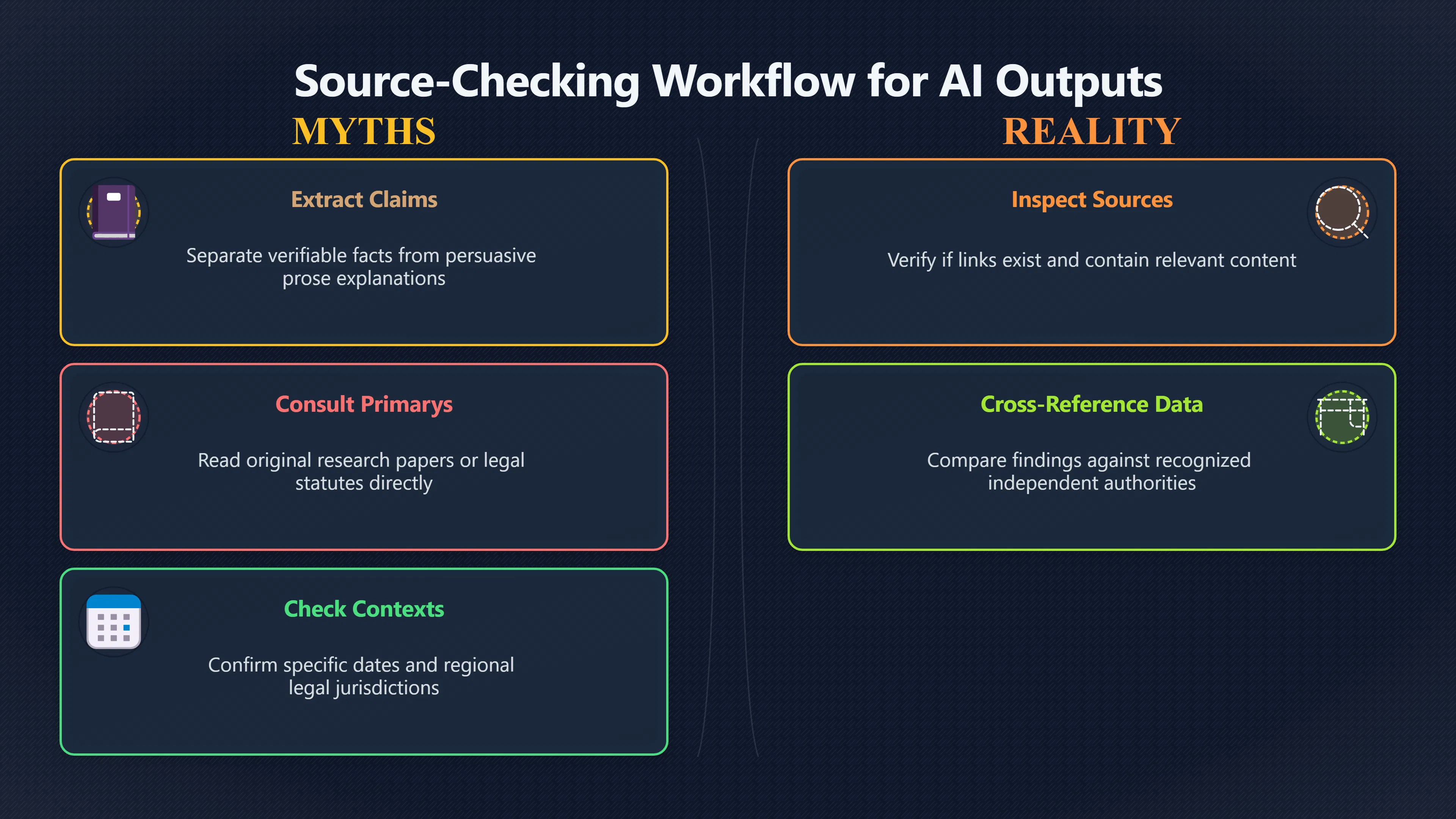
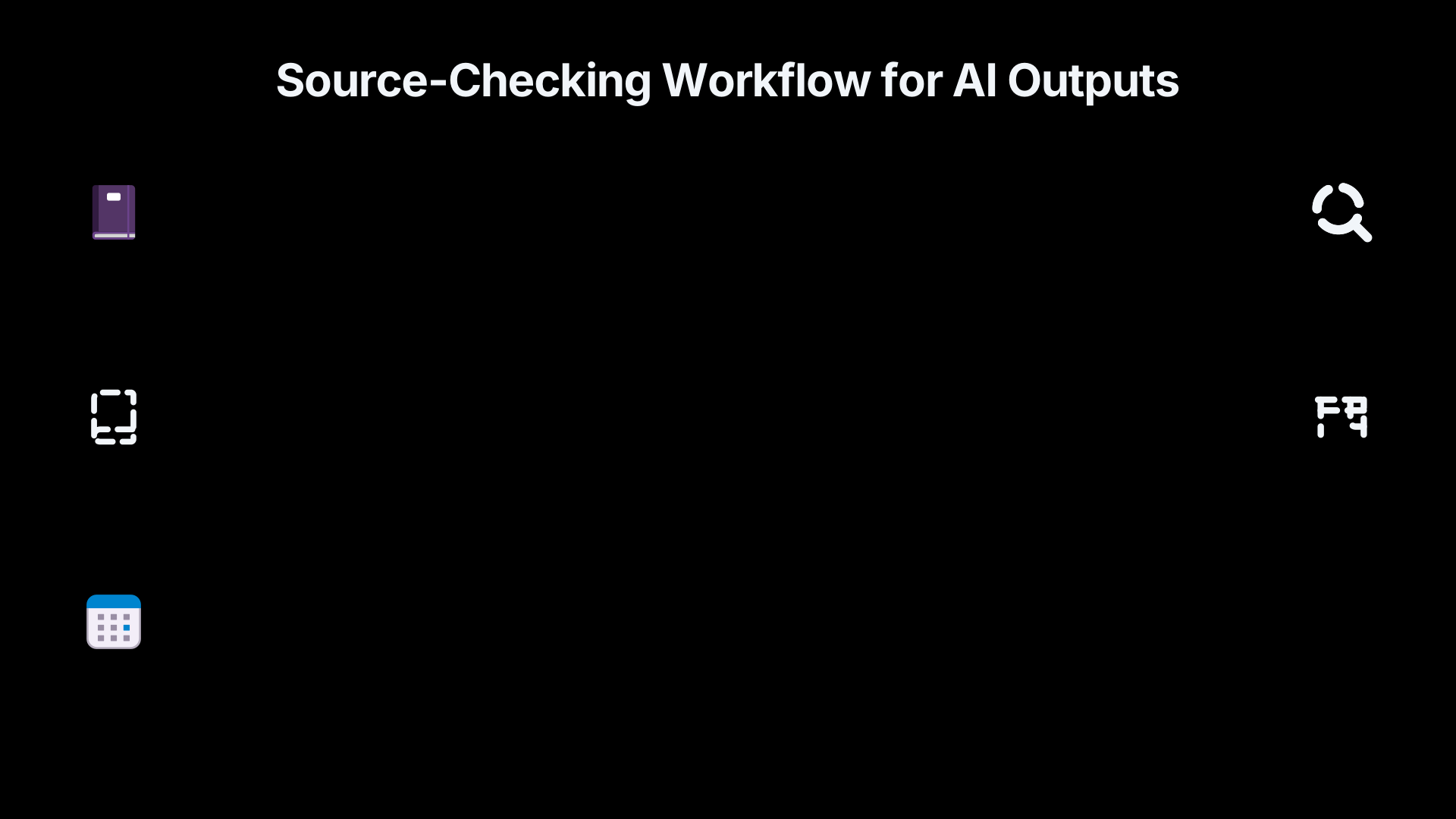
Step 1: Separate claims from explanations
Many chatbot answers combine factual claims with persuasive explanation. Start by extracting the specific claims that can be checked.
For example:
- “This drug commonly causes a particular side effect.”
- “This court case established a legal principle.”
- “This study found a 30% improvement.”
These are verifiable statements. The surrounding prose may sound authoritative, but the claims themselves must stand on evidence.
Step 2: Ask for sources, then inspect them
A chatbot may provide references, links, or citations. Do not assume they are real simply because they are formatted correctly.
Check whether:
- The source actually exists.
- The source says what the chatbot claims it says.
- The source is current enough for the topic.
- The source comes from a reputable institution, journal, court, or organisation.
Legal professionals have learned this lesson repeatedly. AI-generated citations can appear perfectly formatted while referring to non-existent cases or misrepresenting real ones.[Thomson Reuters+2American Bar Association]thomsonreuters.comgenai hallucinationsThomson ReutersGenAI hallucinations are still pervasive in legal filings, but…18 Aug 2025 — GenAI hallucinations continue to plague at…
Step 3: Go to the original source
Whenever possible, read the primary source rather than relying on the chatbot’s summary.
Examples include:
- A published research paper instead of a chatbot’s description of it.
- The text of a law or judicial opinion instead of a chatbot’s interpretation.
- Official health guidance rather than an AI-generated explanation.
Primary sources reduce the risk that an AI system has misunderstood, simplified, or invented details.
Step 4: Cross-check with an independent authority
Do not rely on a single source when the stakes are high.
For medical topics, compare against recognised health authorities, professional bodies, or peer-reviewed literature. For legal questions, consult the relevant legislation, court documents, or qualified legal professionals. For research claims, compare multiple studies and reviews.
Agreement among independent sources is generally more reassuring than repetition within one AI-generated answer.

Step 5: Check dates and jurisdiction
A statement can be accurate in one place or time and wrong in another.
Common failure points include:
- Medical guidance that has been updated.[facebook.com]facebook.comgenerative artificial intelligence has now been part of the public legal landscaGenerative artificial intelligence has now been part of the…21 Apr 2026 — The American Bar Association has issued its first ethical gu…
- Legal rules that differ by jurisdiction.
- Educational standards that have changed.
- Research findings superseded by newer evidence.
Verification is incomplete until the information is confirmed for the correct location, institution, and time period.
Warning signs that a polished answer may be weak
Certain patterns should increase scepticism even when the writing appears professional.
Excessive certainty
High-stakes fields often involve uncertainty, exceptions, and competing interpretations.
Be cautious when a chatbot:
- Claims there is only one correct answer.
- Omits limitations or caveats.
- Presents probabilities as certainties.
The absence of uncertainty is sometimes a stronger warning sign than the presence of uncertainty.
eBay marketplace picks
Marketplace Samples
Example marketplace items related to this page. Use the search link to explore similar finds on eBay.
References that cannot be checked
A common hallucination pattern is the invention of:
- Journal articles.
- Court cases.
- Quotations.
- Statistics.
- Expert statements.
If a citation cannot be located independently, treat the associated claim as unverified. Research on legal hallucinations has found that language models can produce convincing but inaccurate legal references and may not reliably recognise when they are doing so.[arXiv]arxiv.orgLarge Legal Fictions: Profiling Legal Hallucinations in Large Language ModelsJanuary 2, 2024…
Specific numbers without traceable evidence
Precise percentages, dates, rankings, and statistics often create an impression of authority.
Ask:
- Where did this number come from?
- Can I locate the original dataset or publication?
- Does another reputable source report the same figure?
Specificity is not proof.
Answers that fit the question too perfectly
Sometimes the most persuasive answer is the one that agrees with the user’s assumptions.
Research has shown that language models can fail to challenge incorrect premises embedded in prompts. Instead, they may generate a coherent answer based on the mistaken assumption.[arXiv]arxiv.orgLarge Legal Fictions: Profiling Legal Hallucinations in Large Language ModelsJanuary 2, 2024…
Verification should therefore include checking the question’s assumptions as well as the answer.
When uncertainty should stop a decision
Verification is not always about confirming an answer. Sometimes it reveals that the evidence is too weak to support action.
A decision should pause when:
- Sources conflict significantly.
- Primary evidence cannot be located.
- The chatbot cannot provide verifiable references.
- Experts disagree and the consequences are substantial.
- The answer depends heavily on personal circumstances that the chatbot cannot assess.
Health organisations and public-health authorities have repeatedly urged caution when using generative AI in health contexts because inaccurate outputs can affect safety and wellbeing.[World Health Organization+2World Health Organization]who.intWorld Health Organization WHO calls for safe and ethical AI for healthWorld Health OrganizationWHO calls for safe and ethical AI for healthMay 16, 2023 — The World Health Organization (WHO) is calling for ca…
In practical terms, uncertainty should trigger escalation to a qualified professional rather than a search for a more confident chatbot response.
Building a verification habit
The most effective safeguard is not a particular tool but a consistent habit. Treat AI-generated content as a draft, not a final authority. Verify high-consequence claims, inspect cited sources, consult primary evidence, and stop when uncertainty remains unresolved.
This approach recognises both the strength and the weakness of modern AI systems. Their fluency can accelerate learning and research, but fluency is not evidence. In high-stakes topics, trustworthy decisions depend on the quality of the underlying sources, not on how polished the answer sounds.
Endnotes
1.
Source: arxiv.org
Link:https://arxiv.org/abs/2408.15266
Source snippet
People over trust AI-generated medical responses and view them to be as valid as doctors, despite low accuracyAugust 12, 2024...
Published: August 12, 2024
2.
Source: bmjopen.bmj.com
Link:https://bmjopen.bmj.com/content/16/4/e112695
Source snippet
BMJ OpenGenerative artificial intelligence-driven chatbots and...by NB Tiller · 2026 · Cited by 7 — In this independent audit, we evalua...
3.
Source: reuters.com
Title: Judge rules both sides in lawsuit misused AI, disqualifies lawyers
Link:https://www.reuters.com/legal/litigation/judge-rules-both-sides-lawsuit-misused-ai-disqualifies-lawyers-2026-06-09/
Source snippet
District Judge in Mississippi, Sharion Aycock, has disqualified all attorneys involved in a contract dispute case after discovering both...
4.
Source: reuters.com
Link:https://www.reuters.com/legal/litigation/us-appeals-court-[sanctions
Source snippet
appeals court sanctioned two lawyers for submitting court briefs containing fictitious, AI-generated case citations, referred to as "hall...
5.
Source: arxiv.org
Link:https://arxiv.org/abs/2401.01301
Source snippet
Large Legal Fictions: Profiling Legal Hallucinations in Large Language ModelsJanuary 2, 2024...
Published: January 2, 2024
6.
Source: who.int
Title: World Health Organization WHO calls for safe and ethical AI for health
Link:https://www.who.int/news/item/16-05-2023-who-calls-for-safe-and-ethical-ai-for-health
Source snippet
World Health OrganizationWHO calls for safe and ethical AI for healthMay 16, 2023 — The World Health Organization (WHO) is calling for ca...
Published: May 16, 2023
7.
Source: who.int
Link:https://www.who.int/news/item/18-01-2024-who-releases-ai-ethics-and-governance-guidance-for-large-multi-modal-models
Source snippet
World Health OrganizationWHO releases AI ethics and governance guidance for...Jan 18, 2024 — The guidance outlines over 40 recommendatio...
8.
Source: who.int
Link:https://www.who.int/publications/i/item/9789240084759
Source snippet
World Health OrganizationEthics and governance of artificial intelligence for health25 Mar 2025 — This guidance addresses one type of gen...
9.
Source: who.int
Link:https://www.who.int/
10.
Source: who.int
Link:https://www.who.int/publications/i/item/9789240029200
Source snippet
Ethics and governance of artificial intelligence for healthJun 28, 2021 — The WHO guidance on Ethics & Governance of Artificial Intellige...
11.
Source: americanbar.org
Title: aba issues first ethics guidance ai tools
Link:https://www.americanbar.org/news/abanews/aba-news-archives/2024/07/aba-issues-first-ethics-guidance-ai-tools/
Source snippet
American Bar AssociationABA issues first ethics guidance on a lawyer's use of AI toolsJul 29, 2024 — This opinion identifies some ethical...
12.
Source: thomsonreuters.com
Title: genai hallucinations
Link:https://www.thomsonreuters.com/en-us/posts/technology/genai-hallucinations/
Source snippet
Thomson ReutersGenAI hallucinations are still pervasive in legal filings, but...18 Aug 2025 — GenAI hallucinations continue to plague at...
13.
Source: americanbar.org
Link:https://www.americanbar.org/groups/gpsolo/resources/magazine/2026-may-jun/suspect-hallucination-when-generative-ai-finds-perfect-case/
Source snippet
American Bar AssociationTechno Ethics: What to Do When Generative AI Finds You...3 days ago — Many jurisdictions have enacted explicit r...
14.
Source: forbes.com
Link:https://www.forbes.com/sites/lanceeliot/2024/01/24/world-health-organization-who-lays-out-crucial-warnings-about-the-use-of-generative-ai-and-large-language-models-in-medicine-and-health/
Source snippet
World Health Organization (WHO) Lays Out Crucial...Jan 24, 2024 — The World health Organization (WHO) has come out with a vital report o...
15.
Source: americanbar.org
Title: aba ethics generative ai 0125wl
Link:https://www.americanbar.org/advocacy/governmental_legislative_work/publications/washingtonletter/january-25-wl/aba-ethics-generative-ai-0125wl/
Source snippet
ABA Ethics Opinion on Generative AI28 Jan 2025 — The opinion also cautions that use by several lawyers of the same GAI tool may result in...
16.
Source: americanbar.org
Link:https://www.americanbar.org/groups/litigation/resources/litigation-news/2025/lawyer-sanctioned-failure-catch-ai-hallucination/
Source snippet
Lawyer Sanctioned for Failure to Catch AI “Hallucination”Mar 13, 2025 — Federal court says attorney violated Rule 11's requirement to verify...
17.
Source: youtube.com
Link:https://www.youtube.com/watch?v=W8N3oJGCrrw
Source snippet
AI reveals huge amounts of fraud in medical research | DW News...
Additional References
18.
Source: cdc.gov
Link:https://www.cdc.gov/ai/resources/considerations-for-genai-in-public-health.html
Source snippet
Considerations for Generative AI in Public HealthThis guide is designed to help state, tribal, local, and territorial (STLT) public healt...
19.
Source: ailegalauthority.com
Link:https://ailegalauthority.com/ai-hallucination-legal-consequences/
Source snippet
AI Hallucination in Legal Contexts: Court Cases, Sanctions...This page catalogs the legal definition, structural mechanics, causal pathw...
20.
Source: sidgs.com
Link:https://sidgs.com/article/ai-hallucinations-explained-risks-every-enterprise-must-address/
Source snippet
AI Hallucinations in the Enterprise: Risks ExplainedExplore the risks of AI hallucinations in enterprise- from regulatory and financial i...
21.
Source: damiencharlotin.com
Link:https://www.damiencharlotin.com/hallucinations/
Source snippet
AI Hallucination Cases DatabaseThe most comprehensive database of AI hallucination cases in law: legal decisions from courts worldwide, s...
22.
Source: verifywise.ai
Link:https://verifywise.ai/lexicon/ai-output-[validation
Source snippet
How to validate AI output: methods, checklists and toolsHow to validate AI output: techniques, automated checks, human-in-the-loop review...
23.
Source: mountsinai.org
Link:https://www.mountsinai.org/about/newsroom/2025/ai-chatbots-can-run-with-medical-misinformation-study-finds-highlighting-the-need-for-stronger-safeguards
Source snippet
Mount Sinai Health SystemAI Chatbots Can Run With Medical Misinformation, Study...Aug 6, 2025 — “What we saw across the board is that AI...
24.
Source: debevoisedatablog.com
Link:https://www.debevoisedatablog.com/2024/08/05/guidelines-on-the-use-of-generative-ai-tools-by-professionals-from-the-american-bar-association/
Source snippet
Guidelines on the Use of Generative AI Tools...Aug 5, 2024 — Lawyers must disclose their use of generative AI tools if asked by the clie...
25.
Source: ebglaw.com
Link:https://www.ebglaw.com/insights/publications/the-legal-vision-for-the-future-or-an-ai-hallucination-navigating-the-complexities-of-attorney-ethics-and-use-of-artificial-intelligence
Source snippet
The Legal Vision for the Future or an AI Hallucination...2 Apr 2024 — The legal community has observed how AI hallucinations can infuse...
26.
Source: facebook.com
Title: generative artificial intelligence has now been part of the public legal landsca
Link:https://www.facebook.com/NYSBA/posts/generative-artificial-intelligence-has-now-been-part-of-the-public-legal-landsca/1397720352399152/
Source snippet
Generative artificial intelligence has now been part of the...21 Apr 2026 — The American Bar Association has issued its first ethical gu...
27.
Source: leanlaw.co
Title: the hallucination problem a checklist for verifying ai generated legal citations
Link:https://www.leanlaw.co/blog/the-hallucination-problem-a-checklist-for-verifying-ai-generated-legal-citations/
Source snippet
AI Citation Verification: A Law Firm ChecklistDec 5, 2025 — Legal AI tools hallucinate up to 34% of the time. Get our 6-step verification...
Topic Tree