Within Business Adoption
Is your business data ready for AI?
Production AI needs current, permissioned and well-owned business data, or it can scale stale and inaccurate answers faster.
On this page
- Why clean pilot data misleads leaders
- Permissions, source authority and version control
- How stale documents create scalable mistakes
Page outline Jump by section
Introduction
Production AI systems do not fail only because of model limitations. More often, they fail because the organisation cannot reliably supply the right information to the model at the right time. A pilot can appear successful when it uses a carefully prepared dataset, a small group of users and manually maintained documents. Once the same system is connected to real business operations, weaknesses in data quality, ownership, permissions and document management become visible. The result is an AI system that scales confusion, inconsistency and outdated information rather than expertise. Research and industry experience consistently show that trustworthy enterprise AI depends as much on governed data and retrieval processes as on model performance itself.[IBM Research+2London School of Innovation]research.ibm.comResearch IBM is tailoring generative AI for enterprisesIBM ResearchIBM is tailoring generative AI for enterprises - IBM ResearchApril 28, 2023…
 For organisations trying to move beyond experiments, a practical question emerges: does the business have a reliable digital picture of its customers, products, policies and operations? If the answer is uncertain, production AI will struggle regardless of how advanced the underlying model may be.[London School of Innovation]lsi.ac.ukOpen source on lsi.ac.uk.
Is your business data ready for AI?
AI systems depend on context. A language model may know general facts about the world, but enterprise value comes from understanding company-specific information such as contracts, procedures, inventory, regulations, pricing rules and customer histories.
Many organisations discover that this information exists in dozens of disconnected locations. Customer records may live in one system, policies in another, contracts in shared folders and operational knowledge in email threads or meeting notes. According to industry estimates, much enterprise information is unstructured, including documents, PDFs, emails and transcripts that are difficult to connect to AI systems in a controlled way.[Business Insider]businessinsider.comBusiness Insider The most valuable data in your company isn't missingIt's disconnected.Many enterprises possess the data needed to make AI systems effective, but around 80% of this data is unstructured (e.g…
This creates a common misunderstanding. Leaders often assume they have a model problem when they actually have a data problem. If the system cannot find, verify and prioritise the correct information, better models rarely solve the underlying issue. Production retrieval systems frequently fail because of poor retrieval quality, missing evidence and weak document management rather than deficiencies in the language model itself.[DigitalOcean]digitalocean.comDigital Ocean Why RAG Systems Fail in Production | Digital OceanWhy RAG Systems Fail in Production | DigitalOceanApril 29, 2026…
Why clean pilot data misleads leaders
Pilot projects are usually tested under unusually favourable conditions. Teams select a limited set of documents, remove obvious errors, manually organise content and closely supervise outputs. This environment does not resemble everyday operations.
A customer-support pilot, for example, might use a current knowledge base that has been reviewed specifically for the trial. After deployment, the same AI may encounter hundreds of policy documents, regional variations, duplicated files and conflicting instructions. Performance can decline sharply because the production environment contains ambiguity that was hidden during testing.[London School of Innovation]lsi.ac.ukOpen source on lsi.ac.uk.
Several warning signs often emerge only after scaling:
- Different systems contain conflicting versions of the same information.
- Important documents lack ownership.
- Business terminology varies between departments.
- Historical data contains gaps and inconsistencies.
- Critical knowledge exists only in emails or individual employees’ files.
The effect is cumulative. A pilot may demonstrate that AI can answer questions. Production deployment tests whether the organisation can continuously provide accurate context for those answers.
A recurring theme in enterprise discussions is that ingestion and document-processing pipelines often perform well on standard documents but struggle with real-world business content, including complex tables, legacy records and inconsistent formats. These failures introduce hidden quality problems long before the model generates a response.[Reddit]reddit.comAre we all just quietly pretending document extraction for RAG is a solved problem? Because my ingestion pipeline is just a giant b…
Permissions, source authority and version control
One of the most overlooked barriers to production AI is determining which source should be treated as authoritative.
Traditional employees often use judgement to resolve conflicts between documents. They may know that one policy has been replaced, that a spreadsheet is unofficial or that a particular department maintains the definitive version of a process. AI systems do not possess that organisational intuition unless it is explicitly encoded.
Who owns the truth?
Many organisations lack clear ownership for key information assets. When nobody is responsible for maintaining a document or dataset, errors accumulate unnoticed.
Questions that become critical for AI deployment include:
- Which system is the official source for customer data?
- Which policy document overrides older versions?
- Who approves changes?
- How quickly are updates reflected across systems?
- What information should specific users be allowed to access?
These governance questions are central to trustworthy AI because the model’s output quality depends on the trustworthiness of its inputs. NIST’s AI Risk Management Framework emphasises accountability, governance and continuous management of information risks rather than treating AI as a purely technical challenge.[arc42 Quality Model+2NIST]quality.arc42.orgarc42 Quality ModelNIST AI RMF — Artificial Intelligence Risk Management Framework | arc42 Quality ModelJanuary 26, 2023…

Permission problems become AI problems
Generative AI systems often need access to large collections of enterprise content. Yet broad access creates security and compliance concerns.
A system that can search every repository may expose information users should not see. Conversely, a system with overly restrictive access may lack the information required to answer correctly. The challenge is not simply connecting data sources but ensuring that retrieval respects existing permissions and organisational policies. Enterprise AI readiness increasingly depends on maintaining clear boundaries between data access, governance controls and model behaviour.[TechRadar]techradar.comTech Radar3 risks hindering enterprise-ready AIAgentic AI systems, which operate autonomously with minimal human oversight, face three primary risks: 1. Lack of Transparency: These…
Without these controls, organisations can face a difficult trade-off between usefulness and security.
How stale documents create scalable mistakes
Stale information is particularly dangerous because it often appears credible.
Unlike a hallucination, where the model invents information, stale data may be completely real but no longer valid. The AI retrieves an outdated policy, procedure or pricing rule and presents it confidently because the document exists and appears authoritative.
This creates a different category of error: the answer is accurate according to the retrieved document but wrong according to current business reality.
A growing concern in enterprise AI is “version drift”, where multiple copies of documents circulate through email attachments, shared folders and local storage. Retrieval systems may treat outdated and current versions as equally trustworthy unless version control and source authority are explicitly managed.[TechRadar]techradar.comTech Radar What is Version Drift in AI?This typically happens when users save documents locally, email attachments, or sync offline copies to cloud services like OneDrive or Sh…
Why the risk grows with scale
Human workers occasionally catch outdated information because they recognise context. AI systems can distribute the same mistake across thousands of interactions before anyone notices.
Examples include:
- Obsolete customer-service policies.
- Superseded compliance procedures.
- Retired product specifications.
- Expired pricing rules.
- Outdated regulatory guidance.
The more successful an AI deployment becomes, the larger the potential impact of stale information. A mistake that affects ten pilot users can affect thousands of customers after enterprise-wide rollout.
This is why production AI requires continuous document governance rather than one-time data preparation. Information must be reviewed, archived, versioned and monitored as business conditions change.[London School of Innovation]lsi.ac.ukOpen source on lsi.ac.uk.
Retrieval quality matters more than many teams expect
Many enterprise AI systems use retrieval-augmented generation (RAG), a design in which the model searches company documents before producing an answer. In practice, the retrieval stage often determines whether the output will be useful.
When retrieval fails, the model may:
- Miss the most relevant document.
- Retrieve incomplete evidence.
- Rank less authoritative sources above official ones.
- Combine contradictory information.
- Lose critical context during document processing.
Industry analyses of production RAG systems repeatedly identify retrieval quality as one of the primary causes of failure. The model cannot reliably compensate for missing or incorrect evidence supplied by the retrieval layer.[DigitalOcean]digitalocean.comDigital Ocean Why RAG Systems Fail in Production | Digital OceanWhy RAG Systems Fail in Production | DigitalOceanApril 29, 2026…
This shifts attention from model selection to information architecture. Organisations that focus exclusively on model upgrades may see limited improvement if retrieval pipelines, metadata and source governance remain weak.
Data readiness is an operational capability, not a cleaning project
A common mistake is treating data readiness as a one-time exercise completed before deployment. In reality, business information changes continuously.
New policies are published. Products evolve. Employees create documents. Regulations change. Customers update records. Mergers introduce new systems. Every change affects the information available to AI.
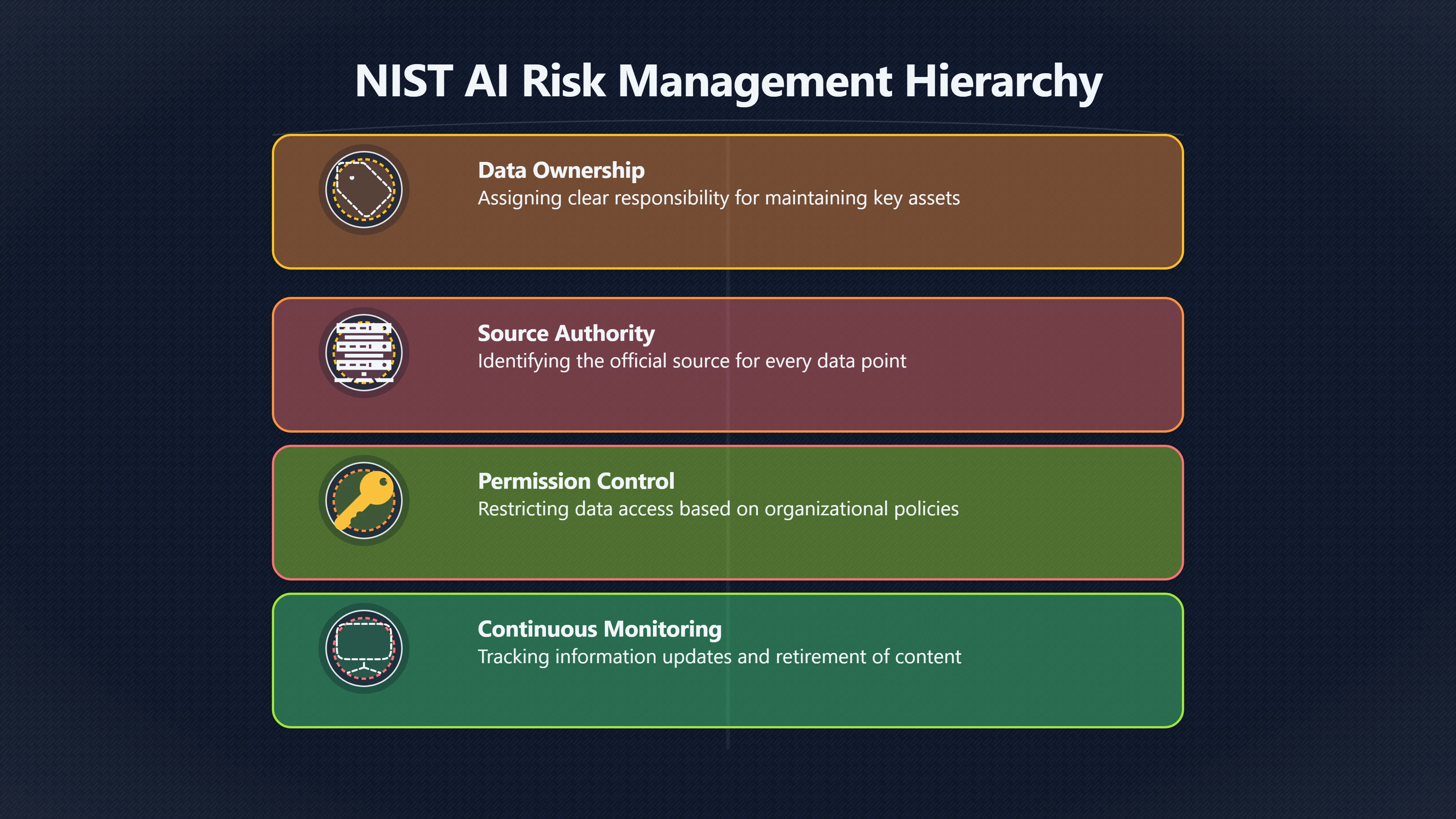
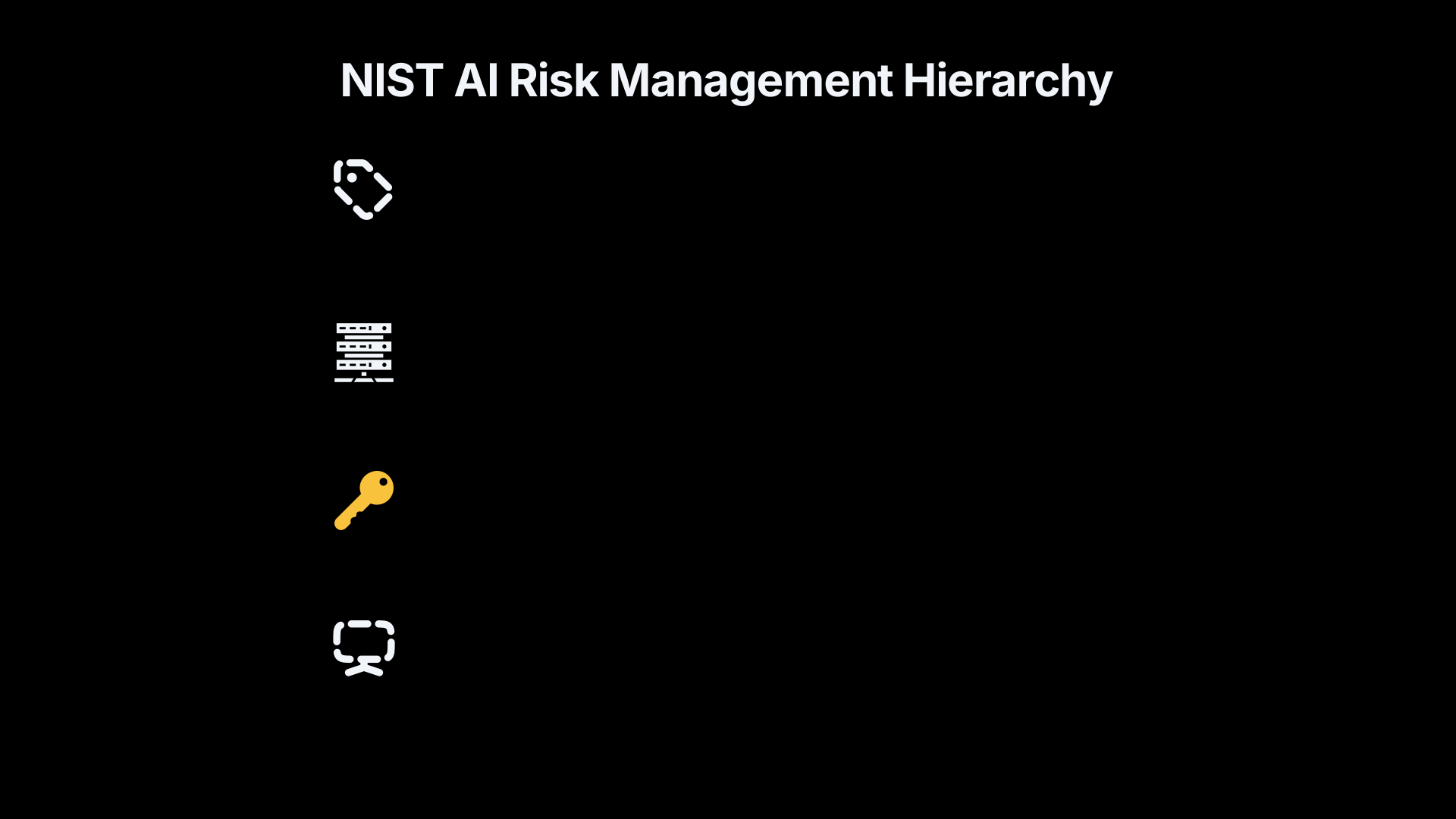
Production AI therefore depends on maintaining a reliable context supply chain rather than conducting a single data-cleansing effort. Organisations need processes for ownership, version management, permissions, monitoring and retirement of outdated content. When those mechanisms exist, AI systems can operate on trusted information. When they do not, scaling AI often means scaling uncertainty.[London School of Innovation]lsi.ac.ukOpen source on lsi.ac.uk.
The practical lesson for organisations moving beyond pilots is straightforward: before asking whether a model is powerful enough, ask whether the business can identify the current, authorised and trusted version of its own knowledge. In many production deployments, that question determines success more than the choice of AI model itself.[IBM Research+2London School of Innovation]research.ibm.comResearch IBM is tailoring generative AI for enterprisesIBM ResearchIBM is tailoring generative AI for enterprises - IBM ResearchApril 28, 2023…
Amazon book picks
Further Reading
Books and field guides related to Is your business data ready for AI?. Use these as the next step if you want deeper reading beyond the article.
Competing in the Age of AI
Explains the importance of data foundations for scalable AI.
The AI-Savvy Leader
Addresses the organisational requirements for successful AI deployment.
eBay marketplace picks
Marketplace Samples
Example marketplace items related to this page. Use the search link to explore similar finds on eBay.



Endnotes
1.
Source: research.ibm.com
Title: Research IBM is tailoring generative AI for enterprises
Link:https://research.ibm.com/blog/generative-ai-for-enterprise
Source snippet
IBM ResearchIBM is tailoring generative AI for enterprises - IBM ResearchApril 28, 2023...
Published: April 28, 2023
2.
Source: nist.gov
Title: AI Risk Management Framework | NIST
Link:https://www.nist.gov/itl/ai-risk-management-framework
Source snippet
AI Risk Management Framework | NIST...
3.
Source: digitalocean.com
Title: Digital Ocean Why RAG Systems Fail in Production | Digital Ocean
Link:https://www.digitalocean.com/community/conceptual-articles/why-rag-systems-fail-in-production
Source snippet
Why RAG Systems Fail in Production | DigitalOceanApril 29, 2026...
Published: April 29, 2026
4.
Source: reddit.com
Link:https://www.reddit.com/r/Rag/comments/1so4hcx/are_we_all_just_quietly_pretending_document/
Source snippet
Are we all just quietly pretending document extraction for RAG is a solved problem? Because my ingestion pipeline is just a giant b...
5.
Source: quality.arc42.org
Link:https://quality.arc42.org/standards/nist-ai-rmf
Source snippet
arc42 Quality ModelNIST AI RMF — Artificial Intelligence Risk Management Framework | arc42 Quality ModelJanuary 26, 2023...
Published: January 26, 2023
6.
Source: nist.gov
Title: AI Risk Management Framework FAQs | NIST
Link:https://www.nist.gov/node/1674681
Source snippet
AI Risk Management Framework FAQs | NIST...
7.
Source: techradar.com
Title: Tech Radar3 risks hindering enterprise-ready AI
Link:https://www.techradar.com/pro/3-risks-hindering-enterprise-ready-ai-and-how-low-code-workflows-help
Source snippet
Agentic AI systems, which operate autonomously with minimal human [oversight]({{ 'oversight/' | relative_url }}), face three primary risks: 1. **Lack of Transparency**: These...
8.
Source: techradar.com
Title: Tech Radar What is Version Drift in AI?
Link:https://www.techradar.com/pro/what-is-version-drift-in-ai
Source snippet
This typically happens when users save documents locally, email attachments, or sync offline copies to cloud services like OneDrive or Sh...
9.
Source: research.ibm.com
Title: An AI model trained on data that looks real but won’t leak personal information
Link:https://research.ibm.com/blog/private-[synthetic
Source snippet
IBM ResearchDecember 12, 2023...
Published: December 12, 2023
10.
Source: airc.nist.gov
Title: NIS T AI Resource Center
Link:https://airc.nist.gov/
Source snippet
NIST AI Resource Center - AIRC...
11.
Source: lsi.ac.uk
Link:https://lsi.ac.uk/insight/data-infrastructure-genai-adoption
12.
Source: businessinsider.com
Title: Business Insider The most valuable data in your company isn’t missing
Link:https://www.businessinsider.com/sc/how-unstructured-enterprise-data-is-limiting-ai-performance
Source snippet
It's disconnected.Many enterprises possess the data needed to make AI systems effective, but around 80% of this data is unstructured (e.g...
Additional References
13.
Source: youtube.com
Link:https://www.youtube.com/watch?v=b5ii0fqBT5g
Source snippet
Emergence Technical Chats | Episode 6: Data Readiness - YouTube Emergence Technical Chats | Episode 6: Data Readiness - YouTube...
14.
Source: informatica.com
Link:https://www.informatica.com/resources/articles/trusted-data-for-ai-agents-guide.html
Source snippet
Data for AI Agents: Enterprise Framework Guide | Informatica...
15.
Source: youtube.com
Title: Why AI agents make your unstructured data problem impossible to ignore
Link:https://www.youtube.com/watch?v=tyud9PiWsug
Source snippet
Collibra on the Future of Enterprise AI: Governing Structured and Unstructured Data...
16.
Source: youtube.com
Title: Ep 71 | AI Adoption: The Data Readiness Problem Holding Enterprises Back
Link:https://www.youtube.com/watch?v=TYiDIBejWLg
Source snippet
Is Your Data AI-Ready? The Semantic Layer and the Last Mile Problem...
17.
Source: arxiv.org
Link:https://arxiv.org/abs/2307.04208
Source snippet
July 9, 2023...
Published: July 9, 2023
18.
Source: youtube.com
Title: Is Your Data AI-Ready? The Semantic Layer and the Last Mile Problem
Link:https://www.youtube.com/watch?v=8xNDaPrYvw8
Source snippet
Emergence Technical Chats | Episode 6: Data Readiness...
19.
Source: youtube.com
Title: Emergence Technical Chats | Episode 6: Data Readiness
Link:https://www.youtube.com/watch?v=TZZYPzp50rA
Source snippet
Why AI agents make your unstructured data problem impossible to ignore...
20.
Source: santiagocompany.com
Link:https://www.santiagocompany.com/insights/why-bigger-models-will-not-fix-enterprise-rag
21.
Source: dataiku.com
Title: www.dataiku.com Enterprise data governance platform by Dataiku
Link:https://www.dataiku.com/product/data-governance
Source snippet
data governance platform by Dataiku...
Topic Tree