Within Fluent errors
When AI citations look real but are not
Fabricated references are especially risky because they borrow the visual signals of scholarship while failing as evidence.
On this page
- Why citation formatting creates a credibility shortcut
- How fabricated sources differ from weak sources
- Checks that expose invented references
Page outline Jump by section
Introduction
One of the most misleading features of AI-generated errors is that they can come wrapped in the appearance of scholarship. A chatbot answer that includes article titles, author names, journal references, court cases, or publication dates often looks more trustworthy than an answer without citations. The problem is that some of those references may not exist at all. When an AI system invents a citation, it borrows the visual signals of evidence while providing none of the substance. The result is a particularly dangerous form of error: a false claim supported by a source that appears verifiable but is actually fabricated. Research, court cases, and academic audits have repeatedly shown that large language models can generate realistic-looking references that cannot be found in any database or library.[Nature]nature.comNatureFabrication and errors in the bibliographic citations …by WH Walters · 2023 · Cited by 523 — This study investigates one particul…
 Within the broader problem of fluent chatbot answers hiding weak evidence, invented citations are especially significant because they can discourage scrutiny. Readers may assume that a detailed reference has already been checked, when in reality it may be nothing more than a plausible string of words generated by a language model.
Why citation formatting creates a credibility shortcut
People often use shortcuts when evaluating information. A statement accompanied by a citation usually appears more reliable than the same statement without one. Academic papers, legal briefs, government reports, and professional publications all rely on references as signals that claims can be independently verified.
AI systems can unintentionally exploit this expectation. Because language models are trained on large collections of text containing bibliographies, footnotes, and reference lists, they learn the structure of citations extremely well. They can generate convincing combinations of author names, article titles, journal names, volume numbers, and publication years even when no such work exists.[Nature]nature.comNatureFabrication and errors in the bibliographic citations …by WH Walters · 2023 · Cited by 523 — This study investigates one particul…
The credibility effect comes from appearance rather than verification. A reader seeing a citation such as:
- A plausible author name
- A technical-sounding title
- A recognised journal
- A realistic publication year
may assume the source has been checked. In reality, each element may have been statistically assembled from patterns in the training data rather than retrieved from an actual publication.[Duke University Libraries Blogs]blogs.library.duke.educhatgpt and fake citationsThese citations may sound legitimate and scholarly, but they are not…Read more…
This creates a paradox: adding references can make an incorrect answer appear more authoritative than a citation-free answer, even though the evidence base is weaker.
How fabricated sources differ from weak sources
Not every citation problem is the same. Weak sources and fabricated sources represent different failures.
A weak source is real but inadequate. For example, a blog post might be cited to support a scientific claim, or an outdated report might be used to discuss current events. The source exists, and readers can evaluate its quality.
A fabricated source is fundamentally different. It cannot be evaluated because it does not exist. The reader is given the impression that supporting evidence exists somewhere, but there is nothing to inspect.[Nature]nature.comNatureFabrication and errors in the bibliographic citations …by WH Walters · 2023 · Cited by 523 — This study investigates one particul…
Several common forms of AI-generated citation fabrication have been documented:
- Completely invented references: the article, book, or case never existed.
- Attribute corruption: a real paper exists, but the author, title, year, or journal details are altered.
- Identifier errors: a citation includes a false DOI, volume number, or page range.
- Source blending: details from multiple real works are merged into a single non-existent reference.[Nature+2arXiv]nature.comNatureFabrication and errors in the bibliographic citations …by WH Walters · 2023 · Cited by 523 — This study investigates one particul…
These errors are particularly difficult to notice because they often look more realistic than random mistakes. The fabricated reference may closely resemble genuine publications in the same field.
Real-world examples show why fake citations matter
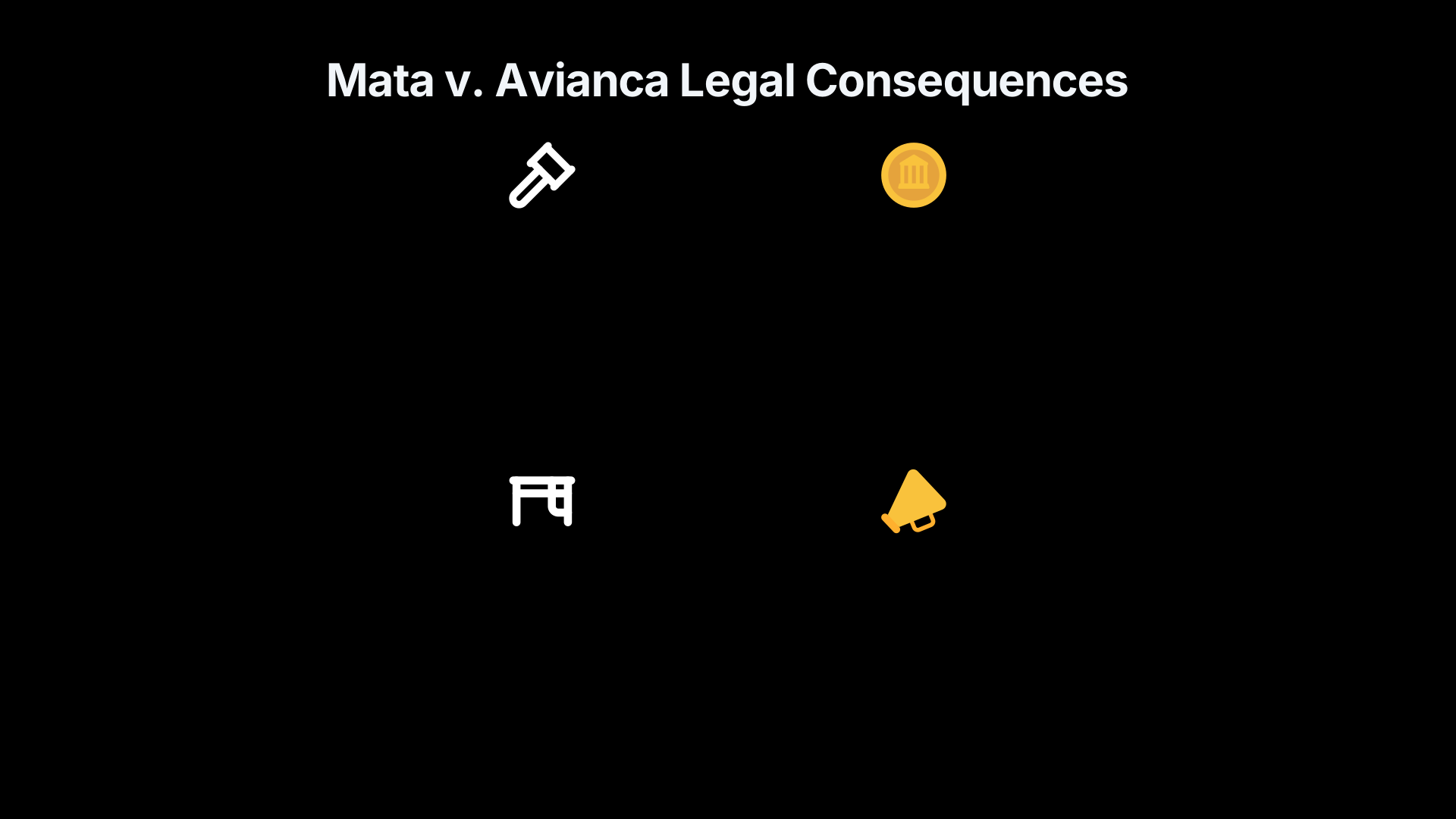
The most widely discussed example emerged in the legal case Mata v. Avianca. Attorneys submitted a court filing containing non-existent legal precedents generated by ChatGPT. The cited cases appeared legitimate enough to enter official filings before their existence was challenged. The court later sanctioned the lawyers involved, and the incident became a landmark example of AI-generated citation fabrication.[Wikipedia+2acc.com]WikipediaMata v. Avianca, IncMata v. Avianca, Inc
The problem has not remained isolated. Courts in multiple jurisdictions have encountered filings containing fabricated AI-generated legal authorities, leading to fines, sanctions, disqualifications, and judicial warnings. Recent rulings in both the United States and the United Kingdom have highlighted continuing concerns about lawyers relying on unverified AI-generated citations.[Reuters+2The Guardian]reuters.comJudge rules both sides in lawsuit misused AI, disqualifies lawyersDistrict Judge in Mississippi, Sharion Aycock, has disqualified all attorneys involved in a contract dispute case after discovering both…
The issue also extends beyond law. Academic studies have documented substantial rates of fabricated references in AI-generated bibliographies and literature reviews. Researchers have found that language models can produce citations that appear scholarly but cannot be located in academic databases.[Nature+2JMIR]nature.comNatureFabrication and errors in the bibliographic citations …by WH Walters · 2023 · Cited by 523 — This study investigates one particul…
More recently, investigators examining AI-assisted reports and research documents have identified large numbers of inaccurate or entirely invented references that survived editorial review processes.[TechRadar]techradar.comThe report contained 45 citations, with only five found to be accurate; the rest were either fabricated, distorted, or misleading. GPTZer…
These cases demonstrate that fabricated citations are not merely formatting errors. They can influence legal decisions, research workflows, policy discussions, and public understanding.
Why invented references are so persuasive
Several factors make fabricated citations unusually effective at creating false confidence.
First, citations shift attention away from the claim itself. Readers often assume verification has already occurred and focus on the argument rather than checking the source.
Second, references create an illusion of transparency. A claim accompanied by a citation appears open to inspection, even when the citation is fictitious.
Third, most readers do not routinely verify references. Recent research examining citation verification practices found substantial gaps between the appearance of references and actual checking behaviour among researchers and reviewers.[arXiv]arxiv.orgOpen source on arxiv.org.
Finally, fabricated citations often contain enough truth to seem authentic. A language model may combine a real author, a real research area, and a realistic title pattern into a convincing but non-existent publication. This mixture of familiarity and invention makes detection harder than spotting an obviously incorrect statement.[Taylor & Francis Online]tandfonline.comTaylor & Francis OnlineHallucinated Citation Analysis: Delving into Student…by AP Watson · 2024 · Cited by 11 — This article examines…

Checks that expose invented references
Fortunately, fabricated citations are often easier to detect than fabricated factual claims because they leave a trail that can be tested.
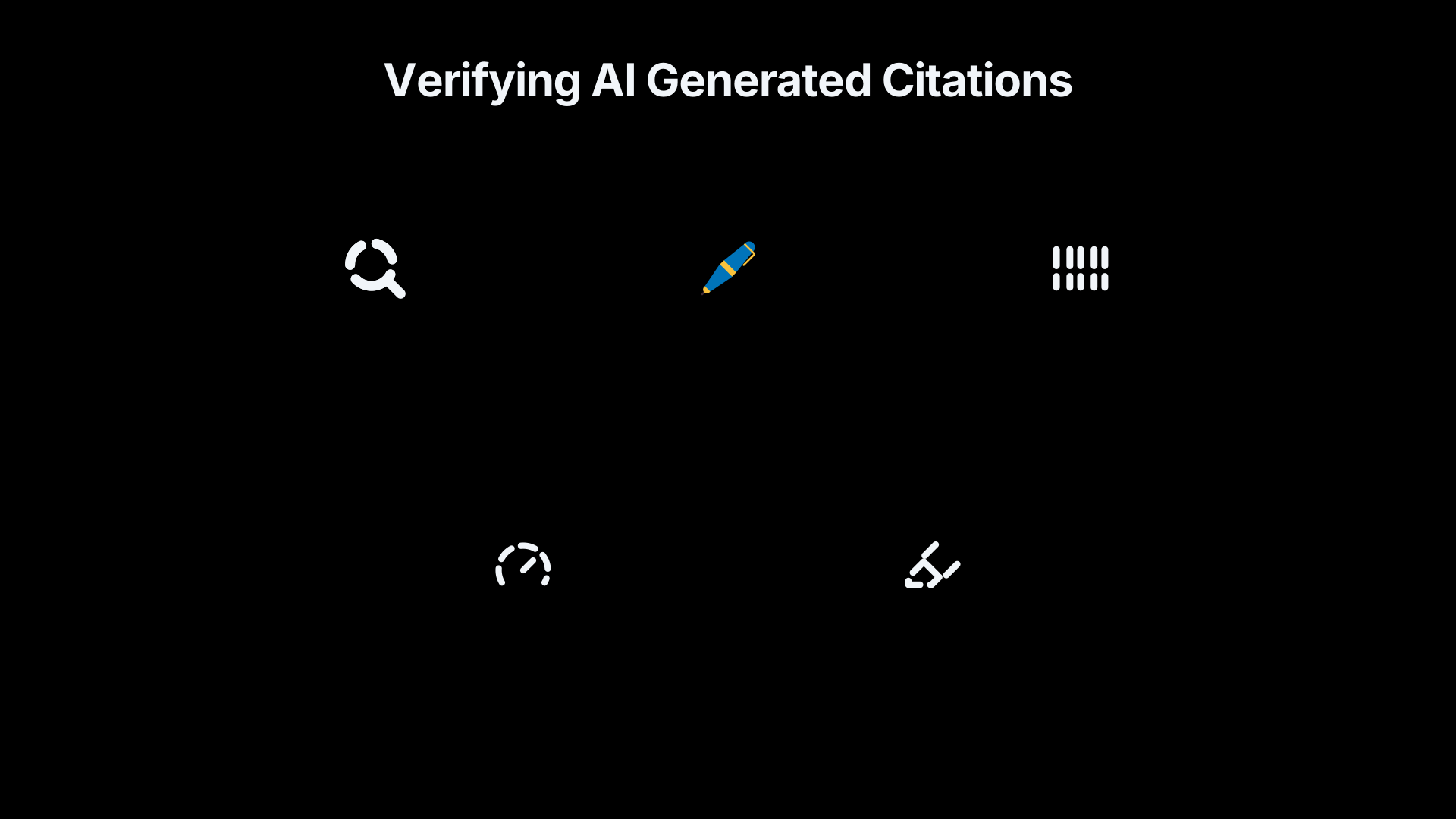
A few verification steps can reveal many invented references:
- Search for the exact title. Genuine academic works, books, and legal cases usually appear in multiple databases.
- Check author-publication combinations. If the named author has never written on the cited topic, the reference may be fabricated.
- Verify identifiers. DOIs, case numbers, and publication details should resolve to actual records.
- Look for independent indexing. Scholarly databases, library catalogues, and court databases should contain the cited work.
- Compare quotations with originals. Even when a source exists, the AI may have invented the quoted content. Nature+2JMIR
A practical warning sign is excessive specificity without easy verification. References that look impressively detailed yet cannot be found quickly in standard databases often deserve closer scrutiny.
What fake citations reveal about AI reliability
Invented citations expose a broader limitation of language models. These systems are highly skilled at reproducing the form of evidence but do not inherently understand whether the evidence exists. A fabricated reference demonstrates that a model can generate the outward appearance of scholarship without performing the underlying act of verification. Nature
For readers trying to understand artificial intelligence, this distinction is important. The presence of a citation should not be treated as proof that a claim is grounded in reality. Citations are only evidence when the cited source exists and genuinely supports the statement being made. When AI systems invent references, they transform a normal credibility signal into a source of confusion, making incorrect information appear more trustworthy precisely because it looks documented. Duke University Libraries Blogs+2PMC
Amazon book picks
Further Reading
Books and field guides related to When AI citations look real but are not. Use these as the next step if you want deeper reading beyond the article.
Hands-On Large Language Models
Explains hallucinations and other generation failures that lead to invented citations.
Natural Language Processing with Transformers
Provides technical foundations for understanding generated text and references.
eBay marketplace picks
Marketplace Samples
Example marketplace items related to this page. Use the search link to explore similar finds on eBay.


Endnotes
2.
Source: blogs.library.duke.edu
Title: chatgpt and fake citations
Link:https://blogs.library.duke.edu/blog/2023/03/09/chatgpt-and-fake-citations/
Source snippet
These citations may sound legitimate and scholarly, but they are not...Read more...
3.
Source: pmc.ncbi.nlm.nih.gov
Link:https://pmc.ncbi.nlm.nih.gov/articles/PMC10439949/
Source snippet
nih.govChatGPT: these are not hallucinations – they're fabrications...by R Emsley · 2023 · Cited by 330 — One study investigating the fr...
4.
Source: pmc.ncbi.nlm.nih.gov
Link:https://pmc.ncbi.nlm.nih.gov/articles/PMC12658395/
Source snippet
by J Linardon · 2025 · Cited by 31 — Fabricated references can mislead readers, distort scientific understanding, and compromise the i...
5.
Source: arxiv.org
Link:https://arxiv.org/abs/2603.03299
Source snippet
How LLMs Cite and Why It Matters: A Cross-Model Audit of Reference Fabrication in AI-Assisted Academic Writing and Methods to Detect...
6.
Source: arxiv.org
Link:https://arxiv.org/abs/2602.06718
7.
Source: Wikipedia
Title: Mata v. Avianca, Inc
Link:https://en.wikipedia.org/wiki/Mata_v._Avianca%2C_Inc
8.
Source: acc.com
Title: Practical Lessons from the Attorney AI Missteps in Mata v
Link:https://www.acc.com/resource-library/practical-lessons-attorney-ai-missteps-mata-v-avianca
Source snippet
8 Aug 2023 — The recent story of two New York attorneys “duped” by ChatGPT into citing “fake” cases in a court submission— and the sancti...
9.
Source: reuters.com
Title: Judge rules both sides in lawsuit misused AI, disqualifies lawyers
Link:https://www.reuters.com/legal/litigation/judge-rules-both-sides-lawsuit-misused-ai-disqualifies-lawyers-2026-06-09/
Source snippet
District Judge in Mississippi, Sharion Aycock, has disqualified all attorneys involved in a contract dispute case after discovering both...
10.
Source: jmir.org
Link:https://www.jmir.org/2024/1/e53164/
Source snippet
Hallucination Rates and Reference Accuracy of ChatGPT...by M Chelli · 2024 · Cited by 434 — The aim of the study is to assess the perfor...
11.
Source: techradar.com
Link:https://www.techradar.com/pro/a-major-kpmg-report-on-ai-was-found-to-be-chock-full-of-ai-hallucinations
Source snippet
The report contained 45 citations, with only five found to be accurate; the rest were either fabricated, distorted, or misleading. GPTZer...
12.
Source: tandfonline.com
Link:https://www.tandfonline.com/doi/abs/10.1080/0361526X.2024.2433640
Source snippet
Taylor & Francis OnlineHallucinated Citation Analysis: Delving into Student...by AP Watson · 2024 · Cited by 11 — This article examines...
13.
Source: theguardian.com
Link:https://www.theguardian.com/technology/2025/jun/06/high-court-tells-uk-lawyers-to-urgently-stop-misuse-of-ai-in-legal-work
Source snippet
In one prominent case against the Qatar National Bank, 18 out of 45 cited cases were entirely fictitious, generated via AI tools used by...
14.
Source: theguardian.com
Link:https://www.theguardian.com/technology/2023/jun/23/two-us-lawyers-fined-submitting-fake-court-citations-chatgpt
Source snippet
Two US lawyers fined for submitting fake court citations...23 Jun 2023 — A US judge has fined two lawyers and a law firm $5,000 (£3,935)...
Additional References
15.
Source: researchgate.net
Link:https://www.researchgate.net/publication/376855338_ChatGPT_Hallucinates_Non-existent_Citations_Evidence_from_Economics
Source snippet
(PDF) ChatGPT Hallucinates Non-existent CitationsA recent study revealed that when being asked to provide references on financial literat...
16.
Source: damiencharlotin.com
Link:https://www.damiencharlotin.com/hallucinations/
17.
Source: medium.com
Link:https://medium.com/%40reviewraccoon/why-chatgpt-creates-non-existing-scientific-citations-and-how-i-learned-this-the-hard-way-894c864b92d8
18.
Source: retractionwatch.com
Title: fake references chatgpt journal academic ethics springer nature whistleblowing
Link:https://retractionwatch.com/2025/12/02/fake-references-chatgpt-journal-academic-ethics-springer-nature-whistleblowing/
Source snippet
The case of the fake references in an ethics journal2 Dec 2025 — The article joins a long list of publications flagged for fake reference...
19.
Source: esquiresolutions.com
Title: federal court turns up the heat on attorneys using chatgpt for research
Link:https://www.esquiresolutions.com/federal-court-turns-up-the-heat-on-attorneys-using-chatgpt-for-research/
Source snippet
Avianca court imposed monetary fines and other remedial measures against the offending attorneys, citing Rule 11 of the Federal...Read more...
20.
Source: enttoday.org
Title: chatgpt generated fake references in academic manuscripts is a problem
Link:https://www.enttoday.org/article/chatgpt-generated-fake-references-in-academic-manuscripts-is-a-problem/
Source snippet
ChatGPT-Generated “Fake” References in Academic...Jun 5, 2024 — This generated material can appear in manuscripts in the form of fake ci...
21.
Source: washingtonpost.com
Title: The Washington Post Lawyers using AI keep citing fake cases in court
Link:https://www.washingtonpost.com/nation/2025/06/03/attorneys-court-ai-hallucinations-judges/
Source snippet
Judges aren't happy.Courts in the U.S. are increasingly encountering legal filings that contain fabricated case citations generated by ar...
22.
Source: reddit.com
Link:https://www.reddit.com/r/OpenAI/comments/105pib0/chatgpt_gives_me_references_i_cant_find_back/
Source snippet
Think about it this way, Chat is giving you Journals and scholars that likely publish on the...Read more...
23.
Source: virtuositylegal.com
Title: ai in court when legal tech goes rogue lessons from mata v avianca
Link:https://virtuositylegal.com/ai-in-court-when-legal-tech-goes-rogue-lessons-from-mata-v-avianca/
Source snippet
AI in Court: When Legal Tech Goes Rogue30 Apr 2025 — These fake cases were generated by ChatGPT, an AI-powered language model, which fals...
24.
Source: wacclearinghouse.org
Link:https://wacclearinghouse.org/repository/collections/continuing-experiments/august-2025/ai-literacy/understanding-avoiding-hallucinated-references/
Source snippet
ucinations—false or fabricated content generated by AI—with a focus on academic references.Read more...
Topic Tree