Within Human Review
What Appeals Reveal About AI Oversight
Appeals turn individual challenges into evidence about whether human oversight is catching mistakes or merely approving outputs.
On this page
- Why affected people need a route to challenge decisions
- What appeal outcomes show about oversight quality
- How complaint patterns expose systemic AI failures
Page outline Jump by section
Introduction
Appeals are one of the clearest tests of whether human oversight of high-risk AI systems is genuinely working. A decision may appear to have been reviewed by a person, but if affected individuals later challenge that decision and many appeals succeed, the appeals process can reveal that important errors were missed earlier. In this sense, appeals do more than provide a remedy for individuals. They generate evidence about the quality of oversight itself.
 In areas such as welfare administration, fraud detection, hiring, credit assessment and content moderation, appeal outcomes can expose whether human reviewers are independently checking AI outputs or merely approving them. When patterns emerge across many complaints, appeals become a governance tool that helps identify weaknesses in both the AI system and the human review process that surrounds it.[Springer Link]link.springer.comSpringer LinkDual erosion of equality and remedy in algorithmic decision systems | Discover Artificial Intelligence | Springer Nature Lin…
Why Affected People Need a Route to Challenge Decisions
Human oversight is often described as a safeguard against AI mistakes. Yet real-world experience shows that reviewers can miss errors, misunderstand outputs, or become overly reliant on automated recommendations. An appeals process recognises that even a decision that has already undergone human review may still be wrong.
For people affected by high-stakes decisions, appeals serve several important functions:
- They provide a second opportunity to present information that may have been ignored or unavailable during the original assessment.
- They create a formal mechanism to contest incorrect data, faulty assumptions or misclassifications.
- They generate records that can be analysed for recurring problems.
- They reduce the risk that an AI-supported decision becomes effectively unchallengeable.
The importance of review rights is reflected in emerging governance frameworks. European rules governing high-risk AI place significant emphasis on human oversight, transparency and the ability to challenge decisions that affect individuals’ rights and opportunities.[Better Regulation]service.betterregulation.comBetter RegulationArticle 22 Authorised representatives of providers of high-risk AI systems | Regulation (EU) 2024/1689 of the European P…
Without meaningful appeals, organisations may never learn that apparently successful systems are producing hidden errors. A system can achieve acceptable performance metrics while still causing serious harm to specific groups whose experiences only become visible through complaints and challenges.
What Appeal Outcomes Show About Oversight Quality
High reversal rates can signal missed errors
One of the strongest indicators of oversight quality is what happens after decisions are challenged. If a large proportion of appealed decisions are overturned, this suggests that earlier review stages failed to detect problems.
An overturned decision does not automatically prove that the AI system itself was defective. The mistake may have arisen from poor data, weak procedures, misunderstanding by reviewers or organisational pressure to accept automated recommendations. However, frequent successful appeals indicate that the overall oversight system is not reliably catching errors before they affect people.
This distinction matters. A human reviewer’s presence alone does not demonstrate meaningful oversight. Appeal outcomes provide a practical measure of whether human intervention is actually improving decision quality.
Appeals reveal where humans defer to automation
Research on automated decision-making has repeatedly highlighted the risk that people defer to algorithmic recommendations, especially when systems appear authoritative or complex. In such environments, reviewers may fail to investigate cases independently.[DOI]doi.orgJustitia ex machina: The impact of an AI system on legal decision-making and discretionary authority - Daan Kolkman, Floris Bex, Nitin…
Appeals can expose this problem. If appeal reviewers consistently identify mistakes that frontline reviewers overlooked, organisations gain evidence that the initial review process may have become a form of rubber-stamping.
A useful question for governance teams is not simply whether appeals succeed, but why they succeed. Common findings include:
- Critical contextual information was ignored.
- Automated risk scores were treated as facts rather than indicators.
- Reviewers lacked access to supporting evidence.
- Time pressures discouraged deeper investigation.
- Reviewers assumed the system was likely to be correct.
When these explanations recur, the problem extends beyond individual mistakes and points to structural weaknesses in oversight.
How Complaint Patterns Expose Systemic AI Failures
Individual appeals matter because they provide remedies. Large numbers of appeals matter because they can reveal system-wide failures.
The warning signs hidden in complaint data
A single successful appeal may be an isolated error. Hundreds of similar appeals can indicate a deeper problem with system design, training data, operational policies or review procedures.
Governance teams increasingly examine complaint and appeal records for patterns such as:
- Repeated errors affecting particular demographic groups.
- Consistent disputes involving specific data sources.
- Frequent challenges to the same model output.
- Regional or institutional variations in outcomes.
- Large differences between original decisions and appeal decisions.
These patterns transform appeals from a customer-service function into a monitoring mechanism.
A key insight from accountability research is that reviewability requires more than correcting individual cases. Systems should generate information that allows organisations to detect recurring failure modes and improve future decisions.[Cambridge Repository]repository.cam.ac.ukOpen source on cam.ac.uk.
Welfare and fraud-detection cases illustrate the stakes
Several high-profile automated decision systems have demonstrated how appeal processes can uncover widespread errors.
In Michigan’s unemployment system, the MiDAS fraud-detection programme incorrectly identified many claimants as committing fraud. Individuals technically had rights to appeal, but notification problems and procedural barriers limited access to effective review. Subsequent legal challenges and investigations helped reveal that the system was producing substantial errors, eventually contributing to its deactivation.[Cambridge University Press & Assessment]cambridge.orgCambridge University Press & AssessmentAdjudication of Artificial Intelligence and Automated Decision-Making Cases in Europe and the USA…
Similar concerns have appeared in welfare and benefits systems internationally. Human rights organisations and the United Nations Special Rapporteur on extreme poverty have warned that automated welfare administration can create serious harms when transparency, accountability and procedural safeguards are weak. In several jurisdictions, complaints and appeals played a crucial role in exposing wrongful accusations, incorrect debt notices and benefit reductions.[AlgorithmWatch]algorithmwatch.orgAlgorithm Watch UN: Protect Rights in Welfare Systems’ Tech OverhaulUN: Protect Rights in Welfare Systems’ Tech Overhaul - AlgorithmWatchOctober 17, 2019…
These examples show that appeals often become the mechanism through which hidden defects first become visible.
When Appeals Fail to Reveal Problems
Appeals are not automatically effective. Poorly designed systems can conceal oversight failures rather than expose them.
Several warning signs suggest that an appeals process may be inadequate:
- Very short deadlines that prevent challenges.
- Limited explanations for the original decision.
- Lack of access to evidence used by the system.
- Appeals reviewed by the same team that made the original decision.
- Generic rejection letters that do not address the complaint.
- High volumes of complaints but very low rates of substantive review.
Research on automated content moderation and other algorithmic systems has found that appeal procedures sometimes provide only superficial reconsideration rather than genuine independent assessment. In such circumstances, appeals may create the appearance of accountability without delivering meaningful scrutiny.[Springer Link]link.springer.comSpringer LinkDual erosion of equality and remedy in algorithmic decision systems | Discover Artificial Intelligence | Springer Nature Lin…
An ineffective appeals process can therefore mask oversight failures instead of revealing them.

Appeals as a Feedback Loop for Better Oversight
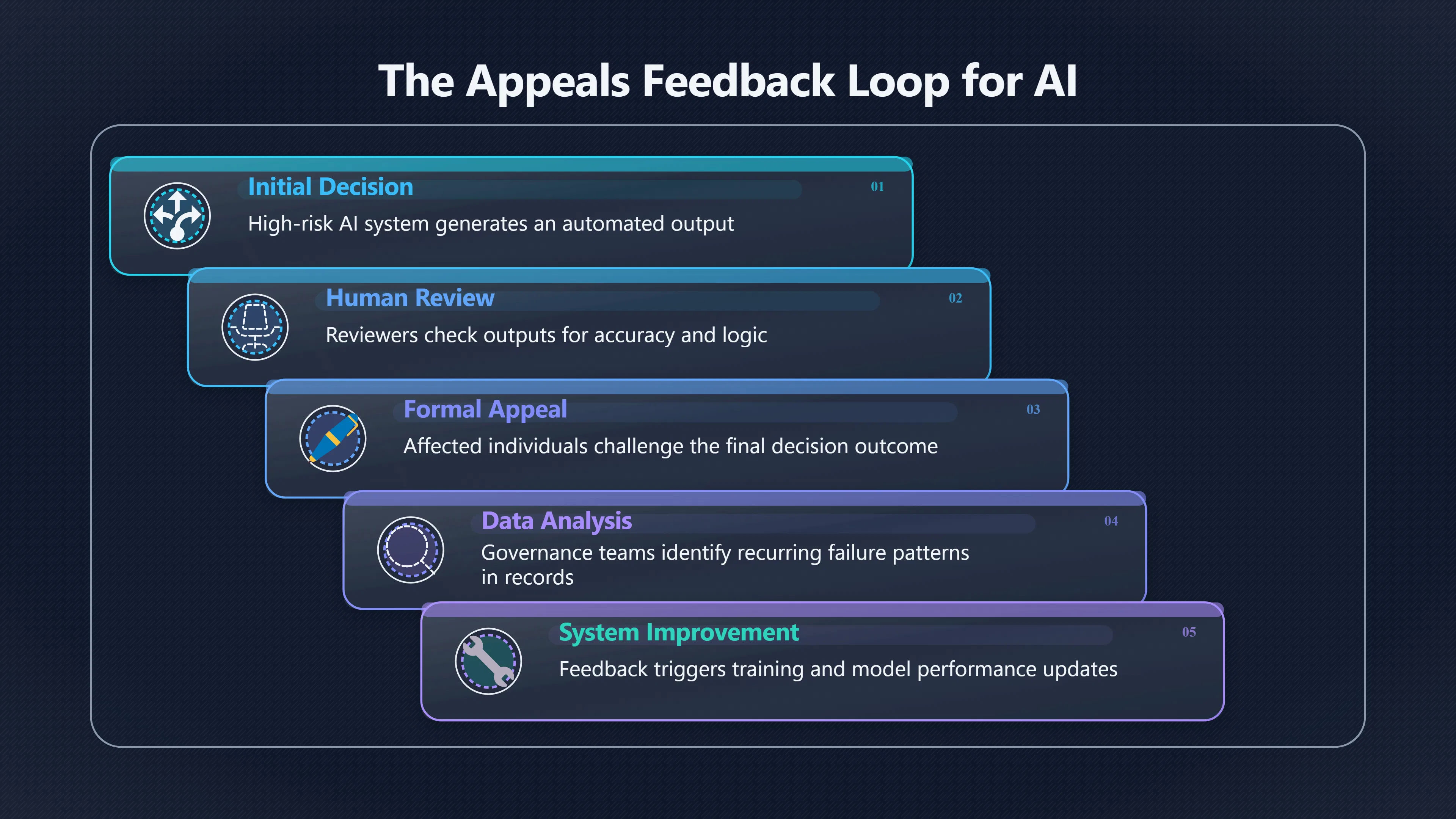
The most valuable appeals systems do more than correct individual outcomes. They feed information back into governance, auditing and system improvement.
Organisations can use appeal data to:
- Identify recurring categories of AI error.
- Measure whether human reviewers are catching mistakes before appeals occur.
- Detect automation bias among reviewers.
- Improve training and guidance for oversight staff.
- Reassess model performance using real-world error reports.
- Trigger deeper investigations when unusual complaint clusters appear.
This transforms appeals from a reactive safeguard into a continuous source of evidence about oversight quality.
For high-risk AI, meaningful human oversight is not proven by the existence of a reviewer. It is demonstrated when people who believe a decision is wrong can challenge it, obtain a genuine reassessment, and generate information that helps uncover mistakes the original process failed to catch. Appeals therefore serve a dual role: protecting individuals and revealing whether the broader oversight system is functioning as intended.
Amazon book picks
Further Reading
Books and field guides related to What Appeals Reveal About AI Oversight. Use these as the next step if you want deeper reading beyond the article.
Weapons of Math Destruction
Shows how oversight failures are revealed through harmful outcomes.
The Black Box Society
Focuses on transparency, challenge rights, and accountability for automated decisions.
eBay marketplace picks
Marketplace Samples
Example marketplace items related to this page. Use the search link to explore similar finds on eBay.




Endnotes
1.
Source: link.springer.com
Link:https://link.springer.com/article/10.1007/s44163-026-01040-6
Source snippet
Springer LinkDual erosion of equality and remedy in algorithmic decision systems | Discover Artificial Intelligence | Springer Nature Lin...
2.
Source: doi.org
Link:https://doi.org/10.1177/20539517241255101
Source snippet
Justitia ex machina: The impact of an AI system on legal decision-making and discretionary authority - Daan Kolkman, Floris Bex, Nitin...
3.
Source: cambridge.org
Link:https://www.cambridge.org/core/journals/european-journal-of-risk-regulation/article/adjudication-of-artificial-intelligence-and-automated-decisionmaking-cases-in-europe-and-the-usa/12C2C1E0F9A3A36F64A3C08CCA419946
Source snippet
Cambridge University Press & AssessmentAdjudication of Artificial Intelligence and Automated Decision-Making Cases in Europe and the USA...
4.
Source: algorithmwatch.org
Title: Algorithm Watch UN: Protect Rights in Welfare Systems’ Tech Overhaul
Link:https://algorithmwatch.org/en/joint-press-release-un-special-rapporteur-report/
Source snippet
UN: Protect Rights in Welfare Systems’ Tech Overhaul - AlgorithmWatchOctober 17, 2019...
Published: October 17, 2019
5.
Source: repository.cam.ac.uk
Link:https://www.repository.cam.ac.uk/items/0e615ac2-5b70-431e-b34d-473ef754ccd6
6.
Source: service.betterregulation.com
Link:https://service.betterregulation.com/document/742215
Source snippet
Better RegulationArticle 22 Authorised representatives of providers of high-risk AI systems | Regulation (EU) 2024/1689 of the European P...
Additional References
7.
Source: arxiv.org
Link:https://arxiv.org/abs/2604.03672
Source snippet
AI Appeals Processor: A [Deep Learning]({{ 'deep-learning/' | relative_url }}) Approach to Automated Classification of Citizen Appeals in Government ServicesApril 4, 2026...
Published: April 4, 2026
8.
Source: reddit.com
Link:https://www.reddit.com/r/AI_Governance/comments/1sepq8d/built_a_risk_classification_matrix_for_eu_ai_act/
Source snippet
a risk classification matrix for EU AI Act compliance after reading Annex III in full — here's how "high risk" actually maps in practiceA...
9.
Source: youtube.com
Link:https://www.youtube.com/watch?v=i3yg5k49u1g
Source snippet
AI-driven VA Claims and The Supreme Court's Bufkin v. Collins ruling. AI NOT THE ULTIMATE SOLUTION...
10.
Source: reddit.com
Title: www.reddit.com Visual explainer of the EU AI Act risk tiers, pretty helpful
Link:https://www.reddit.com/r/europeanunion/comments/1qxkwu4/visual_explainer_of_the_eu_ai_act_risk_tiers/
Source snippet
explainer of the EU AI Act risk tiers, pretty helpfulFebruary 6, 2026...
Published: February 6, 2026
11.
Source: youtube.com
Link:https://www.youtube.com/watch?v=SM57rvS4wz0
Source snippet
ShiftNow Series: Cyber Currents (Ep 5, Pt 2)...
12.
Source: youtube.com
Title: January 23: Algorithmic Decision-Making and Accountability
Link:https://www.youtube.com/watch?v=wO_YK2z5x0A
Source snippet
Law & Tech Speaker Series: Suresh Venkatasubramanian...
13.
Source: consilium.europa.eu
Title: Consilium Artificial intelligence act
Link:https://www.consilium.europa.eu/en/policies/artificial-intelligence-act/
Source snippet
Artificial intelligence act - Consilium...
14.
Source: youtube.com
Title: Shift Now Series: Cyber Currents (Ep 5, Pt 2)
Link:https://www.youtube.com/watch?v=gfdgf54MEGk
Source snippet
January 23: Algorithmic Decision-Making and Accountability...
15.
Source: aiactinfo.eu
Title: Artificial Intelligence Act EU Official Text
Link:https://aiactinfo.eu/
Source snippet
AI ActJune 13, 2024...
Published: June 13, 2024
16.
Source: youtube.com
Title: Law & Tech Speaker Series: Suresh Venkatasubramanian
Link:https://www.youtube.com/watch?v=e-pW6GpsTeA
Topic Tree