Within Hallucinations
How to check AI answers before trusting them
AI-generated text is often good enough to be useful and polished enough to be dangerous. The central lesson from research on AI hallucinations is not that AI answers should never be used, but that they should be treated as drafts rather than finished work.
On this page
- Claims that deserve extra scrutiny
- How to verify citations and precise details
- When to ask for uncertainty or human review
Page outline Jump by section
Introduction
A practical verification process does not require checking every sentence. It requires identifying which parts of an answer would cause harm, embarrassment, financial loss, legal problems, or misinformation if they turned out to be incorrect.

Claims That Deserve Extra Scrutiny
Not every statement in an AI answer carries the same level of risk. A sensible review process focuses first on details that are frequently hallucinated or especially costly to get wrong.
The following categories deserve mandatory verification before publication:
- Statistics and numerical claims: percentages, survey results, market sizes, medical outcomes, budgets, and performance figures.
- Dates and timelines: launch dates, historical events, policy changes, and deadlines.
- Quotations: direct quotes should always be traced to an original source.
- Named sources and references: articles, books, court cases, studies, regulations, and reports.
- Technical or scientific claims: especially when they involve safety, health, engineering, or compliance.
- Predictions and forecasts: AI systems often present speculative information in a factual tone.
- Claims about people or organisations: reputational harm can result from repeating inaccurate statements.
A useful rule is simple: the more precise the claim, the more likely it needs verification. Broad summaries may be substantially correct while individual details within them are not.
For example, an AI-generated explanation of a scientific topic may accurately describe the general concept but invent a supporting statistic or misattribute a finding to the wrong study. The polished writing can make those errors difficult to spot without deliberate checking.[Stony Brook University Libraries]guides.library.stonybrook.eduStony Brook University Libraries Critical Perspectives on AIJeremy Hsu, "AI Hallucinations Are Getting Worse – And They're Here to Stay," New Scientist, May 9…Read more…
How to Verify Citations and Precise Details
One of the most important checks is determining whether cited sources actually exist and support the claim being made.
Never trust a citation because it looks professional
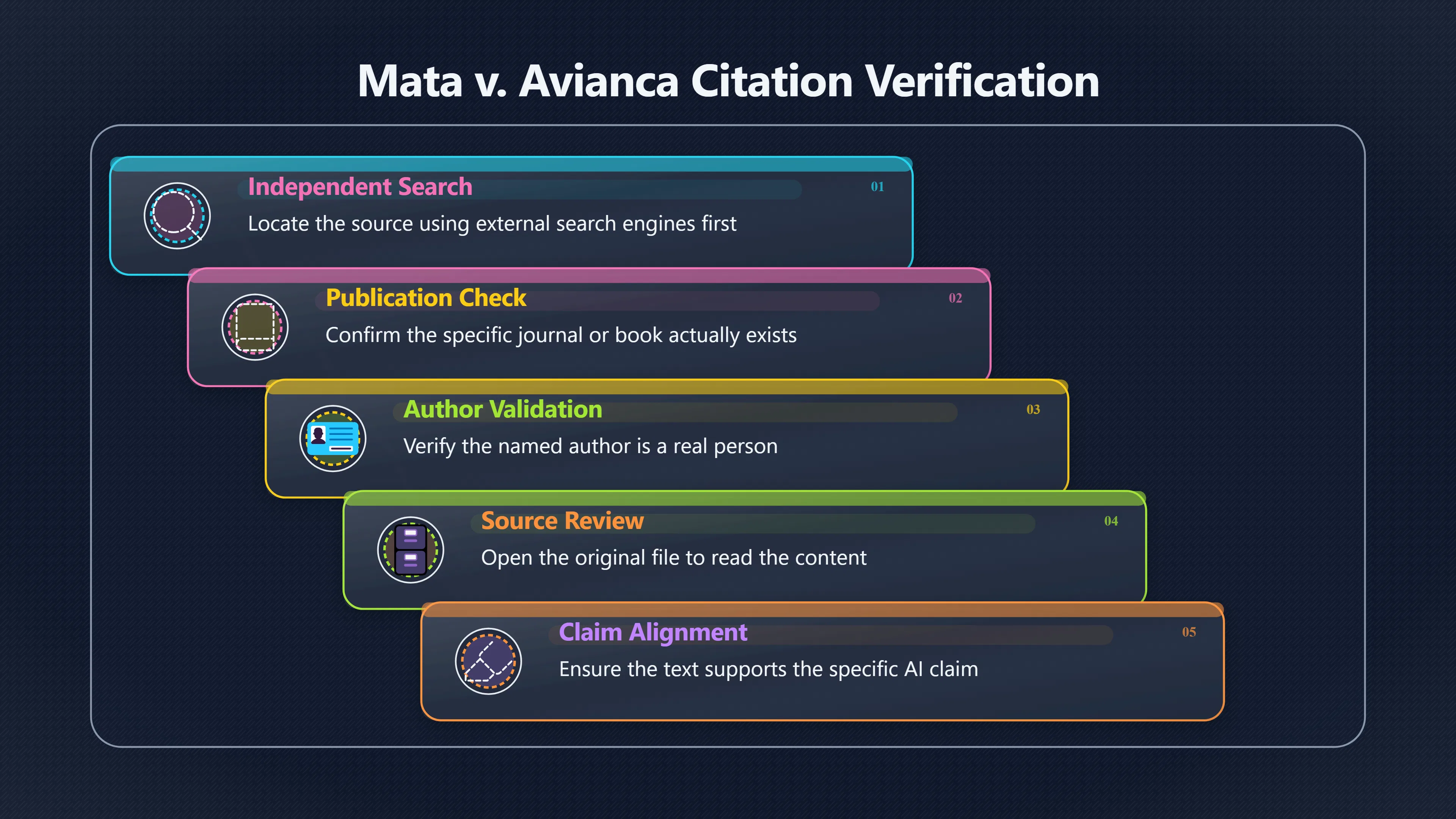
Large language models sometimes generate realistic-looking references that are entirely fictional. A well-known example occurred in the 2023 legal case Mata v. Avianca, where attorneys submitted court filings containing non-existent cases generated by ChatGPT. The court found that the cited authorities were fabricated and imposed sanctions. The case became a widely cited warning about relying on AI-generated references without verification. Justia Law+2Association of Corporate Counsel (ACC)[law.justia.com]law.justia.comLaw Mata vAvianca, Inc., No. 1:2022cv01461 - Document 54 (S.D.N.Y….June 22, 2023 — 2023 Court Description: OPINION AND ORDER ON SANCTIONS: judge…
Before reusing a citation:
- Search for the source independently.
- Confirm that the publication exists.
- Confirm that the author exists.
- Open the original source rather than relying on an AI summary.
- Verify that the cited source actually supports the statement.
A reference that exists is not automatically a valid reference. AI systems sometimes attach genuine sources to claims those sources never made.
Check numbers against primary sources
If an AI answer includes numerical claims, locate the original dataset, report, or official publication whenever possible.
For example:
- Government statistics should be checked against government publications.
- Academic findings should be checked against the paper itself rather than secondary summaries.
- Company figures should be checked against official reports, filings, or announcements.
A single incorrect number can undermine confidence in an otherwise accurate document.
Verify links, titles, and publication details
Common warning signs include:
- Broken links.
- Incorrect publication dates.
- Mismatched author names.
- Articles that cannot be found in reputable databases.
- Citations that appear only in AI-generated content.
If locating a source requires unusual effort, assume it may be incorrect until independently confirmed.

A Practical Publication Checklist
Before publishing AI-assisted content, run through a short review process.
Step 1: Highlight factual claims
Mark statements that make factual assertions rather than offering opinions or general explanations.
Step 2: Identify high-impact claims
Ask which errors would create the greatest consequences if wrong.
Step 3: Verify independently
Use trusted sources to confirm important facts. Ideally, verify using sources that were not suggested by the AI system itself.
Step 4: Check consistency
Look for contradictions between different parts of the text. AI-generated answers can sometimes contain internally inconsistent details.
Step 5: Review citations
Confirm that every cited source exists and supports the associated claim.
Step 6: Confirm dates and numbers
These are among the most common areas where errors survive into final publication.
Step 7: Remove unsupported certainty
Replace overconfident wording with more accurate language when evidence is limited.
Step 8: Conduct a final human read-through
Read the document as if it were written by an unknown contributor rather than by a trusted assistant.
This process resembles editorial review rather than technical auditing. The goal is not perfection but reducing the risk of publishing confident mistakes.
When to Ask for Uncertainty or Human Review
Many verification problems can be reduced before publication by asking the AI system to expose uncertainty.
Instead of accepting an answer as delivered, users can ask:
- Which claims are least certain?
- Which statements require independent verification?
- What evidence supports this conclusion?
- Are there competing interpretations?
- Which parts are based on inference rather than direct evidence?
These questions do not guarantee accuracy, but they can reveal where additional scrutiny is needed.
Human review becomes particularly important in high-stakes contexts such as healthcare, law, finance, engineering, public policy, and academic research. NIST’s AI risk-management guidance emphasises verification, validation, testing, and human oversight throughout the AI lifecycle rather than relying solely on model outputs.[NIST Publications+2NIST Publications]nvlpubs.nist.govai.100 1NIST PublicationsArtificial Intelligence Risk Management Framework (AI RMF 1.0)by N AI · 2023 · Cited by 191 — The NIST modification high…
UNESCO’s guidance on generative AI similarly stresses human agency, oversight, and fact-checking as safeguards against inaccurate or misleading outputs.[UNESCO+2UCL Discovery]unesco.orgguidance generative ai education and researchGuidance for generative AI in education and research7 Sept 2023 — UNESCO's first global guidance on GenAI in education aims to supp…
A useful threshold is this: if a mistake would require a correction notice, create legal exposure, affect someone’s wellbeing, influence a significant decision, or damage credibility, a knowledgeable human reviewer should inspect the content before publication.
Why Verification Remains Necessary Even as AI Improves
Verification is not merely a temporary workaround for early AI systems. Researchers and industry experts continue to treat hallucinations as a persistent challenge because language models generate text probabilistically rather than by guaranteeing factual correctness. Although techniques such as retrieval-augmented generation (RAG), source grounding, and automated checking can reduce errors, they do not eliminate them entirely.[IT Convergence+2IntechOpen]itconvergence.comhow to overcome ai hallucinations using retrieval augmented generationIT ConvergenceHow to Prevent AI Hallucinations with Retrieval Augmented…11 Sept 2024 — Retrieval-augmented generation (RAG) is an effe…
Studies of specialised AI tools have reached similar conclusions. Systems designed for professional domains often reduce hallucination rates but can still produce incorrect citations, unsupported conclusions, or fabricated details. Verification therefore remains a human responsibility even when the tools become more accurate.[arXiv]arxiv.orgHallucination-Free? Assessing the Reliability of Leading AI Legal Research ToolsMay 30, 2024…
The practical mindset is straightforward: treat AI as a capable drafting assistant, not as a final authority. The most reliable workflow combines AI’s speed with human verification of facts, sources, and uncertainty. That approach captures much of the productivity benefit while reducing the risk of publishing plausible but incorrect information.
eBay marketplace picks
Marketplace Samples
Example marketplace items related to this page. Use the search link to explore similar finds on eBay.


Endnotes
1.
Source: nvlpubs.nist.gov
Title: AI.600 1
Link:https://nvlpubs.nist.gov/nistpubs/ai/NIST.AI.600-1.pdf
Source snippet
NIST PublicationsArtificial Intelligence Risk Management Frameworkby N AI · 2024 · Cited by 99 — This document is a cross-sectoral profil...
2.
Source: law.justia.com
Title: Law Mata v
Link:https://law.justia.com/cases/federal/district-courts/new-york/nysdce/1%3A2022cv01461/575368/54/
Source snippet
Avianca, Inc., No. 1:2022cv01461 - Document 54 (S.D.N.Y....June 22, 2023 — 2023 Court Description: OPINION AND ORDER ON SANCTIONS: judge...
Published: June 22, 2023
3.
Source: acc.com
Link:https://www.acc.com/resource-library/practical-lessons-attorney-ai-missteps-mata-v-avianca
Source snippet
AviancaAugust 8, 2023 — The recent story of two New York attorneys “duped” by ChatGPT into citing “fake” cases in a court submission— and...
Published: August 8, 2023
4.
Source: nvlpubs.nist.gov
Title: ai.100 1
Link:https://nvlpubs.nist.gov/nistpubs/ai/nist.ai.100-1.pdf
Source snippet
NIST PublicationsArtificial Intelligence Risk Management Framework (AI RMF 1.0)by N AI · 2023 · Cited by 191 — The NIST modification high...
5.
Source: unesco.org
Title: guidance generative ai education and research
Link:https://www.unesco.org/en/articles/guidance-generative-ai-education-and-research
Source snippet
Guidance for generative AI in education and research7 Sept 2023 — UNESCO's first global guidance on GenAI in education aims to supp...
6.
Source: intechopen.com
Link:https://www.intechopen.com/online-first/1242753
Source snippet
Perspective Chapter: Operationalizing NIST AI RMF for LLMsby G Oz · 2026 — Enterprises commonly use retrieval-augmented generat...
7.
Source: arxiv.org
Link:https://arxiv.org/abs/2405.20362
Source snippet
Hallucination-Free? Assessing the Reliability of Leading AI Legal Research ToolsMay 30, 2024...
Published: May 30, 2024
8.
Source: arxiv.org
Title: arXiv Verif AI: Verified Generative AI
Link:https://arxiv.org/abs/2307.02796
9.
Source: unesco.org
Title: Artificial intelligence in education
Link:https://www.unesco.org/en/digital-education/artificial-intelligence
Source snippet
AIUNESCO AI in Education guides the ethical use of artificial intelligence to enhance learning, teaching, and assessment globally...
10.
Source: unesdoc.unesco.org
Link:https://unesdoc.unesco.org/ark%3A/48223/pf0000395373.locale%3Den
Source snippet
UNESCO's Guidance for Generative AI in Education and Research (UNESCO, 2023b). Indeed, these systems, designed to engage learners in seem...
11.
Source: unesdoc.unesco.org
Link:https://unesdoc.unesco.org/ark%3A/48223/pf0000395373
Source snippet
UNESCO's Guidance for Generative AI in Education and Research (UNESCO, 2023b). The Guidance calls for learners and teachers to be taught...
12.
Source: nist.gov
Link:https://www.nist.gov/publications/artificial-intelligence-risk-management-framework-generative-artificial-intelligence
Source snippet
Artificial Intelligence Risk Management Frameworkby C Autio · 2024 · Cited by 115 — This document is a cross-sectoral profile of and comp...
13.
Source: nist.gov
Link:https://www.nist.gov/itl/ai-risk-management-framework
Source snippet
AI Risk Management FrameworkNIST is seeking comments on a second draft of the NIST Artificial Intelligence Risk Management Framework (AI...
14.
Source: guides.library.stonybrook.edu
Title: Stony Brook University Libraries Critical Perspectives on AI
Link:https://guides.library.stonybrook.edu/genai/ethics
Source snippet
Jeremy Hsu, "AI Hallucinations Are Getting Worse -- And They're Here to Stay," New Scientist, May 9...Read more...
15.
Source: discovery.ucl.ac.uk
Title: Miao and Holmes 2023 Guidance for Generative AI in Education and Resear
Link:https://discovery.ucl.ac.uk/id/eprint/10176438/1/Miao%20and%20Holmes%20-%202023%20-%20Guidance%20for%20Generative%20AI%20in%20Education%20and%20Resear.pdf
Source snippet
UCL DiscoveryGuidance for generative AI in education and researchby F Miao · 2023 · Cited by 1245 — This publication guidance offered her...
16.
Source: unesco.org.uk
Link:https://unesco.org.uk/resources/guidance-for-generative-ai-in-education-and-research
Source snippet
UNESCO in the UKGuidance for generative AI in education and researchThe publication offers concrete recommendations for policy-makers and...
17.
Source: itconvergence.com
Title: how to overcome ai hallucinations using retrieval augmented generation
Link:https://www.itconvergence.com/blog/how-to-overcome-ai-hallucinations-using-retrieval-augmented-generation/
Source snippet
IT ConvergenceHow to Prevent AI Hallucinations with Retrieval Augmented...11 Sept 2024 — Retrieval-augmented generation (RAG) is an effe...
18.
Source: researchgate.net
Link:https://www.researchgate.net/publication/385105010_UNESCO_Proposal_for_the_use_of_Generative_AI_in_Education_Eight_Challenges_and_Seven_Actions
Source snippet
UNESCO Proposal for the use of Generative AI in Education31 Oct 2024 — This proposal explores the integration of Generative Artificial In...
19.
Source: tandfonline.com
Title: The ethics of AI or techno-solutionism?
Link:https://www.tandfonline.com/doi/full/10.1080/01425692.2025.2502808
Source snippet
UNESCO's policy...by Y Mochizuki · 2025 · Cited by 23 — 'In order to address the controversies around generative AI and to harness the p...
20.
Source: verifywise.ai
Link:https://verifywise.ai/ai-governance-library/sector-specific-governance/unesco-ai-education
Source snippet
UNESCO AI and Education GuidanceUNESCO's guidance on AI in education, including ethical considerations, pedagogical implications, and gov...
21.
Source: statescoop.com
Title: unesco urges governments regulate generative ai schools
Link:https://statescoop.com/unesco-urges-governments-regulate-generative-ai-schools/
Source snippet
UNESCO urges governments to regulate generative AI in...Sep 7, 2023 — The new guide advises governments to regulate the use of generativ...
22.
Source: govtech.com
Title: unesco reassert public control over generative ai
Link:https://www.govtech.com/education/k-12/unesco-reassert-public-control-over-generative-ai
Source snippet
UNESCO: Reassert Public Control Over Generative AI14 Sept 2023 — An arm of the United Nations urges the world's governments to regulate g...
23.
Source: dataguidance.com
Title: international unesco issues guidance generative ai
Link:https://www.dataguidance.com/news/international-unesco-issues-guidance-generative-ai
Source snippet
UNESCO issues guidance on generative AI in education...Sep 11, 2023 — UNESCO's Guidance addresses generative AI's role in education, emp...
Additional References
24.
Source: sidgs.com
Link:https://sidgs.com/article/ai-hallucinations-explained-risks-every-enterprise-must-address/
Source snippet
AI Hallucinations in the Enterprise: Risks ExplainedExplore the risks of AI hallucinations in enterprise- from regulatory and financial i...
25.
Source: ft.com
Link:https://www.ft.com/content/7a4e7eae-f004-486a-987f-4a2e4dbd34fb
Source snippet
These errors arise from the probabilistic way the models predict the next word in a sentence, sometimes leading to plausible yet incorrec...
26.
Source: linkedin.com
Link:https://www.linkedin.com/pulse/unesco-guidance-generative-ai-education-research-iblai-rnrle
Source snippet
Guidance for Generative AI in Education and ResearchThis UNESCO publication offers global guidance on the ethical and effective use of ge...
27.
Source: instagram.com
Link:https://www.instagram.com/juanmatagarcia/
Source snippet
Juan Mata (@juanmatagarcia) • Instagram photos and videosI'm joining San Diego FC ownership group! Really happy to announce that I'm a pa...
28.
Source: lsj.com.au
Link:https://lsj.com.au/articles/lawyer-faces-sanctions-for-using-bogus-citations-from-chatgpt/
Source snippet
Lawyer faces sanctions for using 'bogus' citations from ChatGPTMay 29, 2023 — Schwartz was acting for airline passenger Roberto Mata in a...
Published: May 29, 2023
29.
Source: adeptiv.ai
Link:https://adeptiv.ai/nist-generative-ai/
Source snippet
NIST Generative AI Profile ExplainedGenerative AI poses new sources of risk that are not covered by traditional AI governance. Some of th...
30.
Source: researchgate.net
Link:https://www.researchgate.net/publication/397189383_From_Hallucination_to_Harm_Unintended_Ethical_Risks_in_Large_Language_models
Source snippet
(PDF) From Hallucination to Harm Unintended Ethical...Nov 3, 2025 — This research highlights the pressing need for more [responsible AI]({{ 'responsible-ai/' | relative_url }}) d...
31.
Source: rivistauniversitas.it
Title: Implications of AI in Academic Writing Guidelines and Institutional Responses
Link:https://rivistauniversitas.it/document/articles/2025/Implications-of-AI-in-Academic-Writing-Guidelines-and-Institutional-Responses.pdf
Source snippet
Implications of AI in Academic Writing: Guidelines and...3 Dec 2025 — It aims to (1) establish robust ethical and methodological guideli...
32.
Source: seyfarth.com
Title: update on the chatgpt case counsel who submitted fake cases are sanctioned
Link:https://www.seyfarth.com/news-insights/update-on-the-chatgpt-case-counsel-who-submitted-fake-cases-are-sanctioned.html
Source snippet
Update on the ChatGPT Case: Counsel Who Submitted...26 Jun 2023 — On June 8, 2023, the judge in the Mata case held a hearing on the issu...
Published: June 8, 2023
33.
Source: medium.com
Link:https://medium.com/%40mrinal.k.sardar/when-ai-goes-wrong-in-the-courtroom-c532275ccf6c
Source snippet
Avianca, Inc. became a cautionary tale about the dangers of blindly trusting AI-generated content, resulting in significant...Read more...
Topic Tree