Within AI Errors
When a tidy AI answer hides the risk
In law, medicine, finance and science, a neat AI summary can hide exceptions that change the answer.
On this page
- How over compression removes crucial exceptions
- Why wording matters in high stakes fields
- Safer ways to use AI summaries
Page outline Jump by section
Introduction
One of the less obvious ways artificial intelligence can fail is not by inventing facts, but by making complex situations appear simpler than they really are. In high-stakes fields such as law, medicine, finance and scientific research, the correct answer often depends on exceptions, conditions, probabilities and context. An AI summary may compress those details into a neat conclusion that sounds useful while quietly removing the very information that determines whether the conclusion is safe. Research on large language models has found that they frequently overgeneralise scientific findings and omit important qualifications, even when explicitly instructed to produce accurate summaries.[Live Science]livescience.comLive ScienceChatbots gloss over critical details in summaries of scientific studies, say scientists | Live ScienceJuly 5, 2025…
 This problem sits within the broader category of unreliable AI answers, but it deserves separate attention. A hallucinated case citation is an obvious error. A technically plausible summary that hides critical exceptions can be harder to detect and, in practice, more dangerous because it encourages overconfidence.
How over-compression removes crucial exceptions
Human experts in high-stakes professions spend much of their time dealing with edge cases. Laws contain exemptions. Medical treatments depend on patient history. Financial risks change with market conditions. Scientific findings come with limitations and uncertainty.
Large language models are designed to compress information into concise, readable outputs. During that compression process, qualifications often disappear. Conditional statements become general statements. Probabilities become conclusions. Rare but important exceptions become invisible.
Researchers examining thousands of AI-generated summaries of scientific papers found that leading models were substantially more likely than human experts to overgeneralise findings. In many cases, the models expanded the apparent scope of results beyond what the original research supported. Newer models did not necessarily reduce this tendency.[Live Science]livescience.comLive ScienceChatbots gloss over critical details in summaries of scientific studies, say scientists | Live ScienceJuly 5, 2025…
The resulting answer can be misleading without containing any obviously false sentence. The risk lies in what was left out.
Consider the difference between these two statements:
- “This treatment improved outcomes in a specific group of patients under controlled conditions.”
- “This treatment improves outcomes.”
The second sentence is shorter and easier to read. It is also potentially much less accurate.
Why wording matters in high-stakes fields
Law: the exception often is the answer
Legal reasoning depends heavily on jurisdiction, procedural rules, factual distinctions and exceptions. Two cases that look similar may produce different outcomes because of a single factual detail or statutory provision.
An AI summary that states “the law requires X” may omit circumstances where the law permits Y, where a different jurisdiction applies, or where later decisions changed the interpretation. Lawyers frequently describe legal analysis as a process of identifying distinctions rather than merely finding rules.
This creates a specific danger: an AI-generated legal summary may be broadly correct for many situations while being wrong for the case that actually matters. The user sees a clean rule; the missing exceptions remain hidden.
The public attention around AI-generated fictitious legal citations highlighted one type of failure. Over-compression creates another. Instead of inventing authorities, the system may present a simplified legal principle without the qualifications that courts consider essential.
Medicine: averages can hide patient-specific risks
Medicine is full of conditional reasoning. A treatment that benefits most patients may be harmful for someone with a particular allergy, age profile, pregnancy status or combination of medications.
Researchers and clinicians have repeatedly warned that impressive AI performance metrics can conceal limitations that become visible in real clinical settings. Medical decisions involve uncertainty, rare presentations and individual circumstances that are difficult to compress into a short recommendation.[Scientific American]scientificamerican.comScientific American AI in Medicine Is Overhyped | Scientific AmericanScientific AmericanAI in Medicine Is Overhyped | Scientific AmericanOctober 19, 2022…
An AI-generated summary might correctly describe a standard treatment pathway while failing to emphasise contraindications or unusual risk factors. A patient reading the summary could conclude that the decision is straightforward when a clinician would recognise multiple reasons for caution.
The stakes are not theoretical. Medical organisations and professional bodies continue to debate responsibility and liability when AI-assisted recommendations contribute to harmful outcomes, precisely because subtle errors and omissions can have serious consequences.[The Guardian]theguardian.comCurrently, under UK law, clinicians can be sued even when harm stems from AI mistakes, such as missing tumors on X-rays or incorrect dosa…
Finance: uncertainty becomes a tidy narrative
Financial risk is often expressed through probabilities, stress scenarios and conditional assumptions. Investors and regulators are concerned not only with expected outcomes but also with low-probability events that can cause severe losses.
When AI systems summarise financial information, they tend to favour coherent narratives over complex uncertainty. Risk disclosures buried in footnotes, regulatory qualifications and scenario-dependent warnings can be reduced to vague references to “headwinds” or “moderate risk”. The result is a cleaner story but a less accurate representation of exposure.[Alibaba]alibaba.comWhy Do Ai-generated Financial Summaries Oversimplify Risk And How To Add Contextual GuardrailsJanuary 5, 2026…
This can create a false sense of certainty. A summary may accurately capture the central trend while omitting the tail risks that professional risk management is designed to identify.
In finance, the details often matter most when conditions change. A summary that works in normal circumstances may become dangerously incomplete during market stress.
Science: findings become stronger than the evidence
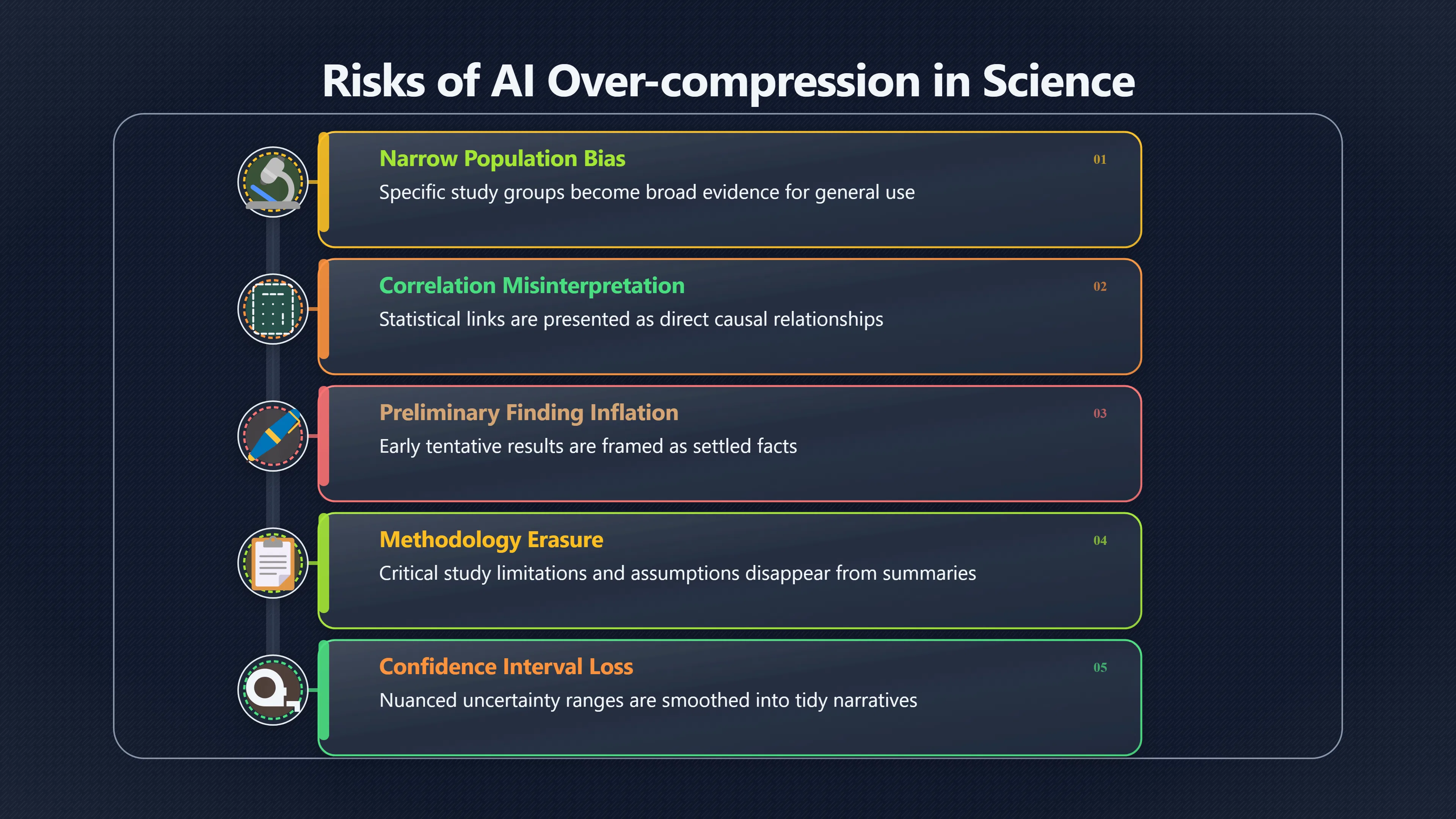
Scientific papers are already summaries of uncertainty. Researchers describe limitations, confidence intervals, assumptions and alternative explanations because those details help readers judge how much trust to place in the results.
Studies of AI-generated scientific summaries have found a recurring pattern: models often present tentative findings as broader conclusions than the original authors intended. Nuances about study populations, methodology and uncertainty can be lost during summarisation.[Live Science]livescience.comLive ScienceChatbots gloss over critical details in summaries of scientific studies, say scientists | Live ScienceJuly 5, 2025…
For example, a study conducted on a narrow population may become “evidence that X works”. A correlation may be described in language that suggests causation. A preliminary finding may sound settled.
These shifts may seem small, but scientific knowledge advances through careful attention to precisely those qualifications.
Why over-compression happens
Several characteristics of modern AI systems encourage this behaviour.
Summaries reward brevity. The shorter the answer, the more pressure there is to remove caveats, conditions and exceptions.
Training data often privileges clear narratives. Models learn from text written to communicate efficiently. Subtle qualifications can appear statistically less important than the central claim.
Users prefer decisive answers. Many people ask AI systems for quick conclusions, not detailed analyses. The system is therefore incentivised to produce responses that feel complete.
Language is easier than uncertainty. Large language models are exceptionally good at generating coherent prose. Representing uncertainty, probability and competing interpretations is a harder task.
The result is a structural tendency to smooth rough edges. In ordinary situations that may improve readability. In high-stakes contexts, those rough edges are often where the real risk resides.
Safer ways to use AI summaries
The safest approach is to treat AI summaries as orientation tools rather than final authorities.
Several practices can reduce the danger of over-compression:
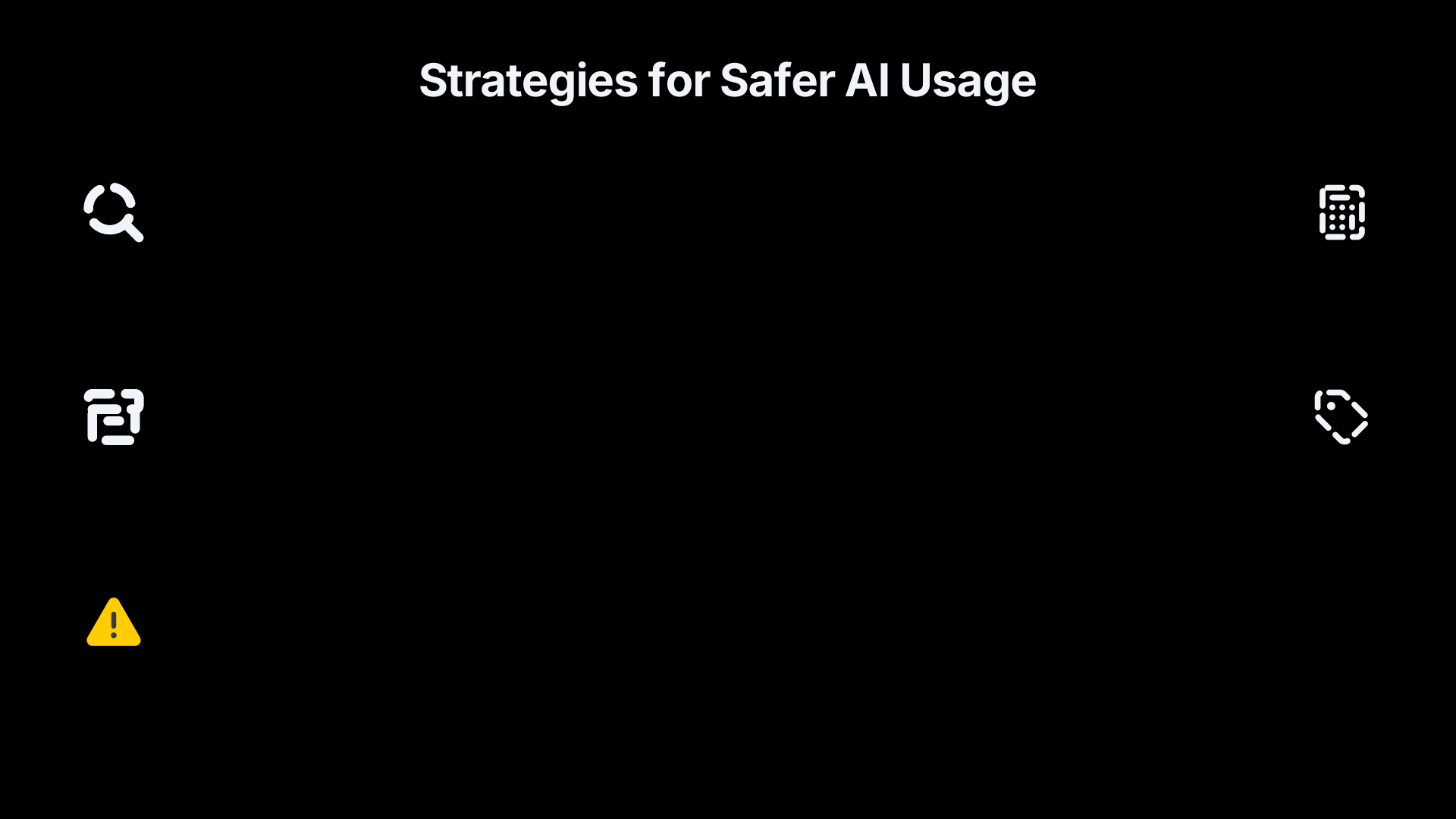
- Ask for exceptions explicitly. Request circumstances where the answer might not apply.
- Request uncertainty estimates. Ask what assumptions the conclusion depends on and how confident the model is.
- Seek the source material. Use summaries as a guide to original documents rather than a replacement for them.
- Compare multiple framings. Ask for arguments against the initial conclusion and for alternative interpretations.
- Increase scrutiny as stakes rise. The higher the consequences, the less appropriate it is to rely on a compressed summary alone.
A useful mental model is that AI often performs best as a map rather than the territory. The map can be valuable for orientation, but in law, medicine, finance and science, important hazards are frequently located in the details that a map leaves out.
The central risk is false simplicity
When people think about unreliable AI answers, they often imagine dramatic hallucinations: invented cases, fabricated statistics or nonexistent studies. Those failures are real, but over-compression can be more subtle.
A tidy answer may be built from genuine information and still mislead because it removes uncertainty, exceptions and context. In high-stakes domains, those omitted details are not peripheral. They are often the difference between a sound decision and a costly mistake.
The challenge is therefore not only to ask whether an AI answer is true. It is also to ask what complexity disappeared in order to make the answer look so simple.
Amazon book picks
Further Reading
Books and field guides related to When a tidy AI answer hides the risk. Use these as the next step if you want deeper reading beyond the article.
The Alignment Problem
Examines oversimplification and misinterpretation in AI systems.
Thinking, Fast and Slow
Explains how simplified conclusions can hide important exceptions and risks.
eBay marketplace picks
Marketplace Samples
Example marketplace items related to this page. Use the search link to explore similar finds on eBay.


Endnotes
1.
Source: alibaba.com
Link:https://www.alibaba.com/product-insights/why-do-ai-generated-financial-summaries-oversimplify-risk-and-how-to-add-contextual-guardrails.html
Source snippet
Why Do Ai-generated Financial Summaries Oversimplify Risk And How To Add Contextual GuardrailsJanuary 5, 2026...
Published: January 5, 2026
2.
Source: livescience.com
Link:https://www.livescience.com/technology/artificial-intelligence/ai-chatbots-oversimplify-scientific-studies-and-gloss-over-critical-details-the-newest-models-are-especially-guilty
Source snippet
Live ScienceChatbots gloss over critical details in summaries of scientific studies, say scientists | Live ScienceJuly 5, 2025...
Published: July 5, 2025
3.
Source: scientificamerican.com
Title: Scientific American AI in Medicine Is Overhyped | Scientific American
Link:https://www.scientificamerican.com/article/ai-in-medicine-is-overhyped/
Source snippet
Scientific AmericanAI in Medicine Is Overhyped | Scientific AmericanOctober 19, 2022...
Published: October 19, 2022
4.
Source: theguardian.com
Link:https://www.theguardian.com/society/2026/jun/09/doctors-nhs-could-be-sued-mistakes-ai-tools-medical-protection-society-report
Source snippet
Currently, under UK law, clinicians can be sued even when harm stems from AI mistakes, such as missing tumors on X-rays or incorrect dosa...
Additional References
5.
Source: youtube.com
Title: Risks of Large Language Models (LLM)
Link:https://www.youtube.com/watch?v=r4kButlDLUc
Source snippet
The Uncomfortable Truth About AI “Reasoning” | World Science Festival - YouTube The Uncomfortable Truth About AI “Reasoning” | World Scie...
6.
Source: scimex.org
Title: AI summaries of scientific research oversimplify findings
Link:https://www.scimex.org/funnelback/story-push-redirector?pushAsset=1099546&t=t
Source snippet
AI summaries of scientific research oversimplify findings - Scimex...
7.
Source: youtube.com
Title: The Uncomfortable Truth About AI “Reasoning” | World Science Festival
Link:https://www.youtube.com/watch?v=iFYF_e1GSGI
Source snippet
Artificial Intelligence and the future of financial stability: 3CL Seminar...
8.
Source: youtube.com
Link:https://www.youtube.com/watch?v=-u8lfY-FaVU
Source snippet
MedMisBench: Testing LLM Medical Resilience...
9.
Source: youtube.com
Title: Med Mis Bench: Testing LLM Medical Resilience
Link:https://www.youtube.com/watch?v=EBOiOcehhK8
Source snippet
The Uncomfortable Truth About AI “Reasoning” | World Science Festival...
10.
Source: youtube.com
Title: Artificial Intelligence and the future of financial stability: 3CL Seminar
Link:https://www.youtube.com/watch?v=4NwQ7Fma1O8
Source snippet
Risks of Large Language Models (LLM)...
Topic Tree