Within Decisions
When human oversight becomes a rubber stamp
A human checkpoint only protects people when reviewers can question the AI output, see wider evidence and override the result.
On this page
- What meaningful human review requires
- How automation bias weakens independent judgement
- Design choices that make review more than approval
Page outline Jump by section
Introduction
Human oversight is often presented as the safeguard that prevents artificial intelligence from making important decisions on its own. In practice, however, a human reviewer does not automatically provide protection. If the reviewer routinely accepts the system’s recommendation, lacks the authority to challenge it, or cannot access the information needed to reach an independent judgement, the process can become a rubber stamp rather than genuine oversight.
 This distinction matters because many organisations describe AI systems as merely “decision support” tools even when the automated recommendation effectively determines the outcome. Regulators, researchers and standards bodies increasingly emphasise that meaningful oversight requires active judgement, not the presence of a person somewhere in the workflow.[Artificial Intelligence Act+2ICO]artificialintelligenceact.euArtificial Intelligence ActArticle 14: Human Oversight | EU Artificial Intelligence ActHuman oversight shall aim to prevent or minimise t…
What meaningful human review requires
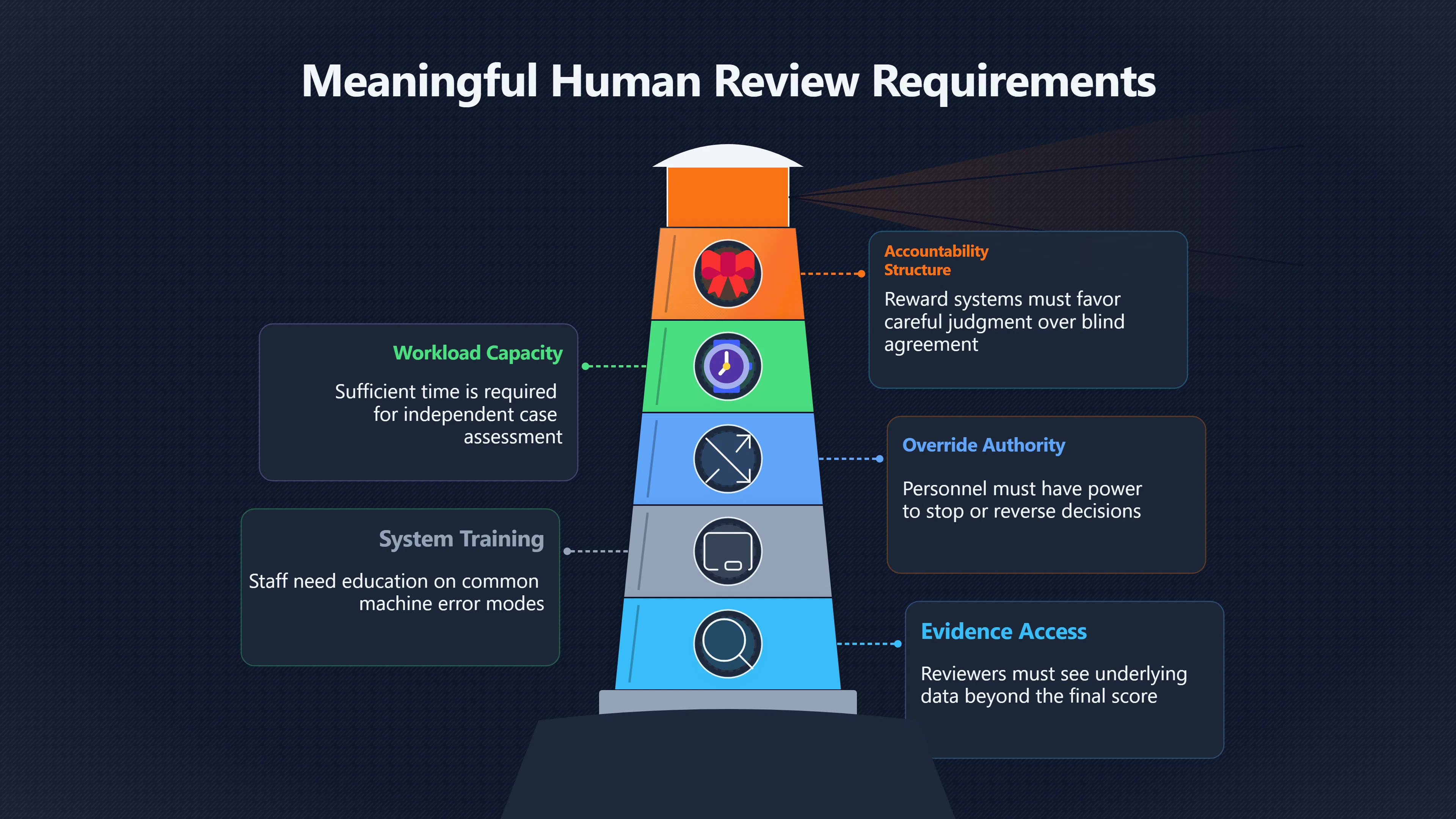
A human review step only changes the outcome if the reviewer can genuinely evaluate and, when necessary, reject the AI recommendation.
Research on effective oversight highlights several conditions that must be present. Reviewers need access to relevant evidence beyond the AI output, enough time to assess the case, sufficient understanding of the system’s limitations, and real authority to intervene. If a person is formally responsible for a decision but lacks the practical ability to influence it, oversight becomes largely symbolic.[arXiv]arxiv.orgOn the Quest for Effectiveness in Human Oversight: Interdisciplinary PerspectivesApril 5, 2024…
Regulatory approaches increasingly reflect this idea. The EU AI Act’s human oversight provisions are designed to minimise risks that remain after technical safeguards are applied and recognise the danger that people may rely too heavily on automated outputs. Oversight is therefore intended to be an active control mechanism rather than a procedural checkbox. Artificial Intelligence Act+2AI Act Service Desk[artificialintelligenceact.eu]artificialintelligenceact.euArtificial Intelligence ActArticle 14: Human Oversight | EU Artificial Intelligence ActHuman oversight shall aim to prevent or minimise t…
Meaningful review generally requires:[dpocentre.com]dpocentre.comFive key considerations for the use of AIBlog4 Oct 2021 — The ICO has stated that the human review has to be meaningful and that simply getting a human to “rubber stamp” the AI s…
- Access to the underlying information used to reach the recommendation.
- Training that enables reviewers to understand common system errors.
- Authority to override, delay or escalate decisions.
- Sufficient time and workload capacity to perform independent assessment.
- Accountability structures that reward careful judgement rather than blind agreement.
Without these conditions, human involvement may exist on paper while automated decision-making continues in practice.
How automation bias weakens independent judgement
The main mechanism behind rubber-stamping is automation bias: the tendency to place excessive trust in machine-generated recommendations.
People often assume that computer systems are more objective, consistent or accurate than human judgement. This can lead reviewers to give disproportionate weight to an AI recommendation even when conflicting evidence is available. NIST identifies this tendency as a significant risk in AI deployment, while data-protection guidance from the UK’s Information Commissioner’s Office (ICO) specifically warns that decision-support systems can encourage routine reliance on automated outputs.[NIST Publications+2NIST AI Resource Center]nvlpubs.nist.govai.100 1NIST PublicationsArtificial Intelligence Risk Management Framework (AI RMF 1.0)by N AI · 2023 · Cited by 182 — For example, whether corre…
Automation bias becomes especially powerful when:[censinet.com]censinet.comAutomation bias, confirmation bias, and overconfidence lead users to trust AI outputs even when evidence contradicts…Read more…
- Reviewers process large volumes of cases.
- Decisions must be made quickly.
- AI systems have historically performed well.
- Organisational culture discourages disagreement.
- Errors are difficult to detect without extensive investigation.
In these circumstances, the reviewer may stop asking whether the recommendation is correct and instead focus on confirming it. The human role shifts from evaluating the decision to validating it.
Researchers studying oversight effectiveness note that passive monitoring is particularly vulnerable. When people spend long periods simply checking automated outputs, their ability to detect anomalies often deteriorates. The result is a dual-verification system that appears robust but functions as a single automated process.[Jolt]jolt.law.harvard.eduredefining the standard of human oversight for ai negligenceRedefining the Standard of Human Oversight for AI…9 Feb 2026 — This reflects automation bias, a phenomenon where humans systematic…
Why nominal oversight can still produce automated decisions
A common misunderstanding is that any human involvement automatically transforms an automated decision into a human decision.
Data-protection authorities have repeatedly challenged this assumption. Guidance associated with automated decision-making rules emphasises that a person cannot merely approve an AI-generated outcome for the process to count as genuine human review. The quality of the intervention matters more than the simple fact that a person was involved.[Data Protection Officers+2Simmons & Simmons]dpocentre.comData Protection OfficersAI and Article 22: The need for meaningful human review19 Apr 2022 — In other words, a human cannot merely 'rubbe…
Recent scrutiny of AI-assisted recruitment provides a concrete example. Investigations by the ICO found that many employers described automated tools as advisory systems while claiming that humans made the final decisions. However, evidence suggested that, in practice, the tools often determined outcomes and human review amounted to little more than endorsement of the recommendation. The ICO concluded that oversight must be active, informed and genuine rather than a token step in the process.[Privacy Matters+2Technology's Legal Edge]privacymatters.dlapiper.comIt cannot be a token gesture or a rubber stamp of an automated outcome.Read morePrivacy MattersUK: ICO Report on Automated Decision-Making in Recruitment7 Apr 2026 — The ICO is clear that human involvement must be mea…
This pattern appears across many domains:
- Recruiters rely on automated rankings to filter applicants.
- Fraud investigators prioritise cases selected by risk-scoring systems.
- Financial institutions depend on automated risk assessments.
- Public-sector agencies use algorithmic prioritisation tools.
In each case, the formal presence of a human reviewer does not guarantee independent judgement.
Design choices that make review more than approval
Avoiding rubber-stamping requires organisational and technical design choices that support sceptical, informed review.
One important principle is ensuring that reviewers see enough context to evaluate the recommendation rather than only the final score. A system that presents a risk score without supporting information encourages acceptance; a system that exposes uncertainty, limitations and relevant evidence makes challenge more likely. Researchers examining automation bias argue that system design should actively counter over-reliance rather than assume users will naturally question automated outputs.[arXiv]arxiv.orgAutomation Bias in the AI Act: On the Legal Implications of Attempting to De-Bias Human Oversight of AIFebruary 14, 2025…
Another critical factor is authority. Human reviewers must have practical override powers, not merely theoretical responsibility. Effective oversight depends on reviewers being able to stop, reverse or escalate decisions without penalty. Both regulatory guidance and academic work on meaningful human control emphasise that responsibility should be matched by actual control over outcomes.[arXiv+3Responsible AI Platform+3euaiact.com]aiactblog.nlResponsible AI PlatformArticle 14 AI Act: Human Oversight | EU high-risk AIArticle 14 AI Act explains human oversight for high-risk AI in…
Organisations can strengthen oversight by:
- Recording when reviewers disagree with AI outputs.
- Auditing override rates and patterns.
- Training staff on known failure modes.
- Requiring additional scrutiny for high-impact decisions.
- Designing interfaces that communicate uncertainty rather than certainty.
- Monitoring whether reviewers are challenging recommendations often enough to indicate genuine engagement.
The goal is not to force humans to reject AI recommendations more frequently. Rather, it is to ensure that agreement results from independent assessment rather than automatic deference.

The central warning
Human oversight is often treated as the solution to the risks of automated decision-making. Yet oversight itself can fail. A reviewer who lacks information, authority, training or time may provide the appearance of accountability while the AI system effectively remains in control.
The key question is therefore not whether a human appears in the workflow. It is whether that person can understand the recommendation, evaluate competing evidence and realistically decide that the system is wrong. When those conditions are absent, human oversight becomes a rubber stamp, and a supposedly supervised process can operate much like fully automated decision-making. link.springer.com+3ICO+3Artificial Intelligence Act[ico.org.uk]ico.org.ukICOHow do we ensure individual rights in our AI systems?ICOThe terms automation bias or automation-induced complacency describe how human users routinely rely on the output generated by a dec…
Amazon book picks
Further Reading
Books and field guides related to When human oversight becomes a rubber stamp. Use these as the next step if you want deeper reading beyond the article.
Thinking, Fast and Slow
Explains cognitive biases that can lead reviewers to defer to systems.
Weapons of Math Destruction
Shows dangers of unquestioned reliance on algorithmic outputs.
eBay marketplace picks
Marketplace Samples
Example marketplace items related to this page. Use the search link to explore similar finds on eBay.


Endnotes
1.
Source: ico.org.uk
Title: ICOHow do we ensure individual rights in our AI systems?
Link:https://ico.org.uk/for-organisations/uk-gdpr-guidance-and-resources/artificial-intelligence/guidance-on-ai-and-data-protection/how-do-we-ensure-individual-rights-in-our-ai-systems/?search=minimisation
Source snippet
ICOThe terms automation bias or automation-induced complacency describe how human users routinely rely on the output generated by a dec...
2.
Source: arxiv.org
Link:https://arxiv.org/abs/2404.04059
Source snippet
On the Quest for Effectiveness in Human Oversight: Interdisciplinary PerspectivesApril 5, 2024...
Published: April 5, 2024
3.
Source: arxiv.org
Title: arXiv Meaningful human control: actionable properties for AI system development
Link:https://arxiv.org/abs/2112.01298
4.
Source: nvlpubs.nist.gov
Title: ai.100 1
Link:https://nvlpubs.nist.gov/nistpubs/ai/nist.ai.100-1.pdf
Source snippet
NIST PublicationsArtificial Intelligence Risk Management Framework (AI RMF 1.0)by N AI · 2023 · Cited by 182 — For example, whether corre...
5.
Source: airc.nist.gov
Title: AI Resource Center AI Risks and Trustworthiness
Link:https://airc.nist.gov/airmf-resources/airmf/3-sec-characteristics/
Source snippet
NIST AI Resource CenterAI Risks and Trustworthiness - AIRC - NIST AI Resource CenterHuman-cognitive biases are omnipresent in decision-ma...
6.
Source: arxiv.org
Link:https://arxiv.org/abs/2502.10036
Source snippet
Automation Bias in the AI Act: On the Legal Implications of Attempting to De-Bias Human Oversight of AIFebruary 14, 2025...
Published: February 14, 2025
7.
Source: euaiact.com
Title: Key Issue 4: Human Oversight
Link:https://www.euaiact.com/key-issue/4
Source snippet
EU AI ActThe EU AI Act proposal would require AI designers to allow human control or interference with an AI system to achieve effective...
8.
Source: link.springer.com
Link:https://link.springer.com/article/10.1007/s43681-026-01147-7
Source snippet
Either humans act as rubber stamps, approving AI outputs they do not fully understand, or...Read more...
9.
Source: nist.gov
Link:https://www.nist.gov/
Source snippet
National Institute of Standards and TechnologyNIST is the National Metrology Institute for the United States, also known as an NMI. Every...
10.
Source: nist.gov
Link:https://www.nist.gov/itl/ai-risk-management-framework
Source snippet
AI Risk Management Framework | NISTNIST has developed a framework to better manage risks to individuals, organizations, and society assoc...
11.
Source: link.springer.com
Link:https://link.springer.com/article/10.1007/s43681-021-00039-2
Source snippet
auditing and impact assessment: according to the UK...by E Kazim · 2021 · Cited by 57 — The guidance seeks to provide a solid methodolog...
12.
Source: artificialintelligenceact.eu
Link:https://artificialintelligenceact.eu/article/14/
Source snippet
Artificial Intelligence ActArticle 14: Human Oversight | EU Artificial Intelligence ActHuman oversight shall aim to prevent or minimise t...
13.
Source: dpocentre.com
Link:https://www.dpocentre.com/blog/ai-and-article-22-the-need-for-meaningful-human-review/
Source snippet
Data Protection OfficersAI and Article 22: The need for meaningful human review19 Apr 2022 — In other words, a human cannot merely 'rubbe...
14.
Source: ai-act-service-desk.ec.europa.eu
Link:https://ai-act-service-desk.ec.europa.eu/en/ai-act/article-14
Source snippet
AI Act Service DeskAI Act Service Desk - Article 14: Human oversightHuman oversight shall aim to prevent or minimise the risks to health...
15.
Source: jolt.law.harvard.edu
Title: redefining the standard of human oversight for ai negligence
Link:https://jolt.law.harvard.edu/digest/redefining-the-standard-of-human-oversight-for-ai-negligence
Source snippet
Redefining the Standard of Human Oversight for AI...9 Feb 2026 — This reflects automation bias, a phenomenon where humans systematic...
16.
Source: simmons-simmons.com
Link:https://www.simmons-simmons.com/en/publications/clamgapbc62ku0b353i8aasos/new-ico-guidance-on-the-lawful-use-of-personal-data-and-ai
Source snippet
Simmons & SimmonsNew ICO guidance on the lawful use of personal data and AI18 Nov 2022 — Further, the ICO guidance has emphasised that th...
17.
Source: privacymatters.dlapiper.com
Title: It cannot be a token gesture or a rubber stamp of an automated outcome.Read more
Link:https://privacymatters.dlapiper.com/2026/04/uk-ico-report-on-automated-decision-making-in-recruitment/
Source snippet
Privacy MattersUK: ICO Report on Automated Decision-Making in Recruitment7 Apr 2026 — The ICO is clear that human involvement must be mea...
18.
Source: technologyslegaledge.com
Link:https://www.technologyslegaledge.com/2026/04/uk-ico-report-on-automated-decision-making-in-recruitment/
Source snippet
Technology's Legal EdgeUK: ICO Report on Automated Decision-Making in...9 Apr 2026 — The ICO stresses that human involvement must be act...
19.
Source: aiactblog.nl
Link:https://www.aiactblog.nl/en/ai-act/artikel/14
Source snippet
Responsible AI PlatformArticle 14 AI Act: Human Oversight | EU high-risk AIArticle 14 AI Act explains human oversight for high-risk AI in...
20.
Source: aiactblog.nl
Title: article 14 human oversight eu ai act
Link:https://www.aiactblog.nl/en/posts/article-14-human-oversight-eu-ai-act
Source snippet
Article 14 EU AI Act: Human Oversight GuideMar 31, 2026 — Article 14 requires human oversight for all high-risk AI systems. Here is what...
21.
Source: digital-strategy.ec.europa.eu
Title: eu A I Act | Shaping Europe’s digital future
Link:https://digital-strategy.ec.europa.eu/en/policies/regulatory-framework-ai
Source snippet
Act | Shaping Europe's digital future - European UnionThe AI Act is the first-ever legal framework on AI, which addresses the risks of AI...
22.
Source: aiact.algolia.com
Title: article 14
Link:https://aiact.algolia.com/article-14/
Source snippet
14: Human Oversight | AI Act made searchable by...Human oversight shall aim at preventing or minimising the risk s to health, safety or...
23.
Source: faicp-framework.com
Link:https://www.faicp-framework.com/AI_RMF_NIST.html
Source snippet
NIST | Artificial Intelligence Risk Management...Understanding the Artificial Intelligence Risk Management Framework, from the US Nation...
24.
Source: intelligence.dlapiper.com
Title: artificial intelligence
Link:https://intelligence.dlapiper.com/artificial-intelligence/?c=EU&t=11-human-oversight
Source snippet
oversight in the European Union - AI Laws of...11 Feb 2026 — Article 14 of the EU AI Act deals with human oversight, stating that provid...
25.
Source: ico.org.uk
Link:https://ico.org.uk/for-organisations/advice-and-services/audits/data-protection-audit-framework/toolkits/artificial-intelligence/human-review/
Source snippet
view is important in the AI lifecycle.Read more...
26.
Source: dpocentre.com
Title: Five key considerations for the use of AI
Link:https://www.dpocentre.com/blog/five-key-considerations-for-the-use-of-ai/
Source snippet
Blog4 Oct 2021 — The ICO has stated that the human review has to be meaningful and that simply getting a human to “rubber stamp” the AI s...
Additional References
27.
Source: aiuc-1.com
Link:https://www.aiuc-1.com/crosswalks/nist-ai-rmf
Source snippet
AIUC-1 x NIST AI RMFThe NIST AI RMF is the United States government framework for managing AI risks throughout the AI lifecycle with four...
28.
Source: scrut.io
Link:https://www.scrut.io/glossary/human-ai-configuration
Source snippet
Human-AI Configuration and OversightThe goal is to design for "meaningful human control" to mitigate risks of over-reliance, automation b...
29.
Source: linkedin.com
Link:https://www.linkedin.com/posts/matt-pluchino-81204118_aigovernace-informationsecurity-adm-activity-7445748443391807488-Lsdk
Source snippet
ICO Guidance on Automated Decision-Making in RecruitmentWe found these key areas needed improvement: • greater transparency • stronger sa...
30.
Source: cambridge.org
Link:https://www.cambridge.org/core/journals/european-journal-of-risk-regulation/article/automation-bias-in-the-ai-act-on-the-legal-implications-of-attempting-to-debias-human-oversight-of-ai/C97C85015056C09326944DE55CBC4D2C
Source snippet
Cambridge University Press & AssessmentAutomation Bias in the AI Act: On the Legal Implications of...by J Laux · Cited by 36 — To ensure...
31.
Source: aphaia.co.uk
Link:https://aphaia.co.uk/meaningful-human-intervention-in-algorithmic-decision-making-practical-guidance-from-the-dutch-dpa/
Source snippet
Meaningful Human Intervention in Algorithmic Decision-Making7 Aug 2025 — The guidance aims to ensure that decisions with legal or signifi...
32.
Source: handleygill.co.uk
Link:https://www.handleygill.co.uk/handley-gill-blog/section-80-data-use-and-access-act-2025-article-22a-uk-gdpr-automated-decision-making-automated-processing-meaningful-human-involvement
Source snippet
What do we mean by meaningful?20 Mar 2026 — The ICO has not yet published guidance on the meaning of “meaningful human involvement” but h...
33.
Source: globalpolicywatch.com
Link:https://www.globalpolicywatch.com/2026/04/uk-ico-consults-on-draft-automated-decision-making-guidance-and-sets-expectations-for-adm-in-recruitment/
Source snippet
UK ICO Consults on Draft Automated Decision-Making...29 Apr 2026 — The Guidance includes a non-exhaustive list of criteria that should b...
34.
Source: insideprivacy.com
Link:https://www.insideprivacy.com/united-kingdom-2/uk-ico-consults-on-draft-automated-decision-making-guidance-and-sets-expectations-for-adm-in-recruitment/
Source snippet
UK ICO Consults on Draft Automated Decision-Making...Apr 24, 2026 — The Guidance includes a non-exhaustive list of criteria that should...
35.
Source: censinet.com
Link:https://www.censinet.com/perspectives/psychology-ai-safety-human-factors
Source snippet
Automation bias, confirmation bias, and [overconfidence]({{ 'overconfidence/' | relative_url }}) lead users to trust AI outputs even when evidence contradicts...Read more...
36.
Source: burges-salmon.com
Title: the data use and access act 2025 navigating the new rules around automated dec
Link:https://www.burges-salmon.com/articles/102mmuc/the-data-use-and-access-act-2025-navigating-the-new-rules-around-automated-dec
Source snippet
The Data (Use and Access) Act 2025: Navigating the New...2 days ago — ADM refers to decisions made about an individual solely by automat...
Topic Tree