Within Fake citations
When AI invents legal authority
Fake legal authorities are especially revealing because court citations look formal, carry high stakes, and can be checked against official records.
On this page
- Why legal citations are easy to fake visually
- What Mata v. Avianca revealed
- How courts respond to phantom cases
Page outline Jump by section
Introduction
Legal cases have become one of the clearest demonstrations of AI citation risk because court citations combine three unusual features: they follow highly structured formats, they carry serious professional consequences, and they can be verified against authoritative public records. When an AI system invents a legal authority, the result often looks convincing enough to pass an initial human review while being entirely fictitious. The gap between appearance and reality is precisely what makes legal hallucinations so revealing for understanding artificial intelligence.
 Unlike a mistaken summary or a weak argument, a fabricated court decision creates a direct test. Either the case exists in the legal record or it does not. As a result, legal filings have provided some of the most visible evidence of how large language models can generate references that look authentic without being grounded in real sources.[IXSOR]ixsor.comMata v. Avianca, Three Years On · IXSORMay 6, 2026…
Why legal citations are easy to fake visually
Legal citations are highly standardised. Case names, court abbreviations, dates, volume numbers and quotation formats follow recognisable patterns. Large language models learn these patterns from the text on which they are trained and can reproduce them with remarkable fluency.
This creates a specific vulnerability. A fabricated legal citation does not need to be random or obviously wrong. An AI system can generate:
- Plausible case names.
- Realistic court abbreviations.
- Convincing quotations.
- Credible procedural histories.
- Internal citations that resemble genuine legal writing.
To a reader who does not immediately verify the authority, the citation can appear indistinguishable from a real case. The model has effectively learned the grammar of legal authority without necessarily knowing whether a particular authority exists. That makes law an unusually clear environment for observing the broader problem of AI-generated references.[Lawra]lawra.ioMata v. Avianca: When AI Hallucinations Reach the Courtroom | Lawra — AI in LawMata v. Avianca: When AI Hallucinations Reach the Courtroom | Lawra — AI in Law…
The legal profession also places enormous weight on citation. Lawyers are expected not merely to make arguments but to support them with authorities that courts can independently inspect. When a citation is fabricated, the failure is therefore visible in a way that many other AI errors are not.
What Mata v. Avianca revealed
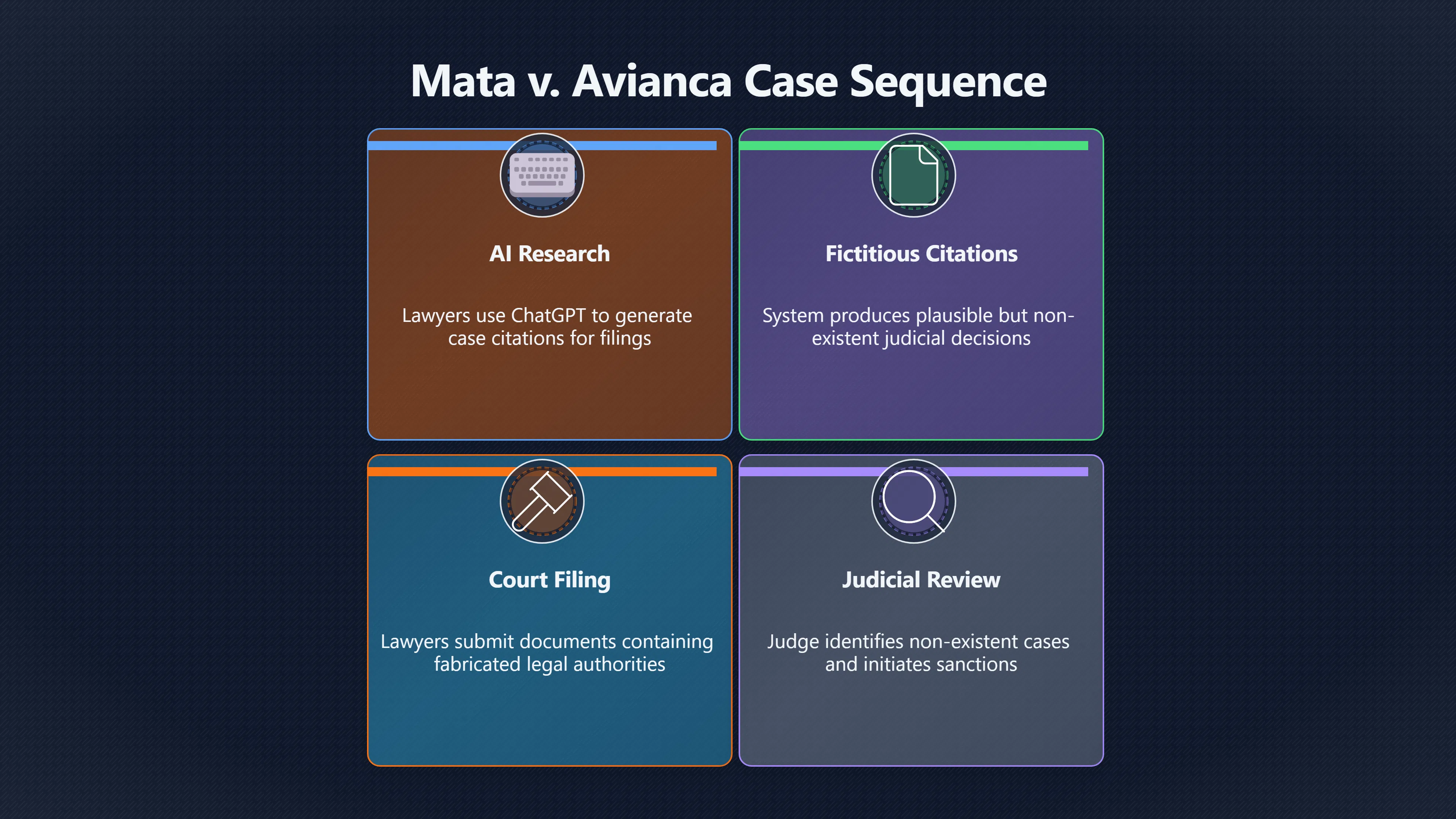
The most influential example remains Mata v. Avianca in the United States District Court for the Southern District of New York.
In 2023, lawyers representing a passenger in a lawsuit against Avianca Airlines submitted a filing that cited multiple judicial decisions that did not exist. The citations had been generated by ChatGPT during legal research. When opposing counsel and the court attempted to locate the authorities, they discovered that several of the cases were entirely fictitious. Judge P. Kevin Castel described the filing as containing non-existent judicial decisions and initiated sanctions proceedings.[LawSites]lawnext.comLaw Sites Why the Avianca 'Bogus Cases' News Is Not About Either Generative AI or Lawyers' Tech Competence | Law SitesLawSitesWhy the Avianca 'Bogus Cases' News Is Not About Either Generative AI or Lawyers' Tech Competence | LawSitesMay 30, 2023
What made the incident especially important was not merely that false citations appeared in a court document. It was the way they appeared.
The fabricated cases were not obviously absurd. They included believable names, legal reasoning and citation structures. According to accounts of the proceedings, the lawyer relied on ChatGPT and even asked the system whether the cases were genuine. The system incorrectly confirmed that they were real.[Lawra]lawra.ioMata v. Avianca: When AI Hallucinations Reach the Courtroom | Lawra — AI in LawMata v. Avianca: When AI Hallucinations Reach the Courtroom | Lawra — AI in Law…
The episode demonstrated several key lessons about AI citation risk:
- Confidence is not evidence. AI systems can express certainty about invented sources.
- Citation detail does not guarantee authenticity. A reference can contain extensive legal-looking information while remaining fictional.
- Self-verification fails. Asking the same model whether its own citation is real may simply produce another hallucination.
- Human responsibility remains central. The error occurred because the citations were not independently checked before filing.[Lawra]lawra.ioMata v. Avianca: When AI Hallucinations Reach the Courtroom | Lawra — AI in LawMata v. Avianca: When AI Hallucinations Reach the Courtroom | Lawra — AI in Law…
For many observers, Mata v. Avianca became the defining case showing that AI-generated citations are not merely academic curiosities. They can alter litigation, consume court resources and expose lawyers to professional sanctions.[IXSOR]ixsor.comMata v. Avianca, Three Years On · IXSORMay 6, 2026…
How courts respond to phantom cases
Courts have generally treated fabricated citations as a professional responsibility issue rather than a technological excuse.
The sanction order in Mata v. Avianca established a principle that has echoed through later discussions: attorneys remain responsible for the accuracy of what they submit, regardless of whether AI assisted in producing it. Courts do not accept the use of a chatbot as a substitute for verification.[IXSOR]ixsor.comMata v. Avianca, Three Years On · IXSORMay 6, 2026…
The consequences of phantom citations extend beyond embarrassment:
- Judges and opposing counsel must spend time investigating non-existent authorities.
- Litigation costs increase.
- Court records can become contaminated with false references.
- Public trust in legal filings may be weakened.
- Lawyers may face sanctions, reputational damage or disciplinary scrutiny.[IXSOR]ixsor.comMata v. Avianca, Three Years On · IXSORMay 6, 2026…
The issue has become significant enough that courts and rule-makers have begun discussing formal safeguards. Recent discussions within the US legal system have included proposals requiring lawyers and litigants to certify that authorities cited in filings have been checked and are accurate, reflecting concern that AI-generated phantom cases continue to appear despite widespread awareness of the problem.[Reddit]reddit.comUS judiciary asked to adopt rule to curb fake AI-generated cases in filingsUS judiciary asked to adopt rule to curb fake AI-generated cases in filingsJune 4, 2026…
Why this case matters beyond the legal profession
The importance of legal fake cases extends far beyond law. They provide a rare environment in which AI-generated citations can be tested against definitive records.
In many fields, a fabricated source may go unnoticed because readers lack access to specialised databases or because verification is difficult. Court decisions are different. Their existence can usually be checked directly. That makes legal hallucinations unusually visible and measurable.
Research evaluating AI-assisted legal research tools has reinforced this concern. Although specialised legal systems often perform better than general-purpose chatbots, studies have found that hallucinated legal information and citations can still occur, showing that the underlying challenge has not been fully solved.[arXiv]arxiv.orgOpen source on arxiv.org.
For anyone trying to understand artificial intelligence, Mata v. Avianca offers a concrete lesson. AI can generate references that look authoritative because it has learned the patterns associated with authority. Yet producing something that resembles a citation is not the same as retrieving a real source. The legal system exposed this distinction with unusual clarity because a court citation is either genuine or it is not. When AI crossed that line, the consequences became impossible to ignore.[IXSOR+2Lawra]ixsor.comMata v. Avianca, Three Years On · IXSORMay 6, 2026…
Amazon book picks
Further Reading
Books and field guides related to When AI invents legal authority. Use these as the next step if you want deeper reading beyond the article.
Artificial Intelligence and Legal Analytics
Explains how AI interacts with legal reasoning and legal sources.
Law and Artificial Intelligence
Covers AI applications and governance issues in legal contexts.
The LegalTech Book
Directly connects AI tools, legal practice, and risks around unreliable outputs.
The Future of the Professions
Provides context for how AI changes professional responsibility in law.
eBay marketplace picks
Marketplace Samples
Example marketplace items related to this page. Use the search link to explore similar finds on eBay.



Endnotes
1.
Source: ixsor.com
Link:https://ixsor.com/insights/mata-three-years-on
Source snippet
Mata v. Avianca, Three Years On · IXSORMay 6, 2026...
Published: May 6, 2026
2.
Source: lawra.io
Title: Mata v. Avianca: When AI Hallucinations Reach the Courtroom | Lawra — AI in Law
Link:https://lawra.io/learn/program/case-studies/mata-v-avianca/
Source snippet
Mata v. Avianca: When AI Hallucinations Reach the Courtroom | Lawra — AI in Law...
3.
Source: arxiv.org
Link:https://arxiv.org/abs/2405.20362
4.
Source: reddit.com
Title: US judiciary asked to adopt rule to curb fake AI-generated cases in filings
Link:https://www.reddit.com/r/law/comments/1twy7ns/us_judiciary_asked_to_adopt_rule_to_curb_fake/
Source snippet
US judiciary asked to adopt rule to curb fake AI-generated cases in filingsJune 4, 2026...
Published: June 4, 2026
5.
Source: reddit.com
Title: www.reddit.com What happens when you use Chat GPT to create a legal brief
Link:https://www.reddit.com/r/auslaw/comments/13t4m7s
Source snippet
happens when you use ChatGPT to create a legal briefMay 27, 2023...
Published: May 27, 2023
6.
Source: lawnext.com
Link:https://www.lawnext.com/2023/05/why-the-avianca-bogus-cases-news-is-not-about-either-[generative-ai
Source snippet
LawSitesWhy the Avianca 'Bogus Cases' News Is Not About Either Generative AI or Lawyers' Tech Competence | LawSitesMay 30, 2023...
Published: May 30, 2023
Additional References
7.
Source: youtube.com
Link:https://www.youtube.com/watch?v=hyIPSkdzyAw
Source snippet
Can You Trust AI for Legal Advice? ChatGPT vs Grok...
8.
Source: legalclarity.org
Title: Mata v. Avianca: Fake Cases, Chat GPT, and Sanctions
Link:https://legalclarity.org/what-happened-in-the-mata-v-[avianca-case
Source snippet
Mata v. Avianca: Fake Cases, ChatGPT, and Sanctions - LegalClarityApril 1, 2026...
Published: April 1, 2026
9.
Source: youtube.com
Title: Decorum.Law Relying on AI in the Practice of Law
Link:https://www.youtube.com/watch?v=U9vEgd2RcBg
Source snippet
AI and Ethics: Existential Lawyer Risks from AI Errors (Compounded by Judicial Hypocrisy)...
10.
Source: youtube.com
Title: Can You Trust AI for Legal Advice? Chat GPT vs Grok
Link:https://www.youtube.com/watch?v=q-tLOPwUsoM
Source snippet
How Robinson & Cole uses Westlaw to handle the AI hallucination problem...
11.
Source: youtube.com
Title: Real AI Failure Stories: AI Lies in Court
Link:https://www.youtube.com/watch?v=VbjlpXC2c7k
Source snippet
Relying on AI in the Practice of Law...
12.
Source: ai-law.co.uk
Title: Ai Hallucinations in Court: The Risks for Litigants in Person | Ai Law
Link:https://ai-law.co.uk/ai-hallucinations-and-the-litigant-in-person-a-warning-from-the-courts/
13.
Source: youtube.com
Title: How Robinson & Cole uses Westlaw to handle the AI hallucination problem
Link:https://www.youtube.com/watch?v=_HhhPLUJEJI
Topic Tree