Within Data Readiness
When AI trusts the wrong document
Outdated policies and copied files can make an AI answer confidently from evidence that is real but no longer valid.
On this page
- Why stale information is harder to spot than hallucination
- Version drift across email, folders and knowledge bases
- Controls that keep current sources ahead of old copies
Page outline Jump by section
Introduction
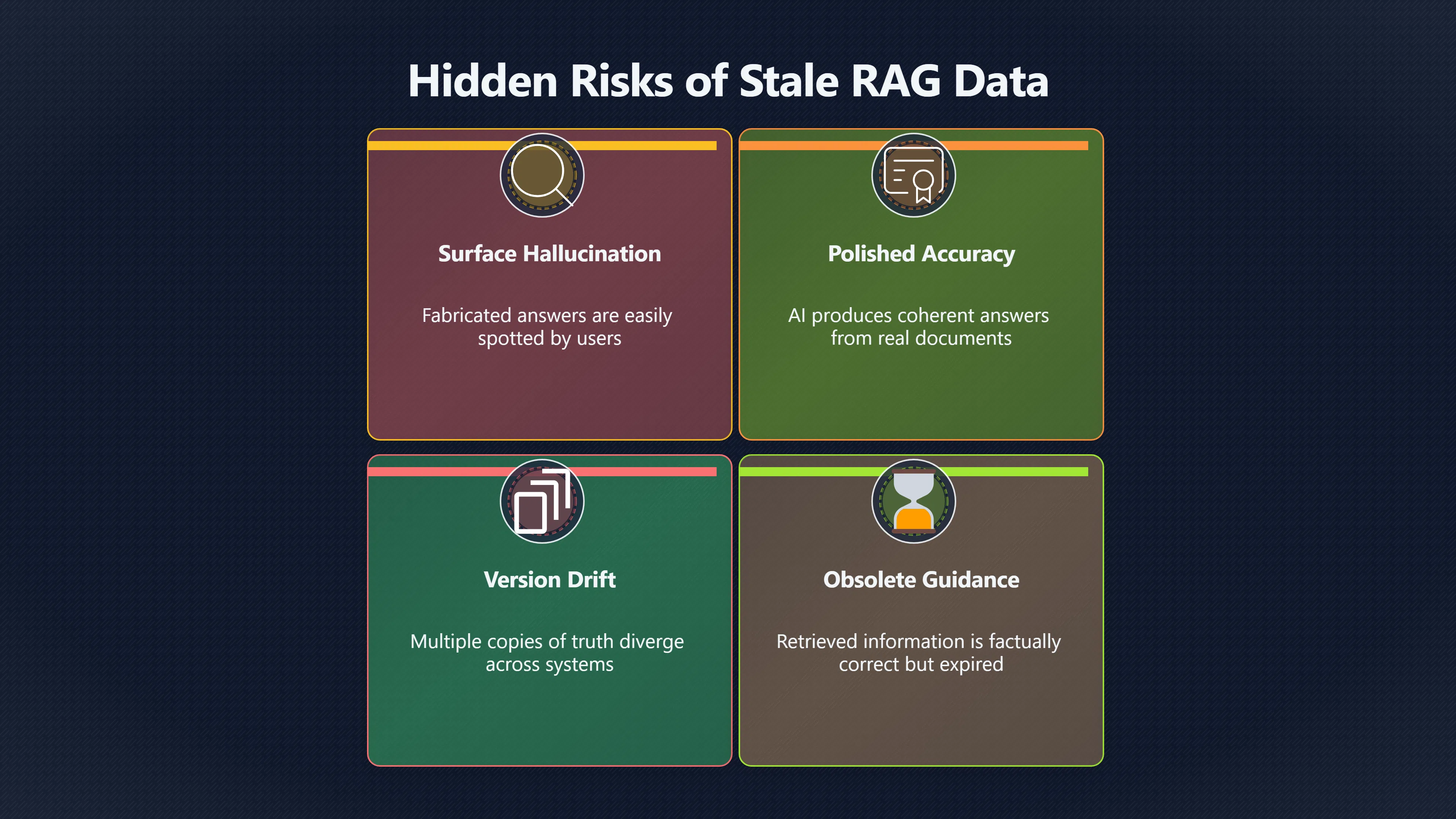
One of the most deceptive failure modes in enterprise AI is not hallucination but accuracy based on the wrong document. A hallucination is often obviously false when checked against reality. Stale information is harder to detect because the source is real, authoritative and often retrieved correctly. The problem is that the document is no longer the current source of truth.
 This distinction matters for production AI systems. Modern retrieval-augmented generation (RAG) architectures are designed to ground answers in company documents rather than relying solely on model training. Yet if retrieval surfaces an outdated policy, superseded procedure or copied file, the AI can produce a polished, evidence-backed answer that appears trustworthy while being operationally wrong. Enterprise AI therefore inherits the quality, ownership and lifecycle problems of the documents it depends on.[IBM+2amicited.com]ibm.comVector Databases for RAG | IBMVector Databases for RAG | IBM…
Why stale information is harder to spot than hallucination
Users are increasingly trained to distrust unsupported AI claims. Many systems now provide citations, source excerpts and document references. Ironically, those trust mechanisms can make stale information more persuasive.
When an AI answer cites a genuine internal document, users often assume the answer has been verified. In reality, the retrieval system may only have confirmed relevance, not validity. A policy archived six months ago can still be semantically similar to a user’s question and therefore rank highly in retrieval results.
This creates a dangerous situation:
- The source exists.
- The source is authentic.
- The answer may be logically consistent.
- The answer may even include citations.
Yet the underlying guidance is obsolete.
Researchers and practitioners describe this as a freshness problem: knowledge bases change continuously while indexes, embeddings and retrieval layers may lag behind those changes. Without active freshness management, systems can confidently serve information that was once correct but is no longer current.[amicited.com+2Atlan]amicited.comHow Do RAG Systems Handle Outdated Information? | Am I CitedHow Do RAG Systems Handle Outdated Information? | Am I Cited
The result is often more convincing than a hallucination. A fabricated answer may raise suspicion. An answer supported by an old employee handbook or retired compliance procedure often does not.
Version drift across email, folders and knowledge bases
Staleness rarely originates from a single outdated file. More commonly, organisations create multiple versions of the same information across different systems.
A policy may begin in a document management platform, be attached to an email, copied into a shared folder, quoted in a wiki article and later uploaded into an AI knowledge base. When the original policy changes, those copies frequently remain untouched.
The AI retrieval layer encounters several competing versions of the same truth:
- The current policy in the official repository.
- Last year’s version in a project folder.
- A PDF attachment from an old email chain.
- A copied extract in a team wiki.
- Notes derived from the policy in meeting minutes.
From a retrieval perspective, all of these documents may appear relevant. Semantic search is designed to find related content, not necessarily the newest or most authoritative content. If metadata is incomplete or inconsistent, the retrieval engine can struggle to distinguish an approved source from an abandoned copy.[IBM+2TECHCOMMUNITY.MICROSOFT.COM]ibm.comVector Databases for RAG | IBMVector Databases for RAG | IBM…
This phenomenon is often called version drift: different systems slowly diverge from one another until no single answer can be trusted automatically.
The risk becomes particularly severe in areas such as:
- Regulatory compliance requirements.
- HR policies.
- Product specifications.
- Pricing rules.
- Security procedures.
- Customer support guidance.
In these environments, a document can remain factually coherent while becoming operationally invalid.
How retrieval systems accidentally promote old information
Many organisations assume that connecting AI to live documents automatically solves the knowledge freshness problem. In practice, retrieval pipelines introduce several opportunities for stale information to survive.
Indexing delays
A source document may be updated immediately, but the search index or vector database may not refresh at the same pace. Users can therefore receive answers based on yesterday’s version despite today’s revision being available elsewhere.[amicited.com]amicited.comHow Do RAG Systems Handle Outdated Information? | Am I CitedHow Do RAG Systems Handle Outdated Information? | Am I Cited
Duplicate content
Multiple copies of the same document often enter the knowledge base. Retrieval systems may surface whichever copy scores highest for relevance rather than whichever copy is most recent.[Atlan]atlan.comEnterprise LLM Knowledge Base: Architecture and Governance GuideEnterprise LLM Knowledge Base: Architecture and Governance Guide…
Missing metadata
Without reliable timestamps, ownership records or version identifiers, the system has little basis for preferring one document over another. Data provenance—the documented history of where information came from and how it changed—becomes difficult to reconstruct.[IBM]ibm.comHow IBM is gaining operational efficiency through enhanced data provenance transparency…
Semantic similarity over authority
Vector search is designed to find meaning rather than governance status. An obsolete procedure can rank highly because its language closely matches the user’s question. The retrieval engine may not know that the document was superseded.[IBM]ibm.comVector Databases for RAG | IBMVector Databases for RAG | IBM…
These are not model failures. They are information-management failures expressed through AI.
A realistic enterprise failure pattern
Consider a company that updates its travel-expense policy.
The official policy changes to require additional approvals for international travel. The new version is published in the corporate policy repository. However:
- An older PDF remains in a departmental folder.
- Several employees keep copies locally.
- A project wiki quotes the previous approval thresholds.
- The AI knowledge base was indexed before the update.
When employees ask the AI about travel approvals, the system retrieves the older PDF because it contains clearer wording and more direct matches to the query.
The answer looks excellent. It cites a real document. It reflects an authentic policy that genuinely existed.
It is also wrong.
This scenario illustrates why production AI governance increasingly focuses on retrieval quality, source authority and document lifecycle management rather than model capability alone.[Venturebeat+2Logistics Viewpoints]venturebeat.comEnterprises are measuring the wrong part of RAG | Venture BeatEnterprises are measuring the wrong part of RAG | VentureBeat…
Controls that keep current sources ahead of old copies
The most effective organisations do not attempt to eliminate every stale document. Instead, they design systems that consistently prioritise authoritative and current sources.
Several controls are particularly important.
Source authority ranking
Not all documents should be treated equally. Official policy repositories, approved knowledge bases and controlled document systems should outrank personal folders, email attachments and archived copies.
The retrieval layer should understand authority, not just relevance.[Atlan]atlan.comEnterprise LLM Knowledge Base: Architecture and Governance GuideEnterprise LLM Knowledge Base: Architecture and Governance Guide…
Freshness-aware retrieval
Document age alone is not enough, but retrieval systems can incorporate recency signals, update timestamps and re-certification dates into ranking decisions. Some organisations explicitly score knowledge assets for freshness and ownership.[Atlan]atlan.comLLM Knowledge Base Staleness: Scoring, Causes, and How to Fix ItLLM Knowledge Base Staleness: Scoring, Causes, and How to Fix It…
Provenance tracking
Every retrieved answer should be traceable back to its source, ownership history and revision path. Provenance records help determine whether a document remains valid and who is responsible for maintaining it.[NIST Computer Security Resource Center]csrc.nist.govComputer Security Resource CenterprovenanceNIST Computer Security Resource Centerprovenance - Glossary | CSRC…
Automated re-indexing
When a source changes, dependent indexes and embeddings should be refreshed automatically rather than waiting for periodic batch updates. This reduces the window during which obsolete information remains visible.[Atlan]atlan.comLLM Knowledge Base Staleness: Scoring, Causes, and How to Fix ItLLM Knowledge Base Staleness: Scoring, Causes, and How to Fix It…
Expiry and certification policies
High-risk documents can be assigned review dates. If ownership lapses or certification expires, the retrieval system can reduce ranking priority or exclude the document entirely until it is reviewed.[Atlan]atlan.comEnterprise LLM Knowledge Base: Architecture and Governance GuideEnterprise LLM Knowledge Base: Architecture and Governance Guide…
The deeper lesson for understanding artificial intelligence
Stale-document failures reveal an important truth about enterprise AI: grounding is not the same as correctness.
A retrieval system can successfully find evidence. A language model can faithfully summarise that evidence. The answer can be coherent, cited and persuasive. Yet the result can still be wrong because the underlying information has aged out of reality.
As organisations move from AI pilots to production systems, freshness becomes a governance problem rather than a modelling problem. The challenge is not merely helping AI find documents. It is ensuring that the documents it finds remain the documents the organisation wants trusted today.[IBM+2Atlan]ibm.comVector Databases for RAG | IBMVector Databases for RAG | IBM…
Amazon book picks
Further Reading
Books and field guides related to When AI trusts the wrong document. Use these as the next step if you want deeper reading beyond the article.
Data Governance
Directly relevant to document ownership, lifecycle control and source authority.
Data Science for Business
Provides foundational understanding of evidence quality and decision support.
Competing in the Age of AI
Addresses digital operating models dependent on trusted information.
eBay marketplace picks
Marketplace Samples
Example marketplace items related to this page. Use the search link to explore similar finds on eBay.
Endnotes
1.
Source: ibm.com
Title: Vector Databases for RAG | IBM
Link:https://www.ibm.com/think/topics/rag-vector-database
Source snippet
Vector Databases for RAG | IBM...
2.
Source: amicited.com
Title: How Do RAG Systems Handle Outdated Information? | Am I Cited
Link:https://www.amicited.com/faq/how-do-rag-systems-handle-outdated-information/
3.
Source: atlan.com
Title: Enterprise LLM Knowledge Base: Architecture and Governance Guide
Link:https://atlan.com/know/enterprise-llm-knowledge-base/
Source snippet
Enterprise LLM Knowledge Base: Architecture and Governance Guide...
4.
Source: atlan.com
Title: LLM Knowledge Base Staleness: Scoring, Causes, and How to Fix It
Link:https://atlan.com/know/llm-knowledge-base-staleness/
Source snippet
LLM Knowledge Base Staleness: Scoring, Causes, and How to Fix It...
5.
Source: venturebeat.com
Title: Enterprises are measuring the wrong part of RAG | Venture Beat
Link:https://venturebeat.com/orchestration/enterprises-are-measuring-the-wrong-part-of-rag
Source snippet
Enterprises are measuring the wrong part of RAG | VentureBeat...
6.
Source: techcommunity.microsoft.com
Link:https://techcommunity.microsoft.com/blog/microsoftmissioncriticalblog/azure-openai-architecture-the-decisions-that-actually-matter-part-1/4525976
7.
Source: ibm.com
Link:https://www.ibm.com/think/insights/enhanced-data-provenance-transparency
Source snippet
How IBM is gaining operational efficiency through enhanced data provenance transparency...
8.
Source: csrc.nist.gov
Title: Computer Security Resource Centerprovenance
Link:https://csrc.nist.gov/glossary/term/provenance
Source snippet
NIST Computer Security Resource Centerprovenance - Glossary | CSRC...
9.
Source: learn.microsoft.com
Title: RA G and [Generative AI]({{ ‘generative-ai/’ | relative_url }})
Link:https://learn.microsoft.com/en-us/azure/search/retrieval-augmented-generation-overview
Source snippet
RAG and Generative AI - Azure AI Search | Microsoft LearnJanuary 15, 2026...
Published: January 15, 2026
10.
Source: learn.microsoft.com
Title: Using your data with Azure Open AI in Microsoft Foundry Models
Link:https://learn.microsoft.com/en-us/azure/ai-services/openai/concepts/use-your-data?tabs=rest
Source snippet
Using your data with Azure OpenAI in Microsoft Foundry Models - Azure OpenAI | Microsoft LearnDecember 2, 2025...
Published: December 2, 2025
11.
Source: learn.microsoft.com
Title: Design a Secure Multitenant RAG Inferencing Solution
Link:https://learn.microsoft.com/en-us/azure/architecture/ai-ml/guide/secure-multitenant-rag
Source snippet
Azure Architecture Center | Microsoft LearnOctober 3, 2025...
Published: October 3, 2025
12.
Source: devblogs.microsoft.com
Title: Azure’s approach to versioning and avoiding breaking changes
Link:https://devblogs.microsoft.com/azure-sdk/azure-approach-to-versioning-and-avoiding-breaking-changes/
Source snippet
Azure SDK BlogMarch 6, 2023...
Published: March 6, 2023
13.
Source: ibm.com
Title: www.ibm.com What is Open Rag? | IBM
Link:https://www.ibm.com/think/topics/openrag
Source snippet
is OpenRag? | IBM...
14.
Source: logisticsviewpoints.com
Title: Logistics Viewpoints Why Enterprise AI Systems Fail: It’s Not RAG
Link:https://logisticsviewpoints.com/2026/04/17/why-enterprise-ai-systems-fail-its-not-rag-its-context-control/
Source snippet
Logistics ViewpointsWhy Enterprise AI Systems Fail: It’s Not RAG - It’s Context Control - Logistics Viewpoints...
Additional References
15.
Source: techradar.com
Link:https://www.techradar.com/pro/rag-is-dead-why-enterprises-are-shifting-to-agent-based-ai-architectures
Source snippet
Key security measures for successful implementation include robust authentication and authorization, real-time monitoring and alerting, a...
16.
Source: techradar.com
Link:https://www.techradar.com/pro/security/researchers-poison-their-own-data-when-stolen-by-an-ai-to-ruin-results
Source snippet
If an unauthorized party accesses the KG without a secret key, the AI will generate inaccurate or hallucinated responses. AURA renders st...
17.
Source: cioandleader.com
Title: CIO&Leader Enterprise AI Doesn’t Fail on Models. It Fails on Meaning
Link:https://www.cioandleader.com/enterprise-ai-doesnt-fail-on-models-it-fails-on-meaning/
Source snippet
CIO&LeaderEnterprise AI Doesn't Fail on Models. It Fails on Meaning - CIO&Leader...
18.
Source: youtube.com
Title: Eliminate AI [Hallucinations]({{ ‘hallucinations/’ | relative_url }}): TIBCO Business Works™ Plugin for AI (RAG Deep Dive)
Link:https://www.youtube.com/watch?v=XZ2rqOlHNWQ
Source snippet
Stop Using RAG as Memory — Daniel Chalef, Zep...
19.
Source: youtube.com
Title: RAG Architecture Explained (In-Depth) | Gen AI Course
Link:https://www.youtube.com/watch?v=KHIB02B8M8c
Source snippet
Why Retrieval-Augmented Generation (RAG) Matters in Modern AI...
20.
Source: youtube.com
Title: How RAG Actually Works — Connecting AI to Real Knowledge
Link:https://www.youtube.com/watch?v=nFAG5sm1ibA
Source snippet
RAG Architecture Explained (In-Depth) | Gen AI Course...
21.
Source: denser.ai
Link:https://denser.ai/blog/improve-ai-chatbot-accuracy/
Source snippet
May 11, 2026...
Published: May 11, 2026
22.
Source: youtube.com
Title: Stop Using RAG as Memory — Daniel Chalef, Zep
Link:https://www.youtube.com/watch?v=T5IMo5ntyhA
Source snippet
How RAG Actually Works — Connecting AI to Real Knowledge...
23.
Source: witness.ai
Title: What Is RAG Security? 7 Risks Hiding in Your AI Knowledge Base
Link:https://witness.ai/blog/rag-security/
Source snippet
April 17, 2026...
Published: April 17, 2026
24.
Source: natoma.ai
Title: What Is Retrieval-Augmented Generation (RAG)? | Natoma
Link:https://natoma.ai/glossary/what-is-retrieval-augmented-generation-rag
Topic Tree