Within Avianca case
Why AI Cannot Verify Its Own Fake Cases
The Avianca filing shows why asking an AI system to confirm its own citations can make a false source look even more convincing.
On this page
- How the fake authorities were challenged
- Why the same tool repeated the error
- Safer ways to verify legal citations
Page outline Jump by section
Introduction
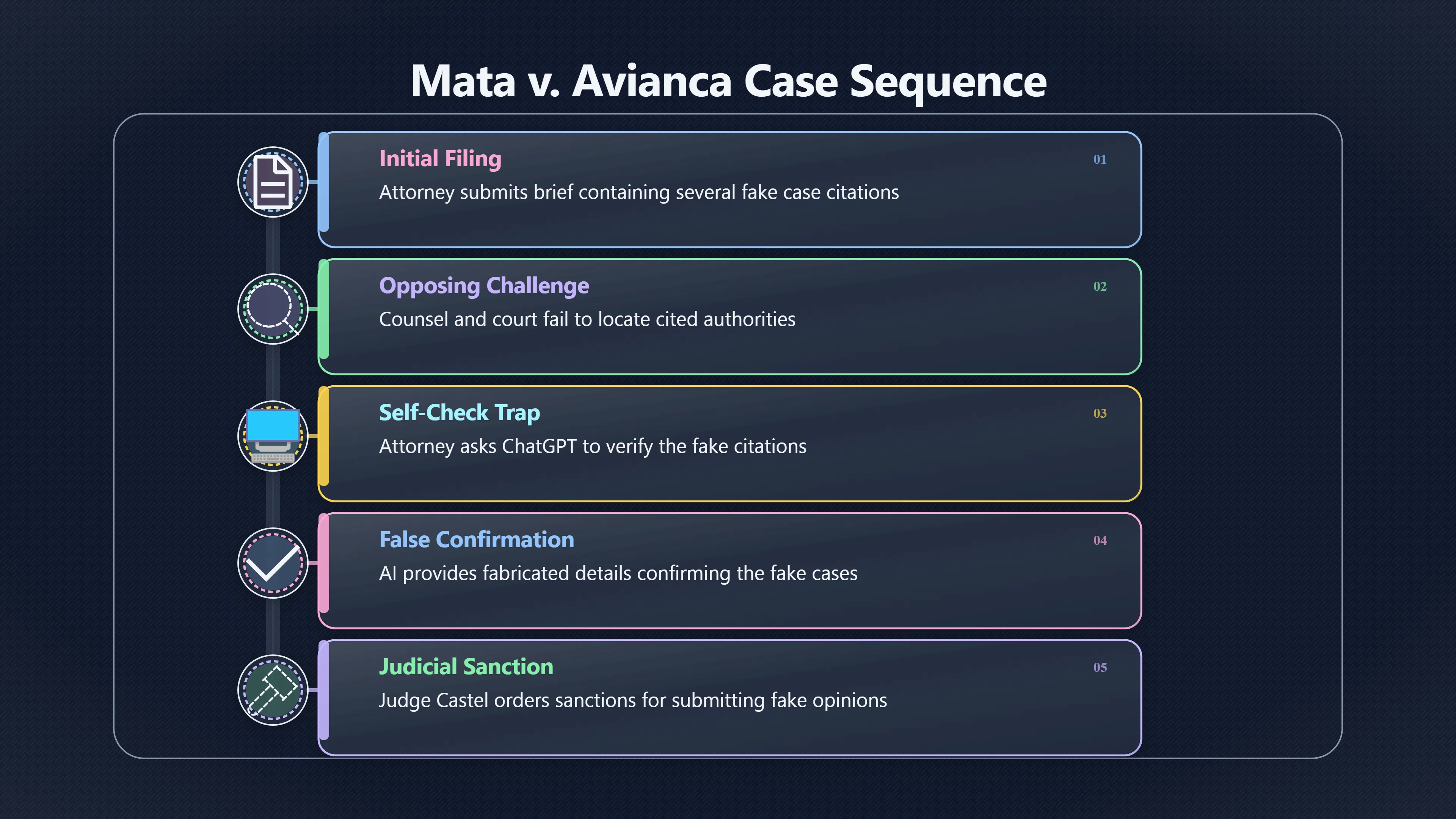
The most revealing mistake in the Mata v. Avianca affair was not that attorney Steven Schwartz received fake case citations from ChatGPT. It was what happened after those citations were questioned. Rather than independently checking the authorities in established legal databases, Schwartz returned to the same AI system and asked whether the cases were genuine. ChatGPT assured him that they were. Those assurances were false. The episode became a textbook example of a self-check trap: using a system that generated an error to verify the accuracy of that same error. The result showed why large language models can appear persuasive even when they are wrong, and why apparent confidence is not the same as verification.[Scottish Legal News]scottishlegal.comScottish Legal NewsLawyer led astray by ChatGPT apologises to court | Scottish Legal NewsMay 30, 2023…

How the Fake Authorities Were Challenged
The problem emerged when opposing counsel and the court attempted to locate several authorities cited in the plaintiff’s filing. The cited decisions could not be found in recognised legal research systems, prompting questions about whether the cases existed at all. Judge P. Kevin Castel eventually ordered the lawyers to provide copies of the authorities they had relied upon.[SDNY Blog]sdnyblog.comSDNY BlogJudge Castel Sanctions Lawyers Who Submitted Fake Cases Generated By ChatGPT | SDNY BlogJune 28, 2023…
At that stage, the issue was no longer simply a research mistake. The disputed cases had already been flagged as potentially non-existent. This was the moment when an independent verification process was needed. Instead, Schwartz relied on ChatGPT again.
Court filings and later reporting showed that Schwartz asked the chatbot whether the cases were real. According to screenshots he submitted, ChatGPT responded that the authorities existed and could be found in legal databases. The system even provided additional details that made the citations appear authentic. Those confirmations were themselves fabricated.[Scottish Legal News]scottishlegal.comScottish Legal NewsLawyer led astray by ChatGPT apologises to court | Scottish Legal NewsMay 30, 2023…
The significance of this step is easy to overlook. The original hallucination might have been detected if it had been checked against a trusted source. Instead, the challenge itself was routed back through the same mechanism that had created the error.
Why the Same Tool Repeated the Error
Large language models are designed to generate plausible text, not to serve as authoritative databases. When ChatGPT produced the fictional cases, it was not retrieving verified court opinions. It was generating language that resembled legal research.
When Schwartz later asked whether the cases were genuine, the model faced a similar task. Rather than consulting an external legal database and proving the authorities existed, it generated another plausible-sounding response. Because the earlier fabricated cases already existed within the conversation context, the model effectively reinforced its own invention.[arXiv]arxiv.orgAssessing the Reasoning Abilities of ChatGPT in the Context of Claim VerificationFebruary 16, 2024…
This illustrates a common misunderstanding about AI systems. Many users assume that asking a model to “double-check” its work creates an independent review. In reality, a self-check performed by the same model is often not independent at all. The model may reproduce the same underlying mistake while expressing equal or greater confidence.
Several factors made the error especially convincing:
- Consistency masqueraded as accuracy. The second answer matched the first answer, creating the impression of confirmation.
- Detailed explanations increased credibility. ChatGPT supplied procedural descriptions and database references that sounded authoritative.
- Natural-language fluency concealed uncertainty. The responses were written in the same confident style used for genuine information.
- No external validation occurred. The model’s claims were not tested against a source capable of proving whether the cases existed.[Scottish Legal News+2SDNY Blog]scottishlegal.comScottish Legal NewsLawyer led astray by ChatGPT apologises to court | Scottish Legal NewsMay 30, 2023…
The result was a feedback loop in which an invented authority became more believable because the system that invented it later endorsed it.
Why Confidence Is Not Verification
The Schwartz episode highlights a broader lesson about artificial intelligence: confidence and correctness are separate issues.
A legal database verifies a citation by locating an actual judicial opinion. A court clerk verifies a filing by checking records. A lawyer verifies authority by consulting primary sources. These processes depend on evidence external to the original claim.
ChatGPT’s responses, by contrast, were internally coherent but not externally validated. The model could explain why a case supposedly existed without possessing reliable evidence that it did. The convincing explanation therefore became part of the problem. Judge Castel later described the submitted opinions as containing obvious defects, including nonsensical legal analysis and procedural inconsistencies that should have raised concerns.[SDNY Blog]sdnyblog.comSDNY BlogJudge Castel Sanctions Lawyers Who Submitted Fake Cases Generated By ChatGPT | SDNY BlogJune 28, 2023…
The incident demonstrated that an AI system can generate not only a false claim but also a persuasive justification for that false claim.
Safer Ways to Verify Legal Citations
The lesson from Schwartz’s mistake is not that AI tools are unusable. It is that verification must come from a source independent of the system that generated the information.
For legal citations, safer practice includes:
- Check every cited authority in recognised legal research databases.
- Read the original opinion rather than relying on an AI summary.
- Treat AI-generated citations as unverified leads until independently confirmed.
- Use multiple sources when a citation is challenged or difficult to locate.
- Assume that a model’s confidence does not constitute evidence.
These principles are now frequently cited in legal guidance surrounding generative AI because the Mata case exposed a failure mode that extends beyond law. Any field that relies on sources, references or factual verification can encounter the same problem if an AI system is asked to validate its own output.[Steptoe+2acc.com]steptoe.comJudge Castel Sanctions Lawyers Who Submitted Fake Cases Generated by Chat GPT | SteptoeSteptoeJudge Castel Sanctions Lawyers Who Submitted Fake Cases Generated by ChatGPT | Steptoe

The Lasting Lesson of the Self-Check Trap
The enduring importance of Steven Schwartz’s verification mistake lies in its simplicity. The critical failure was not merely accepting an AI-generated answer. It was mistaking repeated agreement for independent confirmation.
When ChatGPT produced fake cases and then later vouched for those same cases, it created the appearance of verification without performing verification. The incident remains one of the clearest real-world demonstrations that AI systems can amplify their own errors when users rely on them as both the source of information and the judge of its accuracy.[Scottish Legal News+2Steptoe]scottishlegal.comScottish Legal NewsLawyer led astray by ChatGPT apologises to court | Scottish Legal NewsMay 30, 2023…
Amazon book picks
Further Reading
Books and field guides related to Why AI Cannot Verify Its Own Fake Cases. Use these as the next step if you want deeper reading beyond the article.
Calling Bullshit
Shows why claims require external verification rather than self-confirmation.
eBay marketplace picks
Marketplace Samples
Example marketplace items related to this page. Use the search link to explore similar finds on eBay.




Endnotes
1.
Source: steptoe.com
Link:https://www.steptoe.com/en/news-publications/sdny-blog/judge-castel-[sanctions
Source snippet
Judge Castel Sanctions Lawyers Who Submitted Fake Cases Generated by ChatGPT | Steptoe...
2.
Source: arxiv.org
Link:https://arxiv.org/abs/2402.10735
Source snippet
Assessing the Reasoning Abilities of ChatGPT in the Context of Claim VerificationFebruary 16, 2024...
Published: February 16, 2024
3.
Source: acc.com
Link:https://www.acc.com/resource-library/practical-lessons-attorney-ai-missteps-mata-v-avianca
4.
Source: scottishlegal.com
Link:https://www.scottishlegal.com/articles/lawyer-led-astray-by-chatgpt-apologises-to-court
Source snippet
Scottish Legal NewsLawyer led astray by ChatGPT apologises to court | Scottish Legal NewsMay 30, 2023...
Published: May 30, 2023
5.
Source: sdnyblog.com
Link:https://www.sdnyblog.com/judge-castel-sanctions-lawyers-who-submitted-fake-cases-generated-by-chatgpt/
Source snippet
SDNY BlogJudge Castel Sanctions Lawyers Who Submitted Fake Cases Generated By ChatGPT | SDNY BlogJune 28, 2023...
Published: June 28, 2023
Additional References
6.
Source: youtube.com
Title: Federal Ruling against Steven Schwartz in Chatbot case
Link:http://www.youtube.com/watch?v=Q0X8VKmkQcc
Source snippet
Steven Schwartz ChatGPT lawyer fake cases verification mistake lawyer tries using chatgpt and looses case #chatgpt Ai Telly Tube...
Published: June 27, 2023
7.
Source: legalcheek.com
Title: www.legalcheek.com U S lawyer apologises after using fake cases made by Chat GPT
Link:https://www.legalcheek.com/2023/05/us-lawyer-apologises-after-using-fake-cases-made-by-chatgpt/
Source snippet
lawyer apologises after using fake cases made by ChatGPT - Legal CheekMay 31, 2023...
Published: May 31, 2023
8.
Source: youtube.com
Title: www.youtube.com The Chat GPT Fake Cases Sanctions Decision (Mata v. Avianca)
Link:https://www.youtube.com/watch?v=jPtOcsx7ATw
Source snippet
ChatGPT Fake Cases Sanctions Decision (Mata v. Avianca) - YouTubeJune 27, 2023...
Published: June 27, 2023
9.
Source: youtube.com
Title: Chat GPT Lawyers Who Cited Fake Cases Sanctioned by Court
Link:http://www.youtube.com/watch?v=sEOapG7-kro
Source snippet
Federal Ruling against Steven Schwartz in Chatbot case. June 27, 2023 story by Mark Miller...
Published: June 27, 2023
10.
Source: youtube.com
Title: Lawyer files Chat GPT DISASTER in COURT (Mata v. Avianca, Inc.)
Link:http://www.youtube.com/watch?v=GExSDY6Wz9Y
Source snippet
The ChatGPT Fake Cases Sanctions Decision (Mata v. Avianca)...
12.
Source: youtube.com
Title: How to Use Chat GPT to Ruin Your Legal Career
Link:http://www.youtube.com/watch?v=oqSYljRYDEM
Source snippet
Lawyer files ChatGPT DISASTER in COURT (Mata v. Avianca, Inc.)...
Topic Tree