Within RAG errors
Can AI trust a badly scanned document?
Scanned tables, missing footnotes and broken headings can make a grounded system quote corrupted evidence with misplaced confidence.
On this page
- How OCR changes tables, headings and footnotes
- Why corrupted ingestion is hard to repair later
- Practical signs that a scanned source may be unsafe
Page outline Jump by section
Introduction
Grounded AI systems are often described as safer because they answer questions using documents rather than relying solely on memory. However, that promise depends on the documents entering the system correctly. When reports, contracts, policies, financial statements or historical records are scanned and converted into text through optical character recognition (OCR), small extraction mistakes can quietly corrupt the evidence before the AI ever sees it.
 This matters because modern retrieval-augmented generation (RAG) systems treat OCR output as factual input. If a heading is attached to the wrong section, a table loses its structure, or a footnote disappears during scanning, the AI may retrieve and cite corrupted material while appearing fully grounded. Research on OCR-driven RAG pipelines has found that both formatting errors and semantic errors can cascade through retrieval and answer generation, producing confident but incorrect conclusions.[arXiv]arxiv.orgOCR Hinders RAG: Evaluating the Cascading Impact of OCR on Retrieval-Augmented GenerationDecember 3, 2024…
Can AI trust a badly scanned document?
The short answer is often no. OCR is not merely a transcription step. It acts as a translation layer between a visual document and the text-based knowledge base used by many AI systems.
Humans reading a page can use visual cues such as indentation, column layout, font size, table borders and footnote markers to understand meaning. OCR systems must reconstruct those relationships automatically. When they fail, the resulting text may still look plausible while no longer representing the original document accurately. Research evaluating OCR effects on RAG systems found that even relatively modest OCR noise can significantly reduce downstream retrieval and question-answering performance.[arXiv]arxiv.orgOCR Hinders RAG: Evaluating the Cascading Impact of OCR on Retrieval-Augmented GenerationDecember 3, 2024…
A key problem is that document meaning is often encoded in structure rather than words alone. A financial figure, legal clause or policy exception may depend on where it appears on the page.
How OCR changes tables, headings and footnotes
Tables can lose their meaning even when the numbers survive
Tables are among the hardest document elements for OCR and document AI systems. Real-world tables frequently contain merged cells, hierarchical headers, multiple levels of categorisation and irregular layouts. If OCR captures the text but fails to preserve these relationships, the resulting evidence can become misleading.[TurboLens]turbolens.ioWhy Table Extraction Is One of the Hardest Problems in Document AI | TurboLens BlogFebruary 25, 2026…
Consider a table showing:
ProductRevenue 2024Revenue 2025
If the column alignment is lost during extraction, values can become attached to the wrong year or the wrong product. The individual numbers may be recognised correctly, yet the meaning of the table changes.
Researchers studying OCR-based RAG pipelines identify formatting noise as a major source of downstream error because retrieval systems often depend on the extracted structure when indexing and searching documents.[arXiv]arxiv.orgOCR Hinders RAG: Evaluating the Cascading Impact of OCR on Retrieval-Augmented GenerationDecember 3, 2024…
Broken headings can reassign entire sections
Headings are more than visual decoration. They tell readers which content belongs together.
When OCR misreads page layout, section titles may become detached from their associated paragraphs. Multi-column documents are particularly vulnerable because OCR engines can confuse reading order, causing text from separate sections to be merged. Studies of document layout analysis have shown that identifying page structure correctly remains a challenging problem, especially in complex documents.[Springer Link]link.springer.comSpringer LinkDatasets and annotations for layout analysis of scientific articles | International Journal on Document Analysis and Recogni…
For a grounded AI system, this can create a subtle failure mode. A paragraph describing an exception, limitation or historical policy may be indexed under the wrong heading. The AI then retrieves genuine text but interprets it as belonging to a different topic.
Missing footnotes can remove critical qualifications
Footnotes often contain conditions, exclusions, definitions or methodological caveats. In business reports, regulatory documents and scientific papers, the footnote may be the most important part of the page.
OCR systems sometimes omit footnotes entirely, place them in the wrong location, or separate them from the text they modify. When that happens, a retrieval system may store the main claim but lose the qualification attached to it.
The result is evidence that appears stronger or more absolute than the original document intended. An AI answering questions from that document may therefore produce responses that are technically grounded in the stored text while failing to reflect the actual source.
Why corrupted ingestion is hard to repair later
Many people assume that later AI stages can simply detect and correct OCR mistakes. In practice, this is often difficult.
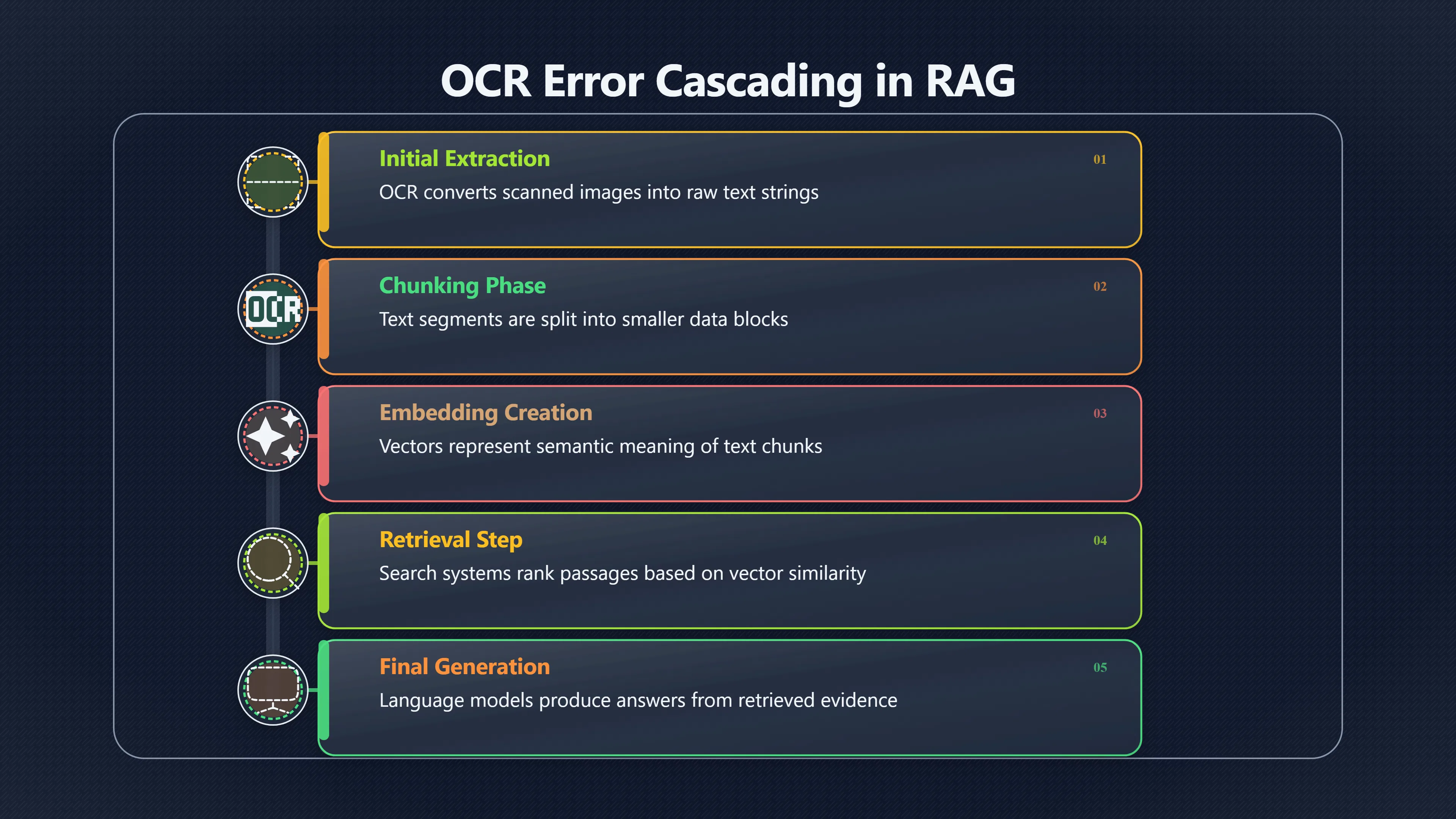
Once OCR output has been indexed into a knowledge base, several downstream processes depend on it:
- The extracted text is split into chunks.
- Chunks are converted into embeddings for retrieval.
- Search systems rank relevant passages.
- The language model uses those passages as evidence.
If the original extraction was wrong, each later stage inherits the error. Researchers describe this as a cascading effect: OCR noise propagates through retrieval and generation, degrading performance at multiple points in the pipeline.[arXiv]arxiv.orgOCR Hinders RAG: Evaluating the Cascading Impact of OCR on Retrieval-Augmented GenerationDecember 3, 2024…
A particularly difficult issue is that many OCR failures are silent. The system still produces searchable text, embeddings and citations. Nothing crashes. The answer looks well sourced. Yet the underlying evidence has already been distorted.
Practitioners building document-based AI systems frequently report that OCR quality becomes a reliability ceiling because structural mistakes in tables, citations and layouts reduce retrieval quality without generating obvious warnings.[Reddit]reddit.comIs OCR accuracy actually a blocker for anyone's RAG/automation pipelines?Is OCR accuracy actually a blocker for anyone's RAG/automation pipelines?November 6, 2025…
Why high OCR accuracy scores can still be misleading
OCR systems are often evaluated using character error rate (CER) or word error rate (WER). These metrics measure how many characters or words were recognised correctly.
The problem is that a document can achieve excellent character-level accuracy while still being unusable for evidence retrieval.
Recent research has shown that strong OCR benchmark scores do not necessarily translate into strong RAG performance. Structural errors and semantic misplacements can trigger retrieval failures even when conventional OCR metrics appear impressive.[arXiv]arxiv.orgOpen source on arxiv.org.
For example:
- Every number in a table may be recognised correctly, but assigned to the wrong row.
- Every paragraph may be captured accurately, but appear in the wrong reading order.
- A footnote marker may disappear even though the footnote text remains elsewhere.
- Section titles may be extracted correctly but attached to the wrong content block.
Traditional OCR metrics may record these documents as highly accurate despite substantial evidence corruption.
Practical signs that a scanned source may be unsafe
Users reviewing AI-generated answers based on scanned documents should be alert to several warning signs.
Tables appear flattened into plain text.
When rows and columns collapse into a paragraph-like sequence, important relationships may have been lost.
Footnotes are missing from retrieved passages.
If a document normally contains citations, disclaimers or explanatory notes but none appear in the retrieved evidence, qualification loss is possible.
Multi-column documents read strangely.
Sentences that jump abruptly between topics can indicate reading-order errors.
Headings and content seem mismatched.
A section title that does not fit the surrounding text may signal layout extraction problems.
The answer cites a document but cannot show the relevant page structure.
Seeing the original page image alongside the extracted text often reveals whether evidence survived ingestion intact.
Numerical data looks plausible but inconsistent.
Unexpected totals, swapped categories or conflicting values can indicate table reconstruction failures.

Why this matters for grounded AI
The lesson is not that OCR makes grounded AI useless. Rather, it highlights a weakness that is easy to overlook. Grounding only guarantees that an answer is based on retrieved evidence. It does not guarantee that the evidence entered the system faithfully.
In many document-heavy environments—legal archives, government records, business reports, compliance systems and historical collections—the most important errors arise before retrieval begins. OCR can alter the structure that gives evidence its meaning. Once those distortions are embedded into a knowledge base, later AI components may quote, retrieve and reason over corrupted material with considerable confidence. Research on OCR-aware RAG evaluation increasingly suggests that preserving document structure is just as important as recognising the words themselves.[arXiv+2arXiv]arxiv.orgOCR Hinders RAG: Evaluating the Cascading Impact of OCR on Retrieval-Augmented GenerationDecember 3, 2024…
Amazon book picks
Further Reading
Books and field guides related to Can AI trust a badly scanned document?. Use these as the next step if you want deeper reading beyond the article.
The Data Detective
Helps readers recognise information-quality problems and data corruption.
Algorithms to Live By
Provides accessible understanding of computational decision processes.
eBay marketplace picks
Marketplace Samples
Example marketplace items related to this page. Use the search link to explore similar finds on eBay.




Endnotes
1.
Source: arxiv.org
Link:https://arxiv.org/abs/2412.02592
Source snippet
OCR Hinders RAG: Evaluating the Cascading Impact of OCR on Retrieval-Augmented GenerationDecember 3, 2024...
Published: December 3, 2024
2.
Source: arxiv.org
Link:https://arxiv.org/abs/2605.00911
3.
Source: turbolens.io
Link:https://www.turbolens.io/blog/2026-02-25-why-table-extraction-is-one-of-the-hardest-problems-in-document-ai
Source snippet
Why Table Extraction Is One of the Hardest Problems in Document AI | TurboLens BlogFebruary 25, 2026...
Published: February 25, 2026
4.
Source: link.springer.com
Link:https://link.springer.com/article/10.1007/s10032-024-00461-2
Source snippet
Springer LinkDatasets and annotations for layout analysis of scientific articles | International Journal on Document Analysis and Recogni...
5.
Source: reddit.com
Title: Is OCR accuracy actually a blocker for anyone’s RAG/[automation]({{ ‘automation-bias/’ | relative_url }}) pipelines?
Link:https://www.reddit.com/r/LLMDevs/comments/1oppxej/is_ocr_accuracy_actually_a_blocker_for_anyones/
Source snippet
Is OCR accuracy actually a blocker for anyone's RAG/automation pipelines?November 6, 2025...
Published: November 6, 2025
6.
Source: reddit.com
Link:https://www.reddit.com/r/Rag/comments/1qnt5u8/feedback_requested_changing_ocr_models_kept/
Source snippet
Reddit[Feedback Requested] Changing OCR Models Kept Breaking My RAG Pipelines — So I Built a Normalization Layer...
7.
Source: reddit.com
Title: www.reddit.com Problems using AI to extract text from scanned pdfs
Link:https://www.reddit.com/r/ArtificialInteligence/comments/1r6hkik/problems_using_ai_to_extract_text_from_scanned/
Source snippet
using AI to extract text from scanned pdfs.February 16, 2026...
Published: February 16, 2026
Additional References
8.
Source: nist.gov
Title: design integration and evaluation form based handprint and ocr systems 0
Link:https://www.nist.gov/publications/design-integration-and-evaluation-form-based-handprint-and-ocr-systems-0
Source snippet
www.nist.govDesign, integration, and evaluation of form-based handprint and OCR systems: | NISTJanuary 1, 1996...
Published: January 1, 1996
9.
Source: mdpi.com
Title: A Survey of Graphical Page Object Detection with Deep Neural Networks | MDPI
Link:https://www.mdpi.com/2076-3417/11/12/5344
Source snippet
A Survey of Graphical Page Object Detection with Deep Neural Networks | MDPI...
10.
Source: youtube.com
Title: Webinar: What Matters in Document Parsing—and How to Measure It
Link:https://www.youtube.com/watch?v=BDWjWmLakN0
Source snippet
Tim Allison – Apache Tika 4.x: Engineered for RAG and Agentic Search #HaystackConf...
11.
Source: youtube.com
Link:https://www.youtube.com/watch?v=8173wSevP-w
Source snippet
LiteParse - 100% Local PDF Parsing (No GPU) | Document Processing for RAG & AI Agents...
12.
Source: youtube.com
Title: How Speculative [Decoding]({{ ‘decoding/’ | relative_url }}) Cuts OCR [Hallucinations]({{ ‘hallucinations/’ | relative_url }}) by 90%
Link:https://www.youtube.com/watch?v=lCP9g8cAPho
Source snippet
Webinar: What Matters in Document Parsing—and How to Measure It...
13.
Source: youtube.com
Title: Why Your PDF Breaks RAG (And How to Fix It)
Link:https://www.youtube.com/watch?v=EbXlqjk8cZ4
Source snippet
How Speculative Decoding Cuts OCR Hallucinations by 90%...
14.
Source: youtube.com
Title: Lite Parse
Link:https://www.youtube.com/watch?v=CrAs59Mnehg
Topic Tree