Within AI Boundary
When automation is not really AI
Invoice routing, payroll calculations and keyword filters can look sophisticated while still being ordinary rule-based software.
On this page
- Common rule based tools that get marketed as AI
- How predefined logic determines the result
- Practical questions for spotting ordinary automation
Page outline Jump by section
Introduction
Many organisations describe their software as “AI-powered” even when it is primarily a collection of business rules. This can make ordinary automation appear more intelligent than it really is. Invoice-routing systems, payroll calculators, approval workflows and keyword-based filters often perform valuable work, but they typically follow instructions written in advance by people rather than inferring new patterns from data. Modern definitions of artificial intelligence increasingly focus on a system’s ability to make inferences rather than simply execute predefined logic. That distinction matters because it affects how products are understood, purchased, regulated and trusted. Recent guidance linked to the EU AI Act explicitly highlights that systems based solely on rules defined by humans to automatically execute operations should be distinguished from AI systems.[ai-act-service-desk.ec.europa.eu]ai-act-service-desk.ec.europa.euA I Act Service Deskrules defined solely by natural persons to automatically execute operations. A key characteristic of AI systems is their capability to in…

Common rule-based tools that get marketed as AI
The confusion often arises because sophisticated automation can look intelligent from the outside. Users see a task being completed automatically and assume AI is involved.
Common examples include:
- Invoice routing systems that send documents to different departments according to supplier names, invoice amounts or approval thresholds.
- Payroll software that calculates tax, pension contributions and deductions according to predefined formulas.
- Customer-service workflows that direct enquiries based on menu selections or keywords.
- Compliance and fraud screening tools that trigger alerts when transactions exceed fixed thresholds.
- Email and document filters that move, categorise or reject items according to specified conditions.
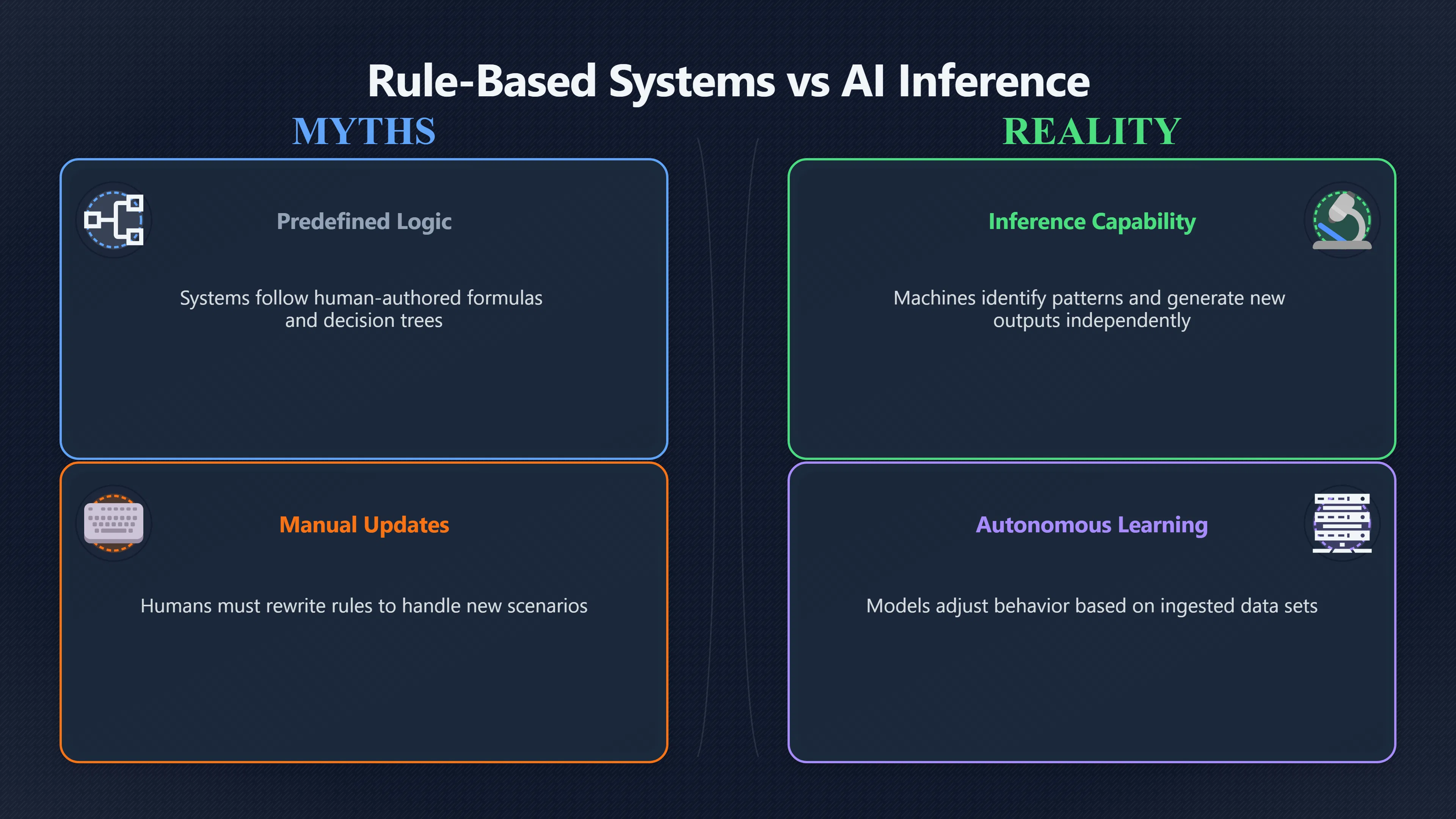
These systems can process large volumes of information and reduce human workload. However, scale and automation alone do not make a system AI. A workflow can handle millions of records while still operating entirely through rules established by programmers, analysts or business managers.
This distinction has become important enough that AI governance frameworks now emphasise it directly. The OECD definition of AI centres on a system’s ability to infer how to generate outputs from inputs, while the EU AI Act highlights inference as a key characteristic separating AI from simpler traditional software.[OECD.AI+2OECD Legal Instruments]oecd.aiWhat is AI?Can you make a clear distinction between AI…6 Mar 2024 — An AI system is a machine-based system that can, for a given set of human-def…
How predefined logic determines the result
The clearest sign that a system is rule-based is that every outcome can be traced back to explicit instructions created by humans.
Consider a simple invoice workflow:
- If the supplier is on an approved list, continue processing.
- If the invoice exceeds £10,000, require manager approval.
- If the invoice exceeds £50,000, require director approval.
- If mandatory fields are missing, reject the submission.
The software may appear intelligent because it consistently reaches the correct department. Yet the outcome is fully determined by rules written beforehand. The system is not discovering new categories, estimating probabilities or learning from previous invoices. It is executing instructions.
The same principle applies to payroll calculations. A payroll application may incorporate hundreds of tax and employment rules, making it extremely complex. Nevertheless, complexity does not automatically create AI. If the software reaches its result by following human-authored formulas and decision trees, it remains conventional software.
A useful test is to ask: Could a developer explain the decision by pointing to a specific rule? If the answer is yes in virtually every case, the system is likely operating through predefined logic rather than inference.
Why the AI label is attractive
Businesses have strong incentives to describe automation as AI.
The term suggests innovation, competitiveness and technological sophistication. During periods of intense interest in AI, attaching the label to existing products can make them seem more valuable to investors, customers and executives.
In some cases the marketing language is not entirely misleading. A product may contain both rule-based components and genuine AI elements. For example, a document-processing system might use machine learning to identify invoice fields but then rely on traditional business rules to route the document through an approval chain.
The problem arises when the distinction disappears and ordinary automation is presented as though it possesses capabilities it does not actually have. This can create unrealistic expectations about flexibility, adaptability and decision-making.
A rule-based workflow cannot usually handle situations outside its programmed logic without modification by humans. By contrast, an inference-based AI system attempts to generate outputs for situations it has not encountered in exactly the same form before. Modern regulatory definitions increasingly use this difference as a central boundary.[ai-act-service-desk.ec.europa.eu+2OECD.AI]ai-act-service-desk.ec.europa.euFrequently Asked Questions | AI Act Service DeskThe AI Act defines an AI system as a 'machine-based system that is designed to operate wi…
Practical questions for spotting ordinary automation
When evaluating a system that is advertised as AI, a few practical questions can reveal whether it is primarily rule-based automation.
Where do the decision rules come from?
If the behaviour comes from conditions, thresholds and workflows written by people, the system is likely conventional software.
Examples:
- “Reject claims over a certain amount.”
- “Escalate complaints containing specific words.”
- “Apply a discount when the customer belongs to a particular category.”
These are business rules, not learned behaviour.
Does the system learn patterns from data?
Inference-based systems typically rely on models built from data. They identify relationships and generate predictions or classifications that were not individually programmed.
If a vendor cannot explain how data contributes to model behaviour and instead describes a collection of fixed conditions, the product may be ordinary automation.
What happens when circumstances change?
Rule-based systems generally require humans to update the rules.
For example, a new tax regulation requires a payroll rule change. A new approval policy requires a workflow change. The software does not discover the new policy on its own.
Can the reasoning be reduced to an explicit flowchart?
Many business-rule systems can be represented as decision trees, checklists or flowcharts. While AI systems can also be represented in simplified forms, their outputs are often generated through statistical models rather than exhaustive lists of predefined conditions.
Why the distinction matters
Calling every automated system AI can blur important differences in capability and risk.
For buyers, it can lead to inflated expectations. A rule-based tool may be reliable and predictable, but it will not necessarily adapt to new situations without manual updates.
For regulators, the distinction affects which systems fall within AI-specific frameworks. The EU AI Act’s definition and accompanying guidance repeatedly emphasise that systems based solely on human-defined rules for automatically executing operations should be distinguished from AI systems, with inference serving as the key differentiating characteristic.[ai-act-service-desk.ec.europa.eu+2Digital Strategy]ai-act-service-desk.ec.europa.euA I Act Service Deskrules defined solely by natural persons to automatically execute operations. A key characteristic of AI systems is their capability to in…
For organisations, understanding the difference helps in selecting the right technology. Sometimes a straightforward rule engine is preferable because it is easier to audit, explain and control. Not every business problem requires machine learning or generative AI.
The most useful question is not whether a system feels intelligent, but how it reaches its results. If the outcome is determined by predefined business rules created by people, the software may be highly effective automation without actually being artificial intelligence.
Amazon book picks
Further Reading
Books and field guides related to When automation is not really AI. Use these as the next step if you want deeper reading beyond the article.
Artificial Intelligence
Helps readers distinguish genuine AI from conventional automation.
eBay marketplace picks
Marketplace Samples
Example marketplace items related to this page. Use the search link to explore similar finds on eBay.


Endnotes
1.
Source: ai-act-service-desk.ec.europa.eu
Title: A I Act Service Desk
Link:https://ai-act-service-desk.ec.europa.eu/en/ai-act/recital-12
Source snippet
rules defined solely by natural persons to automatically execute operations. A key characteristic of AI systems is their capability to in...
2.
Source: oecd.ai
Title: What is AI?
Link:https://oecd.ai/en/wonk/definition
Source snippet
Can you make a clear distinction between AI...6 Mar 2024 — An AI system is a machine-based system that can, for a given set of human-def...
3.
Source: legalinstruments.oecd.org
Link:https://legalinstruments.oecd.org/en/instruments/oecd-legal-0449
Source snippet
OECD Legal InstrumentsRecommendation of the Council on Artificial Intelligence‒AI system: An AI system is a machine-based system that, fo...
4.
Source: ai-act-service-desk.ec.europa.eu
Link:https://ai-act-service-desk.ec.europa.eu/en/faq
Source snippet
Frequently Asked Questions | AI Act Service DeskThe AI Act defines an AI system as a 'machine-based system that is designed to operate wi...
5.
Source: digital-strategy.ec.europa.eu
Link:https://digital-strategy.ec.europa.eu/en/library/commission-publishes-guidelines-ai-system-definition-facilitate-first-ai-acts-rules-application
Source snippet
Digital StrategyThe Commission publishes guidelines on AI system definition...6 Feb 2025 — The guidelines on the AI system definition ex...
6.
Source: oecd.org
Link:https://www.oecd.org/content/dam/oecd/en/publications/reports/2024/03/explanatory-memorandum-on-the-updated-oecd-definition-of-an-ai-system_3c815e51/623da898-en.pdf
Source snippet
man- defined objectives, make predictions, recommendations, or decisions...Read more...
7.
Source: oecd.org
Link:https://www.oecd.org/en/publications/explanatory-memorandum-on-the-updated-oecd-definition-of-an-ai-system_623da898-en.html
Source snippet
contained in the 2019 OECD Recommendation on AI (the “AI Principles”) to...Read more...
8.
Source: legalinstruments.oecd.org
Link:https://legalinstruments.oecd.org/public/doc/648/1df51f15-53fc-43ef-9f13-ee9f957076bc.htm
Source snippet
oecd.orgUntitled‒ AI system: An AI system is a machine-based system that can, for a given set of human-defined objectives, make predictio...
9.
Source: oecd.org
Link:https://www.oecd.org/en/topics/sub-issues/ai-principles.html
Source snippet
AI principlesGenerative AI (GenAI) is a category of AI that can create new content such as text, images, videos, and music. It gained glo...
10.
Source: oecd.org
Link:https://www.oecd.org/en/publications/2019/06/artificial-intelligence-in-society_c0054fa1.html
Source snippet
Artificial Intelligence in SocietyAI systems predict, recommend or decide an outcome to influence the environment... machine-based syste...
11.
Source: digital-strategy.ec.europa.eu
Link:https://digital-strategy.ec.europa.eu/en/library/commission-publishes-guidelines-prohibited-artificial-intelligence-ai-practices-defined-ai-act
Source snippet
publishes the Guidelines on prohibited artificial...4 Feb 2025 — These guidelines provide an overview of AI practices that are deemed un...
12.
Source: digital-strategy.ec.europa.eu
Title: eu A I Act | Shaping Europe’s digital future
Link:https://digital-strategy.ec.europa.eu/en/policies/regulatory-framework-ai
Source snippet
Act | Shaping Europe's digital future - European UnionThe AI Act (Regulation (EU) 2024/1689 laying down harmonised rules on artificial in...
13.
Source: digital-strategy.ec.europa.eu
Title: general purpose ai models ai act questions answers
Link:https://digital-strategy.ec.europa.eu/en/faqs/general-purpose-ai-models-ai-act-questions-answers
Source snippet
europa.euGeneral-Purpose AI Models in the AI Act – Questions & Answers10 Jul 2025 — The AI Act defines a general-purpose AI model as “an...
14.
Source: digital-strategy.ec.europa.eu
Title: navigating ai act
Link:https://digital-strategy.ec.europa.eu/en/faqs/navigating-ai-act
Source snippet
the AI Act | Shaping Europe's digital future28 Jan 2026 — These questions and answers detail the AI Act's goals, governance, enforcement...
15.
Source: oecd.ai
Link:https://oecd.ai/en/ai-principles
Source snippet
Principles overviewAI terms & concepts... An AI system is a machine-based system that, for explicit or implicit objectives, infers, from...
16.
Source: intelligence.dlapiper.com
Title: artificial intelligence
Link:https://intelligence.dlapiper.com/artificial-intelligence/?c=EU&t=04-definitions
Source snippet
in the European Union - AI Laws of the World11 Feb 2026 — There are several key features of the definition which, acting together, distin...
17.
Source: artificial-intelligence-act.com
Title: E U AI Act
Link:https://www.artificial-intelligence-act.com/
Source snippet
EU AI Act - Updates, Compliance, TrainingThe EU AI Act sets harmonised rules for the development, placement on the market and use of AI s...
18.
Source: linkedin.com
Link:https://www.linkedin.com/posts/oecd-ai_what-is-ai-can-you-make-a-clear-distinction-activity-7171120251819032576-UQ-h
Source snippet
OECD.AI's PostThe OECD just released an explanatory memorandum on its updated definition of an AI system. In this blog post, Marko Grobel...
Additional References
19.
Source: artificialintelligenceact.eu
Link:https://artificialintelligenceact.eu/
Source snippet
EU AI ActThe AI Act is a European regulation on artificial intelligence (AI) – the first comprehensive regulation on AI by a major regula...
20.
Source: cedpo.eu
Link:https://cedpo.eu/wp-content/uploads/CEDPO-MicroInsightPaper-How-to-define-an-AI-System-under-the-AI-Act-EN.pdf
Source snippet
How to Define an AI System under the AI ActThis capability to infer distinguishes AI systems from traditional software, which rely on pre...
21.
Source: linkedin.com
Link:https://www.linkedin.com/posts/guilhermediazberrio_so-according-to-a-new-oecd-explanatory-memorandum-activity-7173260503501254657-Y2JE
Source snippet
Guilherme Diaz-Bérrio's Post12 Mar 2024 — The updated definition of an AI system is intended to capture machine-based systems that can in...
22.
Source: skdevitt.medium.com
Link:https://skdevitt.medium.com/how-does-the-updated-oecd-ai-definition-differentiate-ai-systems-from-merely-algorithmic-software-3b18d453f10f
Source snippet
does the updated OECD AI definition differentiate AI...How does the updated OECD AI definition differentiate AI systems from merely algo...
23.
Source: linkedin.com
Link:https://www.linkedin.com/posts/pontuswarnestal_the-original-oecd-definition-of-an-ai-system-activity-7130294166491701248-IWCf
Source snippet
The original OECD definition of an AI system14 Nov 2023 — The original OECD definition of an AI system: "An AI system is a machine-based...
24.
Source: cnil.fr
Title: entry force european ai regulation first questions and answers cnil
Link:https://www.cnil.fr/en/entry-force-european-ai-regulation-first-questions-and-answers-cnil
Source snippet
Entry into force of the European AI Regulation12 Jul 2024 — Unacceptable risk: the AI Act prohibits a limited set of practices that are d...
25.
Source: cms.law
Title: eu commission issues guidelines on the definition of ai systems
Link:https://cms.law/en/hun/legal-updates/eu-commission-issues-guidelines-on-the-definition-of-ai-systems
Source snippet
EU Commission issues guidelines on the definition of AI...7 Feb 2025 — AI system definition does not cover systems that are based on the...
26.
Source: cms.law
Title: eu commission issues guidelines on the definition of ai systems
Link:https://cms.law/en/pol/legal-updates/eu-commission-issues-guidelines-on-the-definition-of-ai-systems
Source snippet
EU Commission issues guidelines on the definition of AI...7 Feb 2025 — AI system definition does not cover systems that are based on the...
27.
Source: arxiv.org
Link:https://arxiv.org/html/2603.10023
Source snippet
Defining AI Models and AI Systems: A Framework to...The effective regulation of AI requires clear definitions for the terms contained wi...
28.
Source: holisticai.com
Link:https://www.holisticai.com/blog/ai-definition-comparison
Source snippet
explicit or implicit objectives, infers, from the input it receives, how to...Read more...
Topic Tree