Within Machine Learning
Why spam filters do not need perfect rules
Spam filtering shows why machine learning works best when examples reveal patterns that fixed rules cannot keep up with.
On this page
- Where fixed keyword rules break down
- How labelled examples teach a spam model
- Why updating the data changes the filter
Page outline Jump by section
Introduction
Spam filtering is one of the clearest examples of why many artificial intelligence systems learn from data instead of relying on fixed rules. At first glance, spam seems easy to define: block messages containing suspicious words and allow everything else through. In practice, however, spam changes constantly. Senders alter wording, formatting, links, and sender details specifically to evade detection. Because the category is fluid rather than fixed, a filter built entirely from hand-written rules quickly becomes outdated. Machine-learning systems perform better because they learn patterns from large numbers of examples and can adapt as those patterns change. Research on email filtering consistently shows that learning from labelled examples allows models to identify combinations of signals that are difficult to express as simple rules.[PMC+2arXiv]pmc.ncbi.nlm.nih.govPMCMachine learning for email spam filteringNIHby EG Dada · 2019 · Cited by 770 — The machine learning model used by Google have now advanced to the point that it can detect a…
Where fixed keyword rules break down
Early spam filters often depended on straightforward rules. A message might be blocked if it contained words such as “winner”, “free”, or “urgent”. While simple, this approach created two problems.
First, legitimate emails sometimes contain the same words. A genuine airline promotion, charity appeal, or work message may use language that resembles spam. Strict keyword rules therefore create false positives, where valid messages are incorrectly filtered.
Second, spammers actively adapt. If a rule blocks “free money”, a sender can switch to “complimentary funds”, insert unusual punctuation, misspell words deliberately, or rely on images rather than text. This creates a continual cat-and-mouse game in which every new rule encourages a new workaround. Reviews of spam-filtering systems describe this evolving behaviour as one of the main reasons machine-learning approaches became dominant.[arXiv]arxiv.orgarXiv Machine Learning for E-mail Spam Filtering: Review,Techniques and TrendsMachine Learning for E-mail Spam Filtering: Review,Techniques and TrendsJune 3, 2016…
A useful real-world illustration is the long-running open-source filter Apache SpamAssassin. Although it contains hundreds of rules and tests, it also incorporates Bayesian learning because rules alone are not sufficient. The system combines multiple signals and learns from examples of both spam and legitimate mail to improve accuracy over time.[Wikipedia+2MailerCheck]WikipediaApache Spam AssassinApache Spam Assassin
How labelled examples teach a spam model
Machine-learning spam filters are usually trained on messages that have already been labelled as either spam or legitimate. Instead of asking developers to write every possible rule, the system examines examples and learns which patterns tend to appear in each category.
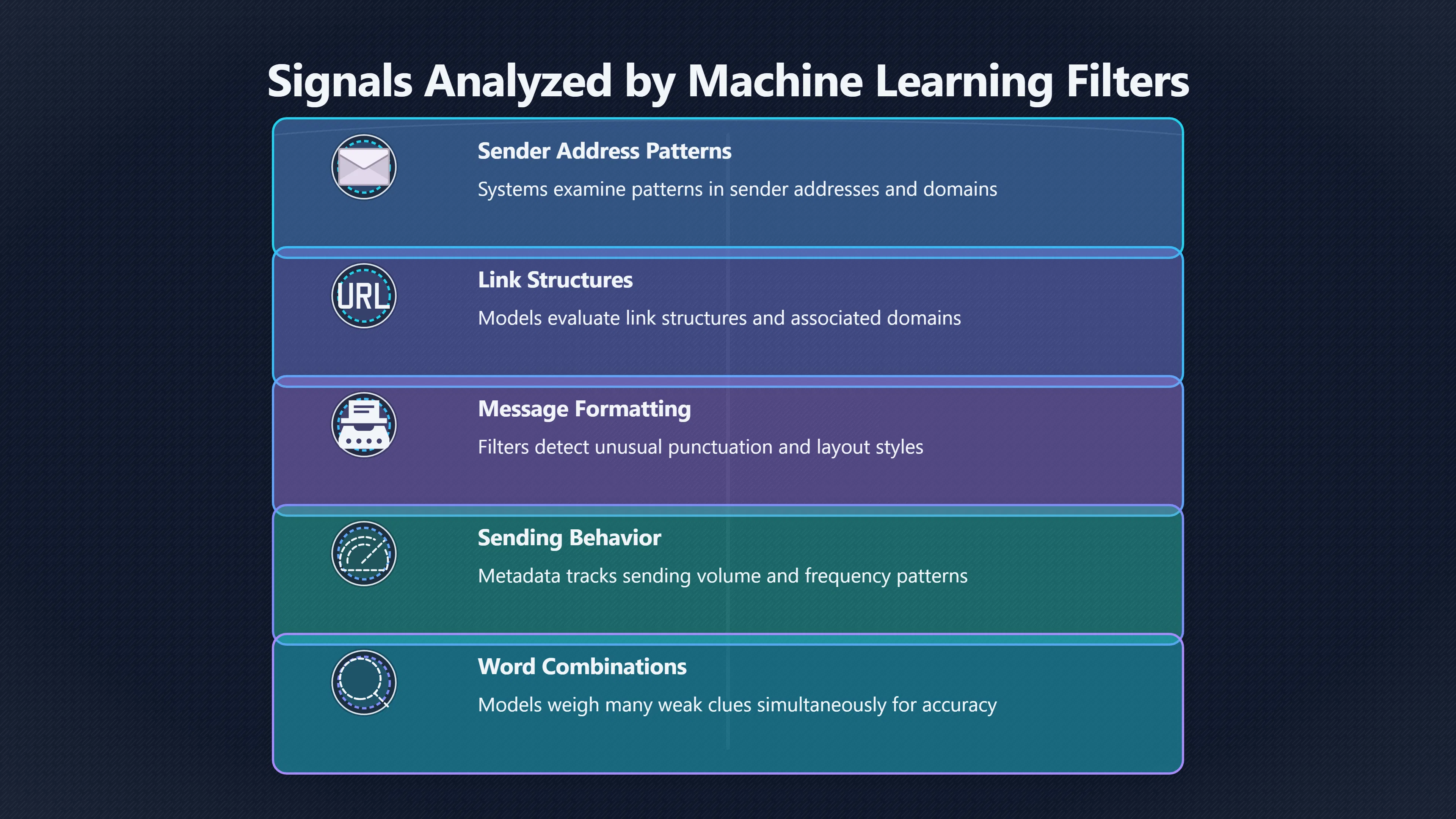
The important point is that the model does not search for one perfect indicator. It learns many weak clues and combines them. These clues may include:
- Words and phrases that frequently appear in spam.
- Patterns in sender addresses.
- Link structures and domains.
- Message formatting.
- Metadata such as sending behaviour or volume.
- Relationships between several features that might seem harmless on their own.
A Bayesian spam filter provides a simple example. During training, it counts how often particular words appear in spam compared with legitimate email. When a new message arrives, it estimates how likely the message is to belong to each category based on the combination of words it contains. The filter is not following a single rule such as “block emails containing X”. Instead, it is weighing many pieces of evidence simultaneously. Research comparing Bayesian approaches with traditional methods found that automatically learned classifiers can outperform manually designed filtering strategies because they adapt to the actual data being observed.[arXiv]arxiv.orgLearning to Filter Spam E-Mail: A Comparison of a Naive…by I Androutsopoulos · 2000 · Cited by 642 — The Naive Bayesian classifie…
Modern systems go further. Large email providers use machine-learning models that analyse many signals at once and continuously refine their predictions. Google has reported that machine learning plays a central role in combating email abuse, while later research noted that Gmail’s filtering systems achieve extremely high detection rates by learning from enormous volumes of labelled examples and user feedback.[Google Research]research.google.comResearch The War Against Spam: A report from the front lineGoogle ResearchThe War Against Spam: A report from the front lineOctober 19, 2007 — by B Taylor · Cited by 16 — This paper is an overview…
Why updating the data changes the filter
One of the most important differences between rules and machine learning is how improvement happens.
With a rule-based system, improvement usually means a human must identify a new spam tactic, write a new rule, test it, and deploy it. The knowledge remains explicitly programmed.
With a machine-learning system, improvement often comes from updating the training data. When users mark messages as spam or rescue legitimate messages from the spam folder, they generate new labelled examples. These examples reveal emerging patterns that the model can learn. As the underlying data changes, the learned pattern changes too.[Mailbird]getmailbird.comMailbird How Machine Learning Spam Filters Analyze Your EmailMailbirdHow Machine Learning Spam Filters Analyze Your Email…January 5, 2026 — 5 Jan 2026 — Research on machine learning in spam filte…
This ability matters because spam is not a stable target. New scams appear, old tactics disappear, and attackers constantly experiment with different approaches. A filter trained on fresh examples can adjust to these shifts more effectively than a fixed collection of keywords.
The same principle appears throughout artificial intelligence. Many real-world categories are not defined by clear boundaries. Whether an email is spam depends on context, intent, behaviour, and evolving tactics. Learning from examples allows the system to track those moving boundaries instead of forcing developers to predict every future variation in advance.[arXiv+2MDPI]arxiv.orgarXiv Machine Learning for E-mail Spam Filtering: Review,Techniques and TrendsMachine Learning for E-mail Spam Filtering: Review,Techniques and TrendsJune 3, 2016…
Why “good enough” patterns beat perfect rules
A common misunderstanding is that a spam filter needs to discover a perfect definition of spam. In reality, machine learning succeeds because it does not require one.
The model only needs to identify patterns that are useful enough to reduce mistakes on new messages. It can combine hundreds or thousands of small signals that would be impractical to encode manually. Even when individual signals are unreliable, their combined statistical pattern can be highly effective.
This is why spam filtering is often used to explain machine learning. The task is too messy, dynamic, and adversarial for a complete hand-written rulebook. By learning from labelled examples, the system can recognise changing patterns, adapt to new tactics, and continue improving as more data becomes available. The lesson extends far beyond email: many successful AI applications work not because they possess perfect rules, but because they learn useful patterns from experience.[PMC+2Google Research]pmc.ncbi.nlm.nih.govPMCMachine learning for email spam filteringNIHby EG Dada · 2019 · Cited by 770 — The machine learning model used by Google have now advanced to the point that it can detect a…
Amazon book picks
Further Reading
Books and field guides related to Why spam filters do not need perfect rules. Use these as the next step if you want deeper reading beyond the article.
Data Science for Business
Uses classification and decision-making examples relevant to spam filtering.
Hands-on Machine Learning with Scikit-Learn, Keras, and Tenso...
Shows how models learn from labelled examples rather than fixed rules.
The Hundred-page Machine Learning Book
Explains classification systems like spam filters.
Machine Learning for Absolute Beginners
Spam filtering is a classic example used to explain machine learning.
eBay marketplace picks
Marketplace Samples
Example marketplace items related to this page. Use the search link to explore similar finds on eBay.



Endnotes
1.
Source: pmc.ncbi.nlm.nih.gov
Title: PMCMachine learning for email spam filtering
Link:https://pmc.ncbi.nlm.nih.gov/articles/PMC6562150/
Source snippet
NIHby EG Dada · 2019 · Cited by 770 — The machine learning model used by Google have now advanced to the point that it can detect a...
2.
Source: arxiv.org
Link:https://arxiv.org/abs/cs/0009009
Source snippet
Learning to Filter Spam E-Mail: A Comparison of a Naive...by I Androutsopoulos · 2000 · Cited by 642 — The Naive Bayesian classifie...
3.
Source: mdpi.com
Link:https://www.mdpi.com/2079-8954/14/3/229
Source snippet
Machine Learning Based Spam Detection in Digital...by M Bani Younes · 2026 — Shallow ML models can learn patterns from labeled datasets...
4.
Source: arxiv.org
Title: arXiv Machine Learning for E-mail Spam Filtering: Review,Techniques and Trends
Link:https://arxiv.org/abs/1606.01042
Source snippet
Machine Learning for E-mail Spam Filtering: Review,Techniques and TrendsJune 3, 2016...
Published: June 3, 2016
5.
Source: Wikipedia
Title: Apache Spam Assassin
Link:https://en.wikipedia.org/wiki/Apache_SpamAssassin
6.
Source: mailercheck.com
Link:https://www.mailercheck.com/articles/spamassassin-score
Source snippet
SpamAssassin Score Explained: An Easy-To-Digest GuideJul 17, 2023 — SpamAssassin works by analyzing an email and giving it a s...
7.
Source: research.google.com
Title: Research The War Against Spam: A report from the front line
Link:https://research.google.com/pubs/archive/36954.pdf
Source snippet
Google ResearchThe War Against Spam: A report from the front lineOctober 19, 2007 — by B Taylor · Cited by 16 — This paper is an overview...
Published: October 19, 2007
8.
Source: mdpi.com
Link:https://www.mdpi.com/2079-9292/13/2/374
Source snippet
These filtering methods are...Read more...
9.
Source: getmailbird.com
Title: Mailbird How Machine Learning Spam Filters Analyze Your Email
Link:https://www.getmailbird.com/how-machine-learning-spam-filters-analyze-email/
Source snippet
MailbirdHow Machine Learning Spam Filters Analyze Your Email...January 5, 2026 — 5 Jan 2026 — Research on machine learning in spam filte...
Published: January 5, 2026
Additional References
10.
Source: dl.acm.org
Link:https://dl.acm.org/doi/10.1145/345508.345569
Source snippet
experimental comparison of naive Bayesian and...A Naive Bayesian classifier is trained automatically to detect spam messages. We test th...
11.
Source: enjoyalgorithms.com
Link:https://www.enjoyalgorithms.com/blog/email-spam-and-non-spam-filtering-using-machine-learning/
Source snippet
Email Spam and Non-spam Filtering using Machine LearningThis article will give an idea for implementing content-based filtering using one...
12.
Source: spamtitan.com
Link:https://www.spamtitan.com/microsoft-365-spam-filter/
Source snippet
How to Improve Office 365 Spam FilterMicrosoft 365 email spam filtering works by comparing inbound mail against IP [block lists]({{ 'block-lists/' | relative_url }}) of known s...
13.
Source: hostgator.com
Link:https://www.hostgator.com/help/article/how-to-use-spam-assassin
Source snippet
How to Use SpamAssassinSpamAssassin is an anti-spam tool that helps filter unwanted messages and works for all of the email accounts in y...
14.
Source: medium.com
Link:https://medium.com/%40preet.bhundia19/machine-learning-techniques-in-spam-filtering-6060bfb403b1
Source snippet
Machine Learning Techniques in Spam FilteringMachine Learning Techniques in Spam Filtering At least 20% of the more than 500 million twee...
15.
Source: jam-software.com
Link:https://www.jam-software.com/spamassassin
Source snippet
SpamAssassin for Windows Your Freeware for Spam-ScoringSpamAssassin for Windows is a powerful email filter which attempts to identify spa...
16.
Source: researchgate.net
Link:https://www.researchgate.net/publication/369462107_Email_Spam_Filtering_Methods_Comparison_and_Analysis
17.
Source: cgi.di.uoa.gr
Link:https://cgi.di.uoa.gr/~takis/pkdd00.pdf
Source snippet
to Filter Spam E-Mail: A Comparison of a Naive...by I Androutsopoulos · Cited by 642 — We address the issue of anti-spam filtering with...
18.
Source: cpanel.net
Title: spam filtering on cpanel everything you need to know about spamassassin
Link:https://www.cpanel.net/blog/tips-and-tricks/spam-filtering-on-cpanel-everything-you-need-to-know-about-spamassassin/
Source snippet
Spam Filtering: What You Need To Know About...Jul 23, 2020 — Learn how to configure SpamAssassin in cPanel for effective spam filtering...
19.
Source: reddit.com
Link:https://www.reddit.com/r/GMail/comments/1iyzxx7/whats_the_correct_way_to_teach_gmail_that_this/
Source snippet
Currently (in android K9/Thunderbird) I select email and mark it as spam, but I seem to receive it again (Gmail doesn't learn?) Of course...
Topic Tree