Within Pilot ROI
The hidden costs after the AI demo
The expensive work often starts after the demo, when AI must connect to legacy systems, security controls and real operational data.
On this page
- Why pilots avoid the hardest system connections
- How legacy software and fragmented databases raise costs
- How to estimate integration work before scaling
Page outline Jump by section
Introduction
Many AI pilots appear inexpensive because they are designed to prove that a model works, not that it can operate inside a real business. The expensive phase often begins after the demonstration, when the system must connect to customer databases, enterprise software, identity-management tools, security controls, compliance processes and operational workflows. At that point, organisations discover that the AI model itself may be only a small part of the total effort.
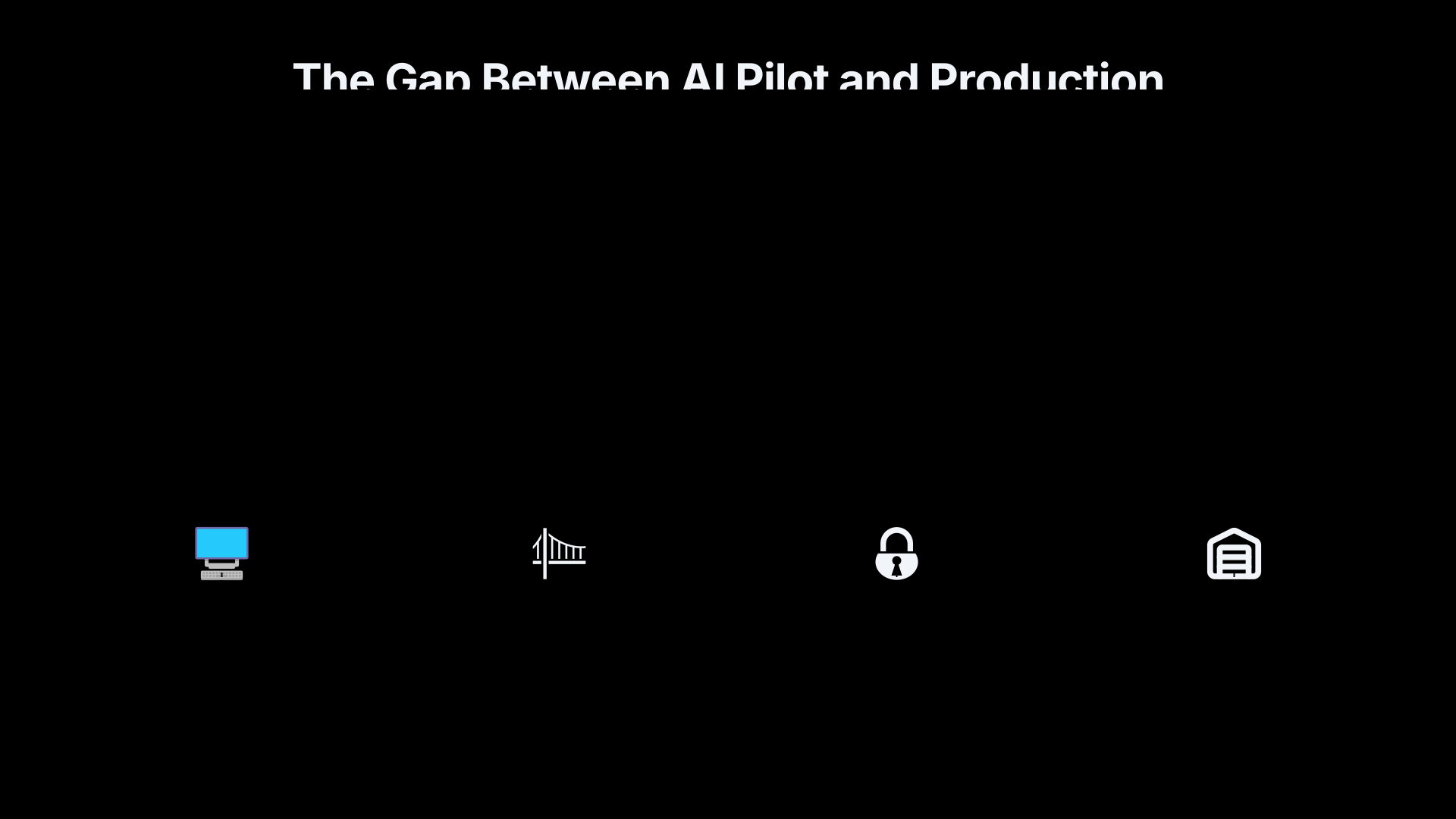 This gap helps explain why so many AI initiatives struggle to produce measurable business returns. Research highlighted by MIT-affiliated analysis of hundreds of enterprise deployments found that most generative AI projects fail to create clear profit-and-loss impact, with integration into existing workflows repeatedly identified as a major obstacle rather than model performance itself.[Tom's Hardware]tomshardware.comThe study, based on 150 interviews, a survey of 350 employees, and 300 public AI deployments, showed that only 5% of AI pilot programs le…
The hidden costs after the AI demo
A pilot often operates in a controlled environment. Documents may be manually uploaded. Outputs may be reviewed by specialists before use. Data may be cleaned in advance. Security exceptions may be temporarily tolerated.
Production environments are different. Once an organisation wants AI to support customer service, procurement, finance, operations or healthcare workflows, the system must interact reliably with existing technology. That requires work that is rarely visible during demonstrations:
- Connecting to multiple business applications.
- Managing permissions and user identities.
- Cleaning and synchronising data.
- Creating audit trails.
- Building monitoring and support processes.
- Meeting security and regulatory requirements.
- Handling failures and exceptions.
As a result, the cost structure shifts from model experimentation to enterprise engineering. Several analyses of enterprise AI deployments argue that workflow integration, governance, data engineering and operational infrastructure consume a large share of the effort required to move from pilot to production.[LinkedIn]linkedin.comWhy 95% of AI Deployments Fail to Deliver ROIMay 14, 2026 — MIT studied 300 enterprise AI deployments. 95% returned zero ROI. Mos…
A common mistake is to compare AI licence fees with expected labour savings while ignoring the integration programme required to make those savings real. When those implementation costs are included, projected returns often fall dramatically.[Opagio]opag.ioio AI Integration Costs: The Hidden Expenses of AI AdoptionAn AI system that shows 200% ROI based on licensing costs alone may show 40% ROI when total…Read more…
Why pilots avoid the hardest system connections
Clean demos rarely reflect production reality
AI vendors naturally demonstrate systems under favourable conditions. The model may interact with a small, curated dataset and a limited number of applications. In contrast, a production deployment may need access to dozens of systems accumulated over many years.
For example, a customer-support assistant might need information from:
- A CRM platform.
- Billing software.
- Order-management systems.
- Product documentation repositories.
- Internal policy databases.
- Identity and access management tools.
Each connection introduces technical work, testing requirements and security reviews. The AI may generate useful answers in isolation, but it cannot automate work effectively until it can retrieve and update information across those systems.
Security requirements expand project scope
A pilot may operate with broad access permissions granted to a small test group. Enterprise deployment usually requires much stricter controls.
Organisations must determine:
- Which employees can access which information.
- How sensitive data is protected.
- Whether AI outputs can be audited.
- How regulatory obligations are met.
- How external AI services interact with internal data.
Recent enterprise guidance on production AI repeatedly highlights governance, access control and security architecture as major barriers to scaling beyond experimentation.[IT Pro+2TechRadar]itpro.comAbout 75% of enterprise leaders report adopting the technology, but true implementation has been rare, with many mistaking AI agents for…
These controls are necessary, but they add implementation time, specialist staffing requirements and ongoing operational costs.
How legacy software and fragmented databases raise costs
Old systems were not designed for AI
Many large organisations operate technology estates built over decades. Critical business processes may depend on applications that predate modern cloud architectures and lack straightforward interfaces.
When AI systems need information from these platforms, teams often must create custom connectors, middleware layers or data-transformation processes. Some enterprise practitioners argue that integration with legacy systems can cost several times more than deployments built on modern platforms because every connection requires bespoke engineering work.[Dan Cumberland Labs]dancumberlandlabs.comDan Cumberland LabsHidden Costs of AI Projects: 7 Things Nobody Tells YouMay 8, 2026 — Integrating AI with legacy systems costs 2-3x more…
The challenge is not that legacy systems are unusable. The challenge is that they were designed for human users and traditional software workflows rather than AI-driven automation.
Fragmented data creates invisible engineering work
AI systems depend on access to reliable information. Unfortunately, enterprise data is frequently distributed across departments, applications and formats.
Customer information may exist in one system, transaction history in another and operational records in a third. Names, identifiers and definitions may not match across databases.
IBM identifies common integration obstacles including poor data quality, incompatible formats, inconsistent structures and hybrid environments that combine cloud and on-premises systems. These issues directly affect AI deployments because inaccurate or fragmented data reduces the quality of outputs and increases engineering complexity.[IBM]ibm.comdata integration challengesTop Data Integration Challenges and Solutions19 Dec 2025 — Data integration challenges such as poor data quality, incompatible formats…
As a result, organisations often spend substantial resources on data preparation before AI can deliver meaningful operational value.

Infrastructure costs emerge late
Another hidden expense appears when usage grows.
A pilot serving a small group may run comfortably with limited infrastructure. A production deployment serving thousands of employees or customers requires:
- Higher reliability.
- Monitoring systems.
- Backup processes.
- Network capacity.
- Scalable data pipelines.[levelact.com]levelact.comenterprise ai projects infrastructure bottlenecksWhy Enterprise AI Projects Fail in 2026May 7, 2026 — 7 May 2026 — Enterprise AI projects are failing due to infrastructure bottle…
- Incident response procedures.
Many organisations discover that AI is not merely a software project but also an infrastructure project involving operational complexity that was not visible during the proof-of-concept phase.[LevelAct]levelact.comenterprise ai projects infrastructure bottlenecksWhy Enterprise AI Projects Fail in 2026May 7, 2026 — 7 May 2026 — Enterprise AI projects are failing due to infrastructure bottle…
Why integration problems destroy ROI
The economic problem is not simply higher costs. Integration delays also postpone benefits.
A company might expect productivity gains within months. Instead, teams spend a year connecting systems, addressing security concerns and cleaning data. During that period:
- Project costs accumulate.
- Business benefits remain unrealised.
- Executive confidence declines.
- Organisational priorities change.
This timing problem is particularly damaging because ROI calculations often assume rapid adoption. MIT-related research on enterprise AI deployments found a sharp divide between organisations achieving measurable outcomes and those trapped in prolonged implementation efforts that never materially affect financial performance.[Tom's Hardware]tomshardware.comThe study, based on 150 interviews, a survey of 350 employees, and 300 public AI deployments, showed that only 5% of AI pilot programs le…
The result is a familiar pattern: an impressive pilot, a difficult integration phase and a disappointing business outcome.

How to estimate integration work before scaling
Organisations can reduce surprises by treating integration as a primary planning activity rather than a technical detail.
Map every system dependency
Before approving expansion, teams should identify:
- Which applications the AI must read from.
- Which applications it must update.
- Which databases provide critical information.
- Which approval processes require human review.
This exercise often reveals that a seemingly simple deployment depends on far more systems than expected.
Measure data readiness, not just model quality
Pilot evaluations frequently focus on accuracy, response quality or user satisfaction. Equally important questions include:
- Is the required data available?
- Is it consistent across systems?
- Can it be accessed securely?
- Who owns it?
Poor data readiness is often a stronger predictor of deployment difficulty than model capability.[IBM]ibm.comdata integration challengesTop Data Integration Challenges and Solutions19 Dec 2025 — Data integration challenges such as poor data quality, incompatible formats…
Budget for operational ownership
Successful AI deployments require ongoing support. Organisations should estimate:
- Security reviews.
- Compliance monitoring.
- Data pipeline maintenance.
- User support.
- Performance monitoring.
- Model updates.
These recurring costs can exceed initial pilot expenses and should be included in business cases from the beginning.[IT Pro+2TechRadar]itpro.comAbout 75% of enterprise leaders report adopting the technology, but true implementation has been rare, with many mistaking AI agents for…
The lesson from failed deployments
The most expensive part of enterprise AI is often not the model. It is the work required to connect that model to the messy reality of business operations.
When organisations underestimate legacy-system integration, fragmented data, security requirements and production support needs, promising pilots can become costly programmes that never achieve meaningful returns. Conversely, companies that treat integration as a core part of the investment—rather than an afterthought—are more likely to move from demonstration to measurable business value. Research from MIT CISR and other enterprise studies suggests that the greatest financial gains emerge not during experimentation, but when organisations successfully build scalable ways of working around AI and embed it into operational systems.[cisr.mit.edu]cisr.mit.edu2025 0801 EnterpriseAIMaturityUpdate WoernerSebastianWeillKaganerGrow Enterprise AI Maturity for Bottom-Line Impact21 Aug 2025 — A new MIT CISR survey has found that enterprises today are making signifi…
Amazon book picks
Further Reading
Books and field guides related to The hidden costs after the AI demo. Use these as the next step if you want deeper reading beyond the article.
AI Engineering
Discusses production deployment challenges and infrastructure realities.
Competing in the Age of AI
Explains why integration and operating-model change drive value.
Digital Transformation
Covers integrating AI with legacy systems and business processes.
eBay marketplace picks
Marketplace Samples
Example marketplace items related to this page. Use the search link to explore similar finds on eBay.




Endnotes
1.
Source: linkedin.com
Link:https://www.linkedin.com/posts/geoff-woods-8534774_mit-studied-300-enterprise-ai-deployments-activity-7460675534973464576-1gt2
Source snippet
Why 95% of AI Deployments Fail to Deliver ROIMay 14, 2026 — MIT studied 300 enterprise AI deployments. 95% returned zero ROI. Mos...
Published: May 14, 2026
2.
Source: techradar.com
Link:https://www.techradar.com/pro/governing-the-hidden-risks-of-generative-ai-in-the-enterprise
Source snippet
While organizations deploy large [language models]({{ 'language-models/' | relative_url }}) to increase productivity and innovation, many overlook critical concerns like security...
3.
Source: linkedin.com
Link:https://www.linkedin.com/posts/ilia-tzortzopoulou-8302b191_the-biggest-challenge-in-enterprise-ai-isnt-activity-7467522008461938689-48gI
Source snippet
Most businesses still rely on legacy systems with no APIs or integration...Read more...
4.
Source: ibm.com
Title: data integration challenges
Link:https://www.ibm.com/think/insights/data-integration-challenges
Source snippet
Top Data Integration Challenges and Solutions19 Dec 2025 — Data integration challenges such as poor data quality, incompatible formats...
5.
Source: levelact.com
Title: enterprise ai projects infrastructure bottlenecks
Link:https://levelact.com/enterprise-ai-projects-infrastructure-bottlenecks/
Source snippet
Why Enterprise AI Projects Fail in 2026May 7, 2026 — 7 May 2026 — Enterprise AI projects are failing due to infrastructure bottle...
Published: May 7, 2026
6.
Source: techradar.com
Link:https://www.techradar.com/pro/ai-is-reaching-finances-core-systems-heres-what-it-takes-to-run-it-there
Source snippet
This limited adoption stems from the challenges of embedding AI into legacy infrastructure that underpins trade capture, risk management...
7.
Source: cisr.mit.edu
Title: 2025 0801 EnterpriseAIMaturityUpdate WoernerSebastianWeillKaganer
Link:https://cisr.mit.edu/publication/2025_0801_EnterpriseAIMaturityUpdate_WoernerSebastianWeillKaganer
Source snippet
Grow Enterprise AI Maturity for Bottom-Line Impact21 Aug 2025 — A new MIT CISR survey has found that enterprises today are making signifi...
8.
Source: linkedin.com
Link:https://www.linkedin.com/posts/richardsocher_most-enterprise-ai-projects-fail-to-deliver-activity-7364669386428780544-77jl
Source snippet
Richard Socher's PostMost enterprise AI projects fail to deliver business value. New MIT research found 95% of GenAI initiatives show zer...
9.
Source: tomshardware.com
Link:https://www.tomshardware.com/tech-industry/artificial-intelligence/95-percent-of-generative-ai-implementations-in-enterprise-have-no-measurable-impact-on-p-and-l-says-mit-flawed-integration-key-reason-why-ai-projects-underperform
Source snippet
The study, based on 150 interviews, a survey of 350 employees, and 300 public AI deployments, showed that only 5% of AI pilot programs le...
10.
Source: opag.io
Title: io AI Integration Costs: The Hidden Expenses of AI Adoption
Link:https://opag.io/insights/ai-integration-costs-hidden-expenses
Source snippet
An AI system that shows 200% ROI based on licensing costs alone may show 40% ROI when total...Read more...
11.
Source: itpro.com
Link:https://www.itpro.com/technology/artificial-intelligence/most-enterprises-are-still-unprepared-to-operationalize-it-it-leaders-are-bullish-on-agents-but-keeping-falling-at-the-final-hurdle-heres-why
Source snippet
About 75% of enterprise leaders report adopting the technology, but true implementation has been rare, with many mistaking AI agents for...
12.
Source: dancumberlandlabs.com
Link:https://dancumberlandlabs.com/blog/hidden-costs-ai-projects/
Source snippet
Dan Cumberland LabsHidden Costs of AI Projects: 7 Things Nobody Tells YouMay 8, 2026 — Integrating AI with legacy systems costs 2-3x more...
Published: May 8, 2026
13.
Source: digitaleconomy.stanford.edu
Title: Enterprise AIPlaybook Pereira Graylin Brynjolfsson
Link:https://digitaleconomy.stanford.edu/app/uploads/2026/03/EnterpriseAIPlaybook_PereiraGraylinBrynjolfsson.pdf
Source snippet
A project originally quoted at 5,000 hours with a...Read more...
Additional References
14.
Source: intuitionlabs.ai
Link:https://intuitionlabs.ai/articles/enterprise-ai-rollout-failures
Source snippet
Enterprise AI Rollout Failures: Causes and Case Studies6 days ago — Examine the systemic causes of enterprise AI rollout failures. This r...
15.
Source: reddit.com
Link:https://www.reddit.com/r/ITManagers/comments/1o8cbwe/mit_study_finds_that_95_of_ai_initiatives_at/
Source snippet
MIT Study finds that 95% of AI initiatives at companies fail...Note: The research is based on 150 interviews with leaders, a survey of 3...
16.
Source: ultramainds.de
Link:https://ultramainds.de/blog/hidden-costs-of-ai-projects
Source snippet
The Hidden Costs of AI Projects: What Nobody Tells YouBased on our experience across dozens of enterprise AI projects, here's a more real...
17.
Source: virtualizationreview.com
Title: mit report finds most ai business investments fail reveals genai divide.aspx
Link:https://virtualizationreview.com/articles/2025/08/19/mit-report-finds-most-ai-business-investments-fail-reveals-genai-divide.aspx
Source snippet
MIT Report Finds Most AI Business Investments Fail...19 Aug 2025 — A new report from the MIT Media Lab's Project NANDA concludes that de...
18.
Source: youtube.com
Link:https://www.youtube.com/watch?v=R0G1fbWimlI
Source snippet
MIT Shows 95% of AI Projects Fail -- Artificial Intelligence...MIT Shows 95% of AI Projects Fail -- Artificial Intelligence Might Be Stu...
19.
Source: fortune.com
Title: mit report 95 percent generative ai pilots at companies failing cfo
Link:https://fortune.com/2025/08/18/mit-report-95-percent-generative-ai-pilots-at-companies-failing-cfo/
Source snippet
MIT report: 95% of generative AI pilots at companies are...18 Aug 2025 — Despite the rush to integrate powerful new models, about 5% of...
20.
Source: mindtheproduct.com
Title: why most ai products fail key findings from mits 2025 ai report
Link:https://www.mindtheproduct.com/why-most-ai-products-fail-key-findings-from-mits-2025-ai-report/
Source snippet
Why most AI products fail: Key findings from MIT's 2025 AI...22 Aug 2025 — MIT published a report on the current state of AI in business...
21.
Source: complexdiscovery.com
Link:https://complexdiscovery.com/why-95-of-corporate-ai-projects-fail-lessons-from-mits-2025-study/
Source snippet
minimal adaptation, resulting in 95% of projects failing to demonstrate profit-and-...Read more...
22.
Source: medium.com
Link:https://medium.com/%40Fransantolo/95-of-corporate-generative-ai-projects-fail-mit-study-finds-47ad5d50db32
Source snippet
do not produce measurable benefits. The main cause is not...Read more...
23.
Source: reddit.com
Link:https://www.reddit.com/r/cscareerquestions/comments/1muu5uv/mit_study_finds_that_95_of_ai_initiatives_at/
Source snippet
"MIT Study finds that 95% of AI initiatives at companies fail...[https://fortune.com/2025/08/18/mit-report-95-percent-generative-ai-pilots..."](https://fortune.com/2025/08/18/mit-report-95-percent-generative-ai-pilots...")...
Topic Tree