Within Human Checks
Can AI Overrides Be Traced Later?
AI oversight becomes accountable when records show what the system suggested, what humans checked, and why they approved or overrode it.
On this page
- What a useful AI decision record should capture
- Why override reasons matter after incidents
- How logging supports compliance and better review
Page outline Jump by section
Introduction
In high-stakes AI applications, human review is only meaningful if it can be reconstructed later. When an AI system recommends a medical treatment, flags a loan applicant, prioritises a legal case, or identifies a compliance risk, organisations need a record showing what the system suggested, who reviewed it, what evidence was examined, and why the final decision differed from—or matched—the AI recommendation. Without that record, accountability becomes difficult to demonstrate after an error, complaint, or regulatory investigation.
 Audit trails provide this accountability. They create a traceable history of AI-assisted decisions, allowing organisations to investigate incidents, evaluate reviewer performance, identify patterns of over-reliance or unnecessary overrides, and satisfy governance requirements. Modern AI governance frameworks increasingly treat logging and traceability as core controls rather than administrative afterthoughts.[Artificial Intelligence Act+2Responsible AI Platform]artificialintelligenceact.euArtificial Intelligence ActArticle 14: Human Oversight | EU Artificial Intelligence ActHuman oversight shall aim to prevent or minimise t…
Can AI Overrides Be Traced Later?
The answer should be yes, particularly when decisions affect health, safety, legal rights, employment, education, or financial outcomes.
An audit trail is more than a timestamp showing that a human clicked “approve”. It is a structured record that preserves the chain of decision-making. If an organisation cannot determine whether a reviewer actually assessed the AI output, it becomes difficult to establish responsibility when something goes wrong.
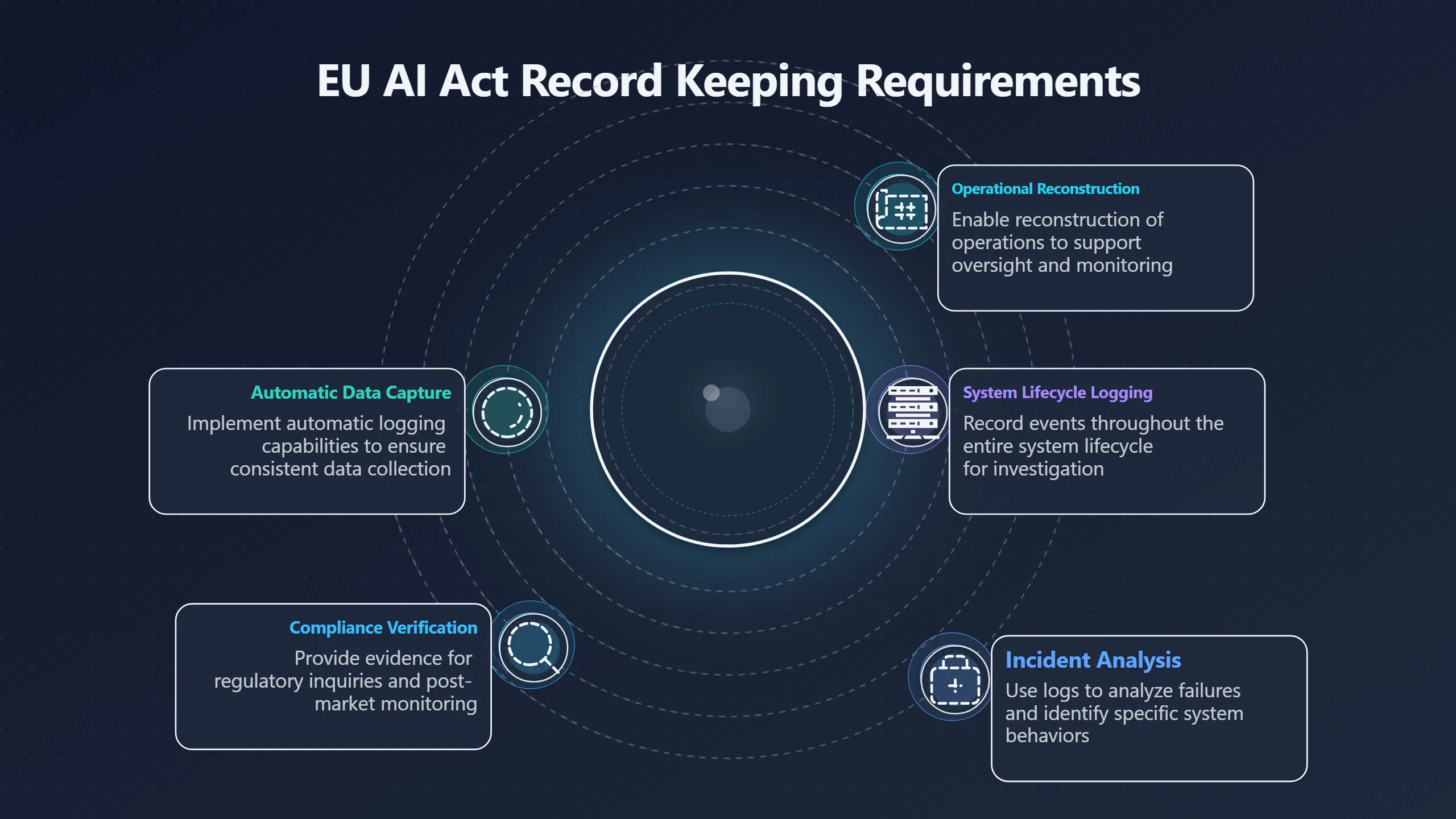
The EU AI Act places strong emphasis on traceability. High-risk AI systems must include logging capabilities that record events throughout the system lifecycle so that operation can be reconstructed and investigated when necessary. These records support oversight, post-market monitoring, incident analysis, and compliance verification. Responsible AI Platform+2AI Act Service Desk[aiactblog.nl]aiactblog.nlResponsible AI PlatformArticle 12 AI Act: Record-keeping | Official text & explanationArticle 12 requires high-risk AI systems to be tech…
In practice, traceability serves two audiences:
- Internal reviewers, who need to understand how a decision was reached.
- External investigators or regulators, who may need evidence months or years after the event.
Without preserved records, organisations are often forced to rely on memory, informal notes, or assumptions about what happened.
What a Useful AI Decision Record Should Capture
A meaningful audit trail captures both the machine’s contribution and the human response.
At a minimum, a decision record should include:
- The AI system version used.
- The time the recommendation was generated.
- The inputs available to the model.
- The output, prediction, score, or recommendation produced.
- Any confidence indicators or uncertainty measures.
- The identity of the reviewer.
- The actions taken by the reviewer.
- Whether the recommendation was accepted, modified, escalated, or rejected.
- The rationale for any override.
- Relevant supporting documents or evidence.
This level of detail allows investigators to reconstruct not only the final outcome but also the decision pathway that produced it.
Research on auditable AI systems highlights the importance of recording user actions, inference events, data usage, and timestamps. Comprehensive logs help organisations trace errors back to specific inputs, system behaviours, or review decisions rather than treating failures as unexplained outcomes.[PMC]pmc.ncbi.nlm.nih.govAn auditable and source-verified framework for clinical AI…by FF Alu · 2026 · Cited by 1 — More generally, audit logs (also called…
A useful record should also distinguish between different forms of human intervention. There is an important governance difference between:
- Confirming an AI recommendation after review.
- Modifying part of the recommendation.
- Fully overriding the recommendation.
- Escalating the case for additional review.
Combining all of these actions into a single “human approved” field hides information that may later prove critical.
Why Override Reasons Matter After Incidents
The most valuable part of many audit trails is often the explanation attached to an override.
Imagine a clinical decision support system recommends a particular treatment, but a physician rejects it because a patient has an unusual medical history not captured by the model. If a later review finds that the physician’s judgement prevented harm, the override reason becomes evidence of effective human oversight.
Conversely, if reviewers repeatedly override accurate recommendations without justification, organisations may discover training problems, workflow issues, or misunderstandings about the AI system.
Override explanations become particularly important when investigating:
- Safety incidents.
- Customer complaints.
- Discrimination claims.
- Regulatory inquiries.
- Litigation.
- Internal quality reviews.
The explanation does not need to be lengthy. In many environments, structured categories combined with a short written rationale provide sufficient context. Examples might include:
- Missing information.
- Data quality concerns.
- Policy exception.
- Context not considered by model.
- Ethical concern.
- Reviewer expertise or judgement.
Such categories make large-scale analysis possible while preserving human context.
Detecting Automation Bias and Reviewer Behaviour
Audit trails do more than explain individual decisions. They reveal patterns in human behaviour.
One recurring concern in AI governance is automation bias: the tendency of people to accept machine recommendations too readily. Researchers and regulators increasingly recognise that human oversight is ineffective if reviewers merely rubber-stamp AI outputs. The EU AI Act specifically addresses risks associated with over-reliance on AI recommendations.[Artificial Intelligence Act]artificialintelligenceact.euArtificial Intelligence ActArticle 14: Human Oversight | EU Artificial Intelligence ActHuman oversight shall aim to prevent or minimise t…
Audit logs help organisations measure whether oversight is functioning as intended.
For example, reviewers who approve 99.9% of recommendations without meaningful examination may indicate excessive trust in the system. On the other hand, reviewers who reject nearly every recommendation may signal inadequate training or a lack of confidence in the tool.
By analysing override rates and reviewer explanations, organisations can identify:
- Excessive reliance on AI.
- Inconsistent review standards.
- Training deficiencies.
- Workflow bottlenecks.
- Areas where the model performs poorly.
This turns audit trails into a governance tool rather than merely a compliance archive.
How Logging Supports Compliance and Better Review
Regulatory frameworks increasingly connect accountability to documentation.
The NIST AI Risk Management Framework emphasises governance, accountability, risk monitoring, and documented organisational responsibilities throughout the AI lifecycle. Effective logging supports these objectives by creating evidence that risk-management processes are actually being followed rather than merely described in policy documents.[NIST Publications+2NIST]nvlpubs.nist.govAI.600 1NIST PublicationsArtificial Intelligence Risk Management Frameworkby N AI · 2024 · Cited by 90 — AI RMF profiles assist organizations in…
The EU AI Act goes further by requiring logging and record-keeping capabilities for high-risk systems so that operation can be reconstructed and monitored over time. Traceability is treated as a foundational requirement for oversight. Responsible AI Platform+2AI Act Service Desk[aiactblog.nl]aiactblog.nlResponsible AI PlatformArticle 12 AI Act: Record-keeping | Official text & explanationArticle 12 requires high-risk AI systems to be tech…
In regulated sectors, audit trails also help demonstrate that human reviewers had a genuine opportunity to assess AI outputs. In healthcare, for example, regulatory guidance often stresses that professionals must be able to understand and independently assess the basis for recommendations rather than simply relying on automated outputs. Documentation showing reviewer evaluation and decision-making can therefore become part of demonstrating meaningful oversight. U.S. Food and Drug Administration+2LFH Regulatory[fda.gov]fda.govclinical decision support softwareFood and Drug AdministrationClinical Decision Support Software - Guidance29 Jan 2026 — This guidance clarifies the scope of FDA's oversig…
Designing Audit Trails That Remain Trustworthy
An audit trail only has value if it is reliable.
Organisations commonly strengthen trustworthiness through controls such as:
- Automatic rather than manual logging where possible.
- Timestamped records.
- User identification and authentication.
- Protection against unauthorised modification.
- Retention policies for future investigations.
- Version tracking for models and prompts.
- Separation between operational staff and audit functions.
Tamper-evident logging is particularly important because audit records may later be used to establish responsibility during investigations. If records can be altered without detection, confidence in the entire oversight process is weakened.[PMC]pmc.ncbi.nlm.nih.govAn auditable and source-verified framework for clinical AI…by FF Alu · 2026 · Cited by 1 — More generally, audit logs (also called…
Another common mistake is recording too little information. A simple log entry stating that a reviewer approved an AI recommendation may satisfy operational needs but often provides little value when reconstructing a consequential decision months later.
From Record-Keeping to Accountability
Audit trails transform human oversight from an abstract governance principle into a verifiable process. They document not only what an AI system recommended but also how human reviewers responded, whether they challenged the recommendation, and why the final outcome was chosen.
For high-stakes AI work, this traceability serves multiple purposes at once: it supports compliance, improves incident investigations, helps detect automation bias, and creates evidence that human oversight is functioning as intended. When organisations can clearly reconstruct AI-assisted decisions, accountability becomes demonstrable rather than merely claimed. arXiv+3Artificial Intelligence Act+3AI Act Service Desk[artificialintelligenceact.eu]artificialintelligenceact.euArtificial Intelligence ActArticle 14: Human Oversight | EU Artificial Intelligence ActHuman oversight shall aim to prevent or minimise t…
Amazon book picks
Further Reading
Books and field guides related to Can AI Overrides Be Traced Later?. Use these as the next step if you want deeper reading beyond the article.
The Alignment Problem
Explains accountability, oversight and human intervention in AI systems.
The Checklist Manifesto
Useful for designing documented review and override procedures.
eBay marketplace picks
Marketplace Samples
Example marketplace items related to this page. Use the search link to explore similar finds on eBay.




Endnotes
1.
Source: pmc.ncbi.nlm.nih.gov
Link:https://pmc.ncbi.nlm.nih.gov/articles/PMC12913532/
Source snippet
An auditable and source-verified framework for clinical AI...by FF Alu · 2026 · Cited by 1 — More generally, audit logs (also called...
2.
Source: arxiv.org
Link:https://arxiv.org/abs/2502.10036
3.
Source: nvlpubs.nist.gov
Title: AI.600 1
Link:https://nvlpubs.nist.gov/nistpubs/ai/NIST.AI.600-1.pdf
Source snippet
NIST PublicationsArtificial Intelligence Risk Management Frameworkby N AI · 2024 · Cited by 90 — AI RMF profiles assist organizations in...
4.
Source: nist.gov
Link:https://www.nist.gov/itl/ai-risk-management-framework
Source snippet
iated with artificial intelligence (AI).Read more...
5.
Source: fda.gov
Title: clinical decision support software
Link:https://www.fda.gov/regulatory-information/search-fda-guidance-documents/clinical-decision-support-software
Source snippet
Food and Drug AdministrationClinical Decision Support Software - Guidance29 Jan 2026 — This guidance clarifies the scope of FDA's oversig...
6.
Source: arxiv.org
Title: arXiv Human Oversight of Artificial Intelligence and Technical Standardisation
Link:https://arxiv.org/abs/2407.17481
7.
Source: nist.gov
Link:https://www.nist.gov/
Source snippet
National Institute of Standards and TechnologyNIST promotes U.S. innovation and industrial competitiveness by advancing measurement scien...
8.
Source: nist.gov
Link:https://www.nist.gov/news-events/news/2026/06/department-commerce-announces-finalization-chips-incentives-powerex-enhance
Source snippet
for U.S. Semiconductor Manufacturing...
9.
Source: nvlpubs.nist.gov
Link:https://nvlpubs.nist.gov/nistpubs/ai/nist.ai.100-1.pdf
Source snippet
Intelligence Risk Management Framework (AI RMF 1.0)by N AI · 2023 · Cited by 174 — With proper controls, AI systems can mitigate and mana...
10.
Source: artificialintelligenceact.eu
Link:https://artificialintelligenceact.eu/article/14/
Source snippet
Artificial Intelligence ActArticle 14: Human Oversight | EU Artificial Intelligence ActHuman oversight shall aim to prevent or minimise t...
11.
Source: aiactblog.nl
Link:https://www.aiactblog.nl/en/ai-act/artikel/12
Source snippet
[Responsible AI]({{ 'responsible-ai/' | relative_url }}) PlatformArticle 12 AI Act: Record-keeping | Official text & explanationArticle 12 requires high-risk AI systems to be tech...
12.
Source: ai-act-service-desk.ec.europa.eu
Link:https://ai-act-service-desk.ec.europa.eu/en/ai-act/article-12
Source snippet
For high-risk AI systems record-keeping obligation applies. High-risk AI systems must have automatic logging capabilities to record event...
13.
Source: lfhregulatory.co.uk
Link:https://lfhregulatory.co.uk/fda-clinical-decision-support-software/
Source snippet
LFH RegulatoryFDA Clinical Decision Support Software, When CDS Is Not...30 Mar 2026 — The software must enable the healthcare professiona...
14.
Source: ai-act-service-desk.ec.europa.eu
Link:https://ai-act-service-desk.ec.europa.eu/en/ai-act/article-71
Source snippet
database for high-risk AI systems listed in Annex IIIThis article describes the establishment and maintenance of an EU database for high...
15.
Source: digital-strategy.ec.europa.eu
Title: eu A I Act | Shaping Europe’s digital future
Link:https://digital-strategy.ec.europa.eu/en/policies/regulatory-framework-ai
Source snippet
Act | Shaping Europe's digital future - European UnionThe AI Act is the first-ever legal framework on AI, which addresses the risks of AI...
16.
Source: pmc.ncbi.nlm.nih.gov
Link:https://pmc.ncbi.nlm.nih.gov/articles/PMC11975648/
Source snippet
US Regulation of Artificial Intelligence in Medicine...by DE Vidal · 2023 · Cited by 15 — Interpretation of FDA regulation, including ne...
17.
Source: autoriteitpersoonsgegevens.nl
Title: eu ai act
Link:https://www.autoriteitpersoonsgegevens.nl/en/themes/algorithms-ai/eu-ai-act
Source snippet
9 Apr 2025 — The EU AI Act is intended to ensure that everyone across Europe can rest assured that AI systems are secure and that fundame...
18.
Source: GOV.UK
Link:https://www.gov.uk/eu-eea
Source snippet
in the EU and EEAThe European Union (EU) is an economic and [political]({{ 'political-video/' | relative_url }}) union of 27 countries. It operates an internal (or single) market...
19.
Source: fda.gov
Title: Clinical Decision Support Software
Link:https://www.fda.gov/media/109618/download
Source snippet
Guidance for Industry...29 Jan 2026 — In order to enable independent evaluation of its basis, the recommendation should be based on info...
20.
Source: daera-ni.gov.uk
Link:https://www.daera-ni.gov.uk/articles/european-union-eu-member-states
Source snippet
European Union (EU) Member StatesThroughout the Department of Agriculture, Environment and Rural Affairs (DAERA) website you will frequen...
21.
Source: elevateconsult.com
Title: nist ai risk management framework
Link:https://elevateconsult.com/insights/nist-ai-risk-management-framework/
Source snippet
NIST AI RMF: A Practical, Answer-Ready Guide6 Oct 2025 — Understand the NIST AI RMF, why it matters, and how to adopt it with a step‑by‑s...
Additional References
22.
Source: ismscopilot.com
Link:https://www.ismscopilot.com/blog/ai-best-practices-nist-framework
Source snippet
5 AI Best Practices for NIST FrameworkFive AI-driven practices for NIST AI RMF: automate governance, map and inventory risks, measure mod...
23.
Source: censinet.com
Link:https://censinet.com/perspectives/ai-in-audit-trails-monitoring-data-usage
Source snippet
AI in Audit Trails: Monitoring Data UsageWhat are the benefits of AI in audit trails? Benefits include enhanced accuracy, faster complian...
24.
Source: aiuc-1.com
Link:https://www.aiuc-1.com/crosswalks/nist-ai-rmf
Source snippet
AIUC-1 x NIST AI RMFThe NIST AI RMF is the United States government framework for managing AI risks throughout the AI lifecycle with four...
25.
Source: compliancequest.com
Link:https://www.compliancequest.com/21-cfr-part-11-compliance/
Source snippet
FDA 21 CFR Part 11 Compliance Requirements and BenefitsTitle 21 CFR Part 11 compliance defines FDA standards for secure e-records, e-sign...
26.
Source: advisori.de
Link:https://www.advisori.de/services/regulatory-compliance-management/eu-ai-act/eu-ai-act-high-risk-ai-systems/eu-ai-act-record-keeping-en
Source snippet
EU AI Act Record Keeping AI Regulation & ComplianceMeet the documentation obligations of the EU AI Act for high-risk AI systems. ADVISORI...
27.
Source: paloaltonetworks.com
Link:https://www.paloaltonetworks.com/cyberpedia/nist-ai-risk-management-framework
Source snippet
NIST AI Risk Management Framework (AI RMF)The NIST AI Risk Management Framework (AI RMF) is a guidance designed to improve the robustness...
28.
Source: linkedin.com
Link:https://www.linkedin.com/posts/dr-fernando-telles_fdas-updated-clinical-decision-support-software-activity-7425028791724470272-8dmc
Source snippet
Audit-Trail Verification vs Clinical Decision Support4 Feb 2026 — The FDA's updated Clinical Decision Support (CDS) Software Guidance (Ja...
29.
Source: lowenstein.com
Link:https://www.lowenstein.com/news-insights/publications/client-alerts/financial-services-ai-risk-management-framework-operationalizing-the-230-control-objectives-before-the-market-wakes-up-data-privacy
Source snippet
Financial Services AI Risk Management Framework24 Feb 2026 — The framework addresses human and nonhuman identity management, role‑based a...
30.
Source: epic.org
Link:https://epic.org/framing-the-risk-management-framework-actionable-instructions-by-nist-in-the-measure-section-of-the-ai-rmf/
Source snippet
Framing the Risk Management Framework: Actionable...Apr 13, 2023 — A.I. Risk Management Framework is a four-part, voluntary framework in...
31.
Source: linkedin.com
Link:https://www.linkedin.com/posts/max-foroughi_fda-guidance-for-clinical-decision-support-activity-7422725538001260545-ZUzK
Source snippet
FDA Guidance on AI in Healthcare: Non-Device CDS CriteriaNot all AI in healthcare needs FDA approval. But most teams don't know why. The...
Topic Tree