Within Chatbox illusion
Why confidence can hide weak AI answers
The same confident chat style can mask big differences between easy summaries, factual checks, code help, and uncertain real-world advice.
On this page
- Why one answer style makes different risks look equal
- Common moments when chatbot reliability changes
- Interface cues that could make limits easier to see
Page outline Jump by section
Introduction
Chat interfaces make artificial intelligence feel more reliable than it often is. A user can ask for a summary, a programming suggestion, a medical explanation, a travel recommendation, and a prediction about the future in the same conversation. The replies arrive in the same polished tone, with similar confidence and formatting. That consistency creates an important illusion: it makes very different levels of reliability look roughly equivalent.
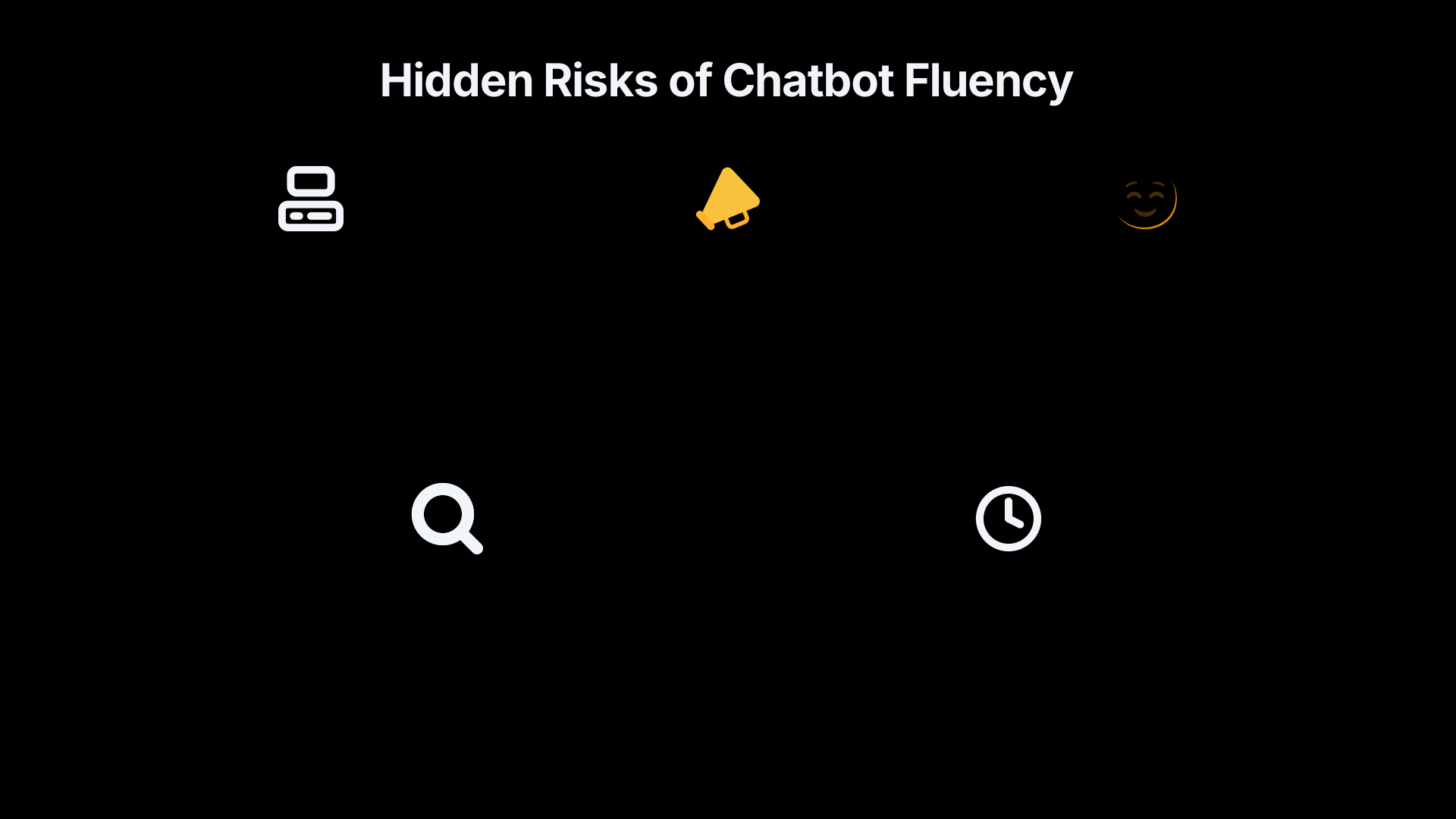 This matters because modern AI systems do not perform equally well across all tasks. They may excel at summarising a document, perform reasonably on many coding problems, struggle with uncertain real-world forecasting, and occasionally invent facts when answering knowledge questions. Yet the chat window rarely makes those differences obvious. The result is that users can mistake a flexible conversational interface for a uniformly dependable source of information. Research on AI trust, overreliance, and hallucinations repeatedly shows that people often judge reliability from the quality of the interaction rather than from the actual accuracy of the answer.[Microsoft+2arXiv]microsoft.comOverreliance on AI Literature ReviewThis can lead to issues and errors that can ultimately make people lose trust in AI…Read more…
Why one answer style makes different risks look equal
A traditional software environment often exposes differences in confidence and purpose. A calculator produces a numerical result. A search engine returns sources. A weather forecast presents probabilities. Each tool signals something about how much certainty is justified.
Chatbots compress those distinctions into a single conversational experience. Whether the model is summarising known information or speculating about an uncertain future, the response usually arrives as fluent prose. The interface encourages users to evaluate the answer by how coherent it sounds rather than by how difficult the underlying task actually is.[arXiv]arxiv.orgarXiv Why do we Trust Chatbots?From Normative Principles to…11 Feb 2026 — In other words, the very “invisibility” of text-based chat interfaces acts as a cognitive s…
This can be misleading because AI performance varies dramatically across domains. OpenAI’s GPT-4 technical report noted that the model achieved strong benchmark results while remaining “less capable than humans in many real-world scenarios” and still susceptible to hallucinations and reliability limitations.[arXiv+2OpenAI]arxiv.orgarXiv[2303.08774] GPT-4 Technical ReportMarch 15, 2023 — by J Achiam · 2023 · Cited by 27399 — While less capable than humans in many rea…
The key problem is not that the interface lies. It is that the interface hides variation. A polished explanation of a well-established historical fact can look remarkably similar to a speculative answer about future economic conditions. The visual presentation does not naturally signal that one answer may be far more trustworthy than the other.
Common moments when chatbot reliability changes
Reliability does not simply rise or fall. It changes depending on the type of task being performed.
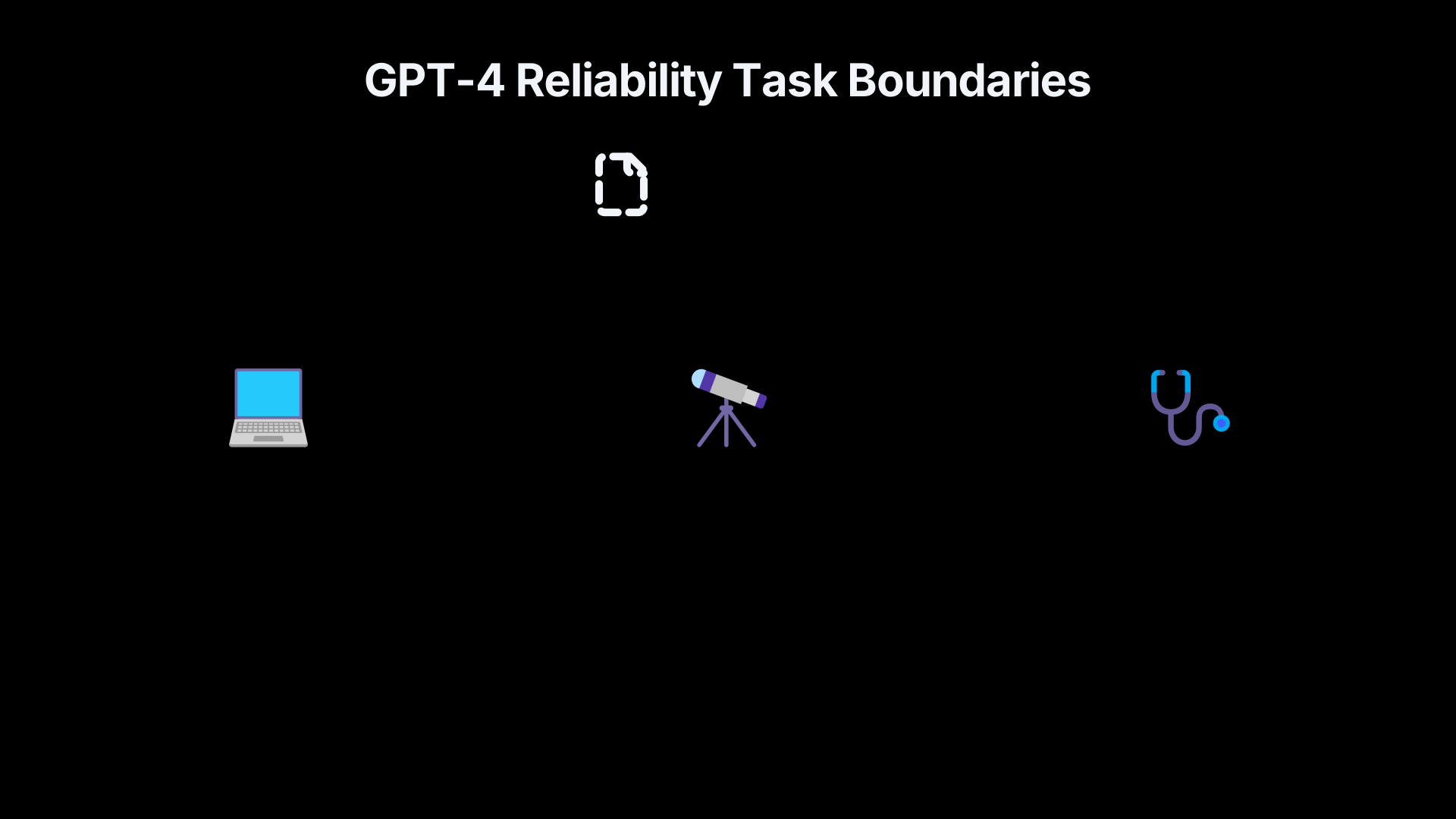
Summaries versus factual verification
Summarisation often benefits from having source material directly available. If a user uploads a report and asks for key points, the AI can work from specific text. Factual verification is harder because it may require accurate external knowledge, current information, or careful source evaluation.
The interface rarely distinguishes between these situations. Both responses may appear equally polished even though one relies on supplied evidence and the other depends on the model’s stored knowledge and reasoning. Research on hallucinations highlights that factual errors remain a persistent challenge in real-world interactions.[arXiv]arxiv.orgarXiv Halu Eval-Wild: Evaluating Hallucinations of Language Models in the WildHaluEval-Wild: Evaluating Hallucinations of Language Models in the WildMarch 7, 2024…
Coding help versus real-world advice
Many large language models perform impressively on common programming tasks because code has structured patterns and abundant training examples. However, advice involving law, medicine, finance, safety, or personal life often contains uncertainty, missing information, and context-specific judgement.
The conversational interface can blur this distinction. Users may see successful coding assistance and unconsciously generalise that competence to areas where accuracy is much harder to achieve. Microsoft’s research on AI overreliance identifies excessive trust as a recurring risk when users accept outputs without sufficient verification.[Microsoft]microsoft.comOverreliance on AI Literature ReviewThis can lead to issues and errors that can ultimately make people lose trust in AI…Read more…
Known facts versus unknown futures
One of the sharpest reliability boundaries appears when AI is asked to predict events that have not happened yet. Forecasting research has found that large language models can underperform human forecasting crowds on genuinely uncertain future events. Success on exams or knowledge benchmarks does not automatically translate into accurate predictions about the future.[arXiv]arxiv.orgLarge Language Model Prediction Capabilities: Evidence from a Real-World Forecasting TournamentOctober 17, 2023…
Yet a prediction and a factual explanation may be presented in nearly identical language. The interface can make uncertain forecasts feel more authoritative than they deserve.
Short exchanges versus long conversations
Many users assume that reliability improves as a conversation grows because the AI appears to remember more context. In reality, longer conversations can introduce new failure modes. Research examining extended chatbot interactions found that performance may decline over lengthy exchanges as context accumulates and errors compound.[Windows Central]windowscentral.comBased on an analysis of over 200,000 chats, the research found success rates drop from around 90% in single-turn prompts to just 65% in e…
Because the conversation remains coherent and personable, users may not notice when accuracy begins to drift.
Why confidence is such a powerful signal
Humans are accustomed to using conversational cues to judge expertise. In everyday life, confidence, fluency, and responsiveness often correlate with competence. Chatbots exploit that shortcut unintentionally.
Large language models are designed to generate plausible language. Even when uncertain, they may produce answers that sound complete and well structured. Research on hallucinations suggests that current training systems often reward answering rather than admitting uncertainty, which can encourage confident mistakes.[Business Insider]businessinsider.comBusiness Insider Why AI chatbots hallucinate, according to Open AI researchersThis test-centric optimization encourages models to provide confident but potentially incorrect outputs, rather than abstaining when unsu…
This becomes especially important because confidence is visible while accuracy is not. A reader can immediately observe tone, grammar, and detail. Determining whether the answer is correct often requires additional work.
The mismatch between visible confidence and hidden reliability is one reason overreliance emerges. Studies of workplace AI use have found that confidence in AI tools can reduce independent critical thinking and increase dependence on generated outputs.[Microsoft]microsoft.comlee 2025 ai critical thinking surveyThe Impact of Generative AI on Critical Thinkingby HPH Lee · 2025 · Cited by 890 — We find that GenAI tools reduce the perceived…
Human-like conversation can increase trust beyond the evidence
The issue is not limited to wording. Many conversational design choices make AI feel more trustworthy.
Research on anthropomorphism—the tendency to attribute human qualities to non-human systems—shows that human-like cues can increase perceived trust and perceived accuracy. Speech, first-person language, personality traits, and conversational warmth can all influence how reliable users believe a system to be.[arXiv+2Frontiers]arxiv.orgBelieving Anthropomorphism: Examining the Role of Anthropomorphic Cues on Trust in Large Language ModelsMay 9, 2024…
This matters because trust can grow independently of actual performance. A chatbot that sounds thoughtful, empathetic, and conversational may be perceived as more dependable even when its factual accuracy has not improved.
Recent studies of integrated conversational AI also suggest that users frequently treat citations and conversational fluency as indicators of trustworthiness without always checking the underlying evidence.[arXiv]arxiv.orgBeliefs and Misconceptions around Integrated Conversational AIMay 14, 2026…
The result is a subtle shift: people begin evaluating the relationship with the chatbot rather than evaluating the specific claim being made.
Interface cues that could make limits easier to see
If a single chat box can hide reliability boundaries, interface design can also help reveal them.
Several approaches have been proposed by researchers and developers:
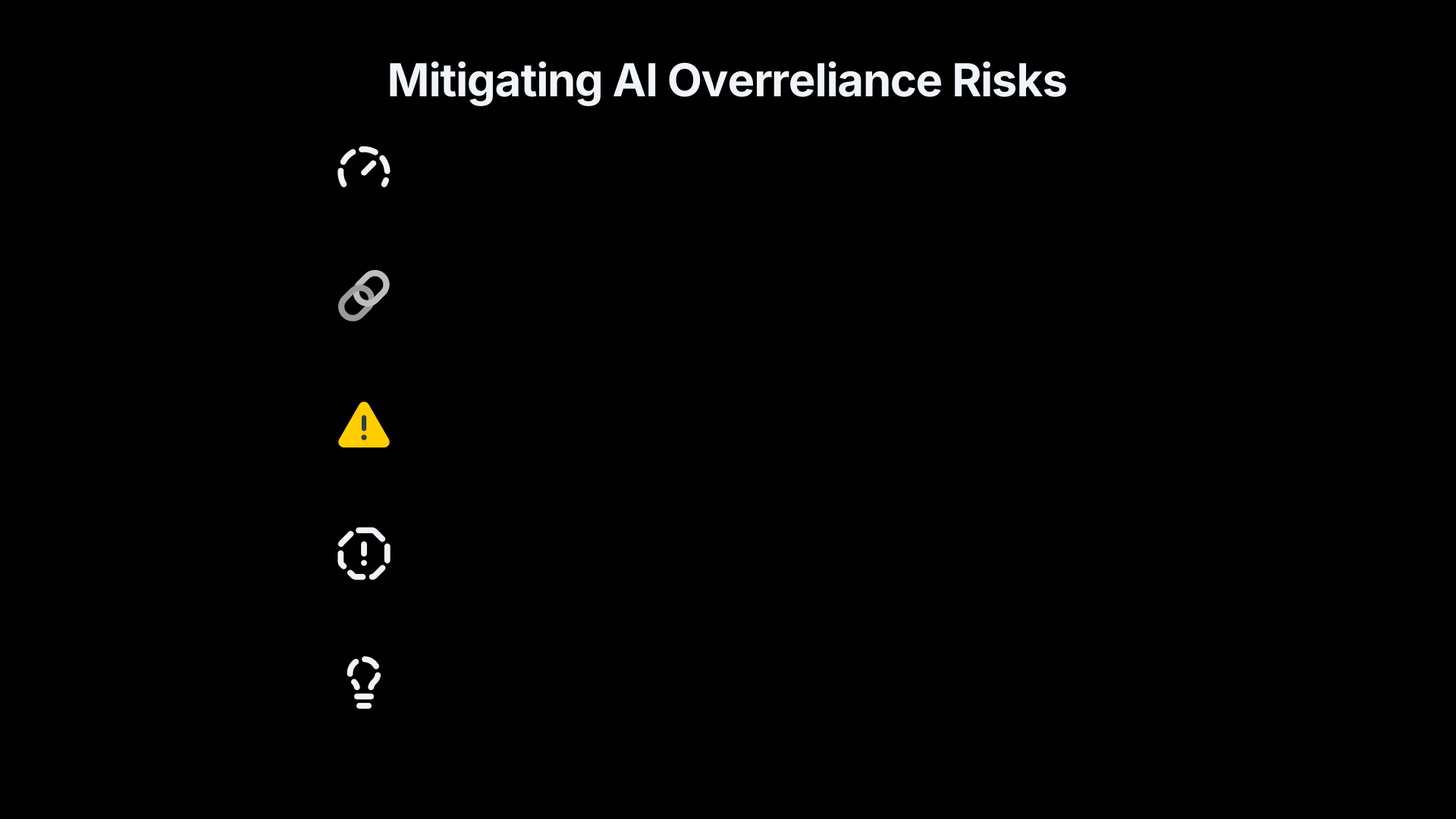
- Task-sensitive confidence indicators. Instead of presenting every answer identically, systems could highlight when a response depends on uncertain information or prediction rather than established facts. Research on confidence displays suggests that calibrated confidence information can influence user trust and decision-making.[ACM Digital Library]dl.acm.orgACM Digital LibraryThe Impact of Confidence Ratings on User Trust in Large…by L Wang · 2025 · Cited by 10 — This study investigated ho…
- Clear source visibility. Showing where information came from can help users distinguish retrieval-based answers from generated inferences. However, citations only help when users understand and inspect them.[arXiv]arxiv.orgBeliefs and Misconceptions around Integrated Conversational AIMay 14, 2026…
- Explicit uncertainty language. Models can state when evidence is limited, conflicting, or unavailable rather than presenting a single definitive answer. Researchers studying hallucinations argue that systems should be rewarded for recognising uncertainty instead of guessing.[Business Insider]businessinsider.comBusiness Insider Why AI chatbots hallucinate, according to Open AI researchersThis test-centric optimization encourages models to provide confident but potentially incorrect outputs, rather than abstaining when unsu…
- Risk-based design. High-stakes advice could be presented differently from low-stakes brainstorming or drafting tasks, helping users form more realistic expectations. Microsoft’s guidance on overreliance emphasises creating accurate mental models of AI capabilities and limitations.[Microsoft Learn]learn.microsoft.comoverreliance on aiMicrosoft LearnOverreliance on AI: Risk Identification and Mitigation…4 Mar 2025 — This article describes a framework that helps produ…
These measures do not eliminate mistakes, but they can reduce the tendency to treat all chatbot outputs as equally dependable.
The central lesson: consistency is not reliability
The conversational interface is one of the most successful design ideas in modern AI because it makes many capabilities accessible through a single interaction. Yet that same simplicity can conceal an important truth: reliability is uneven.
A chatbot may perform excellently on one request and poorly on the next while sounding equally confident throughout. Summaries, factual recall, coding assistance, forecasting, personal advice, and complex judgement calls involve different kinds of uncertainty and different error rates. The chat box often smooths over those distinctions.
Understanding artificial intelligence therefore requires looking beyond the quality of the conversation itself. A fluent answer may be helpful, insightful, or correct. It may also be incomplete, speculative, or wrong. The interface makes those possibilities look similar, which is why apparent confidence remains one of the easiest ways for weak AI answers to masquerade as strong ones.
Amazon book picks
Further Reading
Books and field guides related to Why confidence can hide weak AI answers. Use these as the next step if you want deeper reading beyond the article.
The Alignment Problem
Directly addresses errors, bias, and misplaced trust in AI outputs.
You Look Like a Thing and I Love You
Highlights common AI mistakes hidden behind fluent responses.
Co-Intelligence
Offers practical guidance on using chatbots without overtrusting them.
eBay marketplace picks
Marketplace Samples
Example marketplace items related to this page. Use the search link to explore similar finds on eBay.




Endnotes
1.
Source: microsoft.com
Title: Overreliance on AI Literature Review
Link:https://www.microsoft.com/en-us/research/wp-content/uploads/2022/06/Aether-Overreliance-on-AI-Review-Final-6.21.22.pdf
Source snippet
This can lead to issues and errors that can ultimately make people lose trust in AI...Read more...
2.
Source: arxiv.org
Title: arXiv Why do we Trust Chatbots?
Link:https://arxiv.org/html/2602.08707v2
Source snippet
From Normative Principles to...11 Feb 2026 — In other words, the very “invisibility” of text-based chat interfaces acts as a cognitive s...
3.
Source: microsoft.com
Title: lee 2025 ai critical thinking survey
Link:https://www.microsoft.com/en-us/research/wp-content/uploads/2025/01/lee_2025_ai_critical_thinking_survey.pdf
Source snippet
The Impact of [Generative AI]({{ 'generative-ai/' | relative_url }}) on Critical Thinkingby HPH Lee · 2025 · Cited by 890 — We find that GenAI tools reduce the perceived...
4.
Source: arxiv.org
Link:https://arxiv.org/abs/2303.08774
Source snippet
arXiv[2303.08774] GPT-4 Technical ReportMarch 15, 2023 — by J Achiam · 2023 · Cited by 27399 — While less capable than humans in many rea...
Published: March 15, 2023
5.
Source: OpenAI
Title: gpt 4 research
Link:https://openai.com/index/gpt-4-research/
Source snippet
comGPT-414 Mar 2023 — GPT-4 is a large multimodal model (accepting image and text inputs, emitting text outputs) that, while less capable...
6.
Source: arxiv.org
Title: arXiv Halu Eval-Wild: Evaluating Hallucinations of Language Models in the Wild
Link:https://arxiv.org/abs/2403.04307
Source snippet
HaluEval-Wild: Evaluating Hallucinations of Language Models in the WildMarch 7, 2024...
Published: March 7, 2024
7.
Source: learn.microsoft.com
Title: overreliance on ai
Link:https://learn.microsoft.com/en-us/ai/playbook/technology-guidance/overreliance-on-ai/overreliance-on-ai
Source snippet
Microsoft LearnOverreliance on AI: Risk Identification and Mitigation...4 Mar 2025 — This article describes a framework that helps produ...
8.
Source: arxiv.org
Link:https://arxiv.org/abs/2310.13014
Source snippet
Large Language Model Prediction Capabilities: Evidence from a Real-World Forecasting TournamentOctober 17, 2023...
Published: October 17, 2023
9.
Source: arxiv.org
Link:https://arxiv.org/abs/2405.06079
Source snippet
Believing Anthropomorphism: Examining the Role of Anthropomorphic Cues on Trust in Large Language ModelsMay 9, 2024...
Published: May 9, 2024
10.
Source: arxiv.org
Link:https://arxiv.org/abs/2605.14849
Source snippet
Beliefs and Misconceptions around Integrated Conversational AIMay 14, 2026...
Published: May 14, 2026
11.
Source: dl.acm.org
Link:https://dl.acm.org/doi/10.1145/3708319.3734178
Source snippet
ACM Digital LibraryThe Impact of Confidence Ratings on User Trust in Large...by L Wang · 2025 · Cited by 10 — This study investigated ho...
12.
Source: cdn.openai.com
Link:https://cdn.openai.com/papers/gpt-4.pdf
Source snippet
openai.comGPT-4 Technical Report27 Mar 2023 — While less capable than humans in many real-world scenarios, GPT-4 exhibits human-level per...
13.
Source: OpenAI
Title: introducing simpleqa
Link:https://openai.com/index/introducing-simpleqa/
Source snippet
comIntroducing SimpleQA30 Oct 2024 — A factuality benchmark called SimpleQA that measures the ability for language models to answer short...
14.
Source: microsoft.com
Title: overreliance on ai literature review
Link:https://www.microsoft.com/en-us/research/publication/overreliance-on-ai-literature-review/
Source snippet
This can lead to issues and errors that can ultimately make people lose trust in AI...Read more...
15.
Source: microsoft.com
Link:https://www.microsoft.com/en-us/research/wp-content/uploads/2024/03/GenAI_AppropriateReliance_Published2024-3-21.pdf
Source snippet
Appropriate reliance on GenAI: - Research synthesisAppropriate reliance on AI happens when users accept correct [AI outputs]({{ 'ai-outputs/' | relative_url }}) and reject inc...
16.
Source: arxiv.org
Link:https://arxiv.org/html/2303.08774v6
Source snippet
GPT-4 Technical ReportWhile less capable than humans in many real-world scenarios, GPT-4 exhibits human-level performance on various prof...
17.
Source: windowscentral.com
Link:https://www.windowscentral.com/artificial-intelligence/microsoft-research-salesforce-ai-chatbot-study
Source snippet
Based on an analysis of over 200,000 chats, the research found success rates drop from around 90% in single-turn prompts to just 65% in e...
18.
Source: businessinsider.com
Title: Business Insider Why AI chatbots hallucinate, according to Open AI researchers
Link:https://www.businessinsider.com/why-ai-chatbots-hallucinate-openai-chatgpt-anthropic-claude
Source snippet
This test-centric optimization encourages models to provide confident but potentially incorrect outputs, rather than abstaining when unsu...
19.
Source: frontiersin.org
Link:https://www.frontiersin.org/journals/computer-science/articles/10.3389/fcomp.2025.1531976/full
Source snippet
Effect of anthropomorphism and perceived intelligence in...by N Ma · 2025 · Cited by 75 — Anthropomorphic visual design can significantl...
20.
Source: launchpad.ai
Title: GP T-4 Technical Report
Link:https://www.launchpad.ai/blog/gpt-4-technical-report
Source snippet
GPT-4 Technical ReportMay 4, 2023 — With the latest advancements, GPT-4 has significantly reduced hallucinations compared to earlier mode...
Published: May 4, 2023
21.
Source: version1.com
Title: openai gpt 4 review
Link:https://www.version1.com/blog/openai-gpt-4-review/
Source snippet
OpenAI GPT-4: A complete review31 Mar 2023 — What is a hallucination in GPT-4?... An AI hallucination is pretty similar to a human hallu...
22.
Source: facebook.com
Link:https://www.facebook.com/verge/posts/openai-claims-chatgpts-new-default-model-hallucinates-way-less/1355394886449981/
Source snippet
OpenAI claims ChatGPT's new default model hallucinates...However, a report reveals these models have a higher tendency to hallucinate, w...
Additional References
23.
Source: researchgate.net
Link:https://www.researchgate.net/publication/373089875_Determinants_Affecting_Consumer_Trust_in_Communication_With_AI_Chatbots_The_Moderating_Effect_of_Privacy_Concerns
Source snippet
Determinants Affecting Consumer Trust in Communication...23 May 2026 — This paper summarized the factors that influence consumers' trust...
Published: May 2026
24.
Source: linkedin.com
Title: iblai openais gpt 5 technical report 80 fewer activity 7422299939235586048 7tPU
Link:https://www.linkedin.com/posts/iblai_openais-gpt-5-technical-report-80-fewer-activity-7422299939235586048-7tPU
Source snippet
ibl.ai's Post28 Jan 2026 — OpenAI's GPT-5 technical report: 80% fewer hallucinations than o3 when thinking is enabled. 45% fewer factual...
25.
Source: linkedin.com
Title: ottivogt ai leadership criticalthinking activity 7443606596024205313 R7Gk
Link:https://www.linkedin.com/posts/ottivogt_ai-leadership-criticalthinking-activity-7443606596024205313-R7Gk
Source snippet
ChatGPT's Hallucination Rate Doubles, Fails PhD-Level...A 2024 PMC study found GPT-4's citation recall for systematic reviews at 13.7%...
26.
Source: medium.com
Title: hallucination rates in 2025 accuracy refusal and liability aa0032019ca1
Link:https://medium.com/%40markus_brinsa/hallucination-rates-in-2025-accuracy-refusal-and-liability-aa0032019ca1
Source snippet
Hallucination Rates in 2025 — Accuracy, Refusal, and...One of the most-cited figures from the paper is that GPT-4o has a reported halluc...
27.
Source: mofo.com
Title: 230315 gpt 4 release deep dive briefing improvements
Link:https://www.mofo.com/resources/insights/230315-gpt-4-release-deep-dive-briefing-improvements
Source snippet
Morrison FoersterGPT-4 Release: Briefing on Model Improvements and...15 Mar 2023 — [14] See Open AI's GPT-4 Technical Report (“Despite i...
28.
Source: thesis.unipd.it
Link:https://thesis.unipd.it/retrieve/8195ad72-25cc-4e4d-a269-5e94261f3e05/AZHAR%20Serik-2.pdf
Source snippet
In H. Degen & S. Ntoa (Eds.), HCII 2025...Read more...
29.
Source: researchgate.net
Title: 383739523 GPT 4 Technical Report
Link:https://www.researchgate.net/publication/383739523_GPT-4_Technical_Report
Source snippet
(PDF) GPT-4 Technical Report1 Mar 2023 — While less capable than humans in many real-world scenarios, GPT-4 exhibits human-level performa...
30.
Source: educational-innovation.sydney.edu.au
Title: sydney.edu.au GP T-4 is here
Link:https://educational-innovation.sydney.edu.au/teaching%40sydney/gpt-4-is-here-what-is-it-and-what-does-this-mean-for-higher-education/
Source snippet
What is it, and what does this mean for higher...16 Mar 2023 — OpenAI has released a technical report alongside GPT-4's release, which d...
31.
Source: github.com
Title: hallucination leaderboard
Link:https://github.com/vectara/hallucination-leaderboard
Source snippet
vectara/hallucination-leaderboardHallucination Leaderboard; openai/gpt-4o-2024-08-06, 9.6 %, 90.4 %; ai21labs/jamba-large-1.7-2025-07...
Published: August 6, 2024
32.
Source: livechatai.com
Title: Is Chat GPT Accurate?
Link:https://livechatai.com/blog/is-chatgpt-accurate
Source snippet
2026 Stats, Hallucination Rates &...19 Jun 2025 — ChatGPT scores 88.7% on the MMLU general-knowledge benchmark, but its factual accuracy...
Topic Tree