Within Attention
How did attention lead to foundation models?
Attention did not just improve translation; it made large reusable language models practical by supporting scale, transfer learning, and broad task reuse.
On this page
- From translation systems to reusable language models
- Why parallel training changed model scale
- How pre trained transformers spread across tasks
Page outline Jump by section
Introduction
Attention did more than improve machine translation. It created the technical conditions that made foundation models possible. A foundation model is a large pre-trained system that learns broad patterns from vast amounts of data and can then be adapted or prompted to perform many different tasks. Before attention-based transformers, language systems were usually built for specific purposes and often required separate architectures or training pipelines for each task. The transformer changed that pattern. By allowing efficient parallel training, scaling to much larger datasets, and learning reusable representations of language, attention-based models became practical to pre-train once and reuse many times. The result was the emergence of models such as BERT, GPT, and later multimodal systems that now form the foundation of modern artificial intelligence.[arXiv+2NeurIPS Papers]arxiv.orgarXiv[1706.03762] Attention Is All You NeedJune 12, 2017 — Jun 12, 2017 — We propose a new simple network architecture, the Transformer…

From translation systems to reusable language models
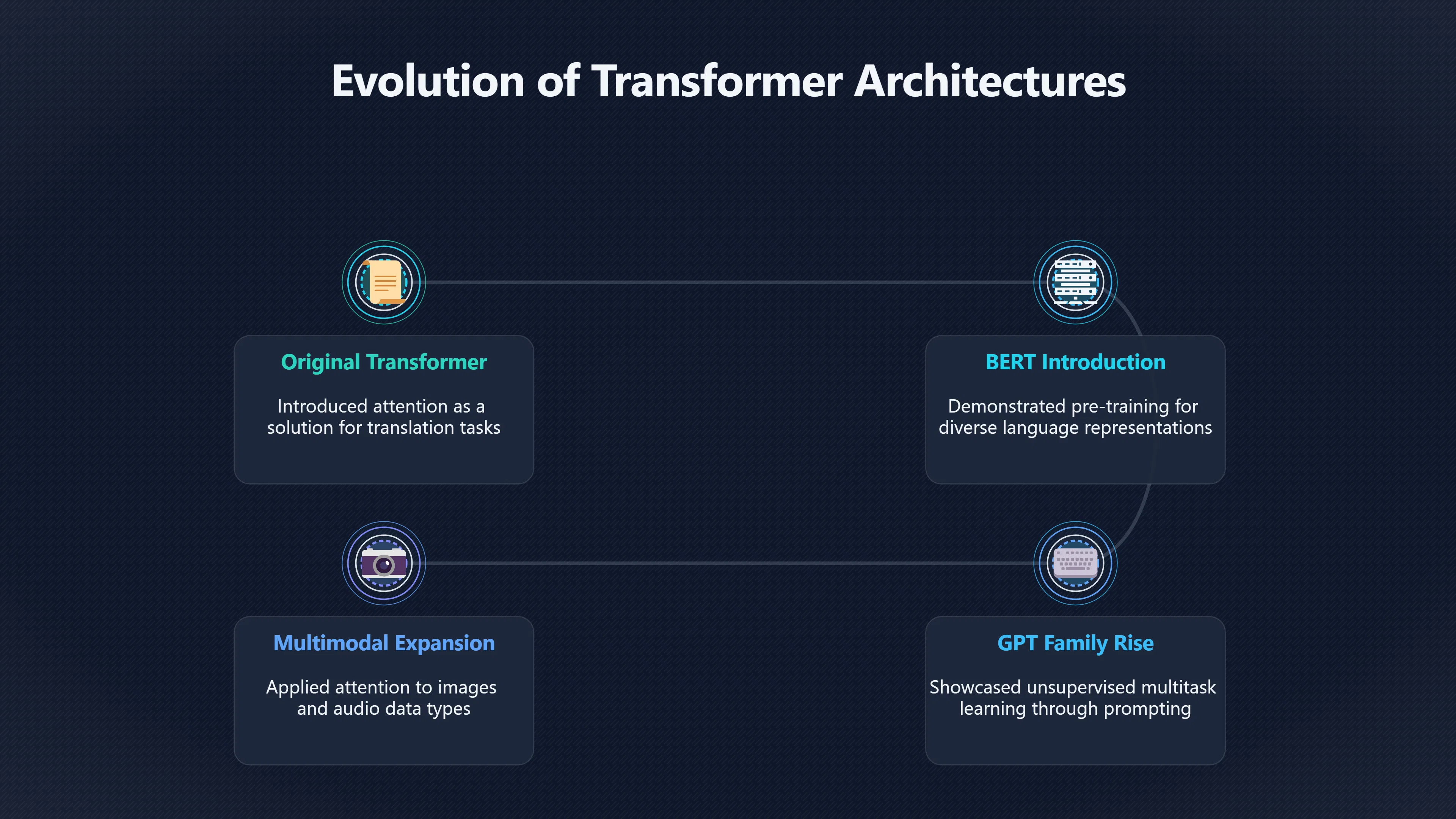
The original transformer paper in 2017 was presented as a solution to sequence-to-sequence tasks such as machine translation. However, its deeper significance was architectural. The authors demonstrated that a model built entirely around attention could outperform leading recurrent approaches while training more efficiently and with greater parallelism.[arXiv]arxiv.orgarXiv[1706.03762] Attention Is All You NeedJune 12, 2017 — Jun 12, 2017 — We propose a new simple network architecture, the Transformer…
This mattered because attention made it possible to treat language modelling as a general-purpose learning problem rather than a collection of specialised tasks. Instead of designing different systems for translation, summarisation, question answering, and classification, researchers could train a single transformer on enormous amounts of text and then adapt it to many downstream uses.
Earlier neural language models certainly learned useful representations, but they struggled to scale efficiently. Attention-based transformers offered a more flexible path: one architecture could process text, learn relationships across long contexts, and be reused repeatedly. This shift from task-specific models to reusable language representations became a defining feature of foundation models.[arXiv+2arXiv]arxiv.orgarXiv[1706.03762] Attention Is All You NeedJune 12, 2017 — Jun 12, 2017 — We propose a new simple network architecture, the Transformer…
Why parallel training changed model scale
A foundation model is only possible if training can be expanded to enormous datasets and increasingly large parameter counts. Attention helped make that expansion practical.
Recurrent neural networks process text sequentially. Every new token depends on computations from previous tokens. This creates a bottleneck because modern hardware such as graphics processing units (GPUs) works best when many operations can be performed simultaneously.
The transformer removed this limitation. Self-attention allows tokens within a sequence to interact in parallel rather than waiting for a chain of recurrent updates. The original transformer paper highlighted substantially greater parallelisation and significantly reduced training time compared with leading recurrent systems.[NeurIPS Papers]papers.neurips.cc7181 attention is all you needNeurIPS PapersAttention is All you Needby A Vaswani · Cited by 247454 — The Transformer allows for significantly more parallelization and…
The importance of this change is difficult to overstate. Once researchers could train much larger models efficiently, they discovered a powerful pattern: increasing model size, data volume, and computation often produced predictable improvements in performance. Large-scale pre-training became economically and technically feasible because attention-based architectures could make effective use of modern computing infrastructure.[NeurIPS Papers]papers.neurips.cc7181 attention is all you needNeurIPS PapersAttention is All you Needby A Vaswani · Cited by 247454 — The Transformer allows for significantly more parallelization and…
In practical terms, attention transformed language modelling from a research exercise constrained by sequential computation into a scalable engineering process. Foundation models emerged because the architecture could absorb more data and more compute than earlier approaches.
How pre-trained transformers spread across tasks
The next crucial step was proving that a single pre-trained transformer could transfer its knowledge to many applications.
BERT, introduced in 2018, showed that a transformer could be pre-trained on large amounts of unlabeled text and then fine-tuned for a wide variety of language tasks with only modest modifications. The same underlying model could support question answering, natural language inference, classification, and other applications. This demonstrated that a general language representation could be reused across domains instead of retraining separate systems from scratch.[arXiv]arxiv.orgOpen source on arxiv.org.
At roughly the same time, the GPT family explored another path. Rather than focusing primarily on task-specific fine-tuning, GPT-style models showed that sufficiently large transformer language models could perform multiple tasks through prompting and context alone. The GPT-2 paper described language models as “unsupervised multitask learners”, highlighting how broad capabilities could emerge from large-scale pre-training.[OpenAI]cdn.openai.comlanguage models are unsupervised multitask learnersLanguage Models are Unsupervised Multitask Learnersby A Radford · Cited by 25478 — The capacity of the language model is essential…
These developments revealed two related ideas:
- A transformer could learn broadly useful representations from raw text.
- The same pre-trained model could be reused across many downstream tasks.
Those are core characteristics of a foundation model.[arXiv]arxiv.orgOpen source on arxiv.org.

Why attention became the common foundation
Attention did not merely create one successful model family. It provided a general mechanism that could be applied across different forms of data.
Because attention operates on relationships between tokens rather than on language-specific rules, the transformer framework proved adaptable beyond text. Researchers later applied transformer architectures to images, audio, code, and multimodal data. Models such as image transformers and multimodal systems borrowed the same basic attention-centred design that originated in language research.[arXiv]arxiv.orgarXiv BEi T: BERT Pre-Training of Image TransformersBEiT: BERT Pre-Training of Image TransformersJune 15, 2021…
This adaptability helped establish a new pattern in artificial intelligence development. Instead of building entirely different architectures for each domain, researchers increasingly started with a transformer-based foundation model and adapted it to new data types and tasks.
The result was a shared technological base spanning search, content generation, programming assistance, image understanding, and multimodal reasoning. Attention became the mechanism that connected these systems because it provided a scalable way to model relationships within complex data.[Wikipedia+2IBM]WikipediaAttention Is All You NeedThe paper introduced a new deep learning architecture known as the transformer, based on the attention mechanism…
What attention contributed beyond accuracy
It is common to describe attention as a technique that improved language understanding. That is true, but it understates its historical significance.
The crucial contribution was organisational rather than merely incremental. Attention enabled:
- Large-scale parallel training.
- Efficient use of modern computing hardware.
- Pre-training on massive datasets.
- Transfer of knowledge across tasks.
- Reuse of a single architecture across domains.
Taken together, these properties transformed language models from specialised tools into broadly applicable platforms. BERT, GPT, and later multimodal systems were built on different objectives and training strategies, but all depended on the transformer architecture that attention made possible.[Wikipedia+3arXiv+3arXiv]arxiv.orgarXiv[1706.03762] Attention Is All You NeedJune 12, 2017 — Jun 12, 2017 — We propose a new simple network architecture, the Transformer…
In the history of artificial intelligence, attention’s most important legacy may therefore be that it turned language modelling into a foundation on which many other capabilities could be built. Rather than creating better translation systems alone, it enabled the rise of foundation models themselves.[arXiv+2NeurIPS Papers]arxiv.orgarXiv[1706.03762] Attention Is All You NeedJune 12, 2017 — Jun 12, 2017 — We propose a new simple network architecture, the Transformer…

Amazon book picks
Further Reading
Books and field guides related to How did attention lead to foundation models?. Use these as the next step if you want deeper reading beyond the article.
Build a Large Language Model (From Scratch)
Directly connects transformers, attention, and modern foundation models.
Natural Language Processing with Transformers
Explains how attention-based transformers became reusable foundation models.
Hands-On Large Language Models
Focuses on pretraining, transfer, and modern foundation-model workflows.
Deep Learning
Rating: 3.5/5 from 6 Google Books ratings
Provides the deep-learning foundations underlying transformer scaling.
eBay marketplace picks
Marketplace Samples
Example marketplace items related to this page. Use the search link to explore similar finds on eBay.


Endnotes
1.
Source: arxiv.org
Link:https://arxiv.org/abs/1706.03762
Source snippet
arXiv[1706.03762] Attention Is All You NeedJune 12, 2017 — Jun 12, 2017 — We propose a new simple network architecture, the Transformer...
Published: June 12, 2017
2.
Source: papers.neurips.cc
Title: 7181 attention is all you need
Link:https://papers.neurips.cc/paper/7181-attention-is-all-you-need.pdf
Source snippet
NeurIPS PapersAttention is All you Needby A Vaswani · Cited by 247454 — The Transformer allows for significantly more parallelization and...
3.
Source: Wikipedia
Link:https://en.wikipedia.org/wiki/Attention_Is_All_You_Need
Source snippet
Attention Is All You NeedThe paper introduced a new [deep learning]({{ 'deep-learning/' | relative_url }}) architecture known as the transformer, based on the attention mechanism...
4.
Source: arxiv.org
Link:https://arxiv.org/abs/1810.04805
5.
Source: cdn.openai.com
Title: language models are unsupervised multitask learners
Link:https://cdn.openai.com/better-language-models/language_models_are_unsupervised_multitask_learners.pdf
Source snippet
Language Models are Unsupervised Multitask Learnersby A Radford · Cited by 25478 — The capacity of the language model is essential...
6.
Source: arxiv.org
Title: arXiv BEi T: BERT Pre-Training of Image Transformers
Link:https://arxiv.org/abs/2106.08254
Source snippet
BEiT: BERT Pre-Training of Image TransformersJune 15, 2021...
Published: June 15, 2021
7.
Source: ibm.com
Link:https://www.ibm.com/think/topics/gpt
Source snippet
sed on a transformer deep learning architecture.Read more...
8.
Source: Wikipedia
Title: Attention ([machine learning]({{ ‘machine-learning/’ | relative_url }}))
Link:https://en.wikipedia.org/wiki/Attention_%28machine_learning%29
Source snippet
Attention (machine learning)In machine learning, attention is a method that determines the importance of each component in a sequence...
9.
Source: Wikipedia
Title: BERT (language model)
Link:https://en.wikipedia.org/wiki/BERT_%28language_model%29
Source snippet
BERT (language model)Bidirectional encoder representations from transformers (BERT) is a language model introduced in October 2018 by...
Published: October 2018
10.
Source: Wikipedia
Link:https://en.wikipedia.org/wiki/Attention
Source snippet
AttentionAttention is the concentration of awareness directed at some task or phenomenon while mostly excluding others. Focused attent...
11.
Source: Wikipedia
Title: [Generative]({{ ‘generative-ai/’ | relative_url }}) pre trained transformer
Link:https://en.wikipedia.org/wiki/Generative_pre-trained_transformer
Source snippet
Generative pre-trained transformerGPTs are primarily used to generate text, but can be trained to generate other kinds of data. For ex...
12.
Source: OpenAI
Link:https://openai.com/gpt-5/
Source snippet
comGPT-5 is hereGPT‑5 is smarter across the board, providing more useful responses across math, science, finance, law, and more. It's lik...
13.
Source: arxiv.org
Link:https://arxiv.org/pdf/1810.04805
Source snippet
1810.04805v2 [cs.CL] 24 May 2019May 24, 2019 — We introduce a new language representa- tion model called BERT, which stands for. Bi...
Published: May 24, 2019
14.
Source: arxiv.org
Link:https://arxiv.org/html/2406.14491v2
Source snippet
However, supervised multitask learning...Read more...
15.
Source: ibm.com
Link:https://www.ibm.com/think/topics/attention-mechanism
Source snippet
attend to) the most relevant parts of input data...
16.
Source: github.com
Link:https://github.com/openai/gpt-2
Source snippet
openai/gpt-2: Code for the paper "Language Models...8 Apr 2026 — Code and models from the paper "Language Models are Unsupervised Multit...
17.
Source: dl.acm.org
Link:https://dl.acm.org/doi/10.1145/3416063
Source snippet
OpenAI Blog... XLNet: Generalized autoregressive pretraining for language understanding.Read more...
18.
Source: aws.amazon.com
Link:https://aws.amazon.com/what-is/gpt/
Source snippet
Generative Pre-Trained Transformers...GPT models give applications the ability to create human-like text and content (images, music, and...
Additional References
19.
Source: merriam-webster.com
Link:https://www.merriam-webster.com/dictionary/attention
Source snippet
ATTENTION Definition & Meaning3 days ago — 1. a: the act or state of applying the mind to something Our attention was on the game. You s...
20.
Source: semanticscholar.org
Link:https://www.semanticscholar.org/paper/BERT%3A-Pre-training-of-Deep-Bidirectional-for-Devlin-Chang/df2b0e26d0599ce3e70df8a9da02e51594e0e992
Source snippet
BERT: Pre-training of Deep Bidirectional Transformers for...A new language representation model, BERT, designed to pre-train deep bidire...
21.
Source: scispace.com
Link:https://scispace.com/papers/bert-pre-training-of-deep-bidirectional-transformers-for-3mez6kncl2
Source snippet
BERT: Pre-training of Deep Bidirectional Transformers for...BERT is designed to pre-train deep bidirectional representations from unlabe...
22.
Source: nanonets.com
Link:https://nanonets.com/chat-pdf/bert-pre-training-of-deep-bidirectional-transformers
Source snippet
BERT: Pre-training of Deep Bidirectional Transformers for...BERT pre-trains deep bidirectional representations from unlabeled text for n...
23.
Source: academia.edu
Link:https://www.academia.edu/41552448/BERT_Pre_training_of_Deep_Bidirectional_Transformers_for_Language_Understanding
Source snippet
BERT: Pre-training of Deep Bidirectional Transformers for...We introduce a new language representation model called BERT, which stands f...
24.
Source: researchgate.net
Link:https://www.researchgate.net/publication/328230984_BERT_Pre-training_of_Deep_Bidirectional_Transformers_for_Language_Understanding
Source snippet
BERT: Pre-training of Deep Bidirectional Transformers for...We introduce a new language representation model called BERT, which stands f...
25.
Source: bibbase.org
Link:https://bibbase.org/network/publication/radford-wu-child-luan-amodei-sutskever-languagemodelsareunsupervisedmultitasklearners-2019
Source snippet
Language Models are Unsupervised Multitask LearnersWe demonstrate that language models begin to learn these tasks without any explicit su...
26.
Source: deepai.org
Link:https://deepai.org/chat/gpt-chat
Source snippet
GPT ChatLooking for a ChatGPT-like experience? Give GPT-Chat a try! Please note that GPT Chat is not affiliated with OpenAI. ChatGPT is a...
27.
Source: slideshare.net
Link:https://www.slideshare.net/slideshow/gpt2-language-models-are-unsupervised-multitask-learners/176914651
Source snippet
GPT-2: Language Models are Unsupervised Multitask...This document summarizes a technical paper about GPT-2, an unsupervised language mod...
28.
Source: medium.com
Link:https://medium.com/data-science/large-language-models-gpt-2-language-models-are-unsupervised-multitask-learners-33440081f808
Source snippet
Language Models Are Unsupervised Multitask LearnersThe GPT-2 authors proposed a novel approach for replacing the common pre-training + fi...
Topic Tree