Within Few shot prompts
Why example order can change AI answers
Changing the order of demonstrations can shift which temporary rule the model treats as the pattern to continue.
On this page
- How demonstrations become a local pattern
- What order changes about the inferred rule
- Simple ways to test order sensitivity
Page outline Jump by section
Introduction
Few-shot prompts work by placing examples directly inside the prompt and letting the model continue the pattern. A surprising consequence is that the same examples can produce different answers when their order is changed. The underlying task may remain identical, yet the model may infer a slightly different temporary rule depending on which demonstrations appear first, last, or next to one another. Researchers have repeatedly found that demonstration order can significantly affect performance, sometimes producing large swings in accuracy despite using exactly the same examples.[arXiv]arxiv.orgAuthors:Yao Lu, Max Bartolo, Alastair Moore,Fantastically Ordered Prompts and Where to Find ThemApril 18, 2021 — by Y Lu · 2021 · Cited by 1742 — Fantastically Ordered Prompts…
 Understanding this effect helps explain an important feature of in-context learning: a language model is not simply reading examples as a static dataset. It is interpreting them as a sequence and trying to infer the pattern that best predicts what comes next. That process makes example order part of the signal.
How demonstrations become a local pattern
When a model receives a few-shot prompt, it does not retrain itself. Instead, it uses the examples currently in context to shape its next-token predictions. The demonstrations act as temporary evidence about what kind of task is being performed, what output format is expected, and which relationships between inputs and outputs matter.[Prompting Guide]promptingguide.aiPrompting GuideFew-Shot Prompting1 Feb 2026 — Few-shot prompting can be used as a technique to enable in-context learning where we provid…
Because the examples are presented as a sequence, the model does not treat them as an unordered collection. It processes them in order and builds an internal representation of the pattern they suggest. Researchers studying in-context learning describe this as a form of temporary task adaptation driven entirely by the prompt context rather than by parameter updates.[arXiv]arxiv.orgIn-Context Principle Learning from Mistakes9 Feb 2024 — In-context learning (ICL, also known as few-shot prompting) has been the sta…
Imagine a sentiment-classification prompt containing three demonstrations. If the first two examples emphasise strong emotional language and the third uses subtle wording, the model may infer that emotional intensity is the key feature. If the order is reversed, the model may instead infer a broader rule about positive and negative opinions. The examples are identical, but the pattern that stands out can change.
What order changes about the inferred rule
Early examples influence the initial hypothesis
The first demonstrations help establish the model’s initial guess about the task. Later examples can refine that guess, but they often do so within the framework already suggested by the earlier examples.
For example, if the opening demonstrations all belong to one category, the model may temporarily overestimate the importance of that category. If the prompt begins with a more balanced set of examples, the inferred rule may be broader and more accurate. Researchers have found that the composition and ordering of demonstrations can influence class balance and prediction behaviour in measurable ways.[OpenReview]openreview.netExample selection is quite important for few-shot…Read more…
Recent examples can become more influential
In many transformer-based language models, information near the end of the context can exert a strong influence on the immediate continuation. The demonstrations closest to the query may therefore receive more practical weight when the model predicts the answer.
This does not mean the model ignores earlier examples. Rather, the examples nearest the question may be most salient when deciding how to continue the sequence. As a result, changing which demonstration appears last can sometimes change the answer even when all examples remain present. Researchers investigating order sensitivity in causal language models have linked part of this effect to how attention and positional information are handled across different locations in the prompt.[arXiv]arxiv.orgOpen source on arxiv.org.
Different orders highlight different regularities
Few-shot examples often contain multiple possible patterns. A translation prompt might simultaneously demonstrate vocabulary choices, sentence structure, formatting conventions and stylistic preferences.
The model must decide which pattern is most important. Changing the order can make one regularity appear more prominent than another. In effect, the sequence acts like a spotlight that directs attention toward certain features of the demonstrations.
This helps explain why two logically equivalent prompts can lead to different outputs. The model is not merely retrieving a stored rule; it is actively constructing a temporary interpretation from the sequence it sees.[OpenReview]openreview.netWhy In-Context Learning Models are Good Few-Shot…by S Wu · Cited by 19 — Our findings show that ICL with transformers can ef…

Evidence that order sensitivity is real
Research has shown that prompt order is not a minor curiosity. A widely cited study on few-shot prompting found that different permutations of the same demonstrations could produce dramatically different results, ranging from strong performance to near-random behaviour on some classification tasks. The authors described some prompt orders as effectively “fantastic” while others performed poorly despite containing identical information.[arXiv]arxiv.orgAuthors:Yao Lu, Max Bartolo, Alastair Moore,Fantastically Ordered Prompts and Where to Find ThemApril 18, 2021 — by Y Lu · 2021 · Cited by 1742 — Fantastically Ordered Prompts…
Subsequent studies have continued to observe order sensitivity across models and tasks. Researchers have reported that model behaviour can vary because of prompt wording, formatting choices and demonstration order, indicating that these systems are often more context-sensitive than users expect.[OpenReview+2IBM]openreview.netHow I learned to start worrying about prompt formattingby M Sclar · Cited by 766 — The paper investigates a critical issue for…
The phenomenon is important because it shows that prompt design is not only about choosing good examples. The arrangement of those examples can also influence the temporary rule the model adopts.
Simple ways to test order sensitivity
A practical way to observe the effect is to keep the demonstrations unchanged while rearranging them.
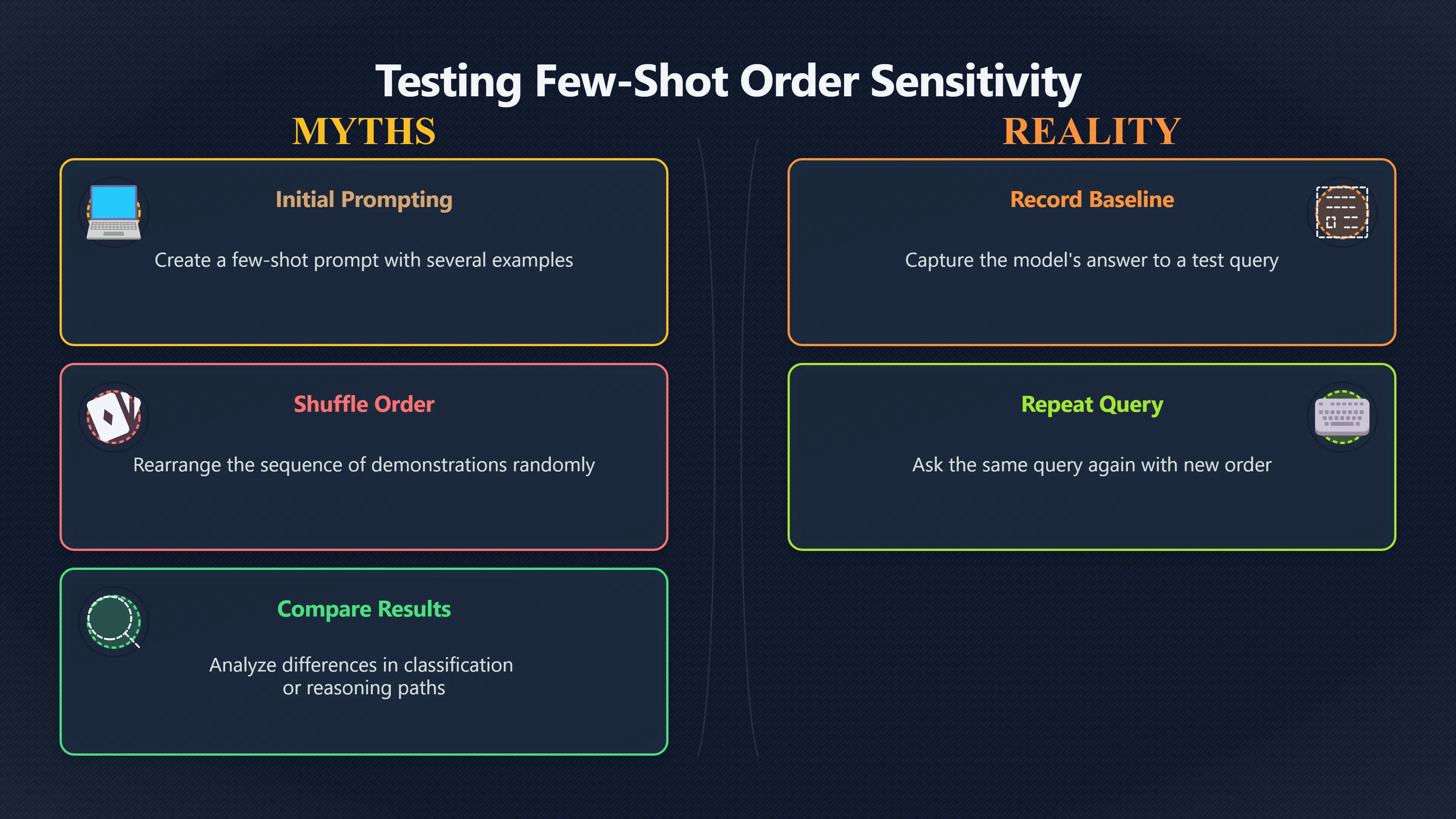
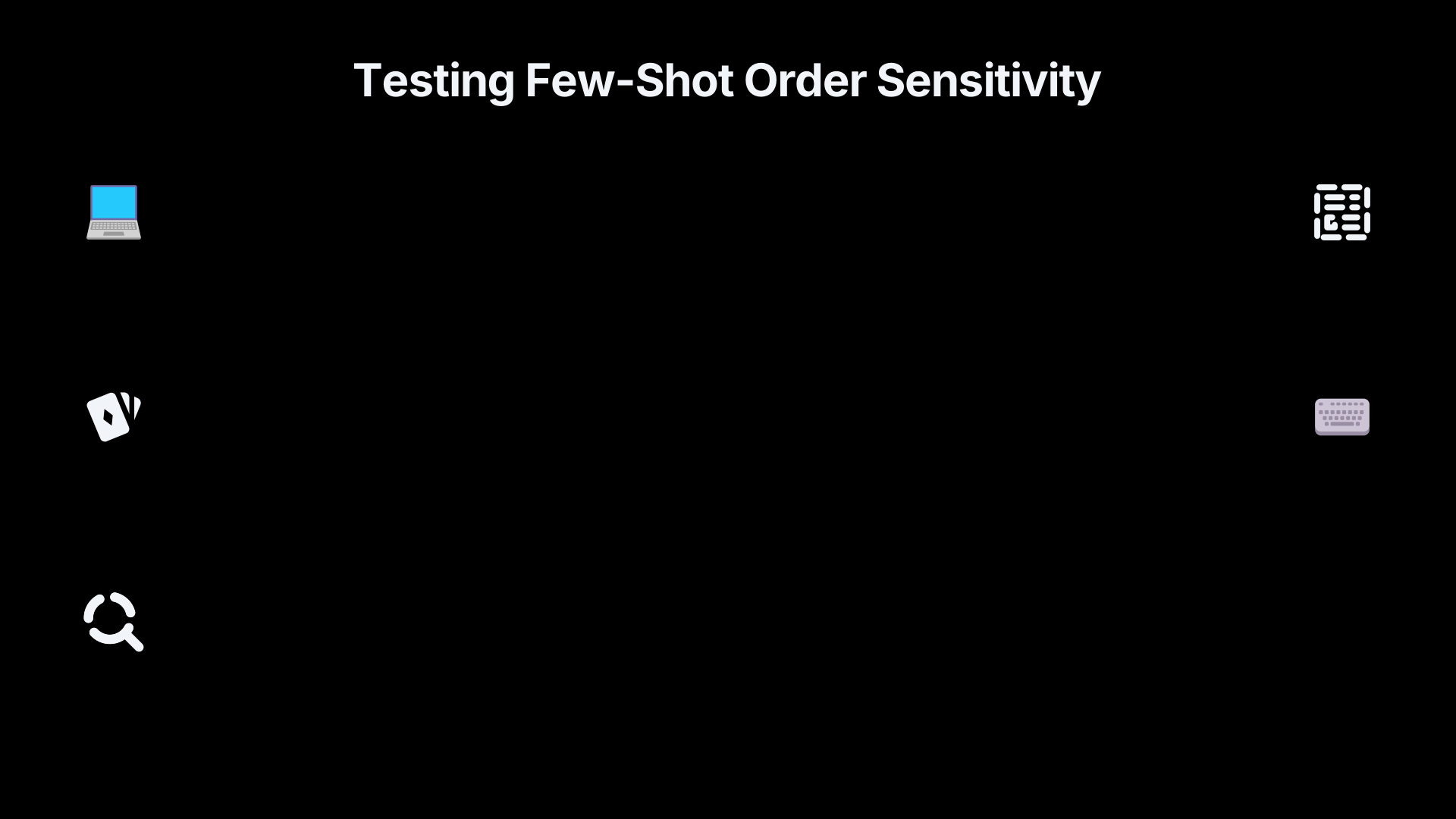
- Create a few-shot prompt with several examples.
- Record the model’s answer to a test query.
- Shuffle the order of the demonstrations.
- Ask the same query again.
- Compare the outputs.
If the task is straightforward, the answer may remain stable. On more ambiguous tasks, however, the model may change its classification, reasoning path, confidence, style or formatting. Researchers often evaluate multiple prompt permutations precisely because a single ordering can give a misleading picture of performance.[arXiv+2arXiv]arxiv.orgAuthors:Yao Lu, Max Bartolo, Alastair Moore,Fantastically Ordered Prompts and Where to Find ThemApril 18, 2021 — by Y Lu · 2021 · Cited by 1742 — Fantastically Ordered Prompts…
Another useful test is to move one particularly representative example closer to or farther from the final query. If the output changes, that suggests the example’s position was helping shape the local rule the model inferred.
Why this matters when using few-shot prompts
The key lesson is that few-shot prompts do not simply provide examples; they provide examples in a sequence. Because language models are designed to continue sequences, the arrangement itself becomes part of the instruction.
When example order changes, the model may focus on different clues, assign different importance to demonstrations, or form a different temporary hypothesis about the task. That is why two prompts containing the same information can still produce different answers. Understanding this mechanism makes few-shot prompting easier to use and helps explain why prompt engineering often involves not only selecting examples but also carefully arranging them.[Prompting Guide+2IBM]promptingguide.aiPrompting GuideFew-Shot Prompting1 Feb 2026 — Few-shot prompting can be used as a technique to enable in-context learning where we provid…
Amazon book picks
Further Reading
Books and field guides related to Why example order can change AI answers. Use these as the next step if you want deeper reading beyond the article.
Prompt Engineering for Generative AI
Directly relates to arranging examples and instructions.
eBay marketplace picks
Marketplace Samples
Example marketplace items related to this page. Use the search link to explore similar finds on eBay.



Endnotes
1.
Source: arxiv.org
Title: Authors:Yao Lu, Max Bartolo, Alastair Moore,
Link:https://arxiv.org/abs/2104.08786
Source snippet
Fantastically Ordered Prompts and Where to Find ThemApril 18, 2021 — by Y Lu · 2021 · Cited by 1742 — Fantastically Ordered Prompts...
Published: April 18, 2021
2.
Source: arxiv.org
Link:https://arxiv.org/abs/2402.15637
3.
Source: arxiv.org
Link:https://arxiv.org/html/2402.05403v2
Source snippet
In-Context Principle Learning from Mistakes9 Feb 2024 — In-context learning (ICL, also known as few-shot prompting) has been the sta...
4.
Source: openreview.net
Link:https://openreview.net/forum?id=iLUcsecZJp
Source snippet
Why In-Context Learning Models are Good Few-Shot...by S Wu · Cited by 19 — Our findings show that ICL with transformers can ef...
5.
Source: openreview.net
Link:https://openreview.net/forum?id=D8oHQ2qSTj¬eId=J2yKqqDNbI
Source snippet
Example selection is quite important for few-shot...Read more...
6.
Source: openreview.net
Link:https://openreview.net/forum?id=D8oHQ2qSTj
Source snippet
Example selection is quite important for few-shot...Read more...
7.
Source: arxiv.org
Title: arXiv Structured Prompting: Scaling In-Context Learning to 1,000 Examples
Link:https://arxiv.org/abs/2212.06713
8.
Source: openreview.net
Link:https://openreview.net/forum?id=RIu5lyNXjT
Source snippet
How I learned to start worrying about prompt formattingby M Sclar · Cited by 766 — The paper investigates a critical issue for...
9.
Source: ibm.com
Link:https://www.ibm.com/think/topics/in-context-learning
Source snippet
specially in smaller models or edge cases...
10.
Source: arxiv.org
Link:https://arxiv.org/pdf/2511.09700
Source snippet
Rethinking Prompt Construction in In-Context Learningby W Li · 2025 — Order matters: Re-evaluating few-shot prompt- ing for text...
11.
Source: arxiv.org
Link:https://arxiv.org/html/2509.13196v1
Source snippet
The Few-shot Dilemma: Over-prompting Large Language...Sep 16, 2025 — We propose a few-shot selection framework and investigate the few-s...
12.
Source: openreview.net
Link:https://openreview.net/forum?id=ewRkjUX4SY
Source snippet
prompting technique, which structures few-shot examples as multi-turn conversation...Read more...
13.
Source: genai.stackexchange.com
Title: what is the difference between in context learning and few shot prompting
Link:https://genai.stackexchange.com/questions/638/what-is-the-difference-between-in-context-learning-and-few-shot-prompting
Source snippet
Few-shot prompting...
14.
Source: ibm.com
Link:https://www.ibm.com/think/topics/few-shot-prompting
15.
Source: promptingguide.ai
Link:https://www.promptingguide.ai/techniques/fewshot
Source snippet
Prompting GuideFew-Shot Prompting1 Feb 2026 — Few-shot prompting can be used as a technique to enable in-context learning where we provid...
16.
Source: dictionary.cambridge.org
Link:https://dictionary.cambridge.org/dictionary/english/prompt
Source snippet
English meaning - Cambridge DictionaryPROMPT definition: 1. to make something happen: 2. to make someone decide to say or do something...
Additional References
17.
Source: reddit.com
Link:https://www.reddit.com/r/PromptEngineering/comments/1cgzkdi/everything_you_need_to_know_about_few_shot/
18.
Source: medium.com
Link:https://medium.com/%40blazingbhavneek/fantastically-ordered-prompts-and-where-to-find-them-5d55a899ea96
Source snippet
Fantastically Ordered Prompts and Where to Find ThemWe have shown that few-shot prompts suffer from order sensitivity, in that, for the s...
19.
Source: apxml.com
Link:https://apxml.com/courses/prompt-engineering-llm-application-development/chapter-2-advanced-prompting-strategies/few-shot-prompting
Source snippet
Few-Shot PromptingExample Sensitivity: Model performance can sometimes be surprisingly sensitive to the specific examples chosen, their f...
20.
Source: medium.com
Link:https://medium.com/%40akankshasinha247/few-shot-prompting-teaching-ai-with-just-a-few-examples-6819273fd6e2
Source snippet
Few-Shot Prompting: Teaching AI With Just a Few ExamplesFew-shot prompting is one of the most practical and powerful prompt engineering t...
21.
Source: medium.com
Link:https://medium.com/%40willystumblr/fantastically-ordered-prompts-and-where-to-find-them-overcoming-few-shot-prompt-order-sensitivity-3303a8f0a725
Source snippet
Overcoming Few-Shot Prompt Order Sensitivity (Lu et al....This paper further develops the study: it analyzes the prompt order sensitivity...
22.
Source: researchgate.net
Link:https://www.researchgate.net/publication/385140768_Order_Matters_Exploring_Order_Sensitivity_in_Multimodal_Large_Language_Models
Source snippet
Order Matters: Exploring Order Sensitivity in Multimodal...22 Oct 2024 — Multimodal Large Language Models (MLLMs) utilize multimodal con...
23.
Source: youtube.com
Link:https://www.youtube.com/watch?v=Ns7oxTn5U6A
Source snippet
Few-Shot Prompting Explained with Powerful Examples (No...FEW SHOT PROMPTS ---------------- Few-shot prompting means giving the AI a few...
24.
Source: researchgate.net
Link:https://www.researchgate.net/publication/362944317_Fantastically_Ordered_Prompts_and_Where_to_Find_Them_Overcoming_Few-Shot_Prompt_Order_Sensitivity
Source snippet
In the public dataset CERRE, the method proposed in this paper outperformed the 32B-scale large-...Read more...
25.
Source: sambanova.ai
Title: Averaging over multiple random orders yields more stable and reliable
Link:https://sambanova.ai/blog/many-shot-prompting-a-practical-guide-to-icl
Source snippet
Many-Shot Prompting: A Practical Guide to In-Context...Apr 22, 2026 — many-shot ICL remains order-sensitive due to positional attention...
26.
Source: pristren.com
Link:https://pristren.com/blog/few-shot-prompting-guide/
Source snippet
Few-Shot Prompting: When It Works, When It Fails, With...11 May 2026 — Few-shot prompting uses 3-5 examples to show the model the patter...
Published: May 2026
Topic Tree