Within Search Ranking
How one word can change the results
Small changes in wording can change ranked results because search systems must guess meaning from short or vague queries.
On this page
- Why short queries leave room for interpretation
- Context signals such as location and settings
- Practical ways to test a search result set
Page outline Jump by section
Introduction
Search ranking begins before any results are ordered. When someone types a query, the search system must first decide what that query probably means. A few words typed into a search box rarely provide complete information, so modern search engines use AI systems to infer intent, fill in missing context and estimate what the user is actually trying to accomplish. This interpretation stage is one reason search ranking is an AI output rather than a simple database lookup. Small changes in wording can produce noticeably different result sets because different words suggest different intentions, audiences or goals. Google states that its ranking systems analyse the meaning of queries and use contextual signals such as location, search settings and other factors to determine what is most relevant at that moment.[Google]google.comHow Does Google Determine Ranking ResultsDiscover how key factors such as meaning, relevance, and quality are used to generate how…
 Understanding how this process works helps explain why two people can search for similar things and receive different results, and why changing a single word can sometimes transform the entire first page.
Why Short Queries Leave Room for Interpretation
Many searches are surprisingly vague. A query such as “jaguar”, “mercury”, “apple” or “python” contains multiple possible meanings. Search systems must estimate which interpretation is most likely before they can rank results. Research on web search ambiguity has shown that a significant proportion of user queries have multiple plausible interpretations, making ambiguity a routine challenge rather than an exceptional case.[ResearchGate]researchgate.netIdentifying ambiguous queries in web searchFirst, we construct the taxonomy of query ambiguity, and ask human annotators to m…
This uncertainty becomes even more important when queries contain only two or three words. Consider these examples:
- “best camera” suggests a buying decision.
- “camera repair” suggests a service need.
- “camera history” suggests an informational goal.
- “camera settings for wildlife” suggests practical guidance.
The core subject remains the same, but the wording signals different intentions. Search systems therefore try to identify not only the topic but also the task behind the query. Information retrieval researchers often describe this as understanding user intent rather than merely matching keywords.[Medium]dtunkelang.medium.comMapping Search Queries To Search IntentsMapping Search Queries To Search Intents - Daniel TunkelangRecognizing when two or more search queries represent the same intent op…
Modern search engines increasingly rely on semantic understanding. Google’s neural matching system, for example, is designed to understand relationships between concepts rather than relying solely on exact word matches. This helps connect searches with relevant information even when the wording differs from the wording used on a webpage.[Google for Developers]developers.google.comfor Developers A Guide to Google Search Ranking Systems Neural matchingNeural matching is an AI system that Google uses to understand representations of concepts in queries and pages and match them to one ano…
How Search Systems Guess What You Mean
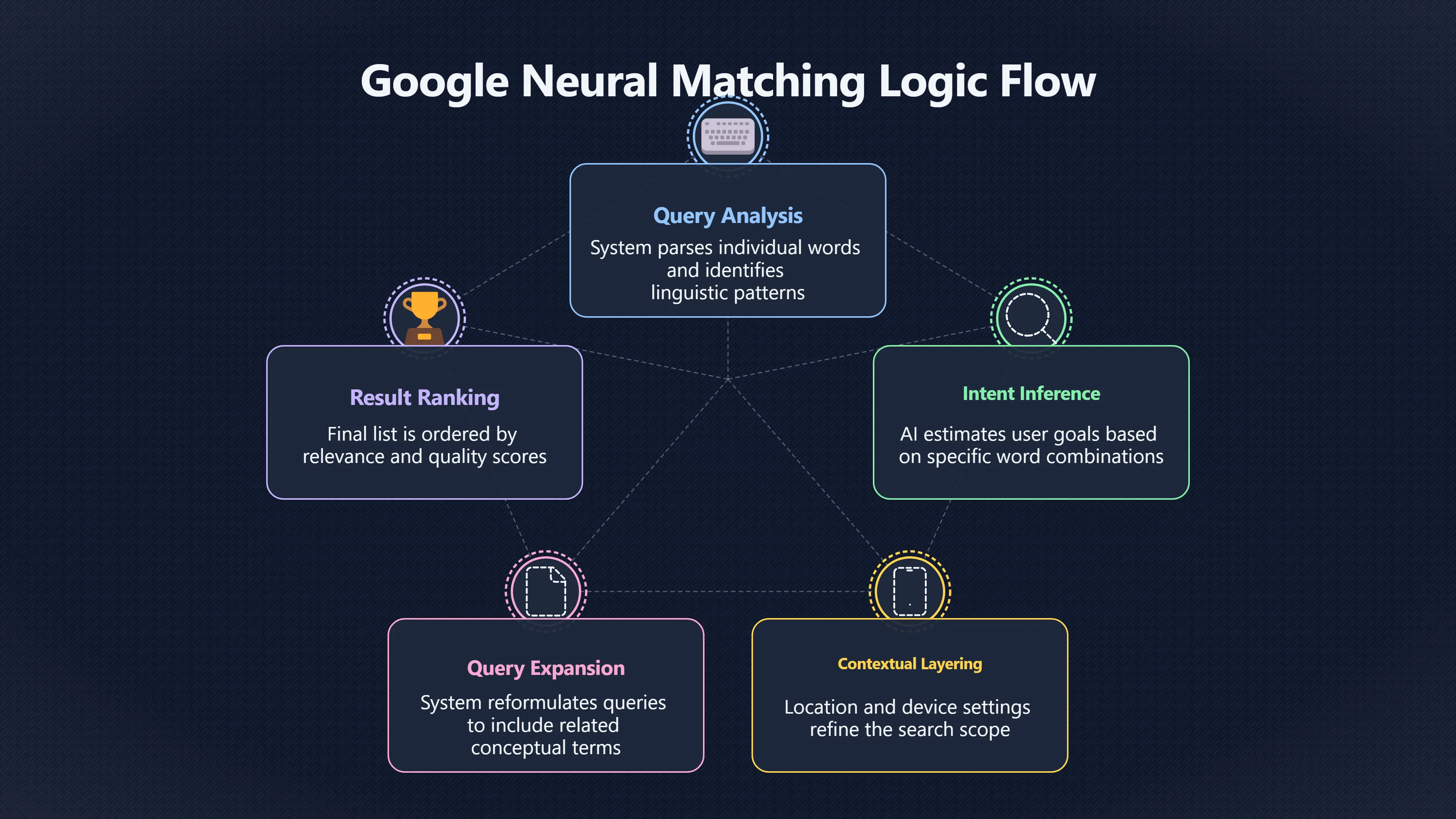
The process of intent inference involves several layers of interpretation.
First, the system analyses the words themselves. Some terms strongly indicate a particular goal. A search containing words such as “buy”, “price”, “review” or “compare” often signals commercial intent, while words such as “definition”, “history” or “meaning” often signal an informational search.
Second, the system looks at relationships between words. A query such as “can you get medicine on holiday abroad” conveys a different purpose from “medicine history abroad”, even though both contain similar vocabulary. Modern language models and ranking systems examine how words interact within the whole query rather than treating each term independently. Google’s ranking documentation notes that AI systems such as neural matching help connect concepts represented in queries with concepts represented in pages.[Google for Developers]developers.google.comfor Developers A Guide to Google Search Ranking Systems Neural matchingNeural matching is an AI system that Google uses to understand representations of concepts in queries and pages and match them to one ano…
Third, search engines often reformulate queries internally. Information retrieval research has long explored query expansion and query reformulation techniques that add related concepts or alternative expressions to improve retrieval when a user’s wording is incomplete or mismatched with available content.[ResearchGate]researchgate.netFollowing established evidence…Read more…
This means that the query a user types is not always the exact query the ranking system ultimately uses when searching its index. The system may expand, reinterpret or connect terms to broader concepts before ranking results.[ResearchGate]researchgate.netFollowing established evidence…Read more…
Context Signals Such as Location and Settings
Intent is not inferred from words alone. Search systems also use context.
Google publicly states that search results may be influenced by factors such as location, language preferences, search settings and other contextual information. The same query can therefore produce different rankings for different people.[Google]google.comHow Does Google Determine Ranking ResultsDiscover how key factors such as meaning, relevance, and quality are used to generate how…
The often-cited example is the word “football”. In the United States, the query commonly returns results related to American football. In the United Kingdom, the same query is more likely to prioritise association football. Google specifically uses this example to explain how contextual relevance works.[Google]google.comHow Does Google Determine Ranking ResultsDiscover how key factors such as meaning, relevance, and quality are used to generate how…
Location becomes even more important for practical searches. A query such as “pizza delivery”, “chemist” or “train station” is difficult to interpret without knowing where the user is. Google’s explanation of local relevance notes that location helps ensure that nearby businesses and services appear instead of geographically irrelevant results.[blog.google]blog.googlelocation relevant search resultsHow location helps provide more relevant search resultsDec 16, 2020 — How location helps provide more relevant search results · Finding b…
Other contextual signals can also matter:
- Preferred language settings.
- Device type.
- Regional search trends.
- Search personalisation settings.
- Previous searches within the same session.
These signals help the system estimate what would be useful, but they also mean that search results are not identical for every user.[Google Help]support.google.comWhen Search considers the context of your search, it gives more relevant results. Some examples of context are: Location…Read more…

Why One Word Can Change the Results
Because ranking depends on inferred intent, even minor wording changes can alter the system’s interpretation.
Consider the difference between:
- “electric cars”
- “best electric cars”
- “electric car problems”
- “electric car tax”
Each query points towards a different information need. The first is broad and exploratory. The second implies evaluation. The third focuses on drawbacks. The fourth suggests policy or financial information.
Search systems respond by prioritising different types of sources. Reviews may dominate one result page, government guidance another, and news coverage a third. The change occurs not because the database changed, but because the AI interpretation of the query changed.
Researchers studying query reformulation have repeatedly found that users modify searches when initial results do not match their expectations. Adding a single clarifying word often narrows the intended meaning and produces a substantially different ranking.[Jia Chen (陈佳)]xuanyuan14.github.ioestigation of users' session-level reformulation behavior on a large-scale session dataset and discover some interesting…Read more…
This is one reason search literacy matters. People sometimes assume that search results reveal an objective view of available information. In reality, results reflect both the information indexed by the search engine and the search engine’s interpretation of the query.
Practical Ways to Test a Search Result Set
One useful way to understand intent inference is to experiment with query wording.
Try changing only one element of a search:
- Replace a broad noun with a more specific one.
- Add a location.
- Add words such as “guide”, “review”, “evidence” or “research”.
- Remove emotionally loaded terms.
- Compare singular and plural forms.
Then compare the first page of results.
Patterns often emerge. Different sources appear. Different result formats become prominent. Different assumptions about user goals become visible. These changes reveal the hidden interpretation layer operating between the query and the ranked results.
Another useful technique is query reformulation. If a search produces unsatisfactory results, changing the wording may be more effective than scrolling further down the page. Information retrieval research consistently treats reformulation as a central part of successful search behaviour because the system’s understanding of intent is shaped by the words provided.[arXiv+2Jia Chen (陈佳)]arxiv.orgA Survey of Conversational SearchIn conversational search, query reformulation is critical due to the complex nature of user intent…

Query Intent as an Everyday AI Decision
Search ranking is often discussed as if it begins when results are ordered. In practice, an important AI decision happens earlier. Before ranking can occur, the system must estimate what the user means.
That estimation involves handling ambiguity, interpreting language, applying contextual signals and connecting queries to concepts rather than simply matching exact words. Modern ranking systems use AI-driven approaches such as neural matching and other language-understanding methods to perform this task.[Google for Developers+2blog.google]developers.google.comfor Developers A Guide to Google Search Ranking Systems Neural matchingNeural matching is an AI system that Google uses to understand representations of concepts in queries and pages and match them to one ano…
As a result, the words people choose are not merely instructions for retrieving information. They are inputs into a process that interprets intent and shapes what information becomes visible in the first place.
Amazon book picks
Further Reading
Books and field guides related to How one word can change the results. Use these as the next step if you want deeper reading beyond the article.
Introduction to Information Retrieval
Rating: 5.0/5 from 5 Google Books ratings
Explains queries, relevance, ranking, and retrieval methods.
Modern Information Retrieval
Rating: 4.0/5 from 5 Google Books ratings
Covers query interpretation and retrieval effectiveness.
Search Patterns
Rating: 3.0/5 from 92 Google Books ratings
Explores how people search and how systems respond.
eBay marketplace picks
Marketplace Samples
Example marketplace items related to this page. Use the search link to explore similar finds on eBay.




Endnotes
1.
Source: google.com
Link:https://www.google.com/intl/en_us/search/howsearchworks/how-search-works/ranking-results
Source snippet
How Does Google Determine Ranking ResultsDiscover how key factors such as meaning, relevance, and quality are used to generate how...
2.
Source: support.google.com
Link:https://support.google.com/websearch/answer/12412910?hl=en
Source snippet
When Search considers the context of your search, it gives more relevant results. Some examples of context are: Location...Read more...
3.
Source: researchgate.net
Link:https://www.researchgate.net/publication/200110575_Identifying_ambiguous_queries_in_web_search
Source snippet
Identifying ambiguous queries in web searchFirst, we construct the taxonomy of query ambiguity, and ask human annotators to m...
4.
Source: dtunkelang.medium.com
Title: Mapping Search Queries To Search Intents
Link:https://dtunkelang.medium.com/search-queries-and-search-intent-1dec79ad155f
Source snippet
Mapping Search Queries To Search Intents - Daniel TunkelangRecognizing when two or more search queries represent the same intent op...
5.
Source: arxiv.org
Link:https://arxiv.org/html/2308.07107v3
Source snippet
Large Language Models for Information Retrieval: A Survey19 Jan 2024 — In this survey, we delve into the confluence of LLMs and IR s...
6.
Source: developers.google.com
Title: for Developers A Guide to Google Search Ranking Systems Neural matching
Link:https://developers.google.com/search/docs/appearance/ranking-systems-guide
Source snippet
Neural matching is an AI system that Google uses to understand representations of concepts in queries and pages and match them to one ano...
7.
Source: researchgate.net
Link:https://www.researchgate.net/publication/333446085_Query_expansion_techniques_for_information_retrieval_A_survey
Source snippet
Following established evidence...Read more...
8.
Source: arxiv.org
Title: arXiv Deep Reinforced Query Reformulation for Information Retrieval
Link:https://arxiv.org/abs/2007.07987
9.
Source: blog.google
Title: location relevant search results
Link:https://blog.google/products-and-platforms/products/search/location-relevant-search-results/
Source snippet
How location helps provide more relevant search resultsDec 16, 2020 — How location helps provide more relevant search results · Finding b...
10.
Source: arxiv.org
Link:https://arxiv.org/html/2410.15576v2
Source snippet
A Survey of Conversational SearchIn conversational search, query reformulation is critical due to the complex nature of user intent...
11.
Source: arxiv.org
Title: arXiv Conv GQR: [Generative]({{ ‘generative-ai/’ | relative_url }}) Query Reformulation for Conversational Search
Link:https://arxiv.org/abs/2305.15645
12.
Source: blog.google
Title: how ai powers great search results
Link:https://blog.google/products-and-platforms/products/search/how-ai-powers-great-search-results/
Source snippet
Feb 3, 2022 — Thanks to this type of understanding, RankBrain (as its name suggests) is used to help rank — or decide the best order for...
13.
Source: youtube.com
Link:https://www.youtube.com/watch?v=hfNYKn9M9lQ
Source snippet
Google RankBrain EXPLAINED In Under 3 Minutes...
14.
Source: youtube.com
Title: Google Rank Brain EXPLAINED In Under 3 Minutes
Link:https://www.youtube.com/watch?v=1FxVBADBjeQ
15.
Source: seroundtable.com
Title: google explains neural matching vs rankbrain 27300
Link:https://www.seroundtable.com/google-explains-neural-matching-vs-rankbrain-27300.html
Source snippet
Neural matching is an artificial intelligence based system that...Read more...
16.
Source: xuanyuan14.github.io
Link:https://xuanyuan14.github.io/files/CCIR19chen.pdf
Source snippet
estigation of users' session-level reformulation behavior on a large-scale session dataset and discover some interesting...Read more...
Additional References
17.
Source: youtube.com
Title: What if user satisfaction is all that matters for ranking on Google?
Link:https://www.youtube.com/watch?v=mYwU1eyUm3s
Source snippet
AI-Native Search Evolution | How Artificial Intelligence Is Reinventing Search Systems | Uplatz...
18.
Source: eprints.whiterose.ac.uk
Link:https://eprints.whiterose.ac.uk/id/eprint/78547/7/WRRO_78547.pdf
Source snippet
White Rose Research OnlineMultiple Approaches to Analysing Query Diversityby P Clough · 2009 · Cited by 59 — In this paper we examine use...
19.
Source: elastic.co
Title: Retrieval queries.Read more
Link:https://www.elastic.co/search-labs/blog/query-rewriting-llm-search-improve
Source snippet
Query rewriting strategies for LLMs & search enginesJan 30, 2026 — Query rewriting strategies are best understood by categorizing...
20.
Source: elastic.co
Title: What is Search Relevance?
Link:https://www.elastic.co/what-is/search-relevance
Source snippet
A Comprehensive...Contextual relevance allows search engines to tailor results based on user-specific factors including geographical l...
21.
Source: ceur-ws.org
Title: paper 12
Link:https://ceur-ws.org/Vol-2950/paper-12.pdf
Source snippet
Toward Conversational Query Reformulationby J Kiesel · 2021 · Cited by 11 — Our analysis of the meta-queries reveals a large varie...
22.
Source: youtube.com
Title: What is Search Intent? Keyword Search Intent Explained For Beginners
Link:https://www.youtube.com/watch?v=83aDlCwmlns
Source snippet
What is Search Intent in SEO with Examples - SEO Tutorials...
23.
Source: youtube.com
Title: What is Search Intent in SEO with Examples
Link:https://www.youtube.com/watch?v=BWcIGqp3sw4
Source snippet
What if user satisfaction is all that matters for ranking on Google?...
Topic Tree