Within Fake citations
Why fake citations sound so real
AI can learn the shape of scholarly authority well enough to invent references that look researched before anyone checks them.
On this page
- How models learn citation grammar
- Why plausible details replace verification
- Examples of citation shaped hallucinations
Page outline Jump by section
Introduction
Fake AI citations are rarely random inventions. They are usually assembled from patterns the model has learned about what a credible reference should look like. This is why a fabricated source can appear so convincing: the author names look plausible, the journal title fits the topic, the publication year seems reasonable, and even identifiers such as page numbers or case citations follow familiar conventions. The model has learned the structure of authority so well that it can generate references that resemble genuine scholarship even when no matching source exists. Research across academic, medical, and legal domains shows that these citation-shaped hallucinations are a persistent failure mode of large language models.[ResearchGate+2MDPI]researchgate.netResearchGate(PDF) Do Language Models Know When They're Hallucinating References?May 29, 2023…
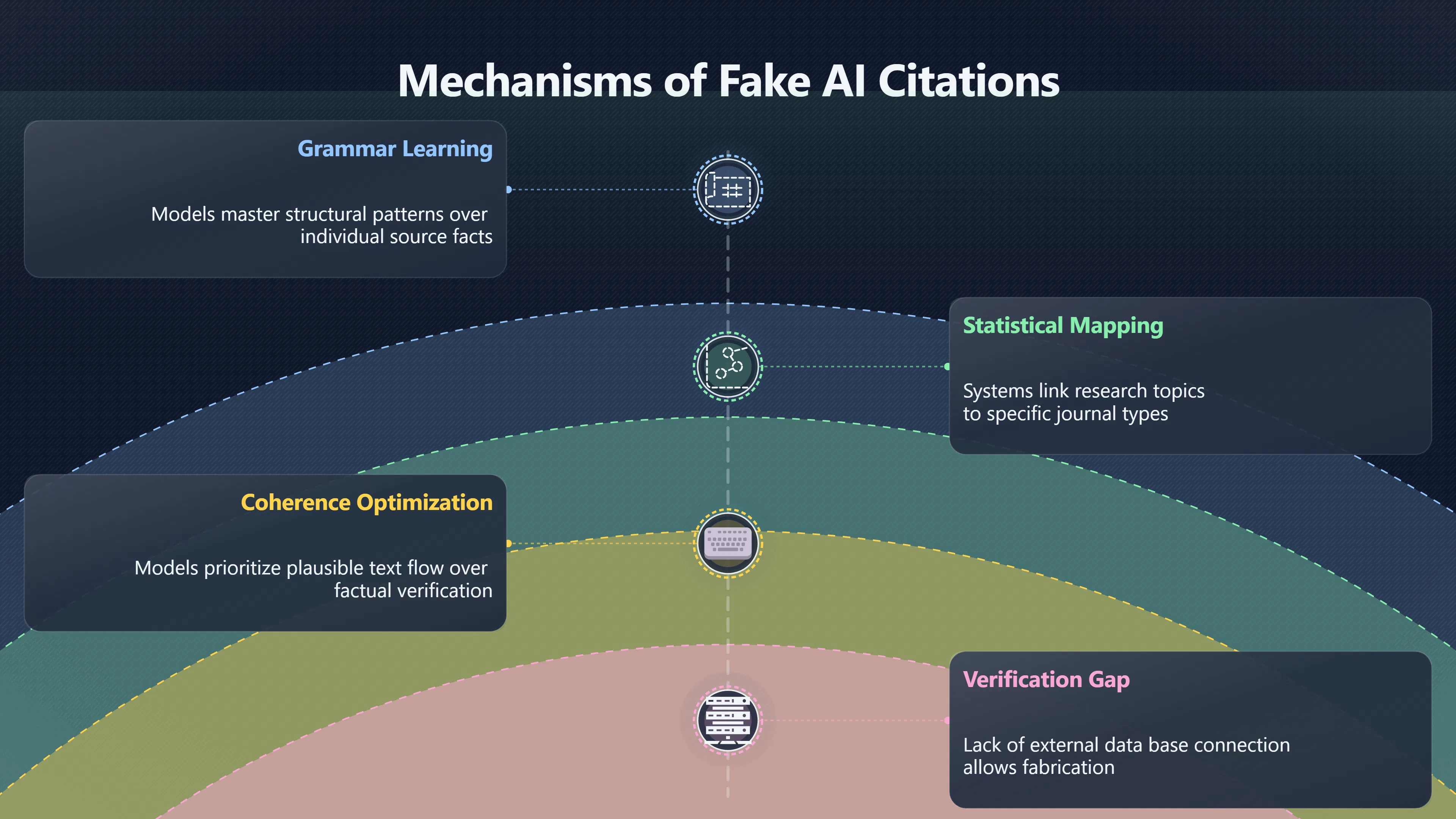
 Understanding how citation patterns become fake sources requires looking at a specific mechanism: models learn citation grammar more reliably than they learn the existence of individual references.
How models learn citation grammar
A citation is not just a collection of facts. It follows a highly regular pattern. Academic references contain predictable combinations of author names, publication years, titles, journals, volume numbers, page ranges, and identifiers. Legal citations have similarly rigid structures. During training, language models encounter millions of these patterns and become highly skilled at reproducing them.[ResearchGate]researchgate.netResearchGate(PDF) Do Language Models Know When They're Hallucinating References?May 29, 2023…
The important point is that the model is learning statistical relationships, not maintaining a verified catalogue of every source ever published. It learns that:
- Certain research topics often appear in particular journals.
- Certain author names frequently occur together.
- Technical titles follow recognisable wording patterns.
- Citation formats differ by discipline but remain internally consistent.
When asked for references, the model can combine these learned elements into a citation that looks authentic because every component individually resembles something real. The resulting reference may be entirely fabricated, partly fabricated, or a hybrid assembled from fragments of genuine publications.[Cool Papers]papers.coolCool PapersCompound Deception in Elite Peer Review: A Failure Mode Taxonomy of 100 Fabricated Citations at NeurIPS 2025 | Cool Papers - I…
This is similar to how a person can produce a grammatically correct sentence about an event that never happened. The structure is correct even when the underlying claim is false.
Why plausible details replace verification
The transition from citation pattern to fake source occurs because language generation and source verification are different tasks.
A language model’s primary objective is to predict likely text. If a user asks for supporting evidence on a specialised topic, the model often generates the kind of reference that would normally accompany such a claim. Unless it is connected to a retrieval system or external database, it has no built-in mechanism that guarantees the source actually exists.[ResearchGate]researchgate.netResearchGate(PDF) Do Language Models Know When They're Hallucinating References?May 29, 2023…
Researchers studying hallucinated references have found that fabricated citations frequently contain a mixture of correct and incorrect details. A title may resemble a real paper, the journal may genuinely exist, and the publication year may fit the field’s timeline, yet the complete reference cannot be found anywhere.[ResearchGate]researchgate.netResearchGate(PDF) Do Language Models Know When They're Hallucinating References?May 29, 2023…
This happens because the model is optimising for coherence rather than verification. From the model’s perspective, producing a reference that fits the statistical pattern of scholarly writing is often easier than expressing uncertainty. The output therefore reflects what a source is likely to look like rather than whether a source can be confirmed.[DeepAI]deepai.orgDeep AIDo Language Models Know When They're Hallucinating References? | Deep AIDeep AIDo Language Models Know When They're Hallucinating References? | Deep AI
Examples of citation-shaped hallucinations
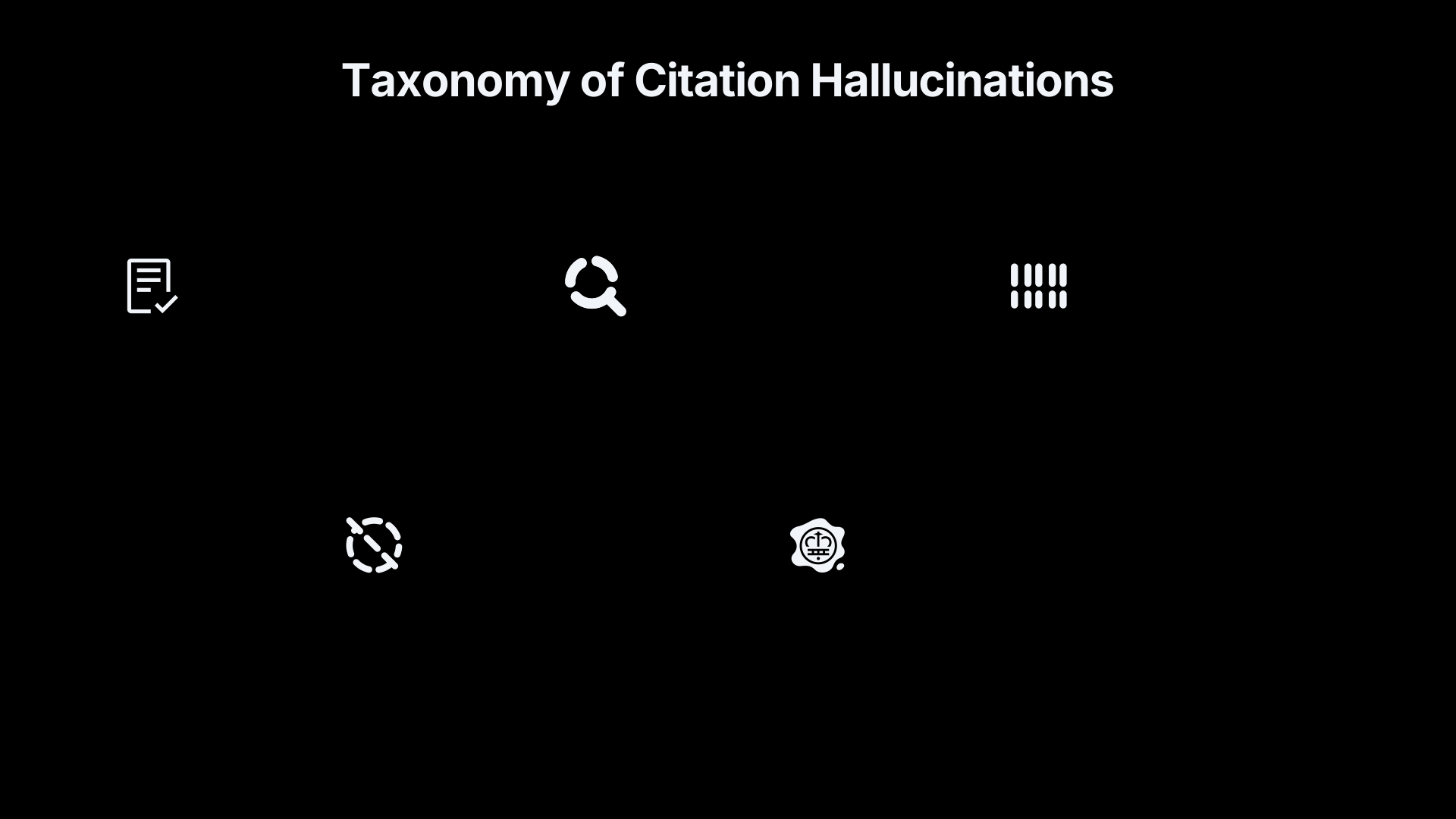
Not all fake citations are identical. Recent analyses have identified several recurring forms of citation fabrication.[Cool Papers]papers.coolCool PapersCompound Deception in Elite Peer Review: A Failure Mode Taxonomy of 100 Fabricated Citations at NeurIPS 2025 | Cool Papers - I…
Total fabrication
Every major component is invented. The authors, title, publication details, and identifiers collectively describe a source that does not exist. Studies examining AI-generated references continue to find substantial rates of complete fabrication.[Cool Papers]papers.coolCool PapersCompound Deception in Elite Peer Review: A Failure Mode Taxonomy of 100 Fabricated Citations at NeurIPS 2025 | Cool Papers - I…
Partial corruption
A real source exists, but some details are altered. The title may be slightly changed, an author omitted, a publication year modified, or a digital object identifier (DOI) replaced with an incorrect one. To a casual reader, the citation still appears legitimate.[Cool Papers]papers.coolCool PapersCompound Deception in Elite Peer Review: A Failure Mode Taxonomy of 100 Fabricated Citations at NeurIPS 2025 | Cool Papers - I…
Identifier hijacking
The model combines a real identifier with the wrong paper or mixes details from multiple sources. Because one part of the citation is genuine, the fabricated reference can survive superficial checking.[Cool Papers]papers.coolCool PapersCompound Deception in Elite Peer Review: A Failure Mode Taxonomy of 100 Fabricated Citations at NeurIPS 2025 | Cool Papers - I…
Semantic fabrication
The citation refers to a source that sounds exactly like the sort of paper that ought to exist. The title aligns perfectly with the topic, making the absence of a real publication difficult to notice without searching databases directly.[Cool Papers]papers.coolCool PapersCompound Deception in Elite Peer Review: A Failure Mode Taxonomy of 100 Fabricated Citations at NeurIPS 2025 | Cool Papers - I…
Why fake citations often survive human review
One reason fabricated references are dangerous is that they exploit the same credibility signals humans rely on when evaluating information.
Readers often judge a source before checking it. A detailed citation containing recognised journal names, realistic author lists, and precise publication information creates an impression of diligence and research. The more complete the reference appears, the more trustworthy it feels.[Nature]nature.comChatGPT: these are not hallucinations – they’re fabrications and falsifications | SchizophreniaAugust 19, 2023…
Evidence suggests that this effect extends beyond casual readers. Large-scale analyses have found fabricated citations appearing in academic manuscripts and even passing through peer-review processes. Researchers studying citation validity have documented invalid references in published papers and identified significant gaps in routine citation verification practices among both authors and reviewers.[Cool Papers]papers.coolCool PapersCompound Deception in Elite Peer Review: A Failure Mode Taxonomy of 100 Fabricated Citations at NeurIPS 2025 | Cool Papers - I…
The result is a credibility shortcut: people often verify the format before verifying the existence.

A memorable case: when citation grammar fooled professionals
The legal profession provides one of the clearest illustrations of citation-shaped hallucinations. In the widely discussed Mata v. Avianca case, lawyers submitted court filings containing fictitious judicial decisions generated by ChatGPT. The fabricated cases included realistic case names, plausible court details, and convincing legal language. Opposing counsel eventually discovered that the cited decisions could not be found in any legal database.[Wikipedia]WikipediaMata v. Avianca, IncMata v. Avianca, Inc
What made the incident notable was not merely that the citations were false. It was that they looked authentic enough to enter formal legal documents. The model had successfully reproduced the grammar of legal authority without providing real authority.[LegalClarity]legalclarity.orgLegal Clarity Mata v. Avianca: Fake Cases, Chat GPT, and SanctionsMata v. Avianca: Fake Cases, ChatGPT, and Sanctions - LegalClarity…
Similar incidents have continued to appear in courts, reinforcing the lesson that realistic citation structure should never be mistaken for evidence that verification has occurred.[Reuters]reuters.comJudge rules both sides in lawsuit misused AI, disqualifies lawyersDistrict Judge in Mississippi, Sharion Aycock, has disqualified all attorneys involved in a contract dispute case after discovering both…
The key mechanism behind fake sources
The central mechanism is simple but powerful: language models learn how references are constructed before they learn whether any particular reference exists.
Because scholarly citations follow highly regular patterns, a model can generate references that satisfy nearly every visual and structural expectation of academic authority. When verification is absent, statistical prediction fills the gap. The output therefore inherits the appearance of scholarship without necessarily inheriting its evidential foundation.[ResearchGate+2DeepAI]researchgate.netResearchGate(PDF) Do Language Models Know When They're Hallucinating References?May 29, 2023…
This is why fake citations sound so real. They are not random errors. They are the product of a system that has become remarkably good at imitating the form of knowledge, even when it cannot confirm the source behind it.[ResearchGate]researchgate.netResearchGate(PDF) Do Language Models Know When They're Hallucinating References?May 29, 2023…
Amazon book picks
Further Reading
Books and field guides related to Why fake citations sound so real. Use these as the next step if you want deeper reading beyond the article.
Artificial Intelligence
Explains why AI systems generate convincing but unreliable outputs.
You Look Like a Thing and I Love You
Demonstrates common AI failure modes and pattern-based mistakes.
Human Compatible
Provides background on why AI outputs require oversight and verification.
eBay marketplace picks
Marketplace Samples
Example marketplace items related to this page. Use the search link to explore similar finds on eBay.


Endnotes
1.
Source: researchgate.net
Link:https://www.researchgate.net/publication/371136684_Do_Language_Models_Know_When_They%27re_Hallucinating_References
Source snippet
ResearchGate(PDF) Do Language Models Know When They're Hallucinating References?May 29, 2023...
Published: May 29, 2023
2.
Source: mdpi.com
Link:https://www.mdpi.com/2306-5729/11/5/122
Source snippet
Evaluating the Integrity of LLM-Generated Citations: Prevalence and Risks of Fabricated References in Scientific Literature...
3.
Source: deepai.org
Title: Deep AIDo Language Models Know When They’re Hallucinating References? | Deep AI
Link:https://deepai.org/publication/do-language-models-know-when-they-re-hallucinating-references
4.
Source: papers.cool
Link:https://papers.cool/arxiv/2602.05930
Source snippet
Cool PapersCompound Deception in Elite Peer Review: A Failure Mode Taxonomy of 100 Fabricated Citations at NeurIPS 2025 | Cool Papers - I...
5.
Source: papers.cool
Link:https://papers.cool/arxiv/2603.07287
6.
Source: nature.com
Link:https://www.nature.com/articles/s41537-023-00379-4
Source snippet
ChatGPT: these are not hallucinations – they’re fabrications and falsifications | SchizophreniaAugust 19, 2023...
Published: August 19, 2023
7.
Source: Wikipedia
Title: Mata v. Avianca, Inc
Link:https://en.wikipedia.org/wiki/Mata_v._Avianca%2C_Inc
8.
Source: legalclarity.org
Title: Legal Clarity Mata v. Avianca: Fake Cases, Chat GPT, and [Sanctions]({{ ‘sanctions/’ | relative_url }})
Link:https://legalclarity.org/what-happened-in-the-mata-v-avianca-case/
Source snippet
Mata v. Avianca: Fake Cases, ChatGPT, and Sanctions - LegalClarity...
9.
Source: reuters.com
Title: Judge rules both sides in lawsuit misused AI, disqualifies lawyers
Link:https://www.reuters.com/legal/litigation/judge-rules-both-sides-lawsuit-misused-ai-disqualifies-lawyers-2026-06-09/
Source snippet
District Judge in Mississippi, Sharion Aycock, has disqualified all attorneys involved in a contract dispute case after discovering both...
10.
Source: nature.com
Link:https://www.nature.com/articles/s41598-023-34806-4
Source snippet
intentions of information sources can affect what information people think qualifies as true | Scientific ReportsMay 12, 2023...
Published: May 12, 2023
11.
Source: arxiv.org
Link:https://arxiv.org/abs/2602.06718
Additional References
12.
Source: pcgamer.com
Link:https://www.pcgamer.com/software/ai/both-lawyers-in-case-use-hallucinating-ai-causing-judge-to-throw-up-hands-bar-them-for-2-years-fine-everybody-and-call-the-whole-thing-off-for-60-days/
Source snippet
Attorneys Kathleen M. Wilson and Kathryn Y. Williams used [generative AI]({{ 'generative-ai/' | relative_url }}) and did not verify the fictitious legal references it produced. T...
13.
Source: reddit.com
Link:https://www.reddit.com/r/science/comments/1p2jxl8/study_finds_nearly_twothirds_of_aigenerated/
Source snippet
Study finds nearly two-thirds of AI-generated citations are fabricated or contain errors. The lack of reliability of large language...
14.
Source: ft.com
Link:https://www.ft.com/content/b3828e92-4961-4b39-84f0-c42f33be3c3f
Source snippet
GPTZero's CEO Edward Tian warned that misinformation from authoritative firms like KPMG undermines public trust and risks spreading AI-in...
15.
Source: youtube.com
Link:https://www.youtube.com/watch?v=Cbe_mhdr4nM
Source snippet
Why AI Hallucinates Academic References | GPT-5.2, Claude 4.6 | Sonnet | Gemini 2.5 Pro Why AI Hallucinates Academic References | GPT-5.2...
16.
Source: reddit.com
Title: www.reddit.com Researchers just found 28 fake AI citations in medical papers
Link:https://www.reddit.com/r/ArtificialInteligence/comments/1tovv8g/researchers_just_found_28_fake_ai_citations_in/
Source snippet
just found 28 fake AI citations in medical papersMay 27, 2026...
Published: May 27, 2026
17.
Source: youtube.com
Link:https://www.youtube.com/watch?v=Czc-x-4NKu0
Source snippet
LLM Hallucinations: 146,000 Fake Citations Found...
18.
Source: youtube.com
Title: Stop Using AI to Write Research Papers (A Professor’s Warning)
Link:https://www.youtube.com/watch?v=24fkAF-W4dI
Source snippet
Introduction to AI for Data Analytics (Webinar)...
19.
Source: youtube.com
Title: LLM Hallucinations: 146,000 Fake Citations Found
Link:https://www.youtube.com/watch?v=0E3mHRT-g8I
Source snippet
Stop Using AI to Write Research Papers (A Professor's Warning)...
Topic Tree