Within RAG errors
When the right topic is the wrong evidence
A sourced answer can still fail when the system retrieves passages that are related to the question but not directly relevant.
On this page
- Why related passages can mislead the answer
- Medical question examples where missing specificity matters
- Checks that reveal whether retrieval matched the question
Page outline Jump by section
Introduction
A grounded AI system can cite real documents and still give the wrong answer. One of the most common reasons is retrieval mismatch: the system retrieves material that is topically related to the user’s question but not actually the evidence needed to answer it. Once those passages enter the context window, the language model often treats them as relevant and builds a coherent response around them. The result is a sourced answer that looks trustworthy because it references genuine documents, even though the retrieved evidence does not truly match the question. Research on retrieval-augmented generation (RAG) repeatedly identifies retrieval quality as a central determinant of answer quality, with irrelevant or partially relevant context causing downstream reasoning errors and factual mistakes.[arXiv+2AI Evaluation Course]arxiv.orgRetrieval-Augmented Generation: A Comprehensive Survey of Architectures, Enhancements, and Robustness FrontiersMay 28, 2025…

When related passages become the wrong evidence
Retrieval systems usually search for passages that appear similar to the user’s query. Similarity, however, is not the same thing as relevance.
A user may ask a narrow question about a specific medical treatment, regulation, or event. The retrieval system might return passages discussing the same disease, law, or topic area without addressing the exact issue being asked. Because the retrieved material shares keywords and concepts with the question, it often receives a high ranking even though it lacks the required answer.[Sciety]sciety.orgRetrieval-augmented generation for natural language processing: a survey | ScietyJune 1, 2026…
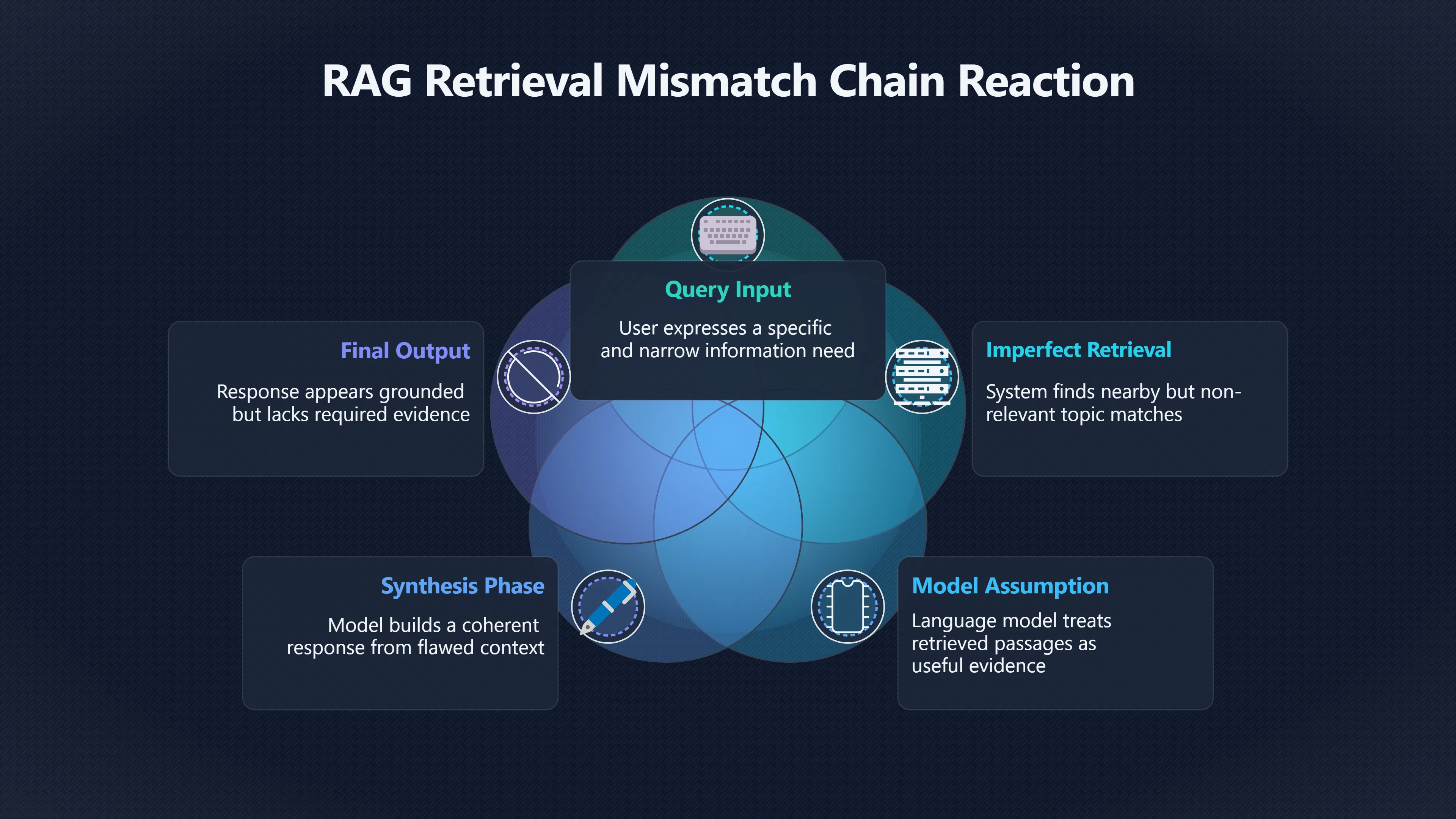
This creates a chain reaction:
- The query expresses a specific information need.
- Retrieval finds nearby but imperfect matches.
- The language model assumes the retrieved passages are useful evidence.
- The model synthesises an answer from those passages.
- The final response appears grounded because the sources are real.
The crucial failure occurs before generation begins. The model is not inventing facts from nowhere; it is being guided by evidence that is related but not sufficiently relevant. Studies of search-augmented language models have shown that noisy or irrelevant retrieval can actively reduce answer quality and increase misleading outputs.[Apple Machine Learning Research]machinelearning.apple.comApple Machine Learning ResearchOver-Searching in Search-Augmented Large Language Models - Apple Machine Learning Research…
Why specificity matters more than topic similarity
Many retrieval systems are optimised to find documents that are semantically similar to a query. This works well for broad questions but can fail when small distinctions determine the correct answer.
Consider the difference between these questions:
- What are the symptoms of asthma?
- What symptoms distinguish severe asthma from mild asthma in adults?
The two questions share most of their vocabulary. A retrieval system that focuses primarily on topic similarity may retrieve general asthma information rather than evidence about severity classification in adults. The answer may therefore be broadly correct about asthma while failing to answer the actual question.[Reddit]reddit.comLimitations of Chunking and Retrieval in Q&A SystemsLimitations of Chunking and Retrieval in Q&A Systems…
The same problem appears in legal, financial, and technical documents. A passage discussing a regulation may be retrieved because it contains matching terminology, even though the user’s question concerns an exception, amendment, threshold, or date that appears elsewhere.
In practical terms, retrieval mismatch often arises because the search system asks, “Is this about the same topic?” when it should ask, “Does this passage contain the evidence needed for this exact question?”
Medical examples where missing details change the answer
Medical question answering illustrates the danger especially clearly because small differences in context can have major consequences.
A clinician might ask about treatment recommendations for a particular patient group, such as pregnant patients, older adults, or people with specific coexisting conditions. If retrieval returns general treatment guidance rather than guidance for the relevant subgroup, the generated answer may sound authoritative while omitting the critical qualification.[ScienceDirect]sciencedirect.comMedical multi-recall embedding: Adaptive retrieval for diverse evidence in medical RAG systems - ScienceDirect…
Researchers evaluating medical RAG systems have noted that retrieval frequently struggles when questions require multiple complementary pieces of evidence rather than a single matching passage. Real clinical questions often depend on combining several documents, guidelines, or sections of a document. When retrieval captures only part of the required evidence, the generated answer can become incomplete or misleading.[ScienceDirect]sciencedirect.comMedical multi-recall embedding: Adaptive retrieval for diverse evidence in medical RAG systems - ScienceDirect…
Another common failure occurs when retrieval finds evidence for the wrong clinical scenario. Two diseases may share symptoms, or two treatments may appear in the same guideline. If the retrieved passages describe the neighbouring condition rather than the target condition, the model may confidently answer the wrong question while citing legitimate medical sources.[ScienceDirect]sciencedirect.comMedical multi-recall embedding: Adaptive retrieval for diverse evidence in medical RAG systems - ScienceDirect…
The mistake is subtle because the cited material is not obviously false. The problem is that it answers a different question.
How ranking errors amplify mismatch
Retrieval systems rarely return only one passage. They usually rank many candidate passages and place the most promising ones at the top.
A mismatch can occur even when the correct evidence is present.
Imagine that ten passages are retrieved:
- Passage 1 is highly related but not directly relevant.
- Passage 2 is highly related but incomplete.
- Passage 3 contains the exact answer.
If the model pays most attention to the highest-ranked passages, it may rely on Passages 1 and 2 while largely ignoring Passage 3. The correct evidence technically exists in the retrieved set, yet the answer still goes wrong because ranking favoured stronger topic overlap over stronger evidential relevance. Research on retrieval pipelines identifies ranking quality as a major determinant of downstream accuracy.[Atlan]atlan.comRetrieval-Augmented Generation: How RAG Works at Enterprise ScaleRetrieval-Augmented Generation: How RAG Works at Enterprise ScaleApril 3, 2026…
This explains why some sourced answers fail even when users later discover that the correct information was somewhere in the provided documents.
Why more retrieved documents do not always help
A common intuition is that retrieving more documents should reduce mistakes. In practice, additional documents can worsen retrieval mismatch.
When many partially relevant passages are included, important evidence competes with distracting evidence. The model must decide which information deserves attention. If several retrieved passages point toward a plausible but incorrect interpretation, they can outweigh the single passage that actually answers the question.[Apple Machine Learning Research]machinelearning.apple.comApple Machine Learning ResearchOver-Searching in Search-Augmented Large Language Models - Apple Machine Learning Research…
Researchers studying search-augmented systems have found that excessive or noisy retrieval can degrade performance rather than improve it. More context does not automatically mean better grounding. The composition of the retrieved evidence matters as much as the quantity.[Apple Machine Learning Research]machinelearning.apple.comApple Machine Learning ResearchOver-Searching in Search-Augmented Large Language Models - Apple Machine Learning Research…
This is sometimes called context dilution: the answer becomes less reliable because genuinely useful evidence is buried among loosely related material.
Checks that reveal whether retrieval matched the question
When evaluating a grounded AI answer, the first question should not be “Did it cite a source?” but rather “Did it retrieve the right source for this question?”
Several checks help reveal retrieval mismatch:
Compare the question to the retrieved passage directly.
Does the passage explicitly address the question, or is it merely about the same topic?
Look for missing qualifiers.
If the question contains details such as age, date, location, disease subtype, or legal exception, verify that those details appear in the retrieved evidence.
Check whether the answer requires multiple pieces of evidence.
Questions involving comparisons, exceptions, or specialised cases often need more than one supporting passage. Missing evidence can signal retrieval failure.[ScienceDirect]sciencedirect.comMedical multi-recall embedding: Adaptive retrieval for diverse evidence in medical RAG systems - ScienceDirect…
Inspect ranking, not just retrieval.
If the correct passage appears far down the retrieved list, the system may still answer incorrectly even though the evidence was technically found.[Atlan]atlan.comRetrieval-Augmented Generation: How RAG Works at Enterprise ScaleRetrieval-Augmented Generation: How RAG Works at Enterprise ScaleApril 3, 2026…
Ask whether the cited text directly supports the claim.
A source can be genuine while still failing to justify the answer being given.
The key lesson
Retrieval mismatch demonstrates why grounding is not a guarantee of correctness. A retrieval system can successfully locate documents about the right subject while missing the evidence required for the actual question. Once that mismatch enters the context window, the language model often constructs a persuasive answer from incomplete, overly general, or adjacent information.
The result is one of the most important failure modes in grounded AI: the right topic paired with the wrong evidence.[OvertimeLabs.ai+2arXiv]overtimelabs.aiOvertime Labs.ai Stop your RAG system hallucinating · Overtime LabsStop your RAG system hallucinating · OvertimeLabs…
Amazon book picks
Further Reading
Books and field guides related to When the right topic is the wrong evidence. Use these as the next step if you want deeper reading beyond the article.
Artificial Intelligence
Explains why AI can reach plausible but incorrect conclusions.
eBay marketplace picks
Marketplace Samples
Example marketplace items related to this page. Use the search link to explore similar finds on eBay.



Endnotes
1.
Source: arxiv.org
Link:https://arxiv.org/abs/2506.00054
Source snippet
Retrieval-Augmented Generation: A Comprehensive Survey of Architectures, Enhancements, and Robustness FrontiersMay 28, 2025...
Published: May 28, 2025
2.
Source: overtimelabs.ai
Title: Overtime Labs.ai Stop your RAG system hallucinating · Overtime Labs
Link:https://overtimelabs.ai/articles/stop-rag-hallucinating
Source snippet
Stop your RAG system hallucinating · OvertimeLabs...
3.
Source: sciety.org
Link:https://sciety.org/articles/activity/10.1007/s10462-026-11605-7
Source snippet
Retrieval-augmented generation for natural language processing: a survey | ScietyJune 1, 2026...
Published: June 1, 2026
4.
Source: reddit.com
Title: Limitations of Chunking and Retrieval in Q&A Systems
Link:https://www.reddit.com/r/Rag/comments/1jh2xgs
Source snippet
Limitations of Chunking and Retrieval in Q&A Systems...
5.
Source: machinelearning.apple.com
Link:https://machinelearning.apple.com/research/search-augmented
Source snippet
Apple [Machine Learning]({{ 'machine-learning/' | relative_url }}) ResearchOver-Searching in Search-Augmented Large Language Models - Apple Machine Learning Research...
6.
Source: sciencedirect.com
Link:https://www.sciencedirect.com/science/article/abs/pii/S0306457326000865
Source snippet
Medical multi-recall embedding: Adaptive retrieval for diverse evidence in medical RAG systems - ScienceDirect...
7.
Source: atlan.com
Title: Retrieval-Augmented Generation: How RAG Works at Enterprise Scale
Link:https://atlan.com/know/what-is-retrieval-augmented-generation/
Source snippet
Retrieval-Augmented Generation: How RAG Works at Enterprise ScaleApril 3, 2026...
Published: April 3, 2026
8.
Source: reddit.com
Link:https://www.reddit.com/r/Rag/comments/1l9hd62
Source snippet
with incomplete answers from RAG system (Gemini 2.0 Flash)June 12, 2025...
Published: June 12, 2025
9.
Source: eval-ai.com
Title: AI Evaluation Course Testing AI Retrieval Reliability in RAG Systems | Eval AI
Link:https://eval-ai.com/articles/rag-retrieval-testing
Additional References
10.
Source: cris.tau.ac.il
Link:https://cris.tau.ac.il/en/publications/making-retrieval-augmented-language-models-robust-to-irrelevant-c/
Source snippet
Tel Aviv UniversityMAKING RETRIEVAL-AUGMENTED LANGUAGE MODELS ROBUST TO IRRELEVANT CONTEXT - Tel Aviv University...
11.
Source: youtube.com
Title: Why Most [Production]({{ ‘retrieval-failures/’ | relative_url }}) RAG Systems Fail (Even When Metrics Look Fine)
Link:https://www.youtube.com/watch?v=nrkDls9ETPU
Source snippet
4 Hidden Reasons Your RAG Is Giving [Wrong Answers]({{ 'wrong-answers/' | relative_url }})...
12.
Source: youtube.com
Title: Why RAG Fails in Production: The Hidden Problems
Link:https://www.youtube.com/watch?v=qncAHDJ6Ft4
Source snippet
Why Most Production RAG Systems Fail (Even When Metrics Look Fine)...
13.
Source: youtube.com
Title: 4 Hidden Reasons Your RAG Is Giving Wrong Answers
Link:https://www.youtube.com/watch?v=zSouH6JdvkQ
Source snippet
Is Your RAG Pipeline Failing? How to Stop AI Hallucinations...
14.
Source: youtube.com
Title: Is Your RAG Pipeline Failing? How to Stop AI Hallucinations
Link:https://www.youtube.com/watch?v=FCuCW6DAIgg
Source snippet
Seven RAG Failures and How to Solve Them...
15.
Source: researchgate.net
Link:https://www.researchgate.net/publication/405428263_Same_Question_Different_Source_Different_Answer_Auditing_Source-Dependence_in_Medical_Multi-Source_RAG
16.
Source: aclanthology.org
Link:https://aclanthology.org/2026.propor-2.18.pdf
17.
Source: youtube.com
Title: Seven RAG Failures and How to Solve Them
Link:https://www.youtube.com/watch?v=8wTTl7DZtpk
Topic Tree