Why chatbots can feel more caring than they are
The ELIZA effect explains why users can mistake fluent, reflective chatbot replies for empathy and understanding.
On this page
- How ELIZA created an illusion of empathy
- Why users project understanding onto software
- What the ELIZA effect means for modern chatbots
Page outline Jump by section
Introduction
The ELIZA effect is the tendency for people to attribute understanding, empathy, or even human-like awareness to a computer program when its responses resemble meaningful conversation. Named after the 1960s chatbot ELIZA, the effect helps explain why chatbots can feel caring, supportive, and emotionally intelligent even when there is no evidence that they genuinely understand a user’s experiences. In the broader effort to understand artificial intelligence, the ELIZA effect reveals something important about both machines and humans: conversational fluency often triggers social instincts that lead people to infer a mind behind the words.[Wikipedia]WikipediaELIZA effectELIZA effect
 Modern AI systems are vastly more sophisticated than ELIZA, but the underlying psychological mechanism remains remarkably similar. When a chatbot responds in a way that appears attentive, reflective, and emotionally appropriate, users may experience the interaction as empathy regardless of how the system actually generates its replies.[Nielsen Norman Group]nngroup.comNielsen Norman Group The ELIZA EffectNielsen Norman GroupThe ELIZA Effect - Why We Love AIOct 6, 2023 — Based on the context of a human-like conversation, users were predispo…
How ELIZA created an illusion of empathy
ELIZA was created by computer scientist Joseph Weizenbaum at MIT between 1964 and 1967. Its most famous script, called DOCTOR, imitated a Rogerian psychotherapist. Rather than analysing emotions or understanding personal problems, the program mainly identified keywords and transformed user statements into questions or reflections. If someone said they felt unhappy, ELIZA might ask why they felt unhappy or encourage them to elaborate.[Wikipedia]WikipediaOpen source on wikipedia.org.
Technically, this was a simple pattern-matching system. Psychologically, however, it was powerful. Many users felt that ELIZA understood them. Some disclosed personal information and reacted emotionally to the conversation despite knowing that the program was software. Weizenbaum later wrote that even brief exposure to the program could induce surprisingly strong beliefs about its understanding and intelligence.[Wikipedia+2Wikipedia]WikipediaELIZA effectELIZA effect
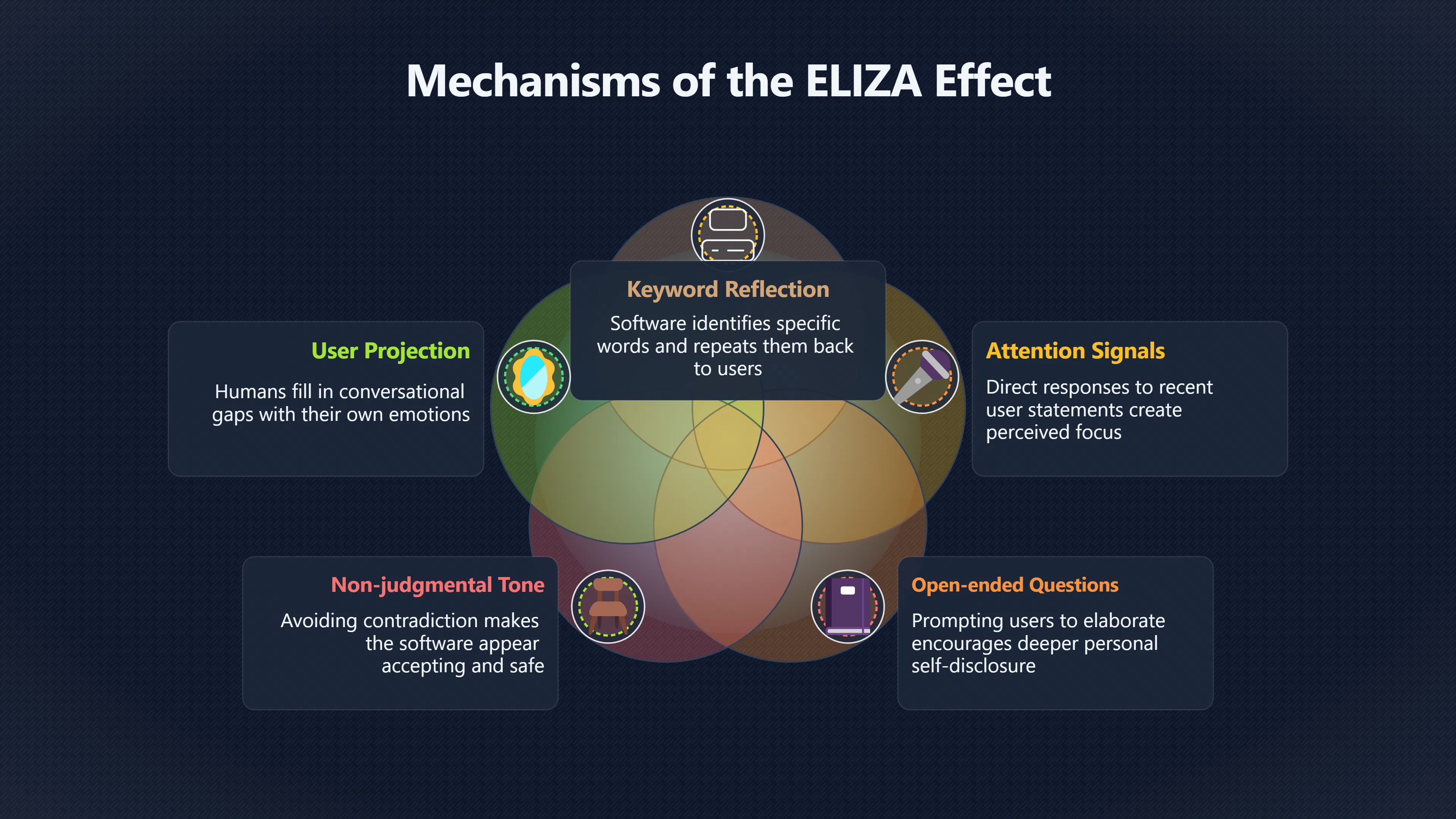
The apparent empathy came from several conversational techniques:
- Reflection: repeating or reformulating a user’s words.
- Attention signals: responding directly to what the user had just said.
- Open-ended questions: encouraging further self-disclosure.
- Non-judgemental language: avoiding contradiction and appearing accepting.
These are techniques that human counsellors sometimes use, but ELIZA employed them without any genuine comprehension. Users often supplied the meaning themselves.[Wikipedia]WikipediaELIZA effectELIZA effect
Why users project understanding onto software
The ELIZA effect is not primarily a property of chatbots. It is a property of human psychology.
Humans evolved to interpret language as evidence of thoughts, intentions, and emotions. In everyday life, coherent conversation almost always comes from another mind. As a result, when software produces convincing social responses, people naturally apply the same assumptions they would use when speaking to another person.[Wikipedia+2SHS Cairn.info]WikipediaELIZA effectELIZA effect
Several psychological processes contribute to this tendency.
Language feels like evidence of a mind
People rarely observe another person’s thoughts directly. Instead, they infer mental states from speech, behaviour, and social cues. When a chatbot produces fluent language, users may unconsciously interpret that fluency as evidence of understanding. The conversation feels meaningful, so the speaker behind it is assumed to be meaningful as well.[Nielsen Norman Group]nngroup.comNielsen Norman Group The ELIZA EffectNielsen Norman GroupThe ELIZA Effect - Why We Love AIOct 6, 2023 — Based on the context of a human-like conversation, users were predispo…
Humans naturally anthropomorphise
Anthropomorphism is the tendency to attribute human characteristics to non-human entities. People do this with pets, vehicles, virtual assistants, and even simple machines. Chatbots are especially powerful triggers because they communicate using one of the most recognisably human behaviours: conversation. Research on chatbot anthropomorphism consistently finds that human-like presentation can increase perceptions of trust, empathy, and social presence.[ResearchGate+2ResearchGate]researchgate.netEffect of anthropomorphism and perceived intelligence in…Mar 19, 2026 — Effect of anthropomorphism and perceived intellige…

Users do much of the work themselves
A striking feature of the ELIZA effect is that users often fill in gaps that the software never addressed. When a chatbot offers a vague but relevant response, people may interpret it through the lens of their own concerns and emotions. The perceived depth often comes partly from the user’s interpretation rather than the system’s actual capabilities.[Wikipedia+2Nielsen Norman Group]WikipediaELIZA effectELIZA effect
Why modern chatbots feel even more empathetic
The original ELIZA relied on simple scripts. Modern large language models can generate context-sensitive responses across long conversations, remember details within a session, adapt their tone, and produce language that closely resembles human dialogue.
These improvements strengthen the same psychological effect that ELIZA revealed decades ago. Users encounter responses that appear sympathetic, encouraging, and tailored to their situation. As a result, many people experience a stronger sense of being understood than ELIZA could ever create.[PMC+2ResearchGate]pmc.ncbi.nlm.nih.govPMCCan Generative AI Chatbots Emulate Human Connection?MG Smith · 2025 · Cited by 59 — This analysis applies theoretical tools from more than 50 years of research on close relationship…
Several design features amplify this perception:
- Expressions of concern such as “I’m sorry you’re going through that.”
- Validation of feelings and experiences.
- Personalised references to earlier parts of the conversation.
- Consistent conversational tone.
- Human-like names, voices, or avatars.
Each feature increases the sense of social presence even though the system may still lack human emotions, self-awareness, or personal experience.[IBM+2ResearchGate]ibm.comeliza effect avoiding emotional attachment to aiThe ELIZA Effect: Avoiding emotional attachment to AI…A 2022 study published in the Journal of Marketing found that anthropomorphic…
An important distinction is that a chatbot can successfully simulate empathic language without necessarily possessing empathy. Human empathy involves subjective emotional understanding and lived experience. A chatbot can reproduce the patterns associated with empathy while operating through statistical prediction and pattern generation.[arXiv]arxiv.orgExploring the Effect of Robotic Embodiment and Empathetic Tone of LLMs on Empathy ElicitationMarch 26, 2025…
What the ELIZA effect means for modern chatbots
The ELIZA effect is neither wholly positive nor wholly negative. It creates opportunities and risks.
On the positive side, people may find conversational systems approachable, supportive, and easy to engage with. Research has shown that users can respond positively to chatbots designed with empathic communication styles, particularly in settings involving guidance, education, or wellbeing support.[PMC]pmc.ncbi.nlm.nih.govEffectiveness of an Empathic Chatbot in Combating Adverse…by M de Gennaro · 2020 · Cited by 328 — In the present study, we examined…
However, the same mechanism can encourage overestimation of a system’s abilities. Users may assume a chatbot understands their circumstances, intentions, or emotional state more deeply than it actually does. This can lead to misplaced trust, excessive reliance, or emotional attachment. Researchers, ethicists, and designers have increasingly highlighted these concerns as AI systems become more socially convincing.[IBM+2TechRadar]ibm.comeliza effect avoiding emotional attachment to aiThe ELIZA Effect: Avoiding emotional attachment to AI…A 2022 study published in the Journal of Marketing found that anthropomorphic…
The challenge is not simply that chatbots sound human. The challenge is that human beings are predisposed to interpret conversational competence as evidence of a caring mind. The ELIZA effect reminds us that a persuasive conversation and genuine understanding are not the same thing. A chatbot may provide useful assistance, emotional comfort, or practical information, yet the feeling of being understood can exceed what the underlying system has actually demonstrated.[Wikipedia+2Nielsen Norman Group]WikipediaELIZA effectELIZA effect

The lasting lesson of the ELIZA effect
More than half a century after ELIZA was created, its central lesson remains relevant. The original program showed that people can experience a sense of empathy from software that merely reflects their words back to them. Modern AI has made the illusion more convincing, but it has not eliminated the underlying psychological tendency.[Wikipedia+2Wikipedia]WikipediaELIZA effectELIZA effect
For anyone trying to understand artificial intelligence, the ELIZA effect is a reminder that the appearance of empathy and the reality of empathy are different questions. Chatbots may communicate in ways that feel compassionate, attentive, and understanding. Whether they truly possess those qualities is a separate issue—one that conversational skill alone cannot answer.[Nielsen Norman Group+2IBM]nngroup.comNielsen Norman Group The ELIZA EffectNielsen Norman GroupThe ELIZA Effect - Why We Love AIOct 6, 2023 — Based on the context of a human-like conversation, users were predispo…
Amazon book picks
Further Reading
Books and field guides related to Why chatbots can feel more caring than they are. Use these as the next step if you want deeper reading beyond the article.
The Most Human Human
Explores why conversational performance is often mistaken for understanding.
You Look Like a Thing and I Love You
Demonstrates how people overestimate AI understanding.
Computer Power and Human Reason
The strongest book for understanding the ELIZA effect and its implications.
Thinking, Fast and Slow
Explains the cognitive shortcuts behind anthropomorphism and projection.
eBay marketplace picks
Marketplace Samples
Example marketplace items related to this page. Use the search link to explore similar finds on eBay.




Endnotes
1.
Source: Wikipedia
Title: ELIZA effect
Link:https://en.wikipedia.org/wiki/ELIZA_effect
2.
Source: Wikipedia
Link:https://en.wikipedia.org/wiki/ELIZA
3.
Source: shs.cairn.info
Title: SHS Cairn.info The impact of anthropomorphism on chatbot performance
Link:https://shs.cairn.info/article/E_RIPS1_072_0101/pdf?lang=en
Source snippet
SHS Cairn.infoThe impact of anthropomorphism on chatbot performanceAbstract. In this article, we look at the projective, psychological fa...
4.
Source: researchgate.net
Link:https://www.researchgate.net/publication/397658877_The_Psychology_of_the_Eliza_Effect_Anthropomorphism_Social_Presence_and_Projection_in_Human-AI_Interaction
Source snippet
The Psychology of the Eliza Effect: Anthropomorphism...These Chatbots and AI assistants now interact in such a way that sounds empatheti...
5.
Source: researchgate.net
Link:https://www.researchgate.net/publication/402289951_Effect_of_anthropomorphism_and_perceived_intelligence_in_chatbot_avatars_of_visual_design_on_user_experience_accounting_for_perceived_empathy_and_trust
Source snippet
Effect of anthropomorphism and perceived intelligence in...Mar 19, 2026 — Effect of anthropomorphism and perceived intellige...
6.
Source: researchgate.net
Link:https://www.researchgate.net/publication/396316870_Anthropomorphic_technology_in_everyday_life_focus_on_chatbots_and_impacts_on_mental_health
Source snippet
focus on chatbots and impacts on mental healthFeb 18, 2026 — The purpose of this review is to increase physician awareness of...
7.
Source: arxiv.org
Link:https://arxiv.org/abs/2506.20748
8.
Source: arxiv.org
Link:https://arxiv.org/abs/2406.17650
9.
Source: pmc.ncbi.nlm.nih.gov
Title: PMCCan [Generative AI]({{ ‘generative-ai/’ | relative_url }}) Chatbots Emulate Human Connection?
Link:https://pmc.ncbi.nlm.nih.gov/articles/PMC12575814/
Source snippet
MG Smith · 2025 · Cited by 59 — This analysis applies theoretical tools from more than 50 years of research on close relationship...
10.
Source: techradar.com
Title: Tech Radar I looked into how AI chatbots respond to emotions
Link:https://www.techradar.com/ai-platforms-assistants/i-looked-into-how-ai-chatbots-respond-to-emotions-and-what-i-found-out-about-the-eliza-effect-completely-changed-how-i-think-about-using-them
Source snippet
Formerly, tech sought user attention; now, AI systems exploit emotional bonds through personalized, empathetic interactions. This is refe...
11.
Source: ibm.com
Title: eliza effect avoiding emotional attachment to ai
Link:https://www.ibm.com/think/insights/eliza-effect-avoiding-emotional-attachment-to-ai
Source snippet
The ELIZA Effect: Avoiding emotional attachment to AI...A 2022 study published in the Journal of Marketing found that anthropomorphic...
12.
Source: arxiv.org
Link:https://arxiv.org/abs/2503.20518
Source snippet
Exploring the Effect of Robotic Embodiment and Empathetic Tone of LLMs on Empathy ElicitationMarch 26, 2025...
Published: March 26, 2025
13.
Source: pmc.ncbi.nlm.nih.gov
Link:https://pmc.ncbi.nlm.nih.gov/articles/PMC6989433/
Source snippet
Effectiveness of an Empathic Chatbot in Combating Adverse...by M de Gennaro · 2020 · Cited by 328 — In the present study, we examined...
14.
Source: Wikipedia
Title: Joseph (Genesis)
Link:https://en.wikipedia.org/wiki/Joseph_%28Genesis%29
Source snippet
Joseph (Genesis)Joseph was the first of the two sons of Jacob and Rachel, making him Jacob's twelfth named child and eleventh son. He...
15.
Source: Wikipedia
Link:https://en.wikipedia.org/wiki/Joseph
Source snippet
JosephIn the Book of Genesis Joseph is Jacob's eleventh son and Rachel's first son, and known in the Hebrew Bible as Yossef ben-Yaakov...
16.
Source: youtube.com
Link:https://www.youtube.com/watch?v=8jGpkdPO-1Y
Source snippet
Wikipedia...
17.
Source: youtube.com
Title: The ELIZA Effect
Link:https://www.youtube.com/watch?v=mJrZe80G6G4
18.
Source: nngroup.com
Title: Nielsen Norman Group The ELIZA Effect
Link:https://www.nngroup.com/articles/eliza-effect-ai/
Source snippet
Nielsen Norman GroupThe ELIZA Effect - Why We Love AIOct 6, 2023 — Based on the context of a human-like conversation, users were predispo...
19.
Source: 99percentinvisible.org
Title: the eliza effect
Link:https://99percentinvisible.org/episode/the-eliza-effect/
Source snippet
12 Oct 2019 — ELIZA was a simple computer program. It would look for the keyword in a user's statement and then reflect it back in the fo...
20.
Source: 99percentinvisible.org
Title: The ELIZA Effect
Link:https://99percentinvisible.org/episode/the-eliza-effect/transcript/
Source snippet
Episode Text TranscriptOct 12, 2019 — Joseph Weizenbaum: After two or three interchanges with the machine, she turned to me and she said...
21.
Source: britannica.com
Link:https://www.britannica.com/biography/Joseph-biblical-figure
Source snippet
In the story, he is sold into slavery by his brothers but rises to prominence in...Read more...
Additional References
22.
Source: medium.com
Link:https://medium.com/%40christine.lynn.chilton/elizas-legacy-the-illusion-of-ai-understanding-and-the-human-cost-of-digital-intimacy-ca2843f8d84c
Source snippet
ELIZA's Legacy: The Illusion of AI Understanding and...And yet, when ELIZA asks how she feels, something inside her breaks open. “Please...
23.
Source: linkedin.com
Link:https://www.linkedin.com/top-content/user-experience/user-experience-and-emotional-[engagement
Source snippet
Eliza Effect and User Trust in TechnologyThe "Eliza Effect" — our human tendency to attribute understanding and empathy... Weizenbaum cr...
24.
Source: joseph-fashion.com
Link:https://joseph-fashion.com/?srsltid=AfmBOooj_E3CIOkeAmq9OEytrDv_nVg_gYzdIRSbba0Ot2E5gXWsY1xz
Source snippet
JOSEPH Official | Luxury Designer Fashion for Women...JOSEPH is a British contemporary designer brand known for its luxury essentials, p...
25.
Source: josephjoseph.com
Link:https://www.josephjoseph.com/
Source snippet
Joseph Joseph UK | Innovative And Functional HousewareBeautifully innovative homeware designed to make life easy. Shop Kitchenware, Cookw...
26.
Source: selfridges.com
Link:https://www.selfridges.com/GB/en/cat/joseph/
Source snippet
JosephShop JOSEPH clothing at Selfridges and discover the minimalist aesthetic of this top British fashion brand. Find luxury blazers, dr...
27.
Source: newyorker.com
Link:https://www.newyorker.com/magazine/2024/10/07/is-a-chat-with-a-bot-a-conversation
Source snippet
It traces the development of AI from the discussions at the 1958 Teddington conference through various technological milestones, like the...
28.
Source: linkedin.com
Link:https://www.linkedin.com/posts/renwen-zhang_exploring-the-effects-of-chatbot-anthropomorphism-activity-7381868988621959168-Rt82
Source snippet
How AI can benefit from human help and empathyA 2024 study published in Frontiers in Psychology found that conversational AI actually red...
29.
Source: linkedin.com
Title: ELIZ A Effect: Navigating Emotional Attachment to AIWe’ve all been there
Link:https://www.linkedin.com/posts/raj-mitra-6a230ab_the-eliza-effect-avoiding-emotional-attachment-activity-7434844731638992896-AuxZ
Source snippet
ELIZA Effect: Navigating Emotional Attachment to AIWe've all been there - subconsciously saying "please" or "thank you" to a chatbot simp...
30.
Source: spectrum.ieee.org
Title: why people demanded privacy to confide in the worlds first chatbot
Link:https://spectrum.ieee.org/why-people-demanded-privacy-to-confide-in-the-worlds-first-chatbot
Source snippet
People Demanded Privacy to Confide in the World's...Between 1964 and 1966, Joseph Weizenbaum, a German American computer scientist at MI...
31.
Source: hal.science
Title: The roles of warmth, competence, and failure severity in shaping
Link:https://hal.science/hal-05563836v2/document
Source snippet
As service robots become more prevalent in frontline service delivery, understanding their role in handling customer complaints is critical...
Topic Tree