Within Business Adoption
When should humans check AI outputs?
Human oversight only works when people know exactly which AI outputs to check, what standard to use and when to override the system.
On this page
- Why human in the loop is too vague
- Different checks for legal, clinical and financial decisions
- Escalation rights, audit trails and accountability
Page outline Jump by section
Introduction
For organisations moving beyond AI pilots, the phrase “human in the loop” is often too vague to be useful. In high-stakes settings such as legal review, clinical decision support, lending, insurance, hiring or regulatory compliance, human oversight only works when people know exactly which outputs require review, what standard they are applying and when they are expected to override the system. Regulators and governance frameworks increasingly emphasise that human oversight is not simply having a person somewhere in the workflow. It means giving humans the information, authority and responsibility needed to prevent harmful decisions and intervene when necessary.[Artificial Intelligence Act+2NIST]artificialintelligenceact.euArtificial Intelligence ActArticle 14: Human Oversight | EU Artificial Intelligence ActHuman oversight shall aim to prevent or minimise t…
 As businesses expand AI use into consequential decisions, the challenge shifts from model performance alone to operational accountability. The key question becomes: when should humans check AI outputs, and what should those checks look like?
Why “human in the loop” is too vague
Many organisations describe an AI process as supervised because a human signs off on the final outcome. In practice, that may provide little protection if reviewers lack time, expertise or authority to challenge the system.
Research on effective oversight suggests that meaningful human review requires several conditions: reviewers must understand the situation, have access to relevant information, possess genuine power to intervene and be accountable for the outcome. Simply presenting an AI recommendation to a busy employee does not automatically satisfy those conditions.[arXiv]arxiv.orgOpen source on arxiv.org.
A common failure mode is automation bias: the tendency for people to over-trust machine recommendations even when they are wrong. The EU AI Act explicitly recognises this risk and requires high-risk systems to be designed so overseers remain aware of the possibility of over-reliance and can correctly interpret outputs.[Taylor & Francis Online+2Artificial Intelligence Act]tandfonline.comTaylor & Francis Online'Human oversight' in the EU artificial intelligence actby L Enqvist · 2023 · Cited by 119 — Article 14(4)(b) requi…
In operational terms, organisations need rules that answer four questions:
- Which decisions require review?
- What evidence must the reviewer examine?
- What conditions trigger escalation?
- Who is accountable for the final decision?
Without explicit answers, human review often becomes a symbolic approval step rather than an effective control.
What should humans actually check?
The most effective validation programmes focus human attention on areas where AI systems are known to fail rather than requiring exhaustive review of every output.
Typical review criteria include:
- Factual accuracy: Are claims supported by evidence?
- Data quality: Was the output generated from complete and relevant information?
- Fairness and consistency: Does the recommendation affect groups differently?
- Policy compliance: Does it comply with internal rules and regulations?
- Contextual judgement: Does the recommendation make sense in the specific case?
- Confidence and uncertainty: Is the model operating near the limits of its competence?
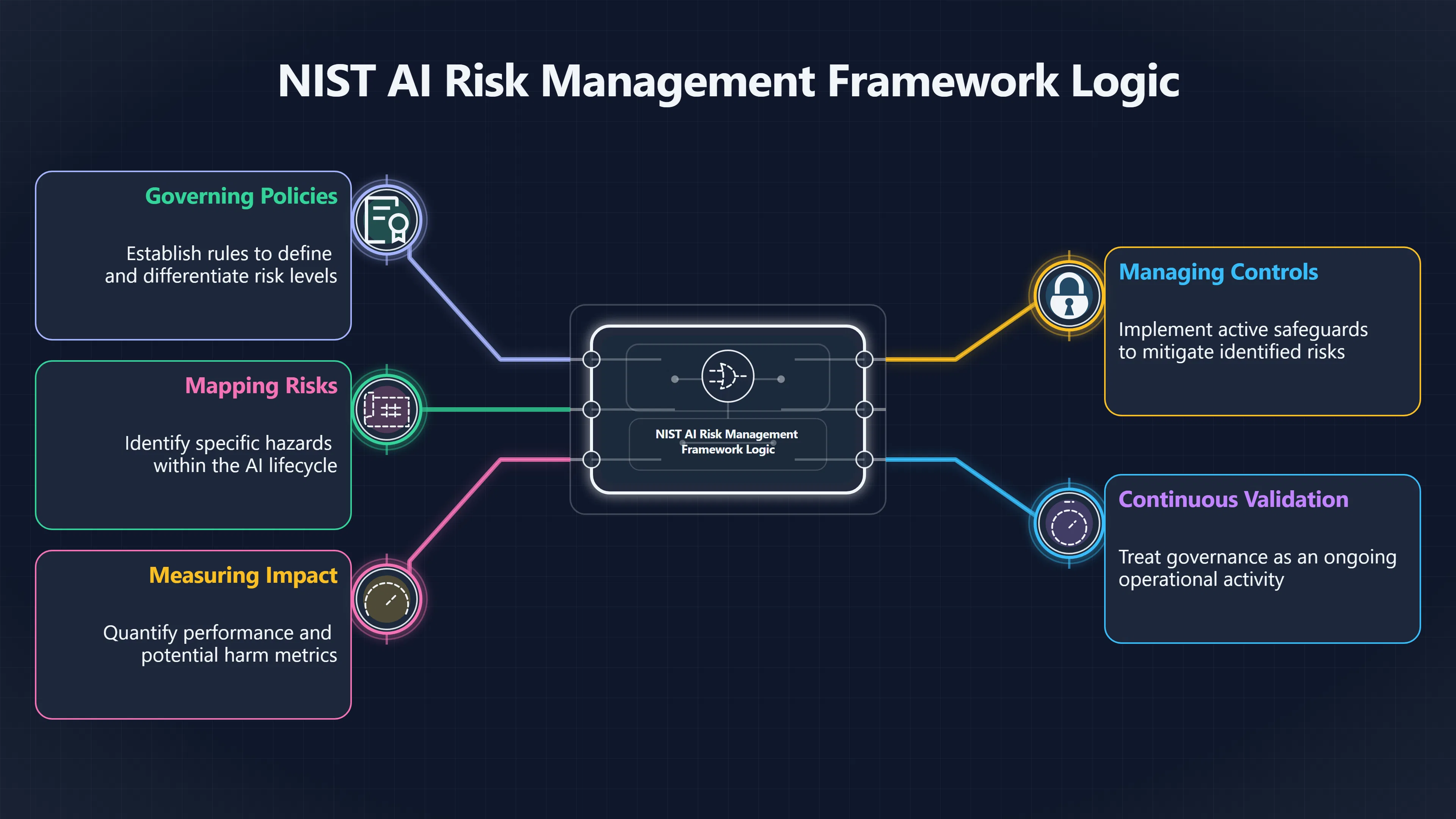
NIST’s AI Risk Management Framework encourages organisations to treat AI governance as an ongoing process of governing, mapping, measuring and managing risk rather than relying on one-off approval exercises. Human validation therefore becomes a continuous operational activity rather than a final checkpoint before deployment.[NIST+2NIST Publications]nist.govAI Risk Management Framework | NISTNIST has developed a framework to better manage risks to individuals, organizations, and society a…
A useful principle is proportionality: the greater the potential impact on health, safety, legal rights or financial outcomes, the stronger the review requirements should be.
Different checks for legal, clinical and financial decisions
High-stakes oversight is not one-size-fits-all. Different domains require different review standards because the consequences of error differ.
Legal decisions
Legal AI systems may summarise case law, draft contracts or identify compliance risks. Human reviewers should not merely assess whether the text sounds plausible. They need to verify:
- Citations and authorities are genuine.
- Relevant statutes and precedents were considered.
- The reasoning matches applicable legal standards.
- Material omissions have not altered conclusions.
A lawyer reviewing an AI-generated contract analysis performs a fundamentally different task from a lawyer editing a junior colleague’s draft. The review must account for the possibility of fabricated citations, omitted authorities or incorrect legal reasoning.
Clinical decisions
Clinical settings present particularly strong oversight requirements because errors may affect patient safety.
Medical AI systems often generate diagnostic suggestions, risk scores or treatment recommendations. Human review should focus on:
- Whether the recommendation aligns with the patient’s full clinical context.
- Whether unusual patient characteristics fall outside training data patterns.
- Whether uncertainty is adequately communicated.
- Whether evidence supports the recommendation.
Clinical researchers have repeatedly highlighted risks arising from biased datasets, under-representation of patient groups and performance differences across populations. Human clinicians therefore need to evaluate not only the recommendation but also whether the AI system is being applied to an appropriate patient population.[PMC]pmc.ncbi.nlm.nih.govBias in medical AI: Implications for clinical decision-makingby JL Cross · 2024 · Cited by 452 — We discuss potential biases that can…
FDA guidance and related discussions around AI-enabled clinical decision support increasingly emphasise transparency, explainability and the clinician’s ability to independently evaluate recommendations rather than simply accept them. U.S. Food and Drug Administration+2U.S. Food and Drug Administration[fda.gov]fda.govclinical decision support softwareFood and Drug AdministrationClinical Decision Support Software - GuidanceJan 29, 2026 — This guidance clarifies the scope of FDA's oversi…

Financial decisions
In lending, insurance, fraud detection and investment contexts, oversight should focus on:
- Evidence supporting the recommendation.
- Potential discriminatory effects.
- Consistency with regulatory obligations.
- Economic assumptions embedded in the model.
- Exceptional cases that fall outside normal patterns.
A credit decision generated by AI should generally be reviewable and explainable. Reviewers need enough information to determine why the recommendation was made and whether policy or regulatory concerns justify overriding it.
Escalation rules matter more than approval buttons
Many organisations focus on who approves AI outputs but spend less time defining escalation paths. Yet escalation rules are often the most important oversight mechanism.
A practical framework specifies:
Routine cases
- Human review follows standard procedures.
- Reviewer can approve or reject.
Flagged cases
- Low confidence scores.
- Missing information.
- Conflicting evidence.
- Unusual patterns.
These cases move automatically to enhanced review.
Critical cases
- Potential harm to health or safety.
- Legal rights implications.[arxiv.org]arxiv.orgSource details in endnotes.
- Significant financial consequences.
- Regulatory reporting obligations.
These cases require senior review or specialist assessment before action.
The purpose of escalation is not to slow every decision. It is to ensure that human expertise is concentrated where AI systems are most likely to create unacceptable risks.
Override authority must be real
One of the most overlooked governance questions is whether reviewers genuinely have authority to reject AI recommendations.
If employees are evaluated primarily on speed or throughput, they may feel pressure to accept machine outputs even when uncertain. Effective oversight requires organisations to make clear that:
- Humans may override AI recommendations.
- Overrides are legitimate and expected in appropriate circumstances.
- Staff will not be penalised for raising concerns in good faith.
- Escalations receive timely attention.
The EU AI Act’s human oversight provisions reflect this principle by requiring high-risk systems to be designed so people can effectively supervise and intervene during use. Oversight is intended to reduce risks to health, safety and fundamental rights rather than merely document that a person viewed the output.[Artificial Intelligence Act+2Responsible AI Platform]artificialintelligenceact.euArtificial Intelligence ActArticle 14: Human Oversight | EU Artificial Intelligence ActHuman oversight shall aim to prevent or minimise t…
A reviewer who lacks authority to stop or alter a decision is not functioning as an effective safeguard.
Audit trails and accountability
Human validation creates value only if organisations can later demonstrate what happened.
For consequential decisions, audit records should typically capture:
- The AI output presented.
- Data used to generate the output.
- Human reviewers involved.
- Changes made by reviewers.
- Reasons for overrides or approvals.
- Escalation decisions.
- Final outcomes.
These records serve several purposes. They support regulatory compliance, enable post-incident investigations, identify recurring failure patterns and help organisations determine whether reviewers are genuinely exercising independent judgement.
The growing regulatory focus on logging, traceability and lifecycle governance reflects recognition that accountability cannot depend on memory or informal processes. Organisations need evidence showing who reviewed a decision, what information they saw and why the final outcome was reached.[NIST+2Artificial Intelligence Act]nist.govAI Risk Management Framework | NISTNIST has developed a framework to better manage risks to individuals, organizations, and society a…
The goal is accountable judgement, not human decoration
The strongest human validation programmes do not treat oversight as a ceremonial approval step attached to an automated process. They define specific review standards, assign clear responsibilities, establish escalation rights and maintain auditable records of decisions.
For businesses adopting AI beyond pilot projects, the central governance lesson is straightforward: a human reviewer only improves safety and accountability when they understand what to check, have the authority to intervene and can be held responsible for exercising informed judgement. Anything less risks creating the appearance of oversight without the substance.[arXiv+2NIST]arxiv.orgOpen source on arxiv.org.
Amazon book picks
Further Reading
Books and field guides related to When should humans check AI outputs?. Use these as the next step if you want deeper reading beyond the article.
The Alignment Problem
Examines failures that occur when human values are not effectively embedded.
Power and Prediction
Discusses decision rights and organizational structures around AI.
eBay marketplace picks
Marketplace Samples
Example marketplace items related to this page. Use the search link to explore similar finds on eBay.




Endnotes
1.
Source: nist.gov
Link:https://www.nist.gov/itl/ai-risk-management-framework
Source snippet
AI Risk Management Framework | NISTNIST has developed a framework to better manage risks to individuals, organizations, and society a...
2.
Source: arxiv.org
Link:https://arxiv.org/abs/2404.04059
3.
Source: arxiv.org
Title: arXiv Human Oversight of Artificial Intelligence and Technical Standardisation
Link:https://arxiv.org/abs/2407.17481
4.
Source: arxiv.org
Link:https://arxiv.org/abs/2502.10036
5.
Source: nvlpubs.nist.gov
Link:https://nvlpubs.nist.gov/nistpubs/ai/nist.ai.100-1.pdf
Source snippet
NIST PublicationsArtificial Intelligence Risk Management Framework (AI RMF 1.0)by N AI · 2023 · Cited by 206 — Responsible AI practices c...
6.
Source: pmc.ncbi.nlm.nih.gov
Link:https://pmc.ncbi.nlm.nih.gov/articles/PMC11542778/
Source snippet
Bias in medical AI: Implications for clinical decision-makingby JL Cross · 2024 · Cited by 452 — We discuss potential biases that can...
7.
Source: fda.gov
Title: clinical decision support software
Link:https://www.fda.gov/regulatory-information/search-fda-guidance-documents/clinical-decision-support-software
Source snippet
Food and Drug AdministrationClinical Decision Support Software - GuidanceJan 29, 2026 — This guidance clarifies the scope of FDA's oversi...
8.
Source: fda.gov
Title: artificial intelligence software medical device
Link:https://www.fda.gov/medical-devices/software-medical-device-samd/artificial-intelligence-software-medical-device
Source snippet
Food and Drug AdministrationArtificial Intelligence in Software as a Medical Device25 Mar 2025 — The FDA's traditional paradigm of medica...
9.
Source: nist.gov
Link:https://www.nist.gov/
Source snippet
National Institute of Standards and TechnologyNIST promotes U.S. innovation and industrial competitiveness by advancing measurement scien...
10.
Source: nist.gov
Link:https://www.nist.gov/news-events/news/2026/06/department-commerce-announces-finalization-chips-incentives-powerex-enhance
Source snippet
for U.S. Semiconductor Manufacturing...
11.
Source: nvlpubs.nist.gov
Title: AI.600 1
Link:https://nvlpubs.nist.gov/nistpubs/ai/NIST.AI.600-1.pdf
Source snippet
Intelligence Risk Management Frameworkby N AI · 2024 · Cited by 112 — GOVERN 3.2: Policies and procedures are in place to define and diff...
12.
Source: fda.gov
Link:https://www.fda.gov/
Source snippet
U.S. Food and Drug AdministrationThe FDA is responsible for protecting the public health by ensuring the safety, efficacy, and security o...
13.
Source: fda.gov
Title: Clinical Decision Support Software
Link:https://www.fda.gov/media/109618/download
Source snippet
In the context of CDS, automation bias...Read more...
14.
Source: artificialintelligenceact.eu
Link:https://artificialintelligenceact.eu/article/14/
Source snippet
Artificial Intelligence ActArticle 14: Human Oversight | EU Artificial Intelligence ActHuman oversight shall aim to prevent or minimise t...
15.
Source: tandfonline.com
Link:https://www.tandfonline.com/doi/full/10.1080/17579961.2023.2245683
Source snippet
Taylor & Francis Online'Human oversight' in the EU artificial intelligence actby L Enqvist · 2023 · Cited by 119 — Article 14(4)(b) requi...
16.
Source: aiactblog.nl
Title: Oversight must aim to prevent
Link:https://www.aiactblog.nl/en/ai-act/artikel/14
Source snippet
Responsible AI PlatformArticle 14 AI Act: official text and human oversightArticle 14 requires high-risk AI systems to be designed and de...
17.
Source: Wikipedia
Title: Food and Drug Administration
Link:https://en.wikipedia.org/wiki/Food_and_Drug_Administration
Source snippet
Food and Drug AdministrationThe FDA is responsible for protecting and promoting public health through the control and supervision of f...
18.
Source: intelligence.dlapiper.com
Title: artificial intelligence
Link:https://intelligence.dlapiper.com/artificial-intelligence/?c=EU&t=11-human-oversight
Source snippet
oversight in the European Union - AI Laws of...11 Feb 2026 — Article 14 of the EU AI Act deals with human oversight, stating that provid...
19.
Source: artificialintelligenceact.eu
Link:https://artificialintelligenceact.eu/article/6/
Source snippet
An AI system is considered high-risk if it is used as a safety component of a product, or if it is a...Read more...
20.
Source: artificialintelligenceact.eu
Title: Section 2: Requirements for High-Risk AI Systems Article 14: Human Oversight
Link:https://artificialintelligenceact.eu/section/3-2/
Source snippet
Article 14: Human Oversight. View the official text, or browse it online using our AI Act Explorer. The text used in this tool is...
21.
Source: artificialintelligenceact.eu
Link:https://artificialintelligenceact.eu/high-level-summary/
Source snippet
Design their high risk AI system to achieve appropriate levels of accuracy...Read more...
22.
Source: pmc.ncbi.nlm.nih.gov
Link:https://pmc.ncbi.nlm.nih.gov/articles/PMC12339208/
Source snippet
and Regulation of Artificial Intelligence Medical...by GE Weissman · 2025 · Cited by 14 — This review summarizes the rapidly evolving re...
23.
Source: digital-strategy.ec.europa.eu
Title: eu A I Act | Shaping Europe’s digital future
Link:https://digital-strategy.ec.europa.eu/en/policies/regulatory-framework-ai
Source snippet
Act | Shaping Europe's digital future - European UnionThe AI Act is the first-ever legal framework on AI, which addresses the risks of AI...
24.
Source: autoriteitpersoonsgegevens.nl
Title: eu ai act
Link:https://www.autoriteitpersoonsgegevens.nl/en/themes/algorithms-ai/eu-ai-act
Source snippet
9 Apr 2025 — The EU AI Act is intended to ensure that everyone across Europe can rest assured that AI systems are secure and that fundame...
Additional References
25.
Source: ai-act-law.eu
Link:https://ai-act-law.eu/
Source snippet
AI Act as a neatly arranged website – Legal TextThe purpose of the AI Act is to promote the uptake of human-centric AI in Europe while en...
26.
Source: linkedin.com
Link:https://www.linkedin.com/posts/rakesh-joshi-lhsc_clinicaldecisionsupport-fda-healthai-activity-7422356865805742080-QK4c
Source snippet
FDA Sets Transparency Guidelines for AI Clinical DecisionsFDA is drawing a clearer line: if AI shapes a clinical decision, clinicians nee...
27.
Source: theguardian.com
Link:https://www.theguardian.com/technology/2024/mar/14/what-will-eu-proposed-regulation-ai-mean-consumers
Source snippet
Expected to become law within weeks, the act will be implemented in stages over the next three years. It defines AI as systems with varyi...
28.
Source: venn.com
Link:https://www.venn.com/learn/nist-ai-risk-management-framework/
29.
Source: thoropass.com
Link:https://www.thoropass.com/blog/nist-ai-rmf
30.
Source: linkedin.com
Link:https://www.linkedin.com/pulse/when-human-in-the-loop-just-checkbox-operational-path-chris-fong-lusmc
31.
Source: orrick.com
Link:https://www.orrick.com/en/insights/2026/01/fda-eases-oversight-for-ai-enabled-clinical-decision-support-software-and-wearables
Source snippet
FDA Eases Oversight for AI-Enabled Clinical Decision...9 Jan 2026 — FDA previews 2026 guidance easing oversight for AI CDS and non-invas...
32.
Source: sidley.com
Link:https://www.sidley.com/en/insights/newsupdates/2022/10/one-step-forward-two-steps-back-fdas-final-guidance-on-clinical-decision-software
Source snippet
One Step Forward, Two Steps Back: FDA's Final Guidance...26 Oct 2022 — The underlying purpose of leveraging medical software, especially...
33.
Source: nature.com
Link:https://www.nature.com/articles/s41746-026-02561-1
Source snippet
d the FDA and global regulators to shift toward governance frameworks...Read more...
34.
Source: mcdermottlaw.com
Title: fda issues long awaited final clinical decision support software guidance
Link:https://www.mcdermottlaw.com/insights/fda-issues-long-awaited-final-clinical-decision-support-software-guidance/
Source snippet
FDA Issues Final Clinical Decision Support Software...30 Sept 2022 — Level of software automation – The guidance describes automation bi...
Topic Tree