Within AI Errors
What AI benchmarks miss about reliability
Benchmarks can show progress while missing failures that appear in long, messy, source-bound or uncertainty-heavy tasks.
On this page
- Why short tests understate real world risk
- Long form grounding and uncertainty problems
- What better factuality tests should capture
Page outline Jump by section
Introduction
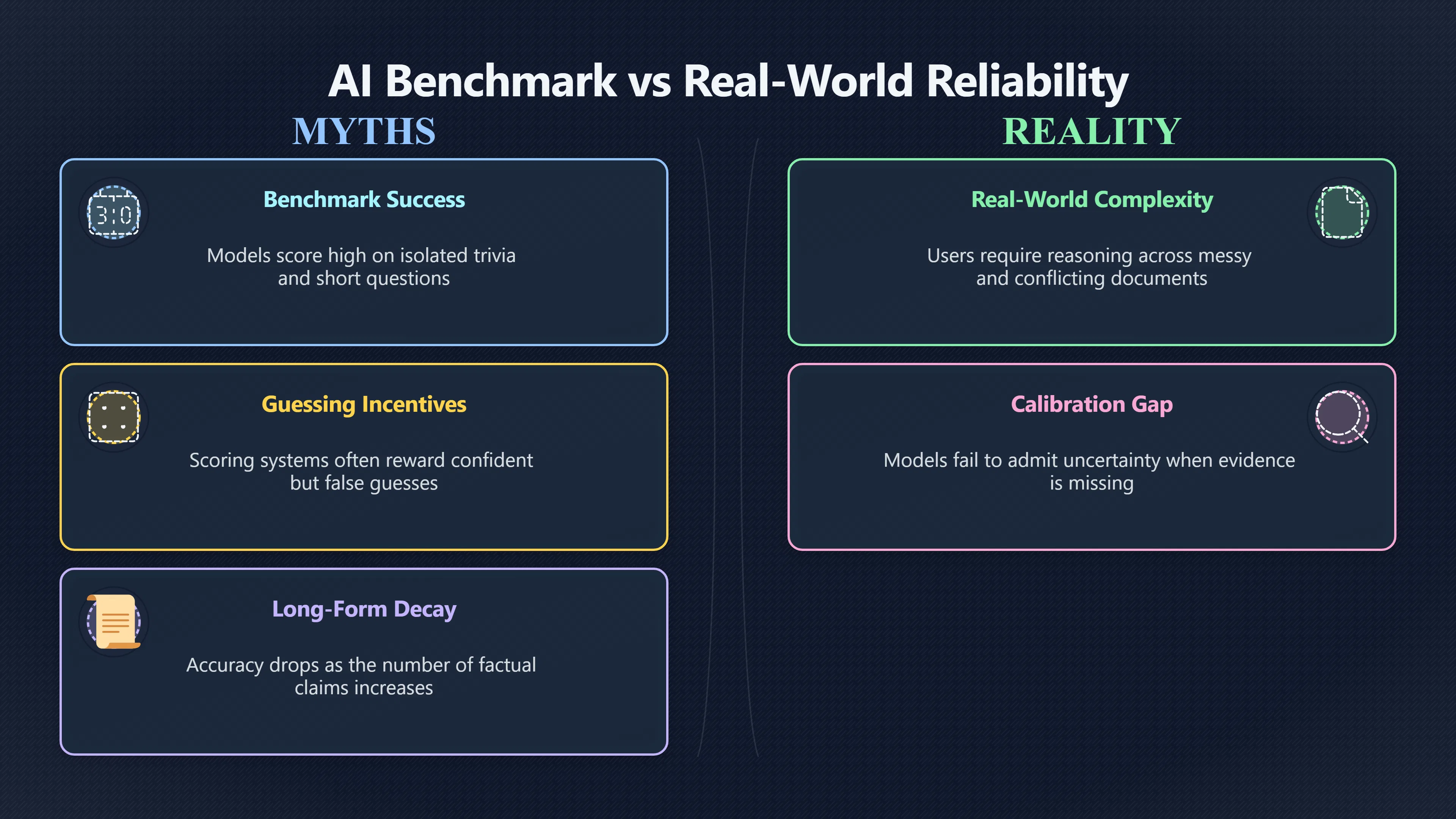
AI benchmarks often show steady progress, yet users still encounter fabricated citations, unsupported claims and confident mistakes in real-world work. The reason is not necessarily that benchmarks are useless. Rather, many benchmarks measure a narrower problem than the one people actually face when using AI systems.
 A model can score highly on short factual questions, multiple-choice tasks or carefully curated datasets while still struggling when asked to analyse lengthy documents, reconcile conflicting evidence, track uncertainty or explain what it does not know. Reliability becomes much harder to measure once tasks involve incomplete information, ambiguous sources and long chains of factual claims. As a result, benchmark scores can create an overly optimistic picture of how dependable an AI system will be outside the testing environment.[OpenAI]OpenAIwhy language models hallucinateSeptember 5, 2025…
Why short tests understate real-world risk
Many popular AI benchmarks focus on questions with clear, predetermined answers. This makes evaluation practical and comparable across models, but it also simplifies the challenge.
In the real world, users often ask questions that involve:
- Multiple documents rather than a single fact.
- Sources that disagree with one another.
- Missing or incomplete evidence.
- Information that is obscure, recent or poorly documented.
- Situations where the correct response may be “there is not enough evidence”.
Benchmarks based on short questions rarely capture these conditions. A model that correctly answers thousands of trivia-style questions may still fail when asked to produce a long report that contains dozens of factual claims. Each individual claim introduces another opportunity for error, and those errors can accumulate even when the overall answer sounds coherent.[Hugging Face]huggingface.coHugging Face Daily PapersHugging FaceDaily Papers - Hugging Face…
Another problem is that benchmark datasets are often curated and cleaned. Real users do not operate in curated environments. They ask about niche organisations, local events, obscure people and specialised documents that may not appear in widely used training or evaluation sets. Research behind the WildHallucinations benchmark found substantially higher hallucination rates for entities lacking strong online documentation, particularly those without dedicated Wikipedia pages.[Hugging Face]huggingface.coHugging Face Daily PapersHugging FaceDaily Papers - Hugging Face…
Benchmarks often reward guessing
A less obvious issue is that many evaluation systems score only whether an answer is correct. They do not adequately distinguish between a model that guesses and a model that admits uncertainty.
If a benchmark awards points only for correct answers, then guessing can sometimes improve scores. A model that invents an answer has a small chance of being right, whereas a model that says “I don’t know” receives no credit. Over thousands of test questions, this can create incentives that favour confident guessing rather than calibrated uncertainty.[OpenAI]OpenAIwhy language models hallucinateSeptember 5, 2025…
This matters because users usually care more about avoiding false information than about receiving an answer at all. In many settings, an honest acknowledgement of uncertainty is safer and more useful than a fluent but incorrect response.
Researchers and developers have increasingly argued that benchmark design should penalise confident errors more heavily and explicitly reward appropriate uncertainty. Otherwise, leaderboards may rank systems in ways that do not reflect real-world trustworthiness.[OpenAI+2Reddit]OpenAIwhy language models hallucinateSeptember 5, 2025…
Long-form grounding and uncertainty problems
Reliability changes when answers become longer
Short-answer benchmarks typically evaluate one claim at a time. Real-world outputs are often much longer.
Consider an AI-generated briefing, legal summary or research overview containing fifty factual statements. Even if the system is highly accurate on individual claims, the probability that at least one statement is wrong rises as more claims are introduced. A benchmark based on isolated questions may therefore underestimate the frequency of errors in long-form writing.[Meta AI]ai.meta.comMeta AIFactScore: Fine-grained Atomic Evaluation of Factual Precision in Long Form Text Generation | Research - AI at MetaNovember 17, 2023…
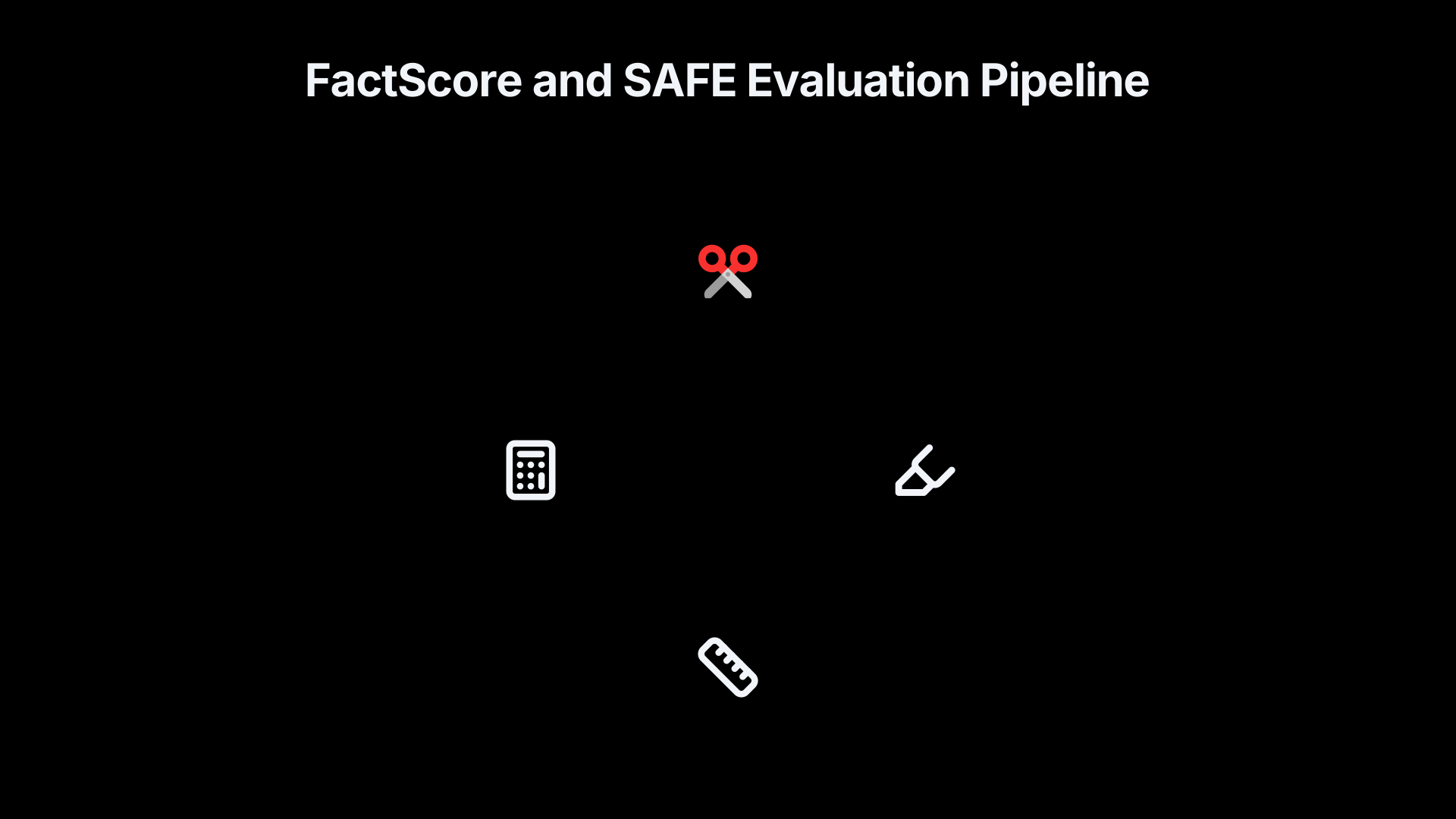
This challenge has motivated the development of long-form factuality benchmarks such as LongFact and evaluation methods such as FACTSCORE and SAFE, which attempt to break long responses into individual factual assertions and verify them separately. These approaches emerged because traditional benchmark scores often failed to reveal how many unsupported claims were hidden inside apparently strong answers.[Meta AI]ai.meta.comMeta AIFactScore: Fine-grained Atomic Evaluation of Factual Precision in Long Form Text Generation | Research - AI at MetaNovember 17, 2023…
Source-bound tasks expose weaknesses
Many benchmark questions can be answered from general knowledge. However, some of the most important uses of AI require grounding answers in specific documents.
Examples include:
- Summarising contracts.
- Analysing scientific papers.
- Reviewing policy documents.
- Producing evidence-based reports.
- Comparing multiple sources.
In these situations, reliability depends not only on factual knowledge but also on accurately tracing claims back to evidence. Research on long-document summarisation has found that existing factuality metrics can become unstable when documents are lengthy, information-dense or require reasoning across multiple sections. Metrics that appear reliable on short summaries often become less dependable in long-context settings.[Københavns Universitets Forskningsportal]researchprofiles.ku.dkKøbenhavns Universitets ForskningsportalStress Testing Factual Consistency Metrics for Long-Document Summarization - Københavns Universit…
This creates a measurement gap: benchmark performance may improve while the ability to stay faithfully grounded in source material remains difficult to verify.
Uncertainty is often invisible in benchmark scores
Many real questions do not have a clean answer.
A historical record may be incomplete. Two sources may conflict. A recent event may not yet be documented. A user may ask a question whose premises are mistaken.
Humans often handle these situations by discussing evidence quality, explaining ambiguity or noting what remains unknown. Traditional benchmark scoring systems usually reduce the outcome to a binary right-or-wrong judgement. That simplification hides an important aspect of reliability: whether a model recognises the limits of its knowledge.[OpenAI]OpenAIwhy language models hallucinateSeptember 5, 2025…
What better factuality tests should capture
Researchers increasingly argue that reliability evaluation should move beyond simple accuracy scores.
A stronger factuality assessment would measure several dimensions simultaneously:
Grounding quality. Can the model connect claims to supporting evidence rather than merely producing plausible text?
Calibration. Does confidence match actual correctness? A reliable system should express more uncertainty when evidence is weak.
Error severity. Not all mistakes are equal. A fabricated citation is different from a minor wording error.
Performance on obscure topics. Evaluation should include subjects that are not heavily represented in popular training sources.
Long-form consistency. The system should maintain factual accuracy across extended outputs rather than only short answers.
Behaviour under ambiguity. Tests should examine whether a model identifies missing information, conflicting evidence and unresolved questions.[AI Models+3OpenAI+3Hugging Face]OpenAIwhy language models hallucinateSeptember 5, 2025…
There is also growing interest in statistical approaches that quantify uncertainty in benchmark results themselves. NIST researchers have argued that more sophisticated evaluation methods can reveal hidden weaknesses in benchmark design and provide a more realistic picture of model capabilities than simple leaderboard scores.[NIST]nist.govNew Report: Expanding the AI Evaluation Toolbox with Statistical Models | NISTNew Report: Expanding the AI Evaluation Toolbox with Statistical Models | NIST…

The central benchmark gap
The key lesson is that benchmark success and real-world reliability are not the same thing. Many benchmarks were designed to measure whether a model can produce the correct answer under controlled conditions. Users, however, need systems that remain trustworthy when information is messy, evidence is incomplete and uncertainty matters.
As AI systems become more capable, the most important reliability question is increasingly not whether they can answer standard benchmark questions. It is whether they can recognise the limits of their knowledge, remain grounded in evidence and avoid inventing information when the correct response is uncertain. Existing benchmarks capture part of that challenge, but they often miss the conditions under which unreliable answers cause the greatest practical harm.[OpenAI+2Hugging Face]OpenAIwhy language models hallucinateSeptember 5, 2025…
Amazon book picks
Further Reading
Books and field guides related to What AI benchmarks miss about reliability. Use these as the next step if you want deeper reading beyond the article.
Artificial Intelligence
Explains why benchmark success does not equal robust intelligence.
The Alignment Problem
Covers evaluation gaps between benchmarks and real-world behaviour.
eBay marketplace picks
Marketplace Samples
Example marketplace items related to this page. Use the search link to explore similar finds on eBay.




Endnotes
1.
Source: OpenAI
Title: why [language models]({{ ‘language-models/’ | relative_url }}) hallucinate
Link:https://openai.com/index/why-language-models-hallucinate
Source snippet
September 5, 2025...
Published: September 5, 2025
2.
Source: nist.gov
Title: New Report: Expanding the AI Evaluation Toolbox with Statistical Models | NIST
Link:https://www.nist.gov/news-events/news/2026/02/new-report-expanding-ai-evaluation-toolbox-statistical-models
Source snippet
New Report: Expanding the AI Evaluation Toolbox with Statistical Models | NIST...
3.
Source: reddit.com
Title: Open AI: Why Language Models Hallucinate
Link:https://www.reddit.com/r/LocalLLaMA/comments/1na7c1b
Source snippet
OpenAI: Why Language Models Hallucinate...
4.
Source: reddit.com
Title: Do you know why Language Models Hallucinate?
Link:https://www.reddit.com/r/LLM/comments/1nd9e2g/do_you_know_why_language_models_hallucinate/
Source snippet
Do you know why Language Models Hallucinate?...
5.
Source: ai.meta.com
Link:https://ai.meta.com/research/publications/factscore-fine-grained-atomic-evaluation-of-factual-precision-in-long-form-text-generation/
Source snippet
Meta AIFactScore: Fine-grained Atomic Evaluation of Factual Precision in Long Form Text Generation | Research - AI at MetaNovember 17, 2023...
Published: November 17, 2023
6.
Source: reddit.com
Link:https://www.reddit.com/r/OpenAI/comments/1rxzv4j/the_fundamental_limitation_of_transformer_models/
Source snippet
Fundamental Limitation of Transformer Models Is Deeper Than “Hallucination”March 19, 2026...
Published: March 19, 2026
7.
Source: reddit.com
Link:https://www.reddit.com/r/MachineLearning/comments/1pobptw/d_what_are_the_most_commonly_cited_benchmarks_for/
Source snippet
December 16, 2025...
Published: December 16, 2025
8.
Source: reddit.com
Link:https://www.reddit.com/r/OpenAI/comments/1k4bat9
Source snippet
April 21, 2025...
Published: April 21, 2025
9.
Source: huggingface.co
Title: Hugging Face Daily Papers
Link:https://huggingface.co/papers?q=Factuality+evaluation
Source snippet
Hugging FaceDaily Papers - Hugging Face...
10.
Source: aimodels.fyi
Link:https://www.aimodels.fyi/papers/arxiv/long-form-factuality-large-language-models
11.
Source: huggingface.co
Title: Hugging Face Paper page
Link:https://huggingface.co/papers/2509.04664
Source snippet
Hugging FacePaper page - Why Language Models Hallucinate...
12.
Source: researchprofiles.ku.dk
Link:https://researchprofiles.ku.dk/da/publications/stress-testing-factual-consistency-metrics-for-long-document-summ/
Source snippet
Københavns Universitets ForskningsportalStress Testing Factual Consistency Metrics for Long-Document Summarization - Københavns Universit...
13.
Source: aimodels.fyi
Link:https://www.aimodels.fyi/papers/arxiv/ccfqa-benchmark-cross-lingual-cross-modal-speech
Source snippet
www.aimodels.fyiCCFQA: A Benchmark for Cross-Lingual and Cross-Modal Speech and Text Factuality Evaluation | AI Research Paper DetailsAug...
Additional References
14.
Source: theguardian.com
Link:https://www.theguardian.com/technology/2025/nov/04/experts-find-flaws-hundreds-tests-check-ai-safety-effectiveness
Source snippet
Importantly, only 16% of benchmarks used statistical testing to validate their accuracy. Ill-defined concepts like “harmlessness” further...
15.
Source: copenlu.com
Link:https://www.copenlu.com/publication/2026_acl_mujahid/
Source snippet
Stress Testing Factual Consistency Metrics for Long-Document Summarization | CopeNLU...
16.
Source: aigovernance.com
Link:https://aigovernance.com/entry/nist-ai-600-1-[generative-ai
Source snippet
NIST AI 600-1 Generative AI Profile — Framework Overview & Compliance Guide | AI Governance InstituteJuly 26, 2024...
Published: July 26, 2024
17.
Source: ainews.com
Link:https://www.ainews.com/p/why-ai-language-models-hallucinate-openai-explains-the-challenge
Source snippet
AI Language Models Hallucinate: OpenAI Explains the ChallengeSeptember 8, 2025...
Published: September 8, 2025
18.
Source: youtube.com
Title: The AI Hallucination Problem (Why It’s Not Fixed)
Link:https://www.youtube.com/watch?v=JTO05qkG_fo
Source snippet
Disincentivizing Hallucination - YouTube Disincentivizing Hallucination - YouTube...
19.
Source: youtube.com
Title: AI Benchmarks Are Lying To You (Here’s What Actually Matters)
Link:https://www.youtube.com/watch?v=jjnqIsdOq9g
Source snippet
Evaluating and Enhancing Language Model Factuality...
20.
Source: sciencestack.ai
Link:https://www.sciencestack.ai/paper/2407.17468
Source snippet
WildHallucinations: Evaluating Long-form Factuality in LLMs with Real-World Entity Queries (arXiv:2407.17468v1) - ScienceStack...
21.
Source: vbn.aau.dk
Title: Stress Testing Factual Consistency Metrics for Long-Document Summarization
Link:https://vbn.aau.dk/en/publications/stress-testing-factual-consistency-metrics-for-long-document-summ/
Source snippet
Aalborg University's Research Portal...
22.
Source: youtube.com
Title: Why AI Benchmarks Are Lying to You
Link:https://www.youtube.com/watch?v=rB4pvsm2AkA
Source snippet
Disincentivizing Hallucination...
23.
Source: arxiv.org
Title: arXiv Are Reasoning Models More Prone to Hallucination?
Link:https://arxiv.org/abs/2505.23646
Topic Tree