Within Risk rules
Why narrow AI can be high risk
The EU AI Act shows how a specialised tool can face strict duties when it affects health, safety, rights, or essential services.
On this page
- Which narrow uses count as high risk
- What duties follow from the classification
- Why low stakes narrow tools are treated differently
Page outline Jump by section
Introduction
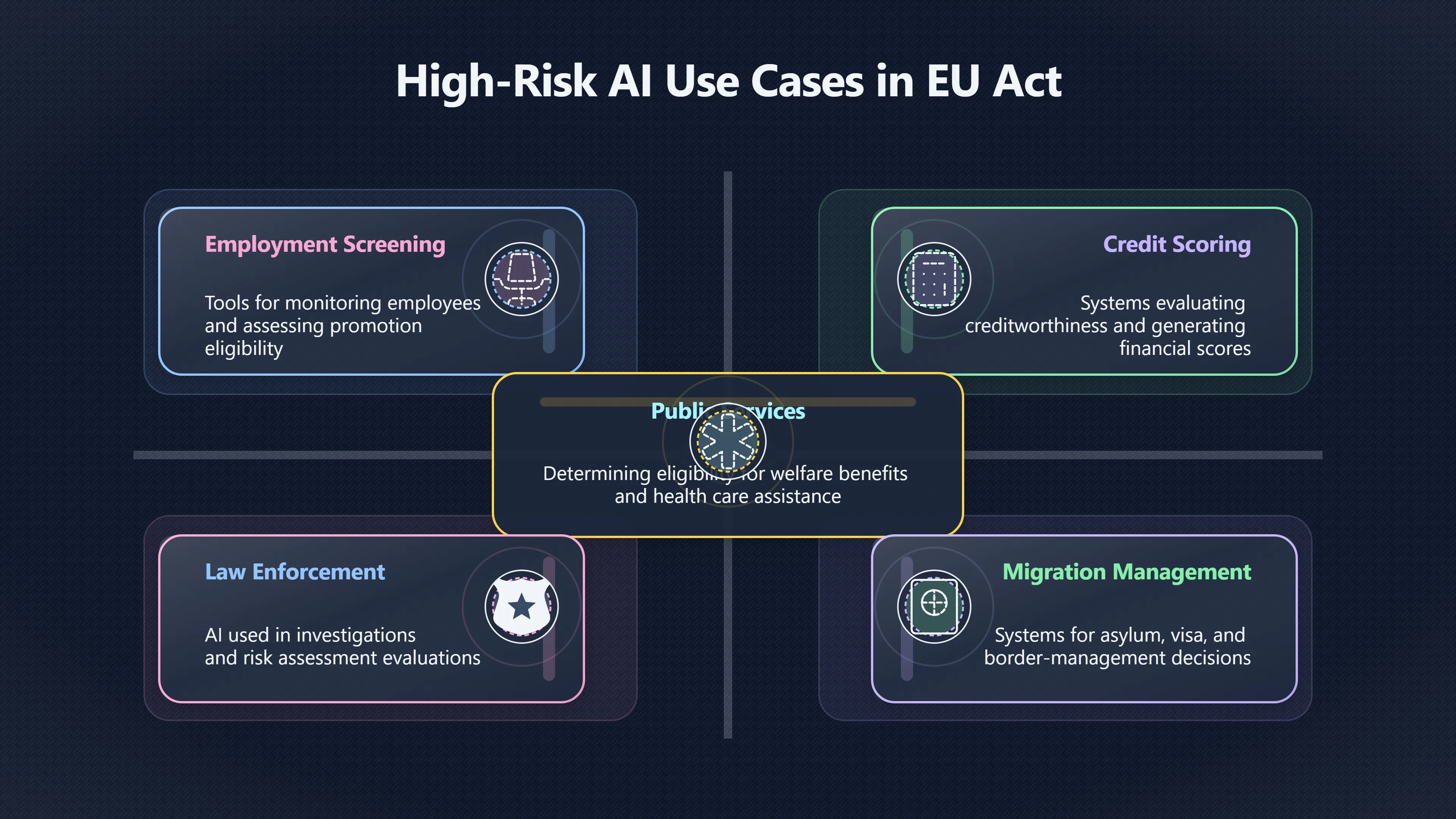
The EU AI Act is a clear example of how modern AI regulation focuses on consequences rather than technological sophistication. A system can be highly specialised, performing only one task, and still face some of the strictest legal requirements in Europe if its outputs affect people’s health, safety, opportunities, or fundamental rights. Under the Act, a recruitment-screening tool, a credit-scoring model, or an AI system that helps assess eligibility for social benefits may be treated as “high-risk” even though each is a narrow AI application rather than a general-purpose system. The key question is not how intelligent the system appears, but whether errors, bias, or misuse could cause serious harm.[Digital Strategy Europe]digital-strategy.ec.europa.euDigital Strategy Europe AI Act | Shaping Europe's digital futureDigital Strategy EuropeAI Act | Shaping Europe's digital future - European UnionHigh-risk AI systems are subject to strict obligations be…
 This approach is central to understanding risk-based AI governance. The Act creates special obligations for narrow systems used in sensitive settings while allowing many lower-impact applications to operate under much lighter rules.[Digital Strategy Europe]digital-strategy.ec.europa.euDigital Strategy Europe AI Act | Shaping Europe's digital futureDigital Strategy EuropeAI Act | Shaping Europe's digital future - European UnionHigh-risk AI systems are subject to strict obligations be…
Which narrow uses count as high risk?
The AI Act identifies specific categories of AI use that can affect fundamental rights, safety, or access to important services. Many of these systems are narrow tools designed for a single purpose, yet they are classified as high-risk because of the significance of the decisions they influence.[Artificial Intelligence Act]artificialintelligenceact.euAccess to and enjoyment of essential private services and essential public services and benefits: (a) AI systems intended to be used by p…
Examples include:
- AI used in recruitment, employee monitoring, promotion decisions, task allocation, or termination-related assessments.
- AI systems that evaluate creditworthiness or generate credit scores.
- AI used to determine eligibility for welfare benefits, healthcare-related assistance, or other essential public services.
- Certain educational assessment and admissions systems.
- AI used in law enforcement investigations, risk assessments, or evidence evaluation.
- Systems used in migration, asylum, visa, and border-management decisions.
- Certain biometric identification and categorisation applications.[AI Act Service Desk]ai-act-service-desk.ec.europa.euAI Act Service DeskAI Act Service Desk - Annex III - European UnionAccess to and enjoyment of essential private services and essential pu…
What connects these examples is not their technical complexity. Many are relatively specialised prediction or classification systems. The common factor is that their outputs can influence employment prospects, financial access, legal treatment, movement across borders, or access to essential services. A mistake in a music recommendation engine may be inconvenient; a mistake in a welfare eligibility system can have life-changing consequences.[Digital Strategy Europe]digital-strategy.ec.europa.euDigital Strategy Europe AI Act | Shaping Europe's digital futureDigital Strategy EuropeAI Act | Shaping Europe's digital future - European UnionHigh-risk AI systems are subject to strict obligations be…
The Act also covers some AI systems that are safety components of regulated products such as medical devices or machinery. In these cases, a narrow AI feature can become high-risk because it contributes directly to safety-critical functions.[Artificial Intelligence Act]artificialintelligenceact.euArtificial Intelligence ActArticle 6: Classification Rules for High-Risk AI SystemsAI systems of the types listed in Annex III are always…
What duties follow from the classification?
Once a narrow AI system falls into the high-risk category, the provider and, in some cases, the deployer must meet extensive compliance requirements before and during use. The obligations focus on governance, documentation, oversight, and risk control rather than on limiting AI capability itself.[Digital Strategy Europe]digital-strategy.ec.europa.euDigital Strategy Europe AI Act | Shaping Europe's digital futureDigital Strategy EuropeAI Act | Shaping Europe's digital future - European UnionHigh-risk AI systems are subject to strict obligations be…
Risk management throughout the system lifecycle
Providers must establish a formal risk-management process that identifies foreseeable harms, evaluates risks, and introduces measures to reduce them. Compliance is not a one-time approval exercise; risks must be monitored throughout the system’s lifecycle.[Artificial Intelligence Act]artificialintelligenceact.euOpen source on artificialintelligenceact.eu.
For example, a hiring-screening system would need procedures to identify and mitigate discriminatory outcomes, monitor performance, and address newly discovered problems after deployment.[Artificial Intelligence Act]artificialintelligenceact.euArtificial Intelligence Act High-levelArtificial Intelligence ActHigh-level summary of the AI ActEstablish a risk management system throughout the high risk AI system's lifecy…
Data governance and quality controls
The Act places strong emphasis on the quality and governance of training, validation, and testing data. The goal is to reduce inaccuracies, bias, and discriminatory outcomes that could affect people in sensitive contexts.[Digital Strategy Europe]digital-strategy.ec.europa.euDigital Strategy Europe AI Act | Shaping Europe's digital futureDigital Strategy EuropeAI Act | Shaping Europe's digital future - European UnionHigh-risk AI systems are subject to strict obligations be…
This requirement reflects a practical concern: many harmful AI outcomes originate not from sophisticated reasoning errors but from flawed data, poor sampling, or inadequate testing.[Digital Strategy Europe]digital-strategy.ec.europa.euDigital Strategy Europe AI Act | Shaping Europe's digital futureDigital Strategy EuropeAI Act | Shaping Europe's digital future - European UnionHigh-risk AI systems are subject to strict obligations be…

Documentation and traceability
High-risk systems must generate sufficient records and documentation to allow regulators, auditors, and users to understand how the system operates and whether it complies with legal requirements. Logging and record-keeping requirements are intended to make decisions traceable rather than opaque.[Digital Strategy Europe]digital-strategy.ec.europa.euDigital Strategy Europe AI Act | Shaping Europe's digital futureDigital Strategy EuropeAI Act | Shaping Europe's digital future - European UnionHigh-risk AI systems are subject to strict obligations be…
A provider cannot simply claim that a model works; it must be able to demonstrate compliance through documented processes and technical evidence.[AI Act Service Desk]ai-act-service-desk.ec.europa.euAI Act Service DeskArticle 16: Obligations of providers of high-risk AI systemsProviders of high-risk AI systems must ensure their system…
Human oversight requirements
A recurring theme in the Act is that high-risk systems should not operate without meaningful human control. Systems must be designed so that humans can monitor outputs, understand limitations, intervene when necessary, and avoid excessive reliance on automated recommendations.[AI Act Service Desk]ai-act-service-desk.ec.europa.euHigh-risk AI systems must be designed to allow human oversight during their operation to minimise risks to health, safety, and fundamenta…
The requirement is not merely symbolic. Human oversight mechanisms are intended to reduce situations where automated decisions become effectively unquestionable because users trust the system too readily.[AI Act Service Desk]ai-act-service-desk.ec.europa.euHigh-risk AI systems must be designed to allow human oversight during their operation to minimise risks to health, safety, and fundamenta…
Conformity assessment and market obligations
Before many high-risk systems can be placed on the EU market, providers must complete conformity-assessment procedures and demonstrate compliance with the Act’s requirements. They must maintain quality-management systems, prepare declarations of conformity, and fulfil registration and record-keeping duties.[AI Act Service Desk]ai-act-service-desk.ec.europa.euAI Act Service DeskArticle 16: Obligations of providers of high-risk AI systemsProviders of high-risk AI systems must ensure their system…
These obligations resemble the regulatory approach used for other products whose failures could create significant harms, reinforcing the idea that high-risk AI is treated as a governance and safety issue rather than merely a software issue.[AI Act Service Desk]ai-act-service-desk.ec.europa.euAI Act Service DeskArticle 16: Obligations of providers of high-risk AI systemsProviders of high-risk AI systems must ensure their system…
Why low-stakes narrow tools are treated differently
The AI Act does not assume that all narrow AI is dangerous. Its structure is deliberately selective. Many specialised systems used for routine consumer functions do not fall into the high-risk category because mistakes are unlikely to threaten safety or fundamental rights.[Digital Strategy Europe]digital-strategy.ec.europa.euDigital Strategy Europe AI Act | Shaping Europe's digital futureDigital Strategy EuropeAI Act | Shaping Europe's digital future - European UnionHigh-risk AI systems are subject to strict obligations be…
Examples include:
- Music and video recommendation systems.
- Product recommendation engines in online shops.
- Many customer-service assistants.
- Personal productivity tools.
- Other applications whose failures typically create inconvenience rather than serious harm.[Digital Strategy Europe]digital-strategy.ec.europa.euDigital Strategy Europe AI Act | Shaping Europe's digital futureDigital Strategy EuropeAI Act | Shaping Europe's digital future - European UnionHigh-risk AI systems are subject to strict obligations be…
This distinction is one of the Act’s most important governance choices. Instead of imposing heavy compliance burdens on every AI application, regulators concentrate oversight on contexts where individuals may lose opportunities, services, freedom, or safety because of an AI-assisted decision.[Digital Strategy Europe]digital-strategy.ec.europa.euDigital Strategy Europe AI Act | Shaping Europe's digital futureDigital Strategy EuropeAI Act | Shaping Europe's digital future - European UnionHigh-risk AI systems are subject to strict obligations be…
The result is a framework in which two equally narrow systems can receive very different treatment. A model that recommends songs may face minimal obligations, while a model that helps decide who receives a loan or public assistance may be subject to extensive legal duties. The difference lies in the stakes of the decision, not in whether the system appears intelligent.[Digital Strategy Europe]digital-strategy.ec.europa.euDigital Strategy Europe AI Act | Shaping Europe's digital futureDigital Strategy EuropeAI Act | Shaping Europe's digital future - European UnionHigh-risk AI systems are subject to strict obligations be…

What this reveals about risk-based AI regulation
The EU AI Act demonstrates that narrow AI and high-risk AI are not opposites. Some of the most heavily regulated systems under the Act are specialised tools built for a single decision-making task. Their regulatory status comes from the potential consequences of their outputs rather than from any claim to general intelligence.[Artificial Intelligence Act]artificialintelligenceact.euArtificial Intelligence ActArticle 6: Classification Rules for High-Risk AI SystemsAI systems of the types listed in Annex III are always…
For readers trying to understand artificial intelligence governance, this is a crucial lesson. Risk-based regulation asks where and how AI is used, who is affected, and what harms could result if the system fails. Under that logic, a narrow recruitment algorithm or credit-scoring model may attract far more scrutiny than a much more capable but lower-stakes AI application.[Digital Strategy Europe]digital-strategy.ec.europa.euDigital Strategy Europe AI Act | Shaping Europe's digital futureDigital Strategy EuropeAI Act | Shaping Europe's digital future - European UnionHigh-risk AI systems are subject to strict obligations be…
eBay marketplace picks
Marketplace Samples
Example marketplace items related to this page. Use the search link to explore similar finds on eBay.



Endnotes
1.
Source: digital-strategy.ec.europa.eu
Title: Digital Strategy Europe AI Act | Shaping Europe’s digital future
Link:https://digital-strategy.ec.europa.eu/en/policies/regulatory-framework-ai
Source snippet
Digital Strategy EuropeAI Act | Shaping Europe's digital future - European UnionHigh-risk AI systems are subject to strict obligations be...
2.
Source: ai-act-service-desk.ec.europa.eu
Link:https://ai-act-service-desk.ec.europa.eu/en/guideline-explorer
Source snippet
AI Act Service DeskGuidelines on the classification of high-risk AI systemsChapter III AI Act imposes a set of requirements and obligatio...
3.
Source: artificialintelligenceact.eu
Link:https://artificialintelligenceact.eu/article/6/
Source snippet
Artificial Intelligence ActArticle 6: Classification Rules for High-Risk AI SystemsAI systems of the types listed in Annex III are always...
4.
Source: artificialintelligenceact.eu
Link:https://artificialintelligenceact.eu/annex/3/
Source snippet
Access to and enjoyment of essential private services and essential public services and benefits: (a) AI systems intended to be used by p...
5.
Source: ai-act-service-desk.ec.europa.eu
Link:https://ai-act-service-desk.ec.europa.eu/en/ai-act/annex-3
Source snippet
AI Act Service DeskAI Act Service Desk - Annex III - European UnionAccess to and enjoyment of essential private services and essential pu...
6.
Source: artificialintelligenceact.eu
Link:https://artificialintelligenceact.eu/section/3-2/
7.
Source: artificialintelligenceact.eu
Title: Artificial Intelligence Act High-level
Link:https://artificialintelligenceact.eu/high-level-summary/
Source snippet
Artificial Intelligence ActHigh-level summary of the AI ActEstablish a risk management system throughout the high risk AI system's lifecy...
8.
Source: ai-act-service-desk.ec.europa.eu
Link:https://ai-act-service-desk.ec.europa.eu/en/ai-act/article-16
Source snippet
AI Act Service DeskArticle 16: Obligations of providers of high-risk AI systemsProviders of high-risk AI systems must ensure their system...
9.
Source: artificialintelligenceact.eu
Link:https://artificialintelligenceact.eu/article/16/
Source snippet
Article 16: Obligations of Providers of High-Risk AI SystemsProviders of high-risk AI systems shall: (a) ensure that their high-risk AI s...
10.
Source: ai-act-service-desk.ec.europa.eu
Link:https://ai-act-service-desk.ec.europa.eu/en/ai-act/article-14
Source snippet
High-risk AI systems must be designed to allow human oversight during their operation to minimise risks to health, safety, and fundamenta...
11.
Source: pwc.nl
Link:https://www.pwc.nl/en/services/artificial-intelligence/[responsible-ai
Source snippet
The EU AI Act - Responsible AI - TransformationThe EU AI Act classifies AI systems into four categories based on their potential risks: u...
12.
Source: artificial-intelligence-act.com
Title: Under NIS 2, operators of essential and important services
Link:https://www.artificial-intelligence-act.com/
Source snippet
EU AI Act - Updates, Compliance, TrainingThe AI Act designates certain AI systems as “high-risk” if they impact safety and fundamental ri...
13.
Source: youtube.com
Title: New EU Guidelines on High-Risk AI Systems
Link:https://www.youtube.com/watch?v=wv2MloU7n2w
Source snippet
EU AI Act - High-risk Systems - AIGP Certification...
14.
Source: youtube.com
Title: EU AI Act
Link:https://www.youtube.com/watch?v=yOmRWplaNDk
Source snippet
The EU AI Act: Risk Tiers and Shifting Gears...
15.
Source: youtube.com
Title: The EU AI Act: Risk Tiers and Shifting Gears
Link:https://www.youtube.com/watch?v=g0DUzgiy0ZI
Source snippet
EU AI Act - High-risk AI Provider Obligations Articles 13-15...
16.
Source: youtube.com
Title: EU AI Act
Link:https://www.youtube.com/watch?v=S3Z5JprCJTQ
Additional References
17.
Source: digitalsme.eu
Link:https://www.digitalsme.eu/ai-act-conformity-tool/
Source snippet
AI Act Conformity ToolFor general-purpose AI models, the AI Act introduces transparency obligations and additional risk management measur...
18.
Source: ai-act-law.eu
Link:https://ai-act-law.eu/
Source snippet
AI Act as a neatly arranged website – Legal TextAccording to Article 6 of the AI Act, high-risk AI is an AI system whose actual use poses...
19.
Source: allai.nl
Link:https://allai.nl/wp-content/uploads/2022/04/AIA-in-depth-3a-High-Risk-AI-Classification.pdf
Source snippet
AIA in-depth #3a High-Risk AI ClassificationAlternative text for paragraph 5 ANNEX III: 5. Access to and enjoyment of essential private s...
20.
Source: dataguard.com
Link:https://www.dataguard.com/eu-ai-act/
Source snippet
EU AI ActIts goal is to ensure that AI technologies operate safely, transparently, and in alignment with fundamental rights. It applies t...
21.
Source: bundesnetzagentur.de
Link:https://www.bundesnetzagentur.de/EN/Areas/Digitalisation/AI/09_HighRisk/start.html
Source snippet
High-risk AI systemsHigh-risk AI systems must be able to be effectively overseen by natural persons, for example through...
22.
Source: bundesnetzagentur.de
Link:https://www.bundesnetzagentur.de/EN/Areas/Digitalisation/AI/08_ProhibitedPractices/start.html
Source snippet
Prohibited practicesThe AI Act provides for three exceptions to the general prohibition on the use of real-time remote biometric identifi...
23.
Source: linkedin.com
Link:https://www.linkedin.com/pulse/eu-ai-act-already-applies-you-paulo-cavallo-ph-d–c6ntc
Source snippet
The EU AI Act Already Applies to YouHigh-risk AI systems are defined in Annex III of the Act. The list includes AI used in credit scoring...
24.
Source: linkedin.com
Link:https://www.linkedin.com/pulse/eu-ai-act-explained-risk-based-classification-datanorth-ai-nopce
Source snippet
The EU AI Act explained: Risk-based classificationThe four risk categories · Examples: Social scoring, manipulative AI, real-time biometr...
25.
Source: ap4ai.eu
Link:https://ap4ai.eu/eu-ai-act
Source snippet
The EU AI actHigh-Risk AI Systems in Law Enforcement. The AIA categorizes certain AI tools in law enforcement as "high-risk" because of t...
26.
Source: cycoresecure.com
Link:https://www.cycoresecure.com/frameworks/eu-ai-act
Source snippet
EU AI Act Compliance Services & ConsultingPrepare for EU AI Act compliance with expert guidance. Cycore helps tech companies classify AI...
Topic Tree